Key takeaways
- Agent scaffolding puts architecture and tools around a language model for goal-driven work.
- An agent harness owns runtime work such as state, tool calls, approvals, and progress.
- Start with simple prompts. Add multi-step behavior only when simpler systems fall short.
What is agent scaffolding?
Agent scaffolding is the software architecture and tooling built around a large language model so it can handle complex, goal-driven tasks. A compact scaffold might contain three things: a capable model, structured instructions that define the work, and well-defined tools the model can use. Those are the foundations of a reliable agent.
The distinction from a simpler language-model application is what that surrounding structure enables. Agents can reason through ambiguity, act across tools, and execute a multi-step workflow from end to end. The model still matters, but the model is not the whole working system.
Read the stack from the task outward. The model supplies the underlying capability. Structured instructions give that capability a clear job. Tools let the agent act beyond the model response. If one of those pieces is vague, the first fix may still be inside the scaffold: clarify the instructions, define the tool, or test whether the model can handle the work. More runtime machinery would not answer that immediate design problem.
AI scaffolding is the broad idea of adding that supporting structure around a model. Agentic AI scaffolding applies it to work in which the model can take actions across multiple steps. Repo-local instruction files and machine-readable specifications are concrete ways to tell an agent what to do. Tools give it an action surface.
That answers what an agent scaffold contains, but it leaves an ownership question open. Once the work persists across calls, changes an external system, or needs recovery, task setup alone does not tell you which component is responsible.
Use responsibility to separate agent scaffolding from a harness
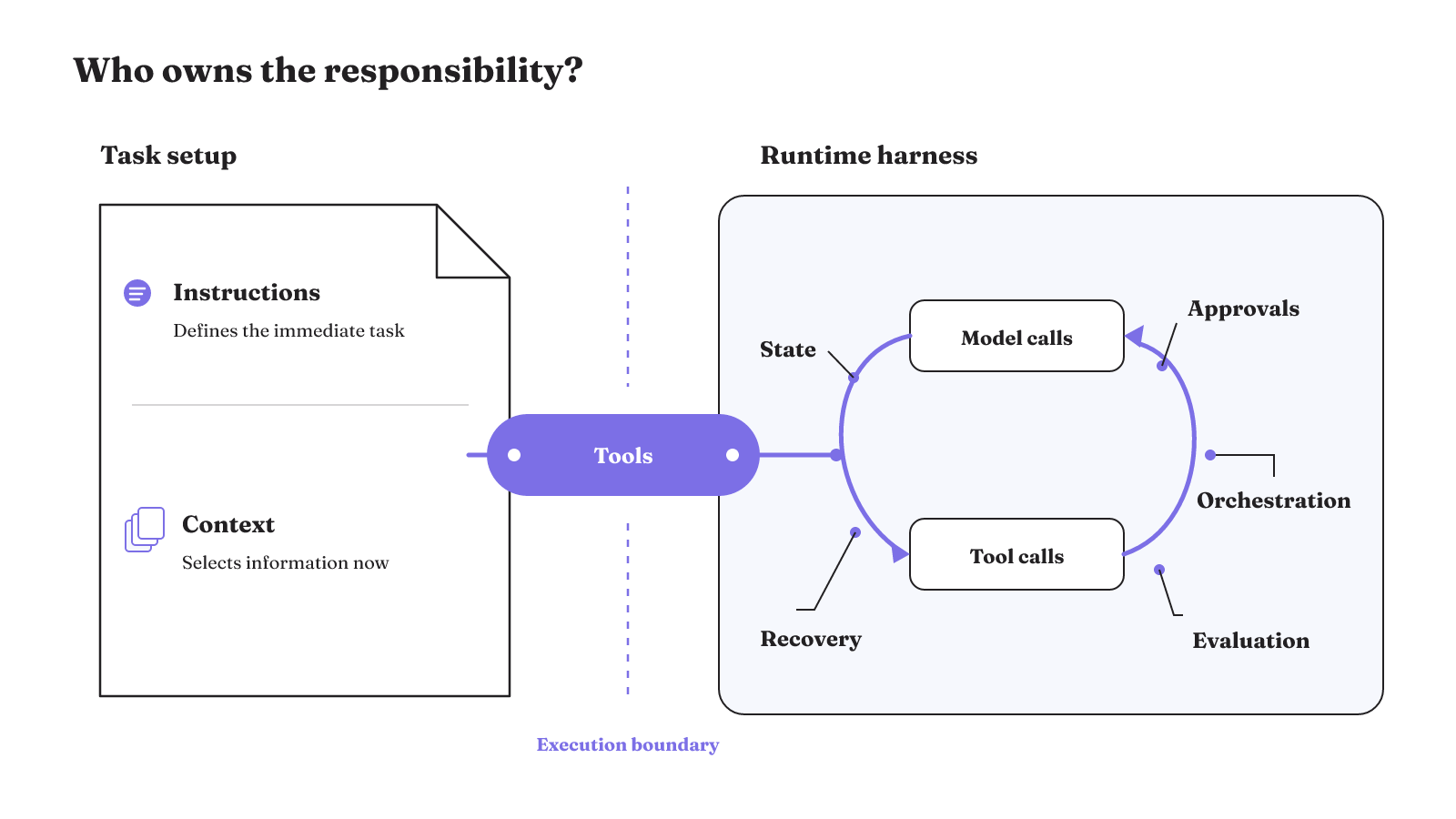
An agent harness is runtime scaffolding that turns a language model into an agent capable of performing work. Concrete agent harness examples include driving model and tool calls, managing conversation state, applying approval policies, and keeping multi-step work moving. We classify the surrounding concerns by the component that must own them after the immediate task has been defined.
| Concern | Immediate responsibility | Runtime responsibility | Classification question |
|---|---|---|---|
| Instructions | Repo-local instructions and machine-readable specifications tell the agent what to do. | The harness drives the model calls that perform the work. | Does this define the task, or govern its execution? |
| Tools | Well-defined tools give the agent its action surface. Tool quality affects agent effectiveness. | The harness drives tool calls. Orchestration can add permissions, logging, retries, and traceability. | Who defines the tool, and who governs each call? |
| Context | Context engineering curates what enters the model's limited attention budget at each step. | The harness manages conversation state and context across the task. | Is this selecting information now, or preserving it across steps? |
| State | The task setup can name the information needed for the current step. | The runtime manages persistent state in production. | Must the information survive another call or a failure? |
| Approvals | Instructions can identify work that needs a decision. | The harness applies approval policies, while orchestration can add approvals. | Which component can allow or stop the action? |
| Orchestration | The scaffold can define the goal and available tools. | The harness keeps the agent progressing through multi-step work; orchestration can add retries and traceability. | Who coordinates work after the first model response? |
| Evaluation and observability | Explicit checks define how recorded behavior will be graded. | An improvement loop can connect traces, human judgment, evaluations, ranked harness changes, and implementation. Observability can track success, policy violations, tool errors, retries, cost, escalations, context length, memory growth, and retrieval quality. | Who records behavior and decides whether a change helped? |
| Side effects, checkpoints, and recovery | The task description identifies the intended external change. | Updates to systems of record need durable state, authorization, idempotency, retry policy, compensation, observability, and auditability. In a multi-step document workflow, a checkpoint can preserve context after a compute-node failure and avoid repeating document processing and external calls. | Who knows what changed and how work can resume? |
When is simple agent scaffolding enough?
Simple scaffolding is enough when a simple prompt can do the work and evaluation does not show a need for more agentic steps. The recommended progression is direct: start with simple prompts, optimize them through comprehensive evaluation, and add multi-step behavior only when the simpler design falls short. Simplicity is a core agent-design principle, not an early phase to discard automatically.
That progression keeps architecture tied to observed behavior. Begin with the model, clear instructions, and the smallest useful tool surface. Run the system and evaluate what it does. If the simple design falls short, add the agentic behavior needed for that gap. Deployment can also start small, validate with real users, and expand capabilities over time.
The evaluation step is the gate between a basic workflow and a more involved one. A failed run does not automatically call for another agent, a longer loop, or a new orchestration layer. First locate the shortfall in the simple system. The allowed next move is then narrower: improve the prompt and evaluate again, or add multi-step behavior because the simpler approach has actually fallen short.
Frameworks create a real tradeoff. They can speed initial development. A production system can later reduce abstraction layers and use basic components. Neither fact makes frameworks inherently temporary or basic components inherently superior. It means the abstraction has to keep earning its place as the system moves from a first working setup into production.
For a builder, that tradeoff is about legibility as well as speed. A framework can help you reach the first working run sooner. Fewer abstraction layers can make the production components more direct. The sound decision depends on the work in front of you, not on whether the architecture looks more agentic.
This is also why the phrase "harness agent" is less useful than an ownership question. If the system only needs immediate instructions and a narrow tool call, keep it simple. If it must preserve state, enforce approvals, or recover across a longer run, assign those duties to a runtime owner.
Long runs expose cost and sustained-outage failures
A loop that looks harmless in a short test can consume tokens on every reasoning iteration. Per-agent, per-session, or per-tenant budget guardrails can stop one misbehaving agent from consuming the monthly budget. The control belongs around the running loop because the cost grows as the iterations continue.
Those scopes let you choose what the budget boundary contains. A per-agent limit contains one agent's loop. A per-session limit contains a single session. A per-tenant limit contains activity assigned to that tenant. The useful question is which unit should stop before one bad loop reaches the broader monthly budget.
Retries have a different limit. In one documented failure case, bounded retries handled isolated errors and rate limits. They did not handle a sustained outage. Once the retries were exhausted, recovery reran the entire implementation agent and repeated work that had already finished before returning to the idempotent pull-request operation.
The case is useful because the retry policy did work within its intended range. It absorbed isolated failures. The longer outage exposed the missing recovery boundary: completed work before the failure was not resumed at a finer checkpoint.
Follow the sequence closely. The short failures stayed inside the bounded retry policy. The sustained outage outlasted that policy. Recovery then restarted an entire implementation agent, repeated finished work, and eventually reached the idempotent pull-request operation again. The failure was not simply "a retry did not work." It was a mismatch between the length of the outage and the recovery unit available after retries ended.
That leaves two separate runtime concerns. Budget guardrails contain a loop that keeps consuming resources. Checkpoints and recovery determine how much completed work a failed run must repeat. A scaffold may describe the task perfectly and still leave both concerns unanswered.
A retry is not a rollback
Retrying a failed workflow step does not undo its earlier side effects. If a restarted workflow repeats an action, it can create duplicate inventory reservations or payment adjustments. A retry policy controls another attempt. It does not, by itself, reverse what an external system already accepted.
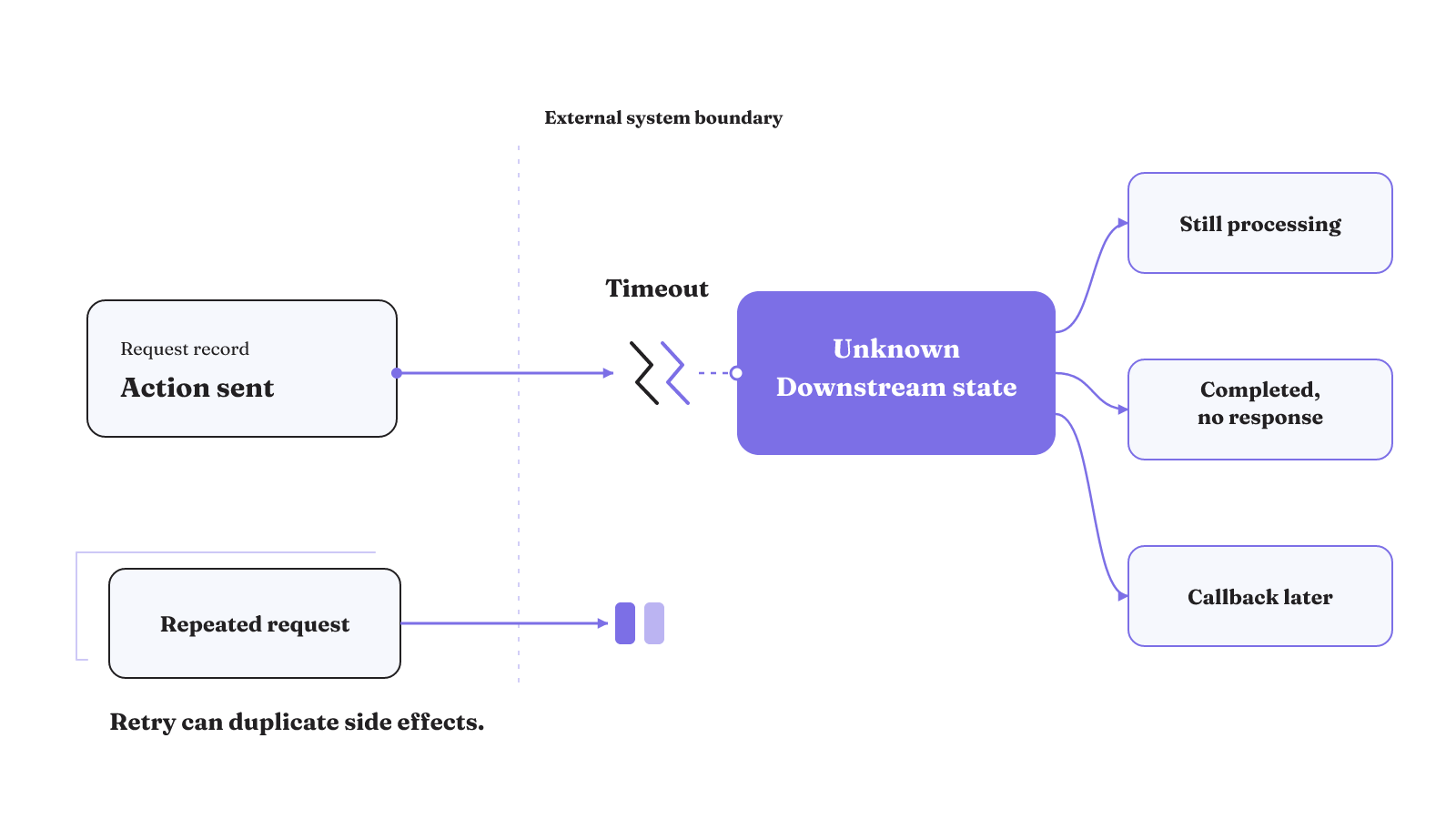
A timeout is even less conclusive. The downstream system may still be processing the operation. It may have completed the operation without returning a response. It may also send a callback later. Treating the timeout as proof of failure can therefore put the workflow out of step with the external system.
That uncertainty matters before any restart. "No response" does not distinguish among the possible downstream states. The timeout itself does not identify which state applies. The runtime still needs an accurate record of the request and any later result before it can classify what happened.
Agents that update systems of record need a larger control set: durable state, authorization, idempotency, retry policy, compensation, observability, and auditability. Those controls answer different parts of the same hard question: what does the runtime know about an action that may already have changed something?
This is where recovery becomes more than running the prompt again. The runtime has to retain enough state to distinguish unfinished work from work whose result is not yet known. It also needs a defined policy for the external effects that occurred before the interruption. A polished prompt cannot own those facts once execution has moved into another system.
Use the side effect as the design test. If the tool can reserve inventory, adjust a payment, or update another system of record, write down the runtime owner for each named control. If authorization, retry policy, compensation, observability, or auditability has no owner, improving the instruction does not fill that control gap.
How do you test whether agent scaffolding works?
Test the behavior, not just the final sentence. Run the agent, record what it did, and grade that behavior with explicit checks. This run, record, and grade loop makes changes easier to confirm and regressions clearer.
Start with visibility. Agent transparency includes explicitly showing the agent's planning steps. That gives the recorded run more than an output to inspect. The path through the work becomes part of what you can evaluate.
Then treat the tool interface as part of the system under test. An agent-computer interface needs thorough tool documentation and testing. A model cannot make up for an action surface whose tool behavior is unclear or untested. The scaffold defines what is available, and the recorded run shows how the agent actually used it.
Keep the grading checks explicit. Run the same behavior after a scaffold or harness change, retain what happened, and apply the checks again. A passing result supports the change. A new failure makes the regression visible. For terminology and a deeper evaluation frame, our agent evaluation glossary covers the role evaluation plays in dependable agent work.
The order matters because each step produces the input for the next. The run produces behavior. The record preserves that behavior for inspection. The grade applies explicit checks. When you change the system, repeating the loop gives you a comparable result instead of a memory of whether the latest run felt better.
Prompt tuning is only one possible change. An agent improvement loop can connect behavior traces, human judgment, evaluations, ranked harness changes, and implementation. The record should be rich enough to show whether the problem sits in the instructions, tools, runtime controls, or another part of the harness.
Visible planning steps also help separate a correct ending from a sound path. Tool documentation gives the action interface a clear description, and testing checks that interface. Together with the recorded behavior and explicit grade, those elements turn a promising demo into a result you can rerun after the next change.
Match controls to consequence
Guardrails should cover the surfaces where an agent receives input, uses tools, or may need human intervention. They do not have to impose the same control level on every task.
Low-risk internal work can use fast approval and minimal logging. Customer-facing operational work can use standard guardrails and audit trails. Work involving personal information, financial data, or regulatory requirements can use enhanced logging, human review, and isolated environments. This risk-proportionate model makes the consequence of the work part of the control design.
This gives you three concrete control postures without forcing every action through the heaviest path. An internal task can stay fast. Customer-facing operations retain a standard guardrail and audit record. Work with sensitive data or regulation receives stronger logging, review, and isolation. The category of work changes the control level.
The practical decision is not whether an agent is "autonomous." It is which actions carry enough consequence to require more review, logging, or isolation. Input filtering, restrictions on tool use, and human intervention are distinct guardrail surfaces. A system can apply them where the work calls for them.
Heavier controls add friction. That friction belongs with higher-consequence work in this model. Routine internal work can keep a faster path, while work with a larger exposure receives the stronger control set.
When should orchestration become more complex?
Begin with one agent. Move to multiple agents only when the system's complexity requires it. Orchestration patterns should match that complexity, so a multi-agent design is not the default proof that a system has matured.
When one loop is no longer enough, composable agent systems can use named patterns such as map-reduce, orchestrator, evaluator-optimizer, and router. Specialist agents can also use a handoff description to support routing instead of concentrating every task in one massive agent. Those are concrete agent orchestration choices, each with more coordination for the runtime to own.
Start with the limitation in the single-agent design. If the work needs routing, a router is available. If it needs specialist agents, handoff descriptions can support the route between them. Without either need, keep the single-agent design.
Use the simplest pattern that fits the work. A single agent keeps routing and state easier to locate. A router introduces a decision about where work goes. Specialist handoffs introduce descriptions that support that routing. The more complex design is justified only when the work needs it.
Complex orchestration also expands the runtime's responsibility. Progress now includes the path between agents, not only the steps inside one agent. The handoff description participates in routing, and the orchestrator has to keep the larger task moving. That is a harness concern even when every specialist has a clear local scaffold.
Take one agent workflow and apply the responsibility map. Mark who owns state, approvals, evaluation, side effects, and recovery. If any answer is still "the prompt," inspect the runtime controls in our agent harness guide and give that responsibility a durable owner.