Key takeaways
- Compare AI agent frameworks open-source by documented workload fit, execution surface, and the conditions that remove each option from your shortlist.
- Match language, team size, data sources, and orchestration complexity before choosing a framework.
- Frameworks earn their place when durable state, retries, delegation, approval, or tracing becomes necessary.
Start with the workload before narrowing the field
The useful question is not which AI agent framework is best in the abstract. It is which execution model fits the work and gives the surrounding system enough control. Language, team size, data sources, and orchestration complexity should shape the shortlist. We start there because these constraints change which framework strengths matter.
As of July 2026, the open-source AI agents list was already broad. It included LangGraph, LangChain DeepAgents, OpenAI Agents SDK, Claude Agent SDK, Google ADK, Pydantic AI, CrewAI, Strands Agents, Mastra, Vercel AI SDK, Microsoft Agent Framework, Agno, and Smolagents. Those names do not all describe the same kind of software, so a long list of AI agents from GitHub is only a starting point.
A framework becomes useful when a system needs durable state, retries, multi-agent delegation, human-in-the-loop steps, and consistent tracing. Those needs reveal work the application would otherwise have to supply. Context management, orchestration, and verification can influence agent performance as strongly as model selection. That is why we treat the harness as an architectural choice, not leftover plumbing. Our guide to framework and harness responsibilities develops that boundary in more detail.
Which AI agent frameworks open-source fit your workload?
The best open-source AI choice right now depends on the workload. This comparison contains exactly seven candidates. Each occupies a documented execution surface and has a stated role. Start with the row that resembles the system you need to operate. Use the final column to remove options whose surface, ecosystem, or orchestration role does not match your work.
All seven projects are open source. LangGraph, Deep Agents, CrewAI, Microsoft Agent Framework, LlamaIndex Workflows, and OpenAI Agents SDK use the MIT license. Google ADK uses Apache 2.0. That licensing baseline keeps the comparison focused on the larger architectural difference: the kind of system each project is designed to run.
| Framework | Execution type | Documented workload fit | Remove when |
|---|---|---|---|
| LangGraph | Agent runtime and low-level orchestration framework | Complex agent tasks | Your workload does not call for low-level orchestration of complex agent tasks. |
| Deep Agents | Agent harness | Long-running workflows | Your workload is not long-running or does not need an agent harness. |
| CrewAI | Multi-agent orchestration framework | Rapid prototyping of role-based agent workflows | Your workload is not a role-based multi-agent workflow. |
| Microsoft Agent Framework | Multi-agent orchestration framework | Microsoft-stack work as the unified successor to AutoGen and Semantic Kernel | Your workload is outside the Microsoft stack or is not multi-agent orchestration. |
| LlamaIndex Workflows | Agent workflow framework | Document-centric, event-driven multi-agent systems | Your workload is not document-centric, event-driven, and multi-agent. |
| Google ADK | Agent development framework | GCP-native teams seeking opinionated agent runtimes | Your team is not GCP-native or does not want an opinionated agent runtime. |
| OpenAI Agents SDK | Multi-agent workflow SDK | Tightly scoped assistants and delegation workflows | Your workload is neither a tightly scoped assistant nor a delegation workflow. |
Read the removal column literally. It reverses each documented fit without claiming that a project is weak. A runtime, an agent harness, an orchestration framework, and a workflow SDK create different execution commitments even when they all appear in a list of open source AI agents or open source AI agent frameworks. This is why searches for the best open source AI agents and the best open-source AI agents rarely produce one durable answer. Once the workload removes the poor matches, inspect the authority, interruption, recovery, evaluation, and trace controls around the survivors. Our open-source agent framework guide separates framework and harness responsibilities before implementation begins.
Turn the shortlist into a control contract
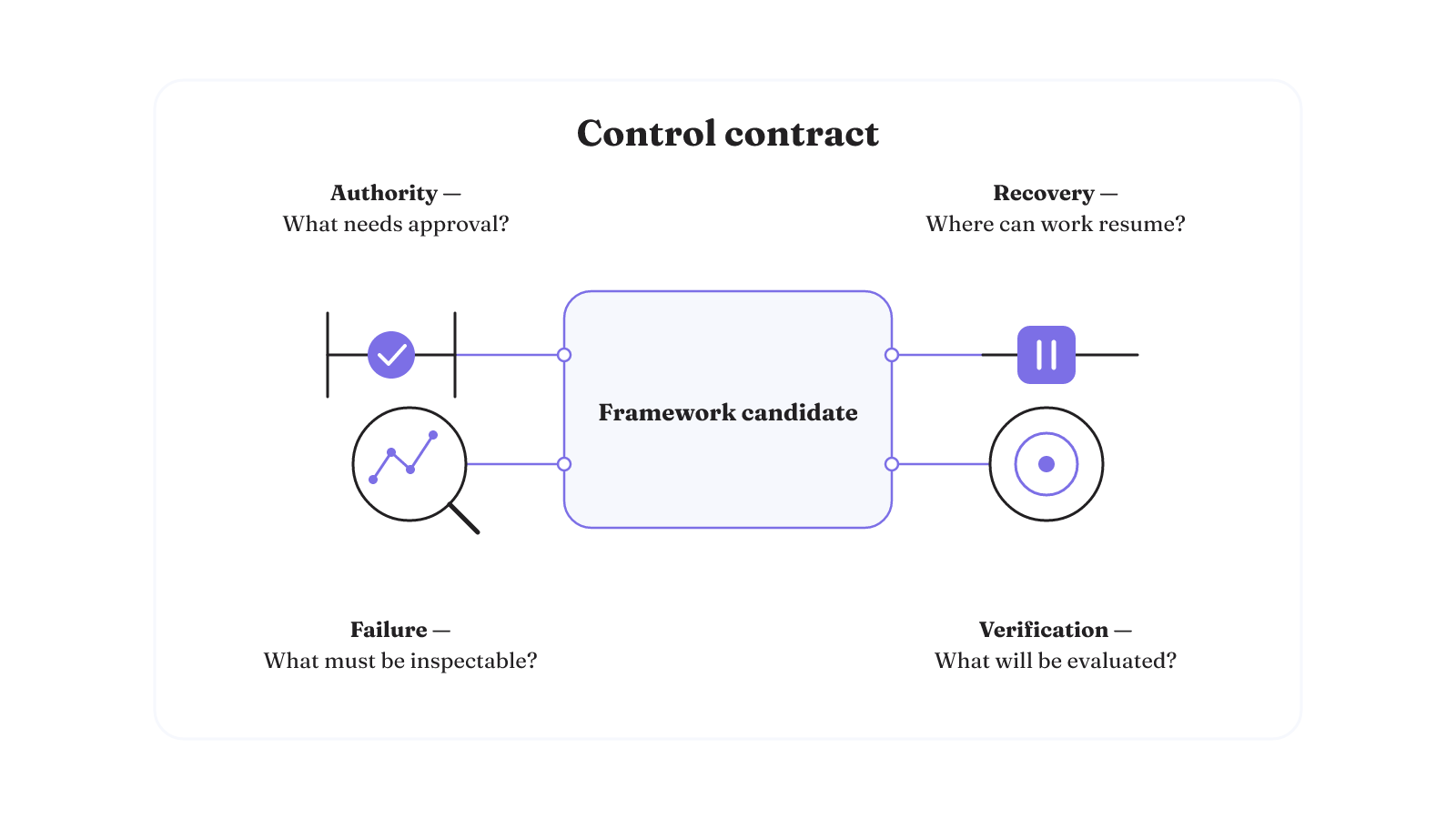
Workload fit narrows the project to test. It does not finish the architecture. We use four follow-on questions to define what the surrounding harness must control:
- Authority: What can the agent do on its own, and which actions cross a consequential or irreversible boundary? Human approval is most useful at those boundaries, not at every routine step.
- Failure: Which part of the execution can fail, and what would you need to inspect to understand the failure? Name the response, tool call, action sequence, or trace that would make the problem legible.
- Recovery: Where can work resume after an interruption? A long-running process needs a concrete recovery point, not a vague promise that the agent can try again.
- Verification: What unit will you evaluate? For an acting system, the execution trajectory matters alongside the final response because the actions and tool use are part of the result you have to operate.
Make the contract concrete enough to test. For a consequential action, name the point where execution must wait and the response that allows it to continue. For an interruption, name the saved progress required to resume. For evaluation, name whether you need the response, action sequence, trajectory, trace, or usage at each step. These requirements do not assume that every candidate provides every control. They give you a stable test for the frameworks that survived the workload filter.
Keep the contract independent of the candidate. Write the required waits, checkpoints, evaluation units, traces, and usage signals before a framework demo supplies its own vocabulary. Then test each surviving project against the same terms. A candidate may provide the execution surface while the surrounding harness supplies some of the controls. That division is acceptable only when it is explicit enough to operate: you know where state lives, which action waits, what progress survives an interruption, which trajectory is judged, and where model usage appears. The result is a shortlist based on workload plus a control plan that can be reviewed before implementation locks in the architecture.
The same contract puts a price on multi-agent decomposition. More agents add coordination, authority, verification, and recovery work. The split should earn those costs. A role-based multi-agent framework may match the workload, but the architecture still has to show where roles hand work off, which agent has authority at each boundary, and how a failed path is inspected and recovered. That is the difference between selecting a project and designing a system you can run.
What control does Microsoft Agent Framework expose?
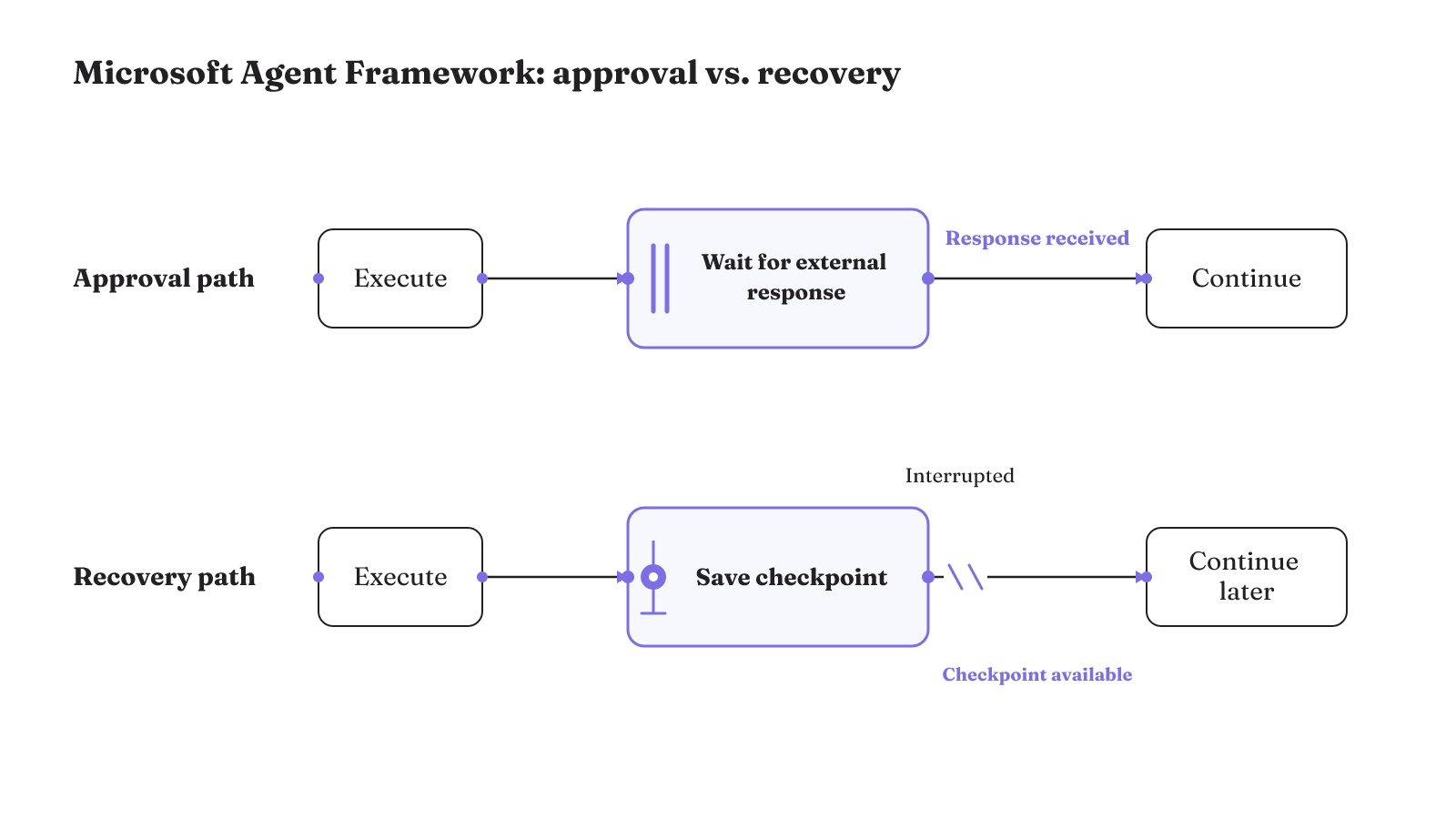
Microsoft Agent Framework exposes control through workflow structure, waits, and recovery points. Its workflows implement human-in-the-loop interaction with request-and-response handling. An executor can wait for an external response before it continues. The pause is part of the execution path, not an informal instruction outside the workflow.
The workflow graph can also express how work moves. Executors can run in sequence, branch into parallel tasks, and rejoin into combined outputs. For a structured process, defined workflows provide more control over task orchestration and flow. That is a more concrete property than a generic “multi-agent” label because it identifies where ordering, branching, and joining live.
Checkpointing adds an interruption boundary. A workflow can save progress and continue later instead of restarting after an interruption. Consider a graph that reaches a consequential step and requests an external response. The executor waits. If execution is interrupted after progress has been saved, checkpointing allows the workflow to continue later. The approved response and the saved progress address different control needs: one gates continuation, while the other supports recovery.
These mechanisms are useful shortlist questions for any agent orchestration framework, open source or otherwise. Can the execution graph represent the actual process? Can an executor wait at a human decision boundary? Can interrupted work resume from saved progress? Microsoft Agent Framework provides named mechanisms for each of those questions. Our open-source agent harness comparison goes deeper on the surrounding control layer.
Separate approval from recovery
Request-and-response handling gives an executor a defined place to wait for an external response. Checkpointing serves another job. It saves progress so interrupted work can continue later instead of restarting. One mechanism controls a pause in the workflow, while the other preserves progress through an interruption.
Executor graphs provide the flow around those controls. A structured process can run in sequence, split into parallel tasks, and rejoin into combined outputs. When reviewing a graph, locate its branch, join, external-response wait, and checkpoint. Those are concrete control points that can be tested against the process being built.
Google ADK shows orchestration and long-running state tradeoffs
A tested modular Google ADK implementation shows both orchestration capability and a state boundary worth inspecting. The implementation supported sequential and parallel orchestration of specialized agents. It also provided mechanisms for defining tools and using them to interact with external systems and data sources.
That combination covers two practical parts of an agent system. The orchestration path determines whether specialized agents run one after another or at the same time. Defined tools create the connection to systems and data beyond the model. These findings are scoped to the tested modular implementation.
The same implementation used a memory-resident task manager. That choice introduced reliability and scalability concerns for long-running processes. The concern is specific and operational: orchestration can be modular while task state still sits in memory. A team evaluating Google ADK for long-running work should inspect the task manager alongside the agent graph and tool definitions.
This is the kind of tradeoff that a framework label or repository count cannot settle. Sequential and parallel agent paths describe execution. External-system tools describe reach. The task manager describes where ongoing work lives. Together they expose separate parts of the system that need to survive real operation.
Inspect the path, tools, and task state
The tested implementation gives a team three concrete surfaces to review. Sequential and parallel paths show how specialized agents are arranged. Tool definitions show how they reach external systems and data sources. The task manager shows where long-running work is held.
The memory-resident task manager introduced reliability and scalability concerns for long-running processes. That concern remains distinct from agent specialization and tool access. For a long-running Google ADK workload, inspect the task manager alongside the graph and tool boundaries. Modular orchestration does not, by itself, answer where ongoing task state should live.
How can you inspect responses, actions, traces, and cost?
Operational control becomes visible when evaluation covers more than the final answer. A system can inspect response quality, tool usage, action sequences, trajectories, traces, benchmarks, persistence, and per-step model usage. Each surface reveals a different part of an acting system.
Strands Evals supports LLM-as-a-judge evaluation of agent responses with flexible scoring criteria. It also supports analysis of tool usage and action sequences with scoring functions. The first mechanism scores what the agent returned. The second examines what the agent did along the way. This distinction matters when the execution trajectory, not only the final response, is under evaluation.
Agent Health brings several inspection surfaces together. It provides automated “Golden Path” trajectory comparison using an LLM judge, real-time OpenTelemetry trace visualization, structured benchmarking, and OpenSearch-backed persistence. Trajectory comparison can examine a run against an expected path. Live traces expose execution as it unfolds, while persistent benchmarks keep structured results available beyond one run.
Cost visibility can reach the same level of detail. Per-step model-call usage can expose costly agent steps for optimization. That is more actionable than one aggregate usage figure because it points to the step where model calls accumulate.
Keep traces and benchmarks inspectable
Agent Health's “Golden Path” mechanism compares a trajectory with an expected path by using an LLM judge. Its real-time OpenTelemetry visualization exposes traces as the system runs. Structured benchmarking and OpenSearch-backed persistence provide another surface for keeping evaluation results.
These mechanisms support three distinct checks. Trajectory comparison asks how a run relates to a Golden Path. Trace visualization makes execution visible in real time. Structured benchmarking with persistence keeps benchmark data in a defined store. A framework shortlist should name which of these inspection surfaces the surrounding system requires instead of using “observability” as one undivided feature.
A serious framework evaluation should therefore include the surrounding harness. Check whether response scoring and action-sequence scoring are available for the system you plan to run. Inspect how trajectories and traces are represented, whether benchmarks persist, and whether model usage is visible per step. These mechanisms do not make one framework universally best. They make the operating behavior legible enough to compare against the workload.
Pressure-test the remaining shortlist with our control-contract guide. Write down the approval boundary, recovery point, evaluation unit, trace surface, and usage signal your workload requires, then test each candidate against that contract.