Key takeaways
- Predefined workflows favor predictable execution.
- Agents adapt to open-ended work, with more unpredictability and resource use.
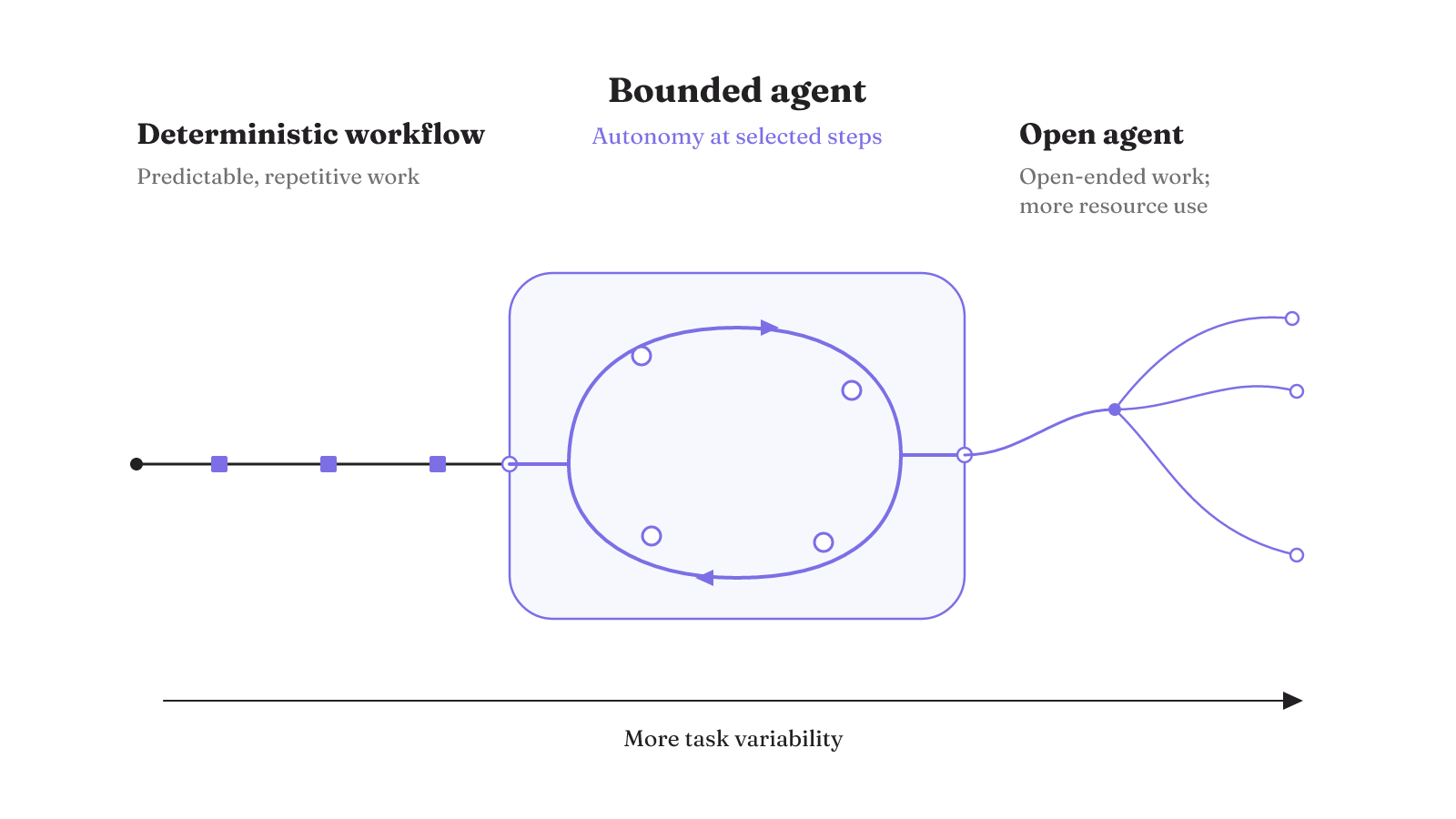
- Deterministic boundaries can contain agent autonomy where adaptation is useful.
Agentic workflows vs AI agents at a glance
The useful question in agentic workflows vs AI agents is not which architecture sounds more advanced. It is where the system needs variability, how much authority follows from it, and what happens when execution drifts. Compare a fixed graph, a bounded agent, and an open agent against the same six criteria.
| Criterion | Deterministic workflow | Bounded agent | Open agent |
|---|---|---|---|
| Task variability | A predefined graph fits well-defined, repetitive work. | The process stays deterministic around the agent. | The agent adapts to open-ended conditions. |
| Decision authority | Executors follow predefined edges. | Autonomy is contained at selected steps. | The agent selects and changes its path. |
| Exception handling | Explicit conditional branches handle expected variation. | Retry or action limits can trigger human intervention. | Adaptive problem-solving covers less structured cases. |
| Observability | Track latency, throughput, and cost per run. | Security permissions and audit logs can be incorporated. | Capture end-to-end traces, success rubrics, quality, and impact. |
| Recovery or handoff | The graph follows a defined branch. | Sensitive or irreversible actions trigger oversight. | A human-intervention mechanism transfers control. |
| Runtime cost | Predefined graphs can be cost-efficient for repetitive work. | Execution caps and token monitoring limit the run. | Iteration adds token use, while multiple turns add latency. |
The right orchestration approach depends on workflow complexity, risk tolerance, and scale. It may change as those conditions change.
What is the difference between an AI agent and an agentic workflow?
An agentic workflow embeds AI inside a predefined process, while an AI agent can observe conditions, choose actions, and alter how it pursues a goal. That is the central difference. The workflow gives the process more authority. The agent gives the model more authority.
In a workflow, the route exists before the run begins. AI may classify an input, draft a response, or choose among defined branches, but the larger sequence remains predefined. This structure is used to produce more predictable outcomes. The model contributes judgment without owning the whole path.
An agent works through a different cycle:
Observe conditions -> process information -> select an action -> pursue the goal
An agent can plan, execute, and iterate toward that goal. A standard automation script, by contrast, executes the same steps regardless of conditions. An agent selects an action based on what it observes.
This is why the label on the whole system can be misleading. A production design can place one adaptive agent inside a predefined process. The surrounding workflow can still own routing, permissions, and completion, while the agent handles the step that cannot be fully specified in advance. If you want a deeper treatment of the adaptive cycle itself, our agent loop guide defines that part of the system.
Start with the simplest path that can do the job
Start with a simple prompt and evaluate it thoroughly. Add a multi-step agentic system only when that simpler design falls short. This sequence keeps architecture tied to demonstrated need instead of making autonomy the default.
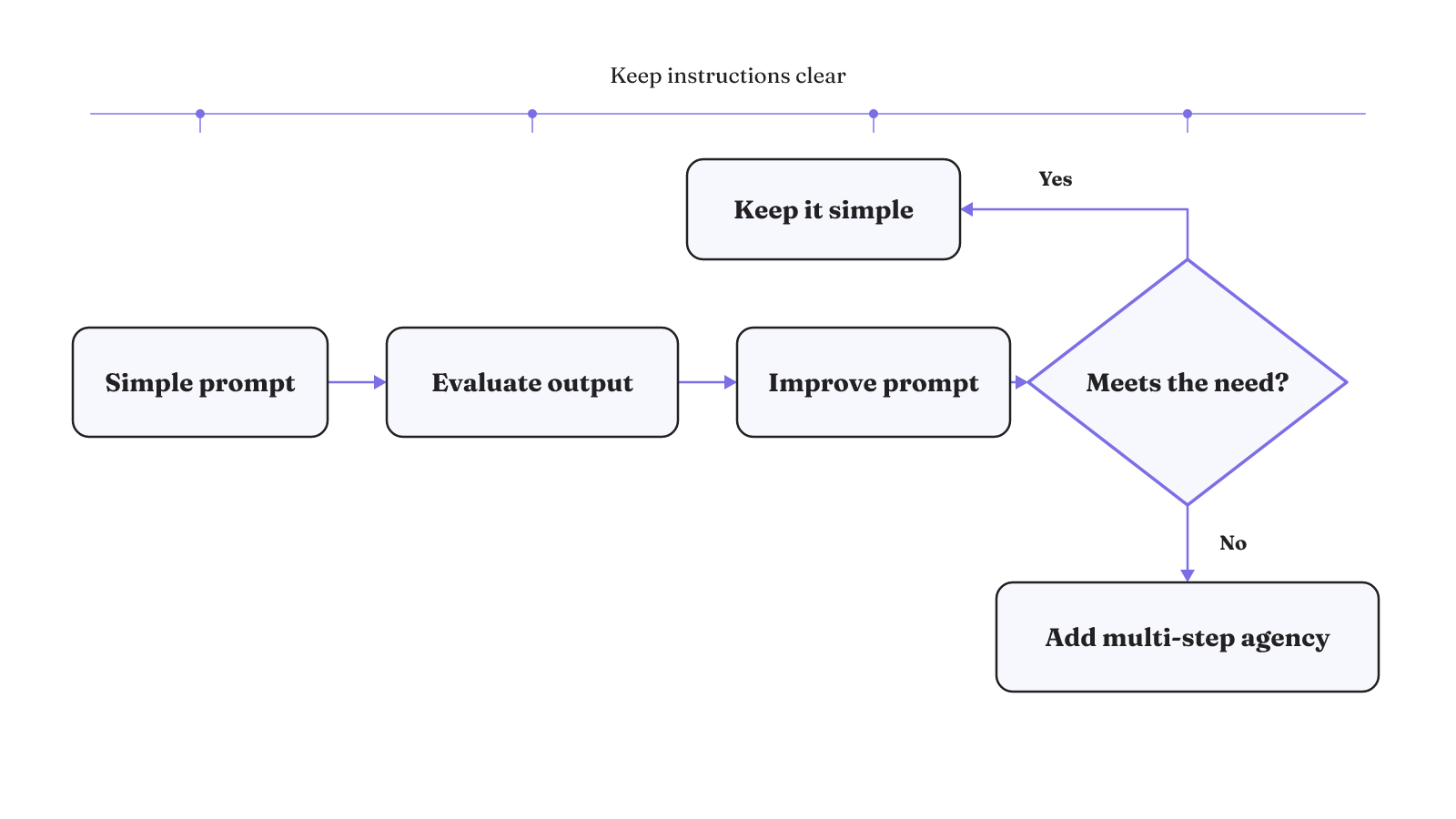
A practical escalation path looks like this:
- Use a simple prompt for the task.
- Evaluate its output comprehensively.
- Improve the prompt while the task remains solvable at that level.
- Add a multi-step agentic system only if the simpler approach cannot do the job.
That order follows official engineering guidance on building effective agents. It also gives you a cleaner comparison. If the prompt already reaches the intended result, a loop adds machinery without answering a proven need.
Comprehensive evaluation is the gate between those levels. Test the simple prompt before concluding that the task requires several steps. Optimize that prompt while the simpler solution remains viable. Only a demonstrated shortfall supports the move to a multi-step system. This keeps the reason for added agency visible: the existing approach could not meet the task, even after evaluation and prompt improvement.
Clear instructions remain necessary at every level. For agents, structured instructions reduce ambiguity, improve decisions, and support smoother execution with fewer errors. Adding a loop does not replace specification. It raises the importance of stating what the agent is trying to do and what its tools are for.
Those instructions also separate an architecture problem from an instruction problem. If clearer directions reduce ambiguity and errors, improve them before treating every weak result as a demand for a more autonomous design. Once a multi-step system is justified, keep the instructions clear and structured. The agent still needs an unambiguous basis for each decision it makes during execution.
The escalation test is therefore demanding but simple: first show where the current design falls short. Then add only the agency needed to address that failure. A multi-step system earns its place through the task, not through the appeal of a more autonomous architecture.
When does an AI agent earn its extra freedom?
An agent earns extra freedom when the work includes ambiguity that a predefined route handles poorly. Three conditions make the strongest fit test: complex decisions, unstructured data, and brittle rule-based systems. In those settings, an agent can reason through ambiguity and act across tools.
Run the fit test against the specific step, not the project as a whole:
- Complex decisions: the work requires the system to reason through a decision that cannot be reduced to a stable predefined route.
- Unstructured data: the agent must work through inputs that do not arrive in one fixed form.
- Brittle rules: a rule-based system breaks when the work falls outside its expected branches.
These are the conditions in which agents are well suited to multi-step work. They justify adaptive action. They do not justify unlimited responsibility.
A focused agent should solve one problem well. If the system picks up additional responsibilities, split the agent and add routing logic. That boundary is more useful than designing a general-purpose agent and hoping its instructions keep unrelated duties separate. It gives each agent a defined problem while routing decides which one should act.
Freedom also depends on the harness around the model. Reliable agents require capable models, well-defined tools, and clear, structured instructions. More autonomy cannot compensate for a vague tool interface or an unclear task. The model needs tools it can use correctly and instructions that make the decision space legible.
Treat those foundations as part of the fit test, not as cleanup after choosing an agent. The model must be capable enough for the work. Each tool must be well defined. The instructions must give the agent a clear structure for acting. If one of those foundations is missing, the architecture does not yet meet the stated requirements for reliable agency, even when the task itself contains real ambiguity.
Scope is a separate boundary. One focused agent can own one problem while routing logic sends other responsibilities to other agents. The wider system may address several problems without asking one agent to carry all of them. This preserves the reason for each agent's existence and makes additional responsibilities an explicit routing choice.
Our working rule is to spend variability where ambiguity requires it. Keep the rest of the path explicit. That turns a broad argument about autonomy into a function-level architecture decision: identify the step that needs adaptive judgment, give one focused agent that responsibility, and keep unrelated responsibilities behind routing boundaries.
Orchestration and handoffs constrain a multi-agent system
A customer-service agent that cannot complete an issue can escalate it to a human agent. A coding agent can hand control back to its user. These handoffs are direct examples of a human-intervention mechanism transferring control when the agent cannot finish the task.
That transfer matters because guardrails have more than one surface. Production agent guardrails should cover input filtering, tool use, and human intervention. A handoff is part of execution design, not an apology at the end of a failed run. Our human-in-the-loop guide goes deeper on where that control can sit.
When several agents are involved, orchestration becomes the control layer that coordinates their work. It can assign work, connect results, and keep the agents inside a wider system.
Multiple agents have a defensible fit when the work requires at least one of these conditions:
- parallel execution;
- specialized tools;
- a large context; or
- multiple decision checkpoints.
Those conditions come from guidance on multi-agent systems. They provide a better reason for decomposition than a vague belief that more agents create a more capable system. The architecture should be paying for parallel work, tool specialization, context separation, or explicit checkpoints.
What should an agentic AI workflow builder provide?
An agentic AI workflow builder should make ownership of the loop and lifecycle explicit. At a lower level, developers manage custom loops and branching. An agent software development kit can provide the loop and lifecycle. The choice determines which execution machinery you build yourself and which machinery the builder supplies.
A useful agentic AI workflow diagram can be written as two compact paths:
Developer-managed path: model call -> developer-managed loop -> custom branch -> tool or response
SDK-managed path: agent lifecycle -> model call or tool -> guardrail or handoff -> trace
The second path reflects an agent SDK that supplies the loop and lifecycle. Its tracing can span model calls, tools, agents, guardrails, and handoffs. The first path leaves custom loops and branches with the development team. Neither ownership model removes the need to understand execution.
Look for three practical qualities in the builder or lower-level harness. First, preserve simplicity in the agent design. Second, expose the agent's planning steps. Third, support the agent-computer interface with tool documentation and testing. These requirements apply whether your team owns the loop or an SDK supplies its lifecycle.
That gives you a concrete builder review:
- Does the design stay simple enough to follow?
- Can you see the agent's planning steps?
- Are tools documented and tested as part of the agent-computer interface?
- Who manages custom loops and branching?
- Do traces span model calls, tools, agents, guardrails, and handoffs?
The first three checks cover design transparency and the tool interface. The last two establish lifecycle ownership and trace scope. They let you compare a lower-level implementation with an SDK-managed lifecycle without assuming that either choice removes engineering work.
Tracing can follow execution across model calls, tools, agents, guardrails, and handoffs. Separately, the implementation choice determines whether your team manages custom loops and branches or uses a supplied lifecycle. Confirm both facts before choosing the builder: loop ownership and the available trace coverage.
How do you measure whether the architecture works?
Measure whether the system completes the intended task. Then measure how often it completes that work autonomously compared with how often it escalates to a human. Together, task-completion rate and the autonomous-completion-to-escalation ratio show whether the workflow reaches its outcome and how much work the agent handles independently.
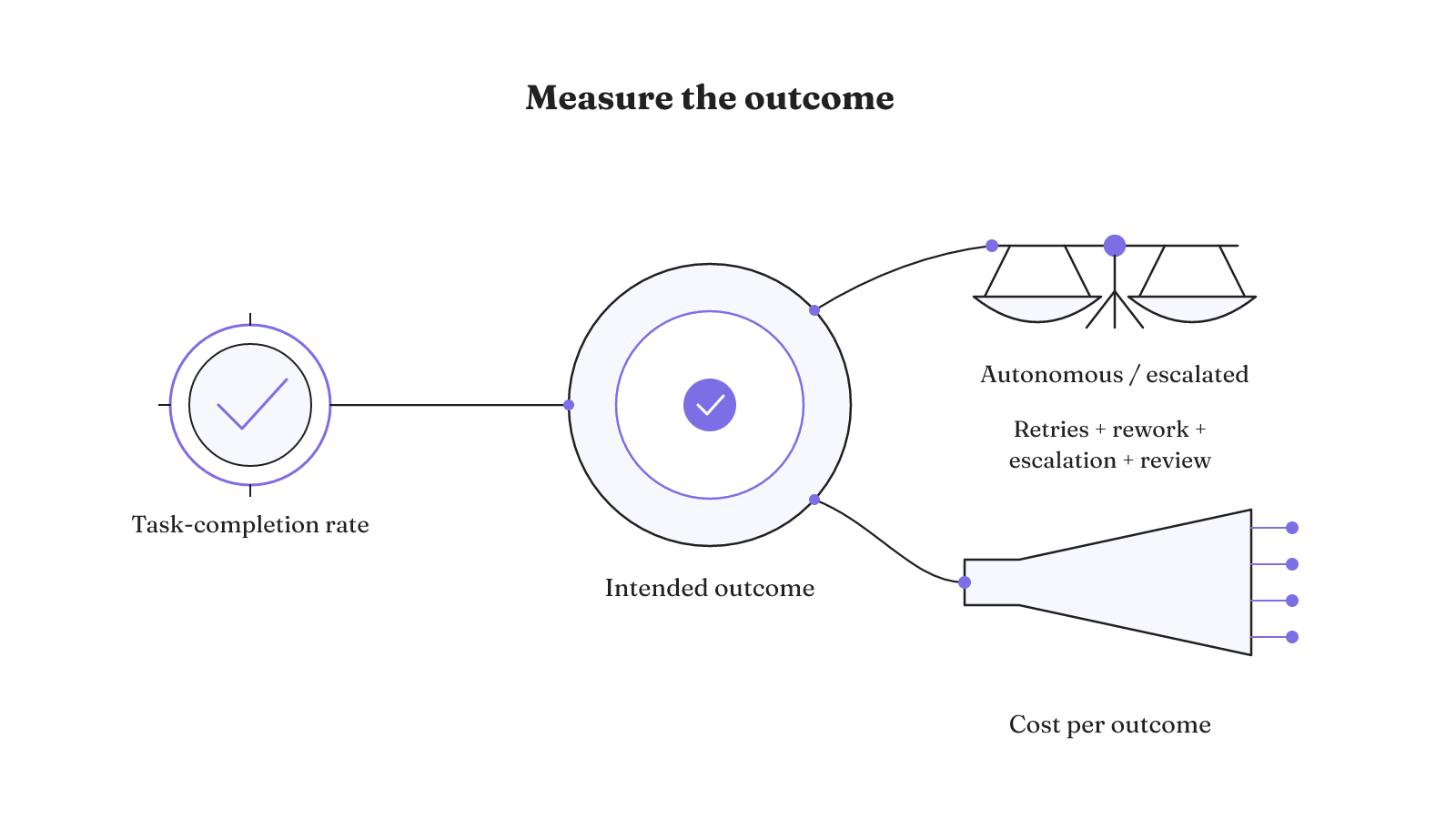
Add one economic measure: cost per outcome tied to a business key performance indicator. For example, connect the full cost of a completed outcome to resolution time. The same method can use cycle time, error rate, or transaction cost when one of those measures matches the task.
Token usage alone is not enough for that decision. It omits retries, rework, escalations, and review burden. Cost per outcome includes the operating burden that appears after the first model call, so it can reveal an architecture that looks cheap at the token level but consumes more work before completion.
The compact measurement bundle is:
- Task-completion rate: did the workflow reach its intended outcome?
- Autonomous completions to human escalations: how much work did the agent handle independently?
- Cost per outcome: what did a completed outcome cost when retries, rework, escalation, and review were included?
Do not treat autonomy as the score. A higher autonomous-completion ratio is descriptive. The result still has to be read beside task completion and the cost attached to the intended outcome.
Choose the architecture from the outcome backward
Before development or deployment, answer two questions:
- Is AI appropriate for this task?
- Can the proposed system achieve its intended purpose?
Those questions come before the choice among a fixed workflow, a bounded agent, and an open loop. AI risk-management guidance calls for determining both whether AI is appropriate for the business task and whether the system achieves its intended purpose.
If AI is appropriate, choose the smallest variability budget that fits the work. A stable, repetitive task points toward a predefined graph. A step that needs adaptive judgment can sit inside deterministic boundaries. Open-ended work may call for an agent that adapts its path, along with the observability, handoffs, and execution limits that make its consequences visible.
There is no one-size-fits-all requirement for every system. Risk management should focus on outcomes and approaches. That keeps the architecture grounded in the purpose of the work instead of forcing every workload into the same pattern.
Compare these boundaries with your current design, then read our guide to building agentic AI systems. Use the agentic AI glossary and the agent-loop and human-in-the-loop guides to define the adaptive cycle, stop conditions, and handoffs you actually need.