Key takeaways
- Start with the simplest AI agent architecture patterns that fit the work.
- Use multiple agents when parallel work, specialized tools, large context, or several decision checkpoints justify the coordination.
- Put human oversight at sensitive, irreversible, and high-stakes actions.
Architecture starts with tools, instructions, and branches
An architecture cannot rescue a vague task. A reliable agent begins with a capable model, well-defined tools, and clear, structured instructions. Those instructions reduce ambiguity, improve decisions, and help the workflow run with fewer errors. This foundation matters whether the system has one agent or many. The practical building blocks are the same: tools define available actions, while instructions define how the agent should use them.
The routine also needs branches for incomplete information and unexpected questions. Consider an agent that must prepare a report from required inputs. Its instruction should not assume every input exists. It needs a conditional branch for the missing-information case, followed by the permitted action for that branch. If the information is present, the normal path can continue. If it is absent, the agent follows the defined alternate path. The branch is part of the architecture because it changes the route the agent can take without leaving the response improvised.
Tool design needs equal care. An agent-computer interface requires thorough documentation and testing. A tool name alone does not make its use well defined. The interface has to give the agent a clear action surface, and testing has to exercise that surface. Before comparing pattern names, make sure the work itself can be expressed through documented tools, structured instructions, and conditional paths.
Which AI agent architecture patterns fit the workload?
Choose the smallest architecture that fits the workload. Add multi-step or multi-agent behavior only when the simpler design falls short. This is the most useful starting rule because it makes added complexity answer to a real need instead of a pattern catalog. Independent guidance converges on this simplest-fit approach.
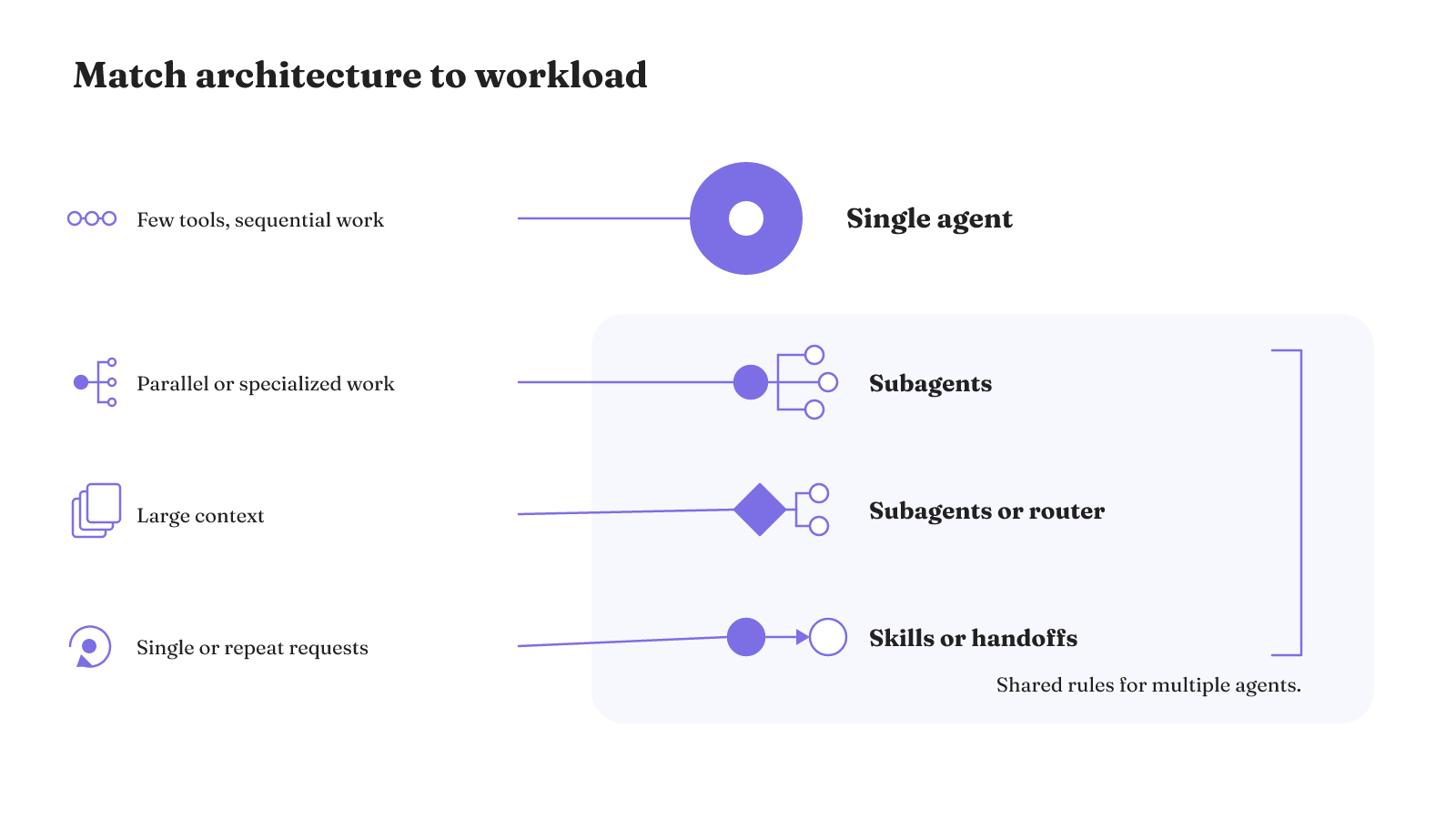
| Workload signal | Smallest fitting architecture | Relevant pattern branch | Added control obligation |
|---|---|---|---|
| Small context, a few tools, simple automation, or well-defined sequential work | Single agent | One agent completing a bounded sequence | Keep governance simple and the task well defined |
| Parallel work or specialized tools | Multiple agents may fit | Subagents for parallel execution | Define shared communication and collaboration rules |
| Large context spread across sources | Multiple agents may fit | Subagents or a router | Define shared communication and collaboration rules |
| Single or repeat requests | Single-request pattern can fit | Skills or handoffs; a router also fits a single request | Match the branch to the request shape before adding orchestration |
For a common vocabulary around these branches, see our note on an agent design pattern.
What does multi-agent orchestration have to add?
Multi-agent orchestration belongs in complex, collaborative work that exceeds what one agent can handle with many tools and knowledge sources. Evaluate whether the scenario actually requires it before adopting it. If a single agent can do the work, orchestration has not yet earned its coordination burden. Microsoft's architecture guidance makes that requirement test explicit.
When the workload does justify an AI agent orchestration architecture, the design needs more than several independent prompts. Successful deployments require explicit role boundaries, communication protocols, continuous monitoring, and built-in oversight. Those are operating mechanisms, not optional documentation. Roles define each agent's part. Protocols give agents a shared way to exchange work. Monitoring keeps the collaboration visible. Oversight supplies a control path when the system reaches a consequential point.
Standardized agent protocols can provide the connective layer across agents and systems. They standardize communication, but they do not remove the need to decide who may act, when work is complete, or where oversight sits. Protocols support the connection layer; collaboration still depends on explicit rules rather than agent intelligence alone.
That is the boundary between decomposition and orchestration. Splitting work creates roles. Orchestration defines how those roles communicate, stay observable, and operate under oversight. Our multi-agent system glossary is useful when you need the category language, but the workload and its coordination rules should drive the implementation.
Failure mode changes the architecture choice
A failed agent step does not always stay local. It can redirect the agent onto a different trajectory and produce an unpredictable outcome. That compounding-error behavior changes architecture selection: you need to consider what happens after a bad step, not only whether the planned path looks sound.
Reliability therefore needs explicit boundaries around uncertainty, side effects, state, recovery, and human intervention. These boundaries tell the harness which effects may occur, what state must remain available, where recovery can begin, and when control must leave the agent. A topology diagram without those boundaries describes arrangement, not containment.
Make those boundaries answerable before selecting a pattern. Where does the architecture represent uncertainty? Which side effects sit behind a control? What state remains available after a failed step? Where can recovery begin? Which condition transfers control to a person? The answers can rule out a visually neat topology that has no defined response to a divergent trajectory. They can also reveal that a simple design already has the containment the workload needs.
Security pressure makes the distinction sharper. Input filtering cannot be the whole prompt-injection defense. System design must also constrain the impact of manipulation when an attack succeeds. A containment-oriented design asks how much authority the manipulated agent can exercise and how far the resulting action can travel.
The risk surface also includes memory poisoning, semantic misuse of legitimate tool interfaces, and contamination through retrieval-augmented generation systems. Each risk reaches a different part of the harness: stored state, permitted tools, or retrieved context. These architecture-level risks belong in the decision because the system needs boundaries for their effects and a recovery path. A pattern that routes work elegantly but leaves state, side effects, and recovery undefined is incomplete for production use.
This is why failure impact belongs beside workload fit. Two tasks may look equally suitable for automation while carrying very different consequences when the trajectory diverges. The architecture has to contain the failure it can create.
Where should a human take control?
Human control should sit at explicit failure thresholds and consequential action boundaries. Retry limits and action limits can transfer control when an agent exceeds them. These thresholds turn an open-ended loop into a bounded process with a defined owner after the limit.
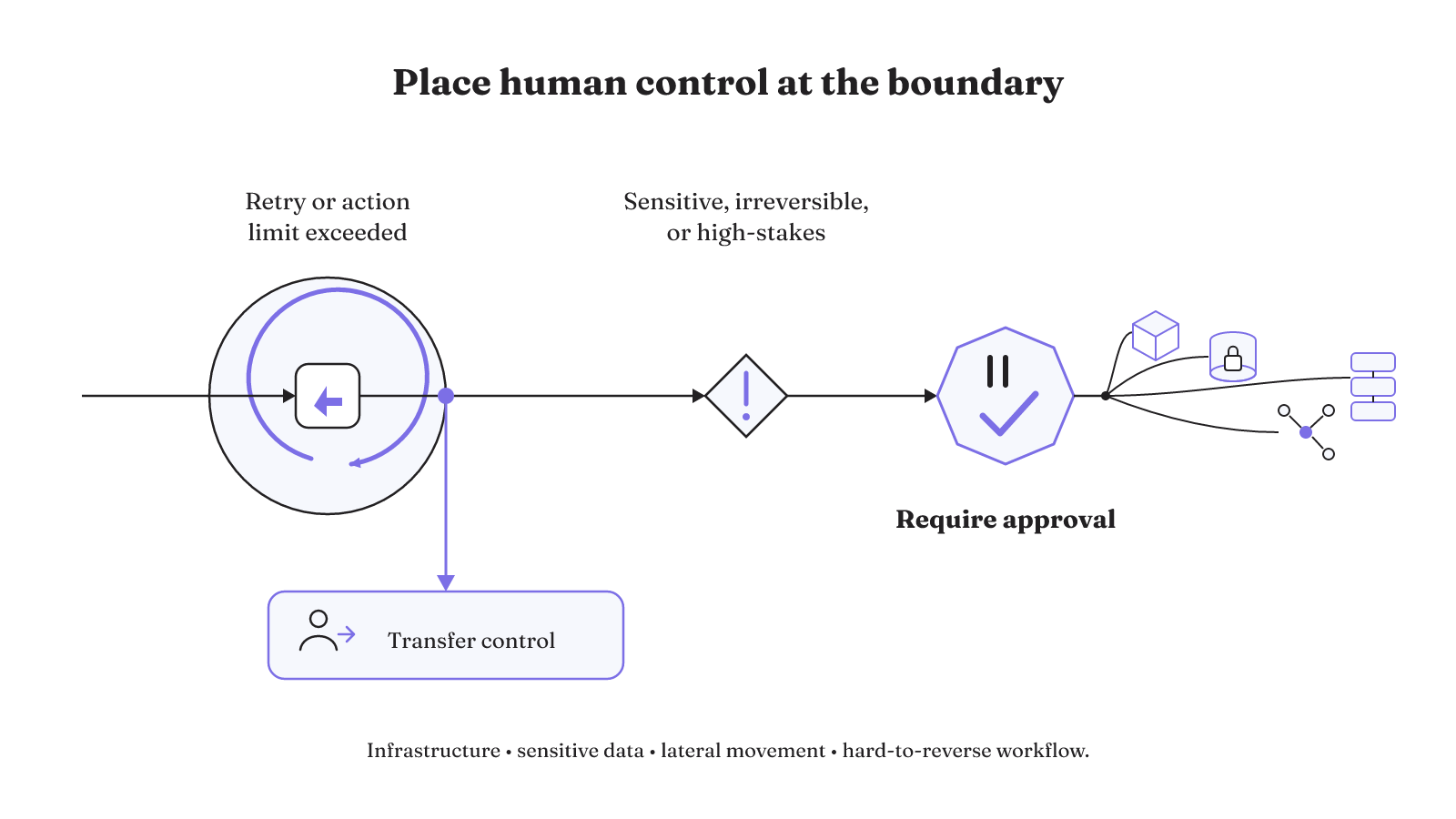
The two kinds of trigger answer different failure questions. Retry and action limits respond to execution that has gone on beyond its allowed boundary. Consequence-based approval responds before a covered action is carried out. An architecture may need both: a transfer after repeated attempts and an approval stop for an action whose effect is sensitive or difficult to reverse.
Action consequence provides the second boundary. Sensitive, irreversible, or high-stakes actions should trigger human oversight until confidence in the agent's reliability grows. Approval is required when an action could change infrastructure, expose sensitive data, move laterally across systems, or trigger a hard-to-reverse business-critical workflow. Those consequence triggers make approval a property of the action, not a vague request for caution.
This placement avoids treating every routine step as equally consequential. The agent can continue within its defined limits, while the harness reserves a human stop point for exceeded thresholds and actions with serious effects. Human intervention is also one layer in a broader set of guardrails that covers inputs and tool use.
For the control concept itself, our human-in-the-loop note provides a shared reference. In the architecture, the important work is concrete: define the threshold, identify the consequential action, and make the transfer of control executable.
Control surfaces bound execution and authority
Control surfaces turn broad guardrail language into enforceable limits. Agent guardrails span input filtering, tool use, and human intervention. Together, those layers constrain what enters the system, which actions it can attempt, and where a person can take over.
Execution limits give loops a hard edge. Useful controls include a maximum number of steps per task, a timeout for the whole execution, and a time limit for the conversation or session. These execution bounds cover different ways a run can keep going: too many actions, too much wall-clock time, or an overlong interaction.
Authority needs its own boundary. Agent access should use scoped, short-lived tokens with expiration, refresh, and revocation instead of long-lived shared API keys. Scope limits what a token can authorize. Expiration and revocation give the system ways to end that authority. A permission model built around short-lived access makes credential lifetime part of the harness.
Treat those token properties as architecture inputs, not deployment details. The agent needs only the scope required for its role. Its authority has a lifetime, a refresh path, and a revocation path. A design that shows which tool an agent calls but omits how that access expires or ends has left part of the authority model outside the diagram.
In a multi-agent design, governance policies can be centralized across agents instead of being hardcoded separately into each one. Centralization gives the architecture one policy surface for shared controls. It does not replace role boundaries or monitoring. It provides a place to enforce common rules while individual agents retain specific jobs.
These mechanisms answer separate control questions: how long may execution continue, what may an agent access, and where are shared policies enforced? Make each one visible in the architecture before implementation begins.
What do controlled architectures look like in practice?
One concrete agentic AI architecture example is a checkpoint-based human-control flow for a Spring AI security-review use case. The state machine persists state and prompt context, pauses at predefined high-risk checkpoints, waits for approval, resumes from that checkpoint, and retains the approval history. Crucially, the orchestrator decides when approval is required. The model does not decide whether its own action needs review.
This example makes several control surfaces tangible. Persisted state supports the pause and resume path. The predefined checkpoint supplies a stop condition. Approval history keeps the intervention visible after execution continues. The orchestrator owns the rule that sends work to a person. The example is specific to that Spring AI security-review implementation, but its mechanism shows what an executable human stop point looks like.
Role design offers another practical lever. Assigning specific roles to individual agents produces a more modular and testable system. A role boundary gives each agent a defined part of the work, which can then be tested as that part.
The task shape also affects whether you use flexible skills or a defined workflow. In one framework-specific example, agent skills provide creative flexibility for open-ended tasks. Defined workflows provide more control over orchestration and task flow for structured processes. That skills-versus-workflows distinction is narrow but useful: open-ended work and structured processes ask for different amounts of control over the route.
How much framework should survive production?
Keep only the abstraction that continues to help in production. Production implementations can reduce framework layers and use basic components where appropriate. That does not make frameworks inherently wrong. It makes every retained layer responsible for a clear job in the running system.
An abstraction review should follow the control path. Can an operator see the planning step through the layer? Is the tool interface still documented and directly testable? Can the team identify which basic component the abstraction coordinates? If a layer makes those answers harder to see and a basic component is appropriate, production guidance allows the layer to be reduced. If the layer keeps the control surface legible, it still has a concrete job.
Three checks keep that review grounded:
- Keep planning steps visible. Agent designs should expose those steps to prioritize transparency.
- Document and test the agent-computer interfaces thoroughly. Tool use is part of the architecture, so the interface deserves the same scrutiny as the agent loop.
- Review each abstraction layer deliberately. Where a basic component is appropriate, remove the extra framework layer instead of preserving it by default.
Production guidance on effective agents supports all three checks: visible planning, carefully designed tool interfaces, and selective use of simple components. The result is not a contest for the fewest dependencies. It is an architecture whose planning, tools, execution limits, permissions, stop points, and recovery controls remain legible to the people operating it.
Use the matrix to select the smallest pattern that fits your workload. Then inspect those control surfaces before implementation. When the pattern is settled and you need to place it inside the wider production system, read our guide to AI agent architectures.