Key takeaways
AI delegation gives an agent a goal and room to pursue it. Autonomy is a design choice. Before granting it, ask how quickly an error will become visible, how cleanly the action can be undone, and what independent proof will confirm correct completion.
What is AI delegation?
AI delegation means giving an agent a goal that it can pursue autonomously. The agent then directs its own process and tool use while completing the task with minimal human input. The point is not simply that a model produces an answer. The delegated agent decides how to move through the work after receiving the goal.
That distinction creates the central engineering problem. The goal tells the agent what to pursue, but it does not settle how much authority the agent should have while pursuing it. Tool access, permissions, stopping conditions, completion evidence, and escalation all sit around the model. Together, they determine what the agent can actually do.
The practical question behind how to delegate work to AI agents is therefore specific: which actions may proceed without intervention, and which actions require a human decision before they happen? That question becomes easier to answer once the workflow is described in concrete steps.
Where does AI delegation work?
Consider a wedding-planning goal. An agent might research venues and vendors, compare pricing and availability, then create timelines and budgets. One request expands into research, comparison, and document production, with the agent directing the steps between the initial goal and the finished material.
A company board presentation creates a different chain. An agent might search connected Google Drive files, extract metrics from spreadsheets, and produce a report. Here, the work crosses a file system, structured data, and a final document. The example is useful because each action has a different permission surface. Searching files, reading a spreadsheet, and producing a report are not the same operation merely because one agent performs all three.
Repeatable workflows are another clear fit. Workspace agents in ChatGPT are designed for work that would otherwise require people to explain the same steps again and copy information between tools. Repeatable AI-supported workflows can also depend on shared systems, standard handoffs, consistent outputs, and constraints involving timing, accuracy, and process.
That broader workflow is the thing being delegated. The agent is not only drafting the last document. It may retrieve inputs from a shared system, carry information across a standard handoff, and produce the consistent output the process expects. Timing, accuracy, and process constraints remain part of the workflow even when a person is no longer moving every piece by hand.
This gives you a practical test for fit. Describe the task from its first input to its final output. Name the shared systems, handoffs, and constraints that already shape the work. If the description contains several agent-directed steps, authority must be considered for those steps, not inferred from the goal alone.
These AI delegation examples share a useful shape: one goal contains several actions, tools, and handoffs. That makes them candidates for an agent loop, where the system can maintain direction across more than one step. It also means the authority decision cannot stop at a label such as "autonomous agent." The useful unit is the individual action inside the workflow.
Autonomy is a design choice, not a capability score
An agent's autonomy level can be chosen separately from its capability and operational environment. A model may be able to perform an action without being authorized to perform it. Capability answers whether the system can act. Autonomy answers whether the system may act without another decision first.
One five-level model describes autonomy through the user's role: operator, collaborator, consultant, approver, and observer. The labels describe a changing relationship between the person and the agent. They should remain intact as one model.
A separate permission ladder uses five different labels: read-only, suggest, supervised execution, monitored autonomy, and full autonomy. This ladder describes what the agent is allowed to do. It should not be merged with the user-role model into a new universal scale. The two models offer different ways to describe authority.
More autonomy is not automatically better. Increasing it introduces tradeoffs involving utility, efficiency, accountability, and cost. A higher level is therefore not a reward for a more capable model. It is an operating choice that needs a defined boundary.
The boundary should also follow actions, not only agents. Different steps in one workflow can run at different autonomy levels. The same agent may read material autonomously, prepare a draft, and then wait before an external write. This action-level view is more precise than assigning one permanent autonomy label to the entire agent.
How much authority should each action get?
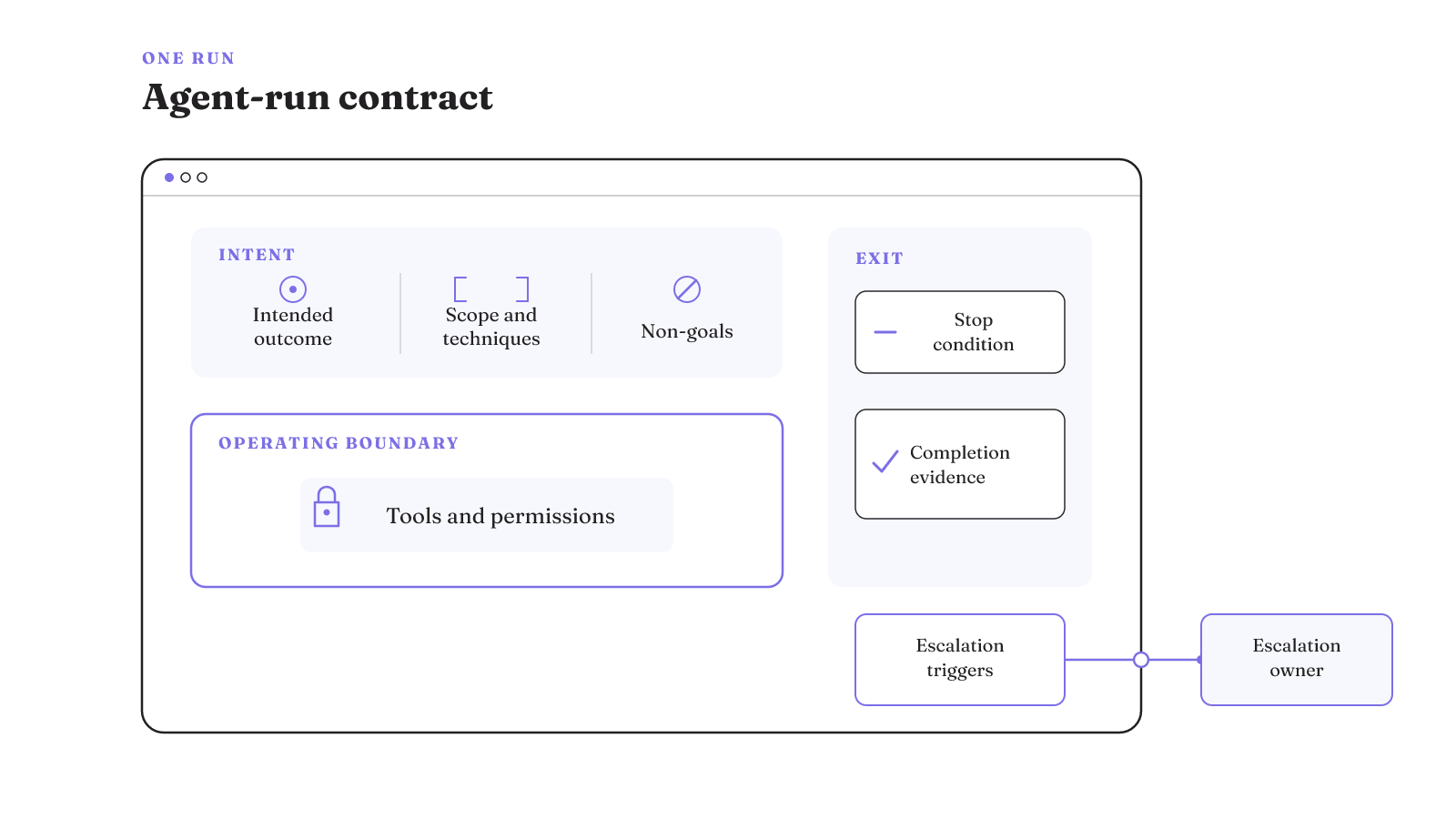
Start by defining one run. An agent-run contract records what the run is supposed to accomplish, where it may operate, what it may use, when it must stop, and how completion will be checked. It gives every authority decision a concrete task boundary. For high autonomy, ask how quickly an error will be detected, how cleanly an action can be undone, and what independent evidence would prove the work correct.
Agent-run contract
For one repeatable workflow, write down:
- The intended outcome.
- The operating scope and allowed techniques.
- The non-goals.
- The tools and permissions.
- The stopping condition.
- Independent evidence of completion.
- The circumstances that trigger escalation.
- The person responsible for that escalation.
| Action type | Detection and undo questions | Authority posture | Required control |
|---|---|---|---|
| Read-only analysis, including summaries, retrieval, and classification | How quickly would an error appear? What evidence would prove the analysis correct? | Can run autonomously | Independent completion evidence |
| Drafts | Can an error be detected before the draft is used? Can the draft be replaced cleanly? | Can run autonomously | Stopping condition and completion evidence |
| Write actions | Can the change be undone cleanly, and what would make an error visible? | Supervised by default until proven safe | Human approval before the write |
| Customer-facing or high-blast-radius actions, including customer email, publishing, and terms or policy updates | Is the action irreversible, ambiguous, costly, regulated, expensive to unwind, or hard to contain? | Supervised | Human approval and an escalation owner |
One workflow can mix these postures. Different actions handled by the same agent may run at different autonomy levels, so the matrix should be applied action by action. Agent sandboxing is a related way to reason about the permission boundary around them.
How can an approval checkpoint work?
A checkpoint makes the authority boundary executable. In one Spring AI security-review implementation, a checkpoint-based state machine lets the agent move through safe stages and pause at predefined high-risk checkpoints. The system persists its state and context, waits for approval, resumes from the correct checkpoint, and retains the approval history.
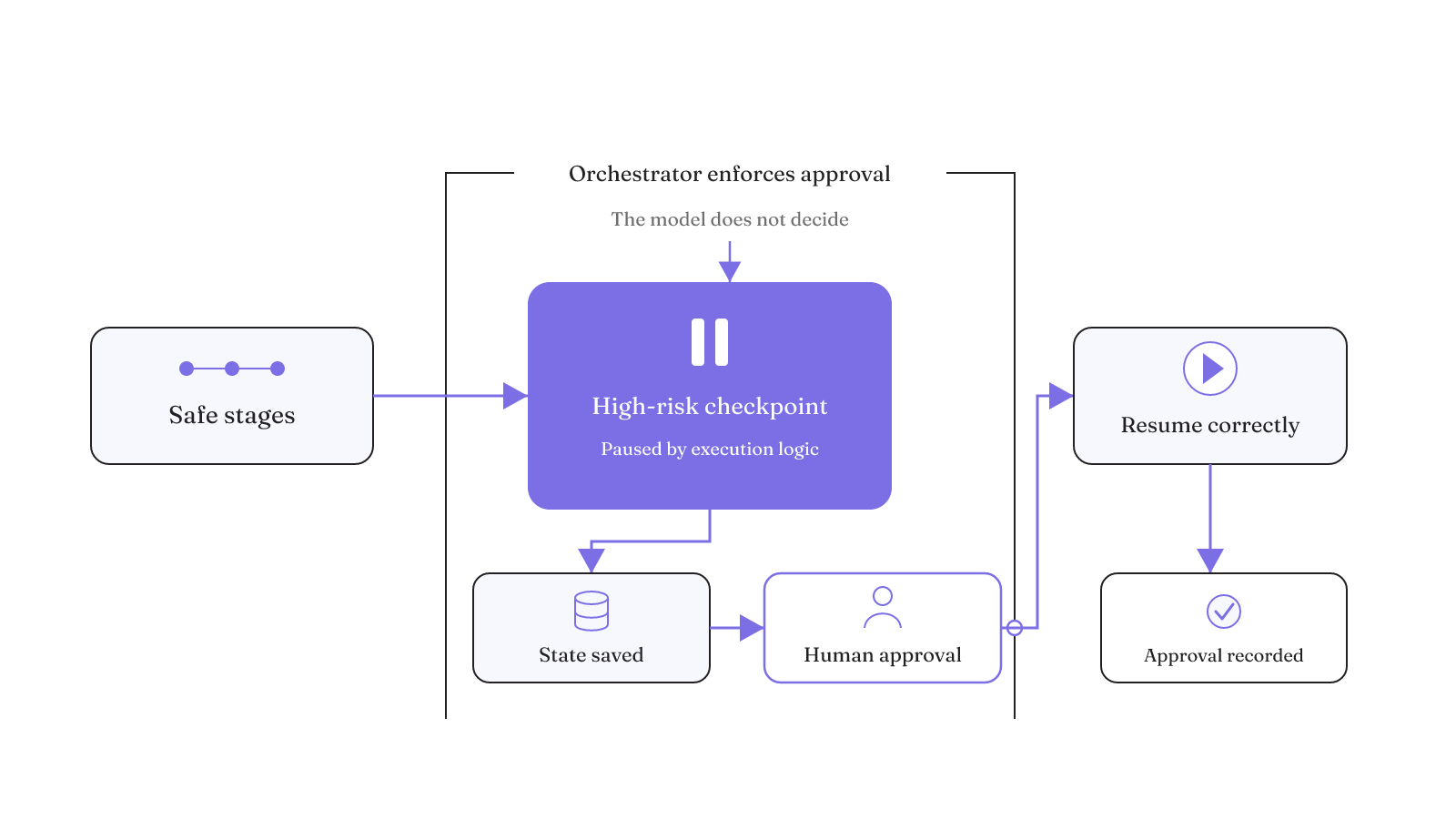
Crucially, the orchestrator decides when approval is required. The model does not decide whether its own next action needs oversight. That decision sits in execution logic outside the model.
This implementation is one concrete pattern, not a universal architecture. Its useful lesson is the separation of duties. The agent can continue through allowed stages, while the orchestrator enforces the pause at a named boundary. Persisted state allows the run to wait without losing its place. Resuming from the correct checkpoint avoids treating approval as a vague message appended to a fresh run. The retained approval history also makes the decision part of the run record.
That is the practical shape of human-in-the-loop control: the human decision is placed at a defined transition, and the surrounding system carries the work to and from that transition.
Higher autonomy requires evaluation and observability
Grant higher autonomy incrementally from measured performance, not from assumed capability. Promotion changes what the agent may do without intervention, so the basis for that change must come from observed work.
The first input is measured performance at the current authority level. The second is operational visibility. Logging, alerting, and audit infrastructure should be present before an agent is promoted to higher autonomy. These controls make the run inspectable while it is operating and after it has finished.
Treat observability as part of the promotion decision, not as cleanup after the authority change. The requirement comes before promotion: logging, alerting, and audit infrastructure need to exist while the agent is still operating at the lower level. A promotion decision without those records lacks the operating visibility required for higher autonomy.
The third input is an evaluation that resembles the work the agent will actually receive. Agent evaluations should use realistic tasks, unambiguous success criteria, thoughtfully designed graders, and problems difficult enough to produce useful signal. Transcript review matters because a correct-looking result does not describe the path that produced it. Iterating on the evaluation can improve its signal-to-noise ratio.
Each part tightens a different part of the test. Use realistic tasks rather than detached demonstrations. State success criteria without ambiguity. Design graders with care, and choose problems difficult enough to expose meaningful differences. Review the transcript as well as the result. Then iterate on the evaluation when its signal is noisy. This produces a test of the delegated work, including the trajectory the agent followed.
The fourth input is regression coverage from failures already found. When a person fixes a mistake manually, that fix can become a test so the same failure is covered in future evaluations. The repair then changes the system's ongoing checks instead of disappearing inside one corrected run.
Together, these inputs form a promotion gate: measured performance, logging and alerts, realistic evaluation with explicit success criteria and transcript review, and tests derived from manual fixes. The gate does not prescribe one performance number for every workflow. It asks for evidence tied to the actual task before the authority boundary widens.
Autonomy needs review after launch
An autonomy decision can become stale. The agent, underlying model, and business context may all change after launch, so autonomy levels should be reviewed periodically. A workflow that passed its promotion gate still needs monitoring once it operates under the wider boundary.
A periodic review should reconsider the level when any of those three inputs changes. The agent may change, the model may change, or the business context may change. The autonomy setting should not remain fixed merely because the workflow has already launched.
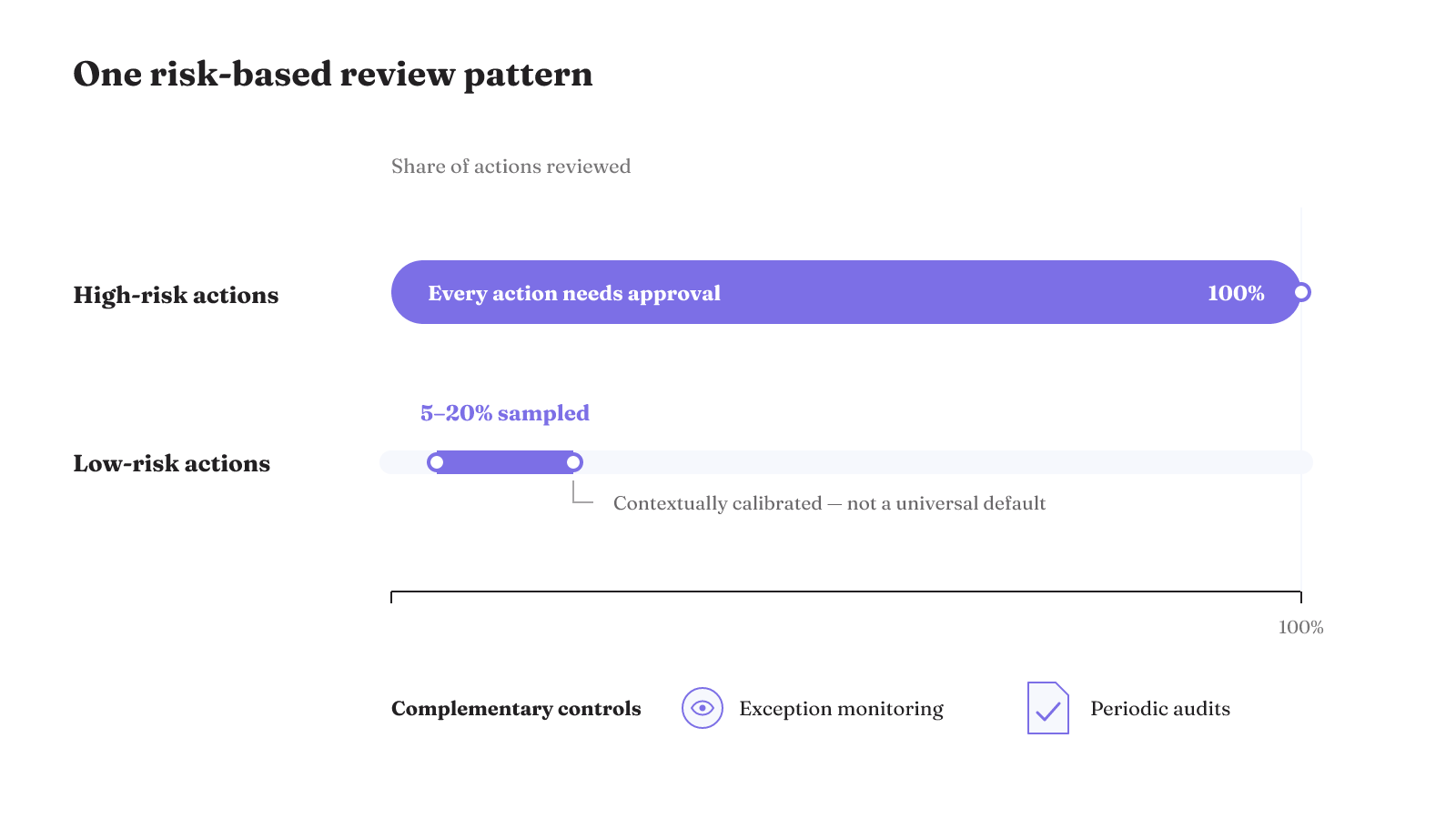
One risk-based sampling pattern approves 100% of high-risk actions and reviews a 5–20% sample of low-risk actions. The pattern combines that sampling with exception monitoring and periodic audits of actions that were approved automatically. The 5–20% range is a pattern that needs contextual calibration, not a default for every workflow.
Ongoing review matters because errors can compound across an autonomous workflow. A bad decision at step three can alter the context available at later steps and feed incorrect data into step five. If review checks only the final output, the earlier decision and the corrupted handoff can remain difficult to see.
The step-three failure is not confined to step three. Later work receives context changed by that decision, and incorrect data can travel forward. That is why an audit needs access to the sequence of work, not only the last artifact the run produced.
Exception monitoring can surface runs that depart from expected behavior. Periodic audits create a separate look at actions the system allowed to proceed. Sampling adds direct inspection of some low-risk actions without requiring approval for every one. High-risk actions remain fully approved in this pattern. These mechanisms do different work, but they share one purpose: keeping the authority level connected to what the system is doing after launch.
The harness supplies state, tools, feedback, and constraints
The authority design lives in the agent harness. An agent harness is the code, configuration, and execution logic outside the model. It turns a raw model into an agent by supplying state, tool execution, feedback loops, and enforceable constraints.
The distinction is concrete. The model can direct its process, but the harness supplies the state available to that process and the tools it may execute. Feedback loops carry results back into the run. Enforceable constraints define limits around execution. Changing the harness can therefore change the operating boundary without treating model capability as permission.
Approval logic belongs in this surrounding system as well. In the checkpoint example, the orchestrator determines when approval is required, persists state while the run waits, and resumes from the correct checkpoint after the decision. That keeps the approval boundary in execution logic instead of asking the model to decide when it should be supervised.
This is why the authority decision belongs at the function level. One model can participate in several actions with different permissions, approval points, and evidence requirements. The harness can hold those distinctions even when the model stays unchanged.
Use the agent-run contract on one repeatable workflow before widening its authority. Define the outcome, scope, non-goals, permissions, stopping condition, completion evidence, and escalation path. Then assign authority to each action and place approval at the consequential transitions. For a deeper view of the surrounding system, read our guide to the agent harness.