
Key takeaways
- Start with one focused job.
- Require approval before consequential actions.
- Measure completion, escalation, speed, capacity, and cost per run.
- Save successful-stage checkpoints so a failed run can resume.
An AI playbook can be a book, a template, a programming system, or a set of workflow instructions. The label is informal. For recurring AI work, the useful question is what happens when the instructions meet tools, changing state, approvals, and failure. You need to inspect the workflow beneath the format.
What is an AI playbook in operational terms?
Here, we use "AI playbook" as an informal label for a recurring AI workflow and the instructions that direct its agents. This is an operational scope, not an industry-wide definition. It gives you something concrete to inspect without claiming that every book, library, or vendor uses the term in the same way.
An AI agent workflow is a sequence of tasks that one or more agents execute dynamically toward a specific goal. The agents can use reasoning, tools, and memory to adapt while the work is running. A workflow may combine reasoning layers, tool integrations, memory systems, and multi-agent orchestration. If several agents are involved, agent orchestration is part of the control surface, not merely a diagram of who calls whom.
The instruction layer gives that moving system direction. One published agent-instructions structure specifies a role identity, core responsibilities, expertise, key principles, and an analysis framework. Those fields answer questions about what the agent is meant to do and how it should approach the work. The workflow answers a different set of questions: which tasks run, which tools and memory are involved, and how the system behaves as conditions change.
That distinction matters when two artifacts both call themselves playbooks. A polished instruction document may define a strong role while leaving the running workflow unclear. A capable workflow may still have vague instructions. Evaluating recurring work means looking at both layers together.
Use a six-part workflow-control matrix
Before choosing a format or implementation, put one recurring task through this matrix. Each row asks for a control you can point to or a measure you can record. A blank cell is not a verdict. It shows where the workflow still needs a concrete design decision.
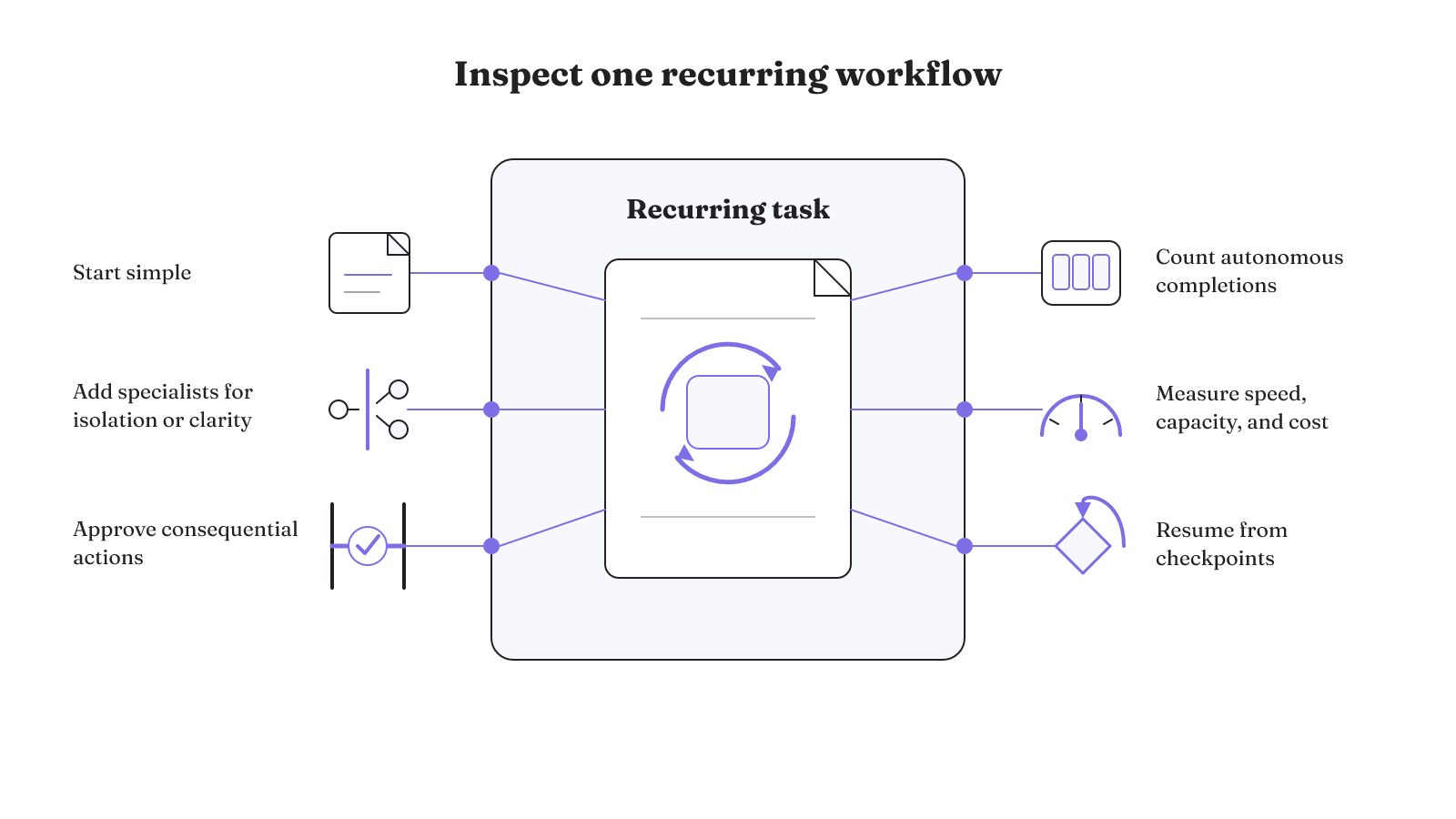
| Review area | What to inspect | Concrete test |
|---|---|---|
| Task scope | Whether a simple prompt can handle the job before a multi-step agentic system is added | Start with a simple prompt, evaluate it thoroughly, and add multiple steps only if the simpler approach falls short. |
| Specialist threshold | Whether a specialist materially improves capability isolation, policy isolation, prompt clarity, or trace legibility | Name the specific improvement that justifies another agent. |
| Approval | Whether the workflow asks for explicit confirmation before consequential actions | Identify the action that pauses for user confirmation. |
| Completion | How often the intended outcome is reached without human intervention | Record the intended outcome and count completions that do not need human intervention. |
| Operating load | Run speed, supported concurrent runs, and token-and-compute cost per run | Measure all three under the workload you plan to run. |
| Recovery | Whether successful-stage checkpoints let work resume after failure | Locate the checkpoint from which the workflow would restart. |
Start with one focused job
A focused agent should begin by solving one problem well. As users ask for more, you can add another agent or split the existing one, then introduce routing logic when several agents need to share the work. The order is useful: demand creates the reason for a split, and routing follows the presence of multiple agents.
The opposite approach is to keep adding tools and responsibilities to one massive agent. As that surface grows, the error rate and chance of choosing the wrong tool rise. More reach does not remove the need for a clear job boundary.
Splitting early has its own cost. It creates more prompts, traces, and approval surfaces without necessarily improving the workflow. A specialist earns a place when it materially improves capability isolation, policy isolation, prompt clarity, or trace legibility. That threshold is more useful than agent count because it names the benefit the new boundary must deliver.
You can apply the threshold without treating architecture as permanent. Write down the single problem the current agent owns. When a new demand arrives, ask whether it harms prompt clarity, mixes policies, obscures the trace, or needs isolated capabilities. If none of those conditions materially improves with a specialist, another agent adds coordination without an established gain.
When should AI playbooks stop for approval?
The workflow should stop before it executes a consequential action. Customer messages, financial updates, access changes, deletions, and operational commitments require approval before execution. The pause belongs immediately before the action, when a person can still prevent it.
That boundary also limits a concrete security failure. Prompt injections are malicious instructions placed where an agent may encounter them. Their purpose is to manipulate its behavior and induce unintended actions. Explicit user confirmation before consequential actions reduces harm from these attacks, while takeover and pause controls let the user intervene.
An approval screen needs enough substance for a real decision. The reviewer needs the source context, proposed output, escalation reason, and clear options to approve, edit, reject, or return the case. A bare “continue?” prompt exposes a button without exposing the judgment behind it.
Review depth can change with consequence. In a content workflow, a risk tier can determine reviewer count, automated checks, and required human judgment. Regulated claims, executive messaging, pricing pages, and customer-facing policy language receive deeper scrutiny and senior sign-off. That approach does not insert the same interruption into every step. It ties the approval surface to the kind of action the workflow is preparing to take.
When you inspect an AI playbook, locate the exact action that waits. Then inspect the decision presented to the reviewer. The presence of a human is not enough if that person cannot see the source context, proposed output, and reason for escalation or cannot send the work back.
How do you know the workflow is working?
Start with outcomes and escalations. The ratio of autonomous completions to human escalations indicates how much the agent handles independently. It gives each escalation a place in the operating record instead of treating human intervention as invisible cleanup.
That ratio needs a defined completion target. Workflow evaluation can track how often the intended outcome is reached without human intervention. For one recurring task, write the intended outcome in terms that a completed run can satisfy or miss. Then count the runs that reach it and the runs that escalate. The result describes this workflow's handling of that outcome. It is not a general score for the agent.
Changes need a repeatable comparison. Repeatable datasets and evaluation runs support benchmarks over time, prompt comparisons, and larger-scale evaluations. Keep the dataset stable when comparing a proposed prompt change, so the comparison is about the change you made rather than a different collection of cases.
Final outcomes are only part of the picture. Trace grading supports error identification at scale, which helps expose where a workflow went wrong across its execution. This is especially useful when a failed final result could have several origins in the path through reasoning, tools, and orchestration.
Recovery does not get a softer evaluation. Output produced after recovery should meet the same quality criteria as output from a successful run. Otherwise, “recovered” may only mean that execution ended. Use the same completion definition and quality checks for both paths.
The agent evaluation glossary connects these measures to the wider evaluation discipline. For the workflow in front of you, keep the record compact: intended outcome, completion without intervention, escalation, operating measures, trace result, and the quality result after recovery.
Make recovery part of the procedure
Suppose an operation sends an email, changes a document, writes to a customer relationship management system, creates a ticket, or triggers a refund. If a retry repeats that operation, the external effect may happen twice. Each of these operations must carry an idempotency key or a deduplication contract, so replay has an explicit control.
If re-executing an operation would be unsafe, make it idempotent or place it behind a manual approval gate. A generic instruction to "retry" provides neither control. During a failure test, attempt the replay path and check whether it reaches idempotent execution or the manual gate.
A workflow with meaningful side effects should define four things: the action that commits the business change, the signals that show partial completion, a compensating action, and the irreversible actions that require human resolution. This turns failure handling into named state and action instead of a vague exception path.
A recoverable task also needs a durable checkpoint before external side effects, references to its artifacts, a heartbeat or lease model, and a resumable state machine with legal transitions. The checkpoint records where the task reached a durable stage. Artifact references keep outputs attached to that state. The heartbeat or lease model helps represent whether work is still owned, while the state machine defines which resumptions are legal.
These controls change what “run it again” means. The system is no longer guessing whether the earlier attempt committed an action. It has a checkpoint, a record of artifacts, a state transition, and a replay rule. If the action cannot be replayed safely, the procedure reaches the manual gate instead.
Recovery needs authoritative state
A retry can duplicate a partially completed mutation when recovery logic has not recorded the prior execution. This is the dangerous gap between “the worker stopped” and “nothing happened.” A transport-level success signal can also miss duplicate external actions and reasoning loops that continue to consume budget.
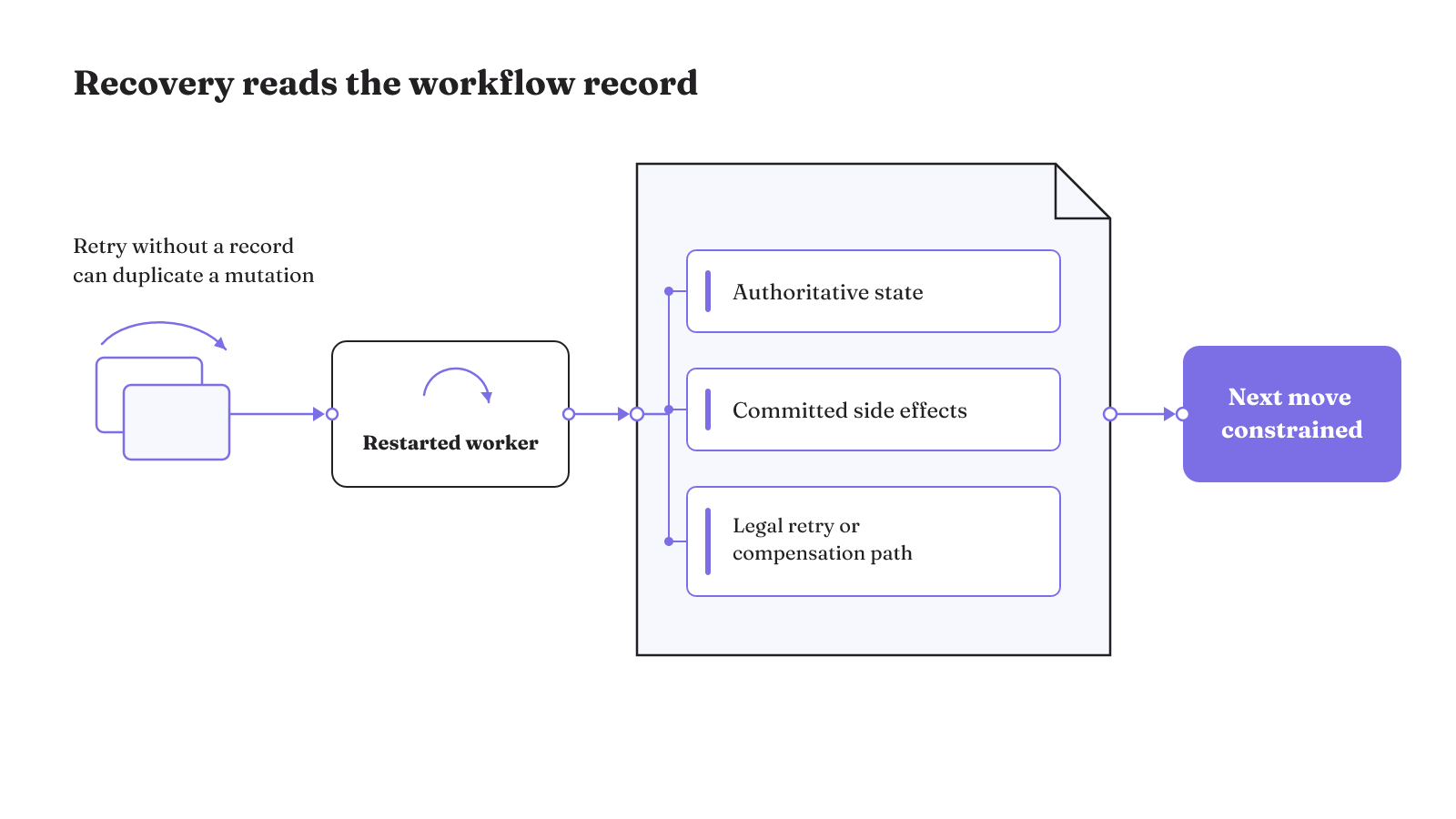
Long-running recovery therefore needs controls that observe workflow state and side effects directly. The recovery path needs to know what the workflow did, not only whether a message was delivered or a process returned success.
When a worker restarts, it should obtain three facts from the workflow store: the authoritative state, the side effects already committed, and the legal path for retry or compensation. Those facts constrain the worker's next move. If a mutation is already committed, the stored record prevents the restarted worker from treating the task as untouched. If partial work needs compensation, the legal path identifies that route.
This is where durable state becomes an operating control. Memory used for an agent's reasoning does not by itself establish which external changes were committed or which transition is allowed. The recovery worker needs the authoritative workflow record for that decision.
The broader agent harness guide places state, tools, execution, and constraints around the model. For a recurring workflow, inspect the store that recovery actually reads. It should expose committed side effects and permitted recovery transitions, not merely the last message that passed through the system.
What should a recovery run show?
Recovery should make progress legible. The operator should be able to see which steps completed, which are retrying, and which are waiting for human intervention. Those states let a person distinguish durable progress from work that is still active or blocked on judgment.
Not every parallel run needs to collapse into one all-or-nothing result. If 8 of 10 parallel agents succeed, partial-result composition can deliver the 8 successful results and report the 2 failures separately. The output preserves completed work while keeping the failures visible.
Compensation should be just as explicit. If one agent creates a file and the next agent fails, a compensating action can remove the created file before retrying. The cleanup is part of the recovery procedure, not an informal task left for someone to notice later.
These examples give a recovery run a clear surface. It reports completed work, active retries, and cases waiting for a person. It separates successful parallel results from failures. Where a failed sequence left a reversible side effect, it executes the defined compensating action before retrying.
Apply the six-part matrix to one recurring AI task you already understand. Write down its focused job, the threshold for adding a specialist, the consequential action that requires approval, the completion and operating measures, and the checkpoint that recovery will use. Then run one failure test and inspect the state, side effects, retry path, and visible recovery output.