Key takeaways
Start with one agent. Compare multi agent orchestration patterns only when a specialist would improve a clear boundary. An early split adds prompts, traces, and approval surfaces. The pattern earns its place when you can name who controls the next action and how the system recovers from failure.
What is multi-agent orchestration?
Multi-agent orchestration coordinates role-specific, LLM-driven agents on a shared task. The defining feature is not the number of model calls. It is the coordination mechanism that lets distinct agents cooperate. Common roles include an orchestrator, worker, router, planner, critic, and tool specialist, though a useful system does not need every role. This distinction between models and acting systems matters when drawing the architecture boundary.
Here is a hypothetical role map for a research workflow. An orchestrator assigns a bounded task to a worker, while a critic checks the worker's output against the workflow's criteria. A router selects the receiving agent, and a planner shapes the work before dispatch. This sketch separates responsibilities, but it does not settle permissions, state transfer, approval, or recovery.
That is why labels such as AI agent design patterns and AI agent orchestration patterns are only a starting vocabulary. A practical role taxonomy names sequential, parallel, router, hierarchical, and graph coordination. The architecture decision begins when you specify how those roles exchange work and how the harness controls their actions.
When does one agent stop being enough?
One agent stops being enough when specialization buys a concrete improvement. The strongest reasons are capability isolation, policy isolation, prompt clarity, or trace legibility. Each added agent should have a clear reason to exist. If one agent can complete the workload, orchestration should remain simple. If it cannot, add the smallest number of agents that solves the problem.
Use four tests before making the split:
- Capability isolation: a specialist materially improves the capability boundary.
- Policy isolation: the work needs a distinct policy boundary.
- Prompt clarity: separating responsibilities makes instructions clearer.
- Trace legibility: the split makes execution easier to inspect.
This is the practical difference between useful specialization and architecture by diagram. Splitting too early creates more prompts, traces, and approval surfaces without necessarily improving the workflow. Those surfaces become additional objects to design, test, observe, and repair.
The single-agent default is not absolute. Hard security, compliance, organizational-separation, or guaranteed multi-domain-scaling requirements can mandate architectural separation. Azure's single-agent and multi-agent guidance treats those constraints as reasons a multi-agent design may be required. For ordinary workload growth, the safer rule is incremental: begin with one agent and evolve only when complexity demands it. This keeps the burden of proof on every new handoff.
Multi agent orchestration patterns: a control-first selection matrix
Multi agent architecture patterns affect governance, cost control, coordination design, and production risk. They need explicit role boundaries, communication protocols, continuous monitoring, and built-in oversight. Every added invocation also consumes tokens for its instructions, context, reasoning, and tool interactions. Early evaluation can turn observed failures into test cases, help prevent regressions, and replace subjective impressions with metrics.
At Rifty, we use the matrix below as an organizing model, not a universal taxonomy or performance ranking. It synthesizes common coordination patterns, Azure's pattern-specific cost conditions, failure-derived evaluation practices, and Open Multi-Agent's scoped recovery mechanics into one set of workload questions.
Framework preference comes after these obligations. When comparing AI agent orchestration tools, use those questions for each candidate:
| Pattern | Task dependency and next-action owner | State, authority, and verification boundary | Cost and recovery pressure |
|---|---|---|---|
| Sequential | Which dependency unlocks the next step, and who dispatches it? | What state crosses each handoff, which tools can the receiver use, and what verifies completion? | Record the calls accumulated across steps. Identify where a local retry ends and broader containment begins. |
| Parallel | Which tasks are independent, and who joins their results? | What context may each branch receive, and what checks the combined output? | Measure the resource spike from concurrent calls. Decide how one branch failure affects the join. |
| Router | Is the choice a receiving agent or an execution branch from current state? | What state informs the route, what authority follows it, and how is the route checked? | Measure routing plus worker calls. Define recovery for a bad route or failed branch. |
| Hierarchical | Which manager assigns work, and when may it revise the plan? | What can managers delegate, what can workers do, and where does verification occur? | Track manager iteration and worker calls. Bound escalation when planning does not settle. |
| Graph | Which nodes depend on which outputs, and who selects the next eligible node? | What data travels on each edge, and what gate protects consequential nodes? | Trace cost by node. Put checkpoint and containment boundaries around likely failure paths. |
| Repairable | Which unexecuted nodes may change when the plan no longer fits? | Who validates and approves a patch before it becomes active? | Preserve revision history. Define an atomic commit point, checkpoints, and rollback behavior. |
Suppose you are designing a research workflow in which several searches are independent, but synthesis must wait for all accepted results. Applying the matrix points to parallel workers with a controlled join. The orchestrator owns dispatch, each worker receives only its assigned query and context, and a critic checks the combined draft before it can be written to shared state. The cost review covers the concurrent calls, while the recovery decision defines what happens when one branch fails before the join. That workload does not need a general hierarchy. It needs parallel execution with one explicit merge and verification boundary.
Failure propagation is a trajectory problem
A failed agentic step can redirect execution onto a different trajectory and produce unpredictable outcomes. That behavior has been observed in multi-agent research systems. Recovery controls should be selected and layered around the failure mode the system is most likely to encounter.
We use a bounded engineering heuristic here: first ask whether the fault leaves the remaining task graph valid. Then place the recovery boundary before the first consequential or irreversible action on a potentially wrong path. The exact control depends on the workload. The important architecture decision is where local handling stops and broader plan repair or human escalation begins.
The architecture question is not only whether a failed task can run again. It is whether the remaining path is still valid. Once failure changes state, dependencies, or the next eligible action, recovery may need to repair the plan itself.
What should authority and verification control?
Authority controls what an agent may do. Verification checks whether its work satisfies the system's criteria. Production guardrails can span input filtering, tool use, and human intervention. These boundaries should be visible in the execution path because role names do not define them.
Human intervention is especially useful early in deployment. It helps identify failures, uncover edge cases, and establish an evaluation cycle. Production guidance for building agents connects that early oversight with the work of turning observed behavior into a more disciplined system.
A concrete Azure multi agent orchestration design shows how several controls can work together. The production workflow combines confidence-threshold escalation, asynchronous approval for high-stakes actions, feedback collection, and audit workflows. Microsoft's human-in-the-loop workflow is one implementation scope, not a universal template. Its value is the control bundle: escalation has a trigger, consequential actions can wait for approval, feedback is collected, and the trajectory remains auditable.
Verification needs an equally explicit design. Agent evaluations should use realistic tasks drawn from failures, unambiguous success criteria, thoughtfully combined graders, sufficiently difficult problems, iterative signal improvement, and transcript review. A failure-derived evaluation practice tests the trajectory as well as the final response.
Clear success criteria remove ambiguity about what counts as a pass. Combined graders let the evaluation draw on more than one signal. Difficult problems keep the test from saturating before the system improves. Transcript review then exposes the execution path behind a score. Together, they create a cycle in which observed failures become test cases and future changes can be checked for regression.
Approval and evaluation also operate at different moments. An approval gate can stop a high-stakes action before it proceeds. An evaluation can examine completed trajectories, including the planning and tool calls that produced the result. A production design may need both because permission to act and evidence that the system acted well are separate control questions.
Tool interfaces also carry control obligations. Agent implementations should preserve design simplicity, expose planning steps for transparency, and support the agent-computer interface with thorough tool documentation and testing. The guidance on building effective agents puts planning visibility and tool quality inside the engineering work. A capable model cannot compensate for an unclear interface or an authority boundary that exists only in someone's head.
How do patterns change cost and context load?
Cost follows the execution shape. Sequential and handoff patterns limit concurrent resource use, but their cost accumulates across steps. Concurrent patterns can increase throughput while spiking resource consumption. Magentic orchestration has variable cost because its manager iterates until it builds a viable plan. Azure's AI agent design patterns make these conditions explicit, so none of the three should be called cheap or expensive in the abstract.
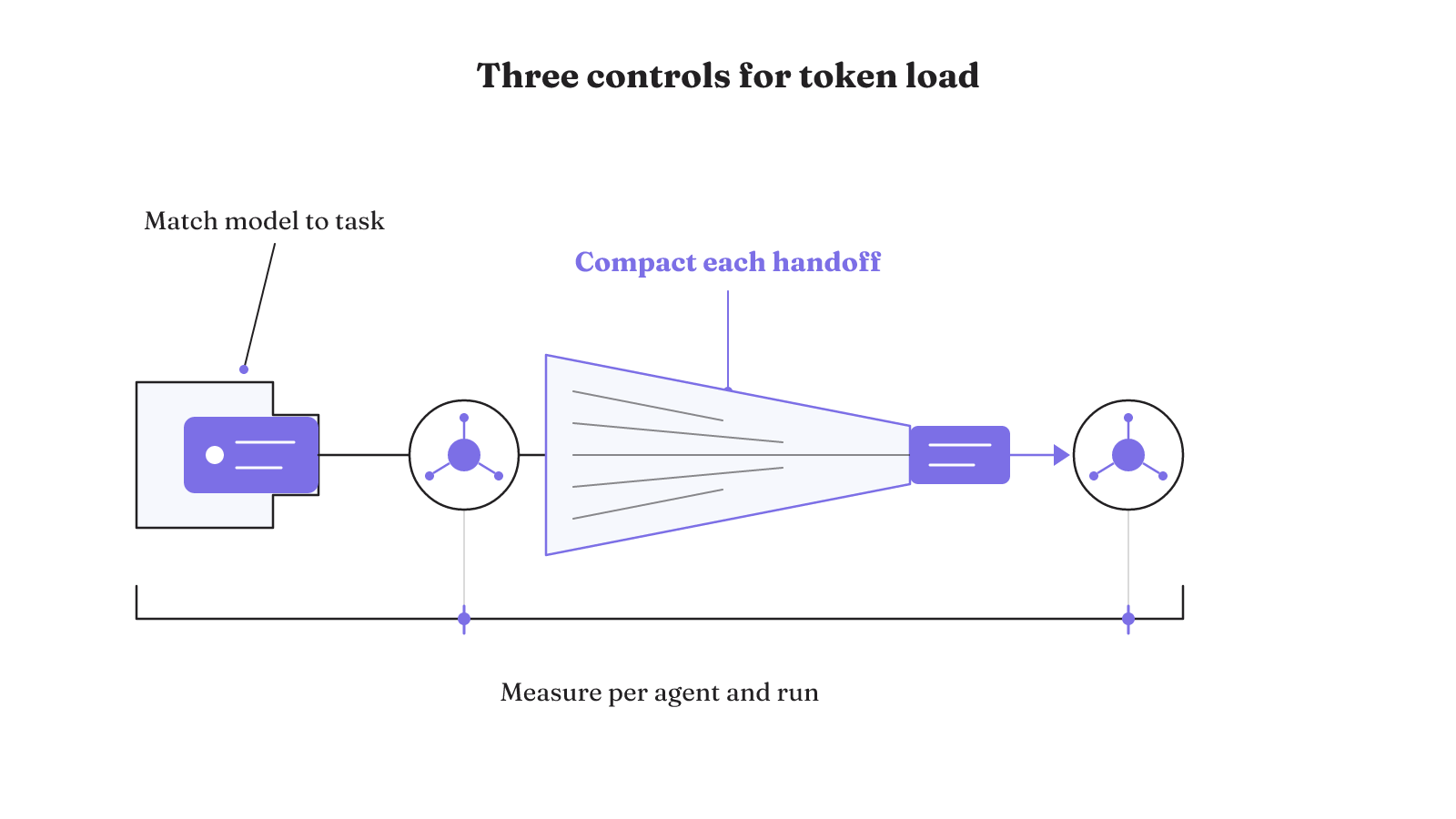
Multi-agent orchestration multiplies model invocations. Each agent consumes tokens for instructions, context, reasoning, and tool interactions. The first useful measurement is therefore token consumption per agent and per orchestration run. That reveals which agents and patterns are candidates for cost optimization.
Three controls can reduce avoidable load:
- Match model capability to task complexity. Classification, extraction, and formatting can often use smaller, less expensive models without reducing overall quality.
- Measure at agent and run level. Per-agent token monitoring shows where the orchestration spends its budget.
- Compact context between agents. Pass less token volume across handoffs instead of carrying every prior detail forward.
Context compaction is not merely a cost setting. Context engineering curates the information entering a model's limited attention budget at each step. Its goal is the smallest high-signal token set that maximizes the likelihood of the desired outcome. That context-engineering discipline turns a vague handoff into a concrete state-design question: what does this receiver actually need now?
The answer can differ by role. A router needs enough current state to select a receiver or branch. A worker needs the instructions, context, and tool access for its bounded task. A critic needs the output and the criteria used to judge it. Treating every handoff as a full transcript ignores those role boundaries and increases the token volume passed through the orchestration. Compaction gives each receiver a smaller payload, while per-agent monitoring shows whether that payload is actually reducing consumption.
The cost review should follow the same execution trace as the control review. Measure manager iterations, worker calls, parallel spikes, and handoff payloads where they occur. Then compare the added cost with the isolation, clarity, or legibility the specialist was supposed to provide.
A plan patch needs a safe commit point
Repairable orchestration becomes concrete when a system can change the remaining plan without corrupting work already in motion. Open Multi-Agent's adaptive recovery provides one scoped example. It validates plan patches against agent eligibility, limits, task states, references, and the resulting task graph. An optional approval gate can sit after validation.
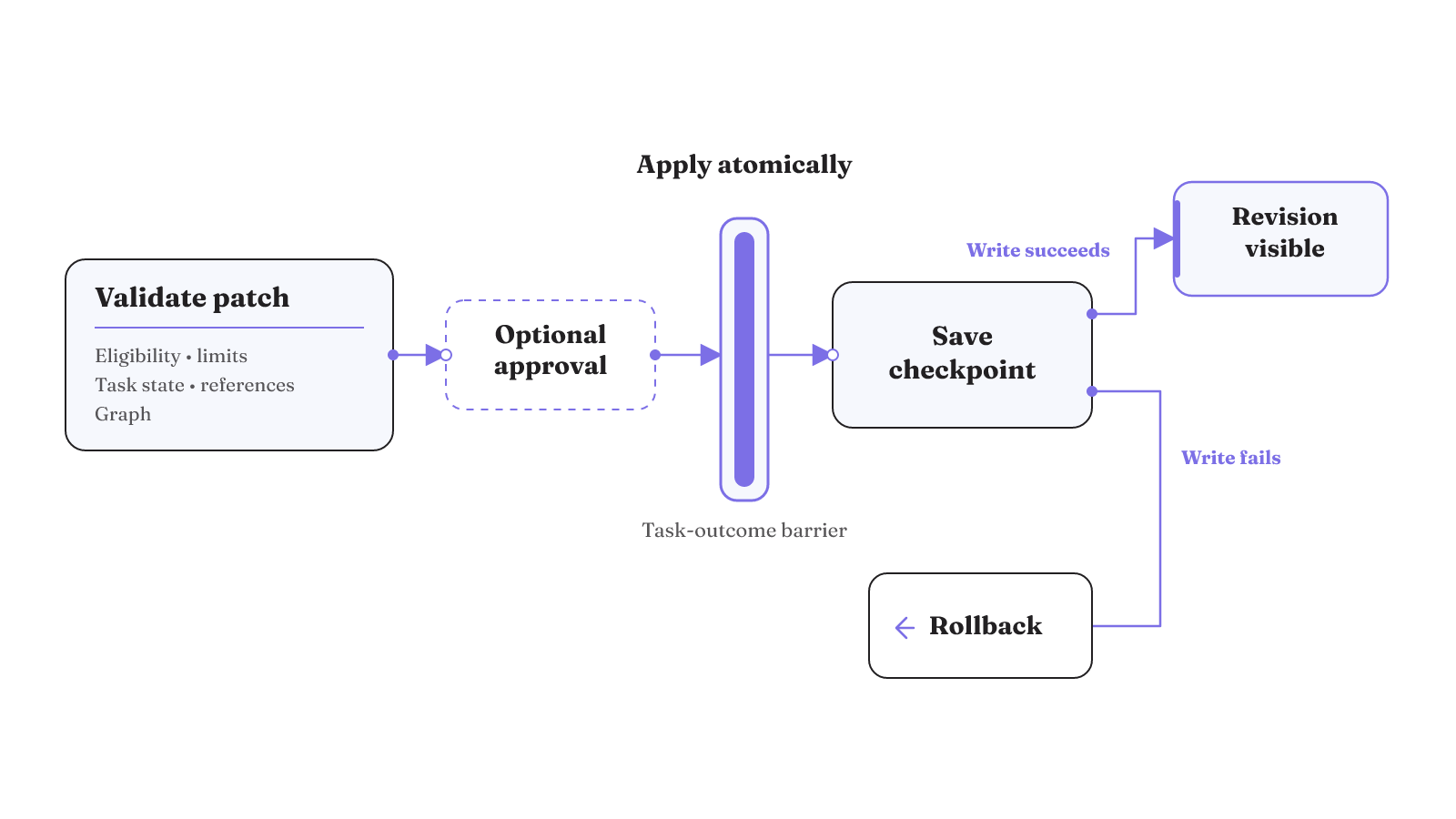
The patch is then applied atomically at a task-outcome barrier, before downstream dispatch or failure cascade. That barrier is the commit point. It prevents the new plan from becoming partly active while downstream work is already being sent under the old one.
The implementation also exposes revision history through results, progress events, and observability spans. Checkpoints persist that history, and the system rolls back when a checkpoint write fails. These documented adaptive-recovery mechanics join validation, approval, atomic application, observability, persistence, and rollback into one repair path.
Each mechanism protects a different boundary. Eligibility, limits, task states, references, and the resulting graph are checked before the patch can alter execution. The optional approval gate creates a place for human authority. Atomic application keeps old and new plans from being committed in pieces. Results, events, and spans make revisions legible after the fact. Checkpoint persistence gives the revision durable state, while rollback covers a failed checkpoint write.
This example should not be treated as a standard shared by every tool. For this Open Multi-Agent implementation, the review checklist is scoped to its documented mechanics: what may change, what validates the change, where optional approval sits, when the patch commits, how the revision is observed, and what happens if persistence fails. That checklist describes this implementation's recovery boundary, not a universal requirement for repairable orchestration.
Reliable systems need operations, not more pattern names
Reliable agents pair capable models with well-defined tools and clear, structured instructions. At multi-agent scale, that foundation expands into comprehensive testing, detailed prompt and tool design, robust operations, and collaboration among teams that understand current agent capabilities. The engineering account of a multi-agent research system is direct about that operating burden.
These requirements do not disappear when the pattern looks simple on paper. A sequential workflow still needs dependable tools and instructions at each step. A router still needs tested branches and visible decisions. A graph still needs correct dependencies and state movement. A repairable design adds validation, commit, checkpoint, and rollback behavior. The diagram can summarize the path, but operations have to keep that path working.
At Rifty, we treat the whole harness as the durable unit: model, tools, instructions, task graph, state, authority, evaluation, observability, and recovery. Framework selection cannot remove those responsibilities. It can only give them a particular implementation surface.
This is also where the decision to add a specialist is tested over time. The new role should continue to provide the isolation, clarity, or trace legibility that justified it.
Apply the control-first matrix to one real workflow before adding another agent. Write down the task dependencies, next-action owner, state transfer, authority boundary, verification gate, token pressure, and likely recovery path. If the proposed specialist does not buy capability isolation, policy isolation, prompt clarity, or trace legibility, keep the design simpler. If it does, make the new boundary inspectable and test its failure path. Our multi-agent orchestration architecture guide can help you carry that workload contract into the wider harness design.