Key takeaways
- An autonomous agent observes, decides, and acts toward a goal. A multi-agent system coordinates several such agents.
- Start with one agent for well-defined, sequential work. More agents do not make an architecture more mature.
- Add specialists when independent work, parallel execution, tool or context breadth, checkpoints, or clearer isolation justify the extra operating burden.
Our working rule is simple: agent count is a topology decision. It changes where context lives, how permissions are divided, what must be monitored, and how failures are recovered. The useful question is not whether several agents look more capable. It is whether the workload earns another boundary.
What are autonomous agents and multi-agent systems?
An autonomous agent is a software system that perceives its environment, processes information, and acts toward a specific goal. Its defining boundary is conditional action. A standard automation script follows the same steps regardless of conditions. An agent selects an action based on what it observes.
A multi-agent system brings several autonomous agents into one framework. Those agents collaborate, coordinate, and sometimes compete to achieve complex goals. Each can perceive its environment, make decisions, and interact with the others.
That distinction is architectural. One agent can still perform a long sequence of work. Several agents create several decision-making actors and the interactions between them. The count does not tell you whether the system is reliable, safe, or well designed. It tells you how agency has been divided.
This boundary matters before you choose tools or frameworks. First decide whether the workload calls for adaptive action at all. Then decide whether one adaptive actor can carry the work cleanly or whether separate agents need to own distinct parts.
Autonomy means acting through tools and ambiguity
Autonomy becomes concrete when an agent can reason through ambiguity, act across tools, and handle multi-step tasks. The agent is not merely producing an answer. It is choosing actions along an execution path.
That pattern fits work involving complex decisions, unstructured data, or rule-based systems that have become brittle. A single agent can inspect what it has, select a tool, observe the result, and continue through several steps. None of this requires a second agent.
The model alone does not make the system reliable. Reliable agents depend on three parts working together: a capable model, well-defined tools, and clear, structured instructions. The tool boundary determines what the agent can do. The instructions shape how it approaches the work.
Agent architectures should start with a single agent and evolve to multiple agents only when needed. A small context, a few tools, and simple automation favor that baseline. Independent work, parallel branches, and specialized tools are signals that a multi-agent design deserves consideration.
What are examples of autonomous agents and multi-agent systems?
The examples span physical and digital work. Multi-agent applications include drone swarms, trading bots, warehouse automation, reinforcement-learning simulations, content agents, and research assistants. These examples do not share one universal architecture. They show the range of work in which several autonomous actors can interact.
Taxonomies for individual agents vary. One published taxonomy uses self-driving cars as an example of learning agents, while robotics and virtual agents illustrate hybrid agents. The useful point is not the label count. It is that autonomy can appear in one acting system before any multi-agent coordination is introduced.
Coding work offers a more inspectable orchestration example. Symphony is an agent orchestrator that turns a project-management board such as Linear into a control plane for coding agents. The board provides a place from which work can be directed across those agents.
Examples help only when their role boundaries remain visible. A warehouse automation system, research workflow, and coding orchestrator may all contain several agents, but the architecture decision still depends on the work each agent owns and the coordination their interaction requires.
When should you use one agent or a multi-agent system?
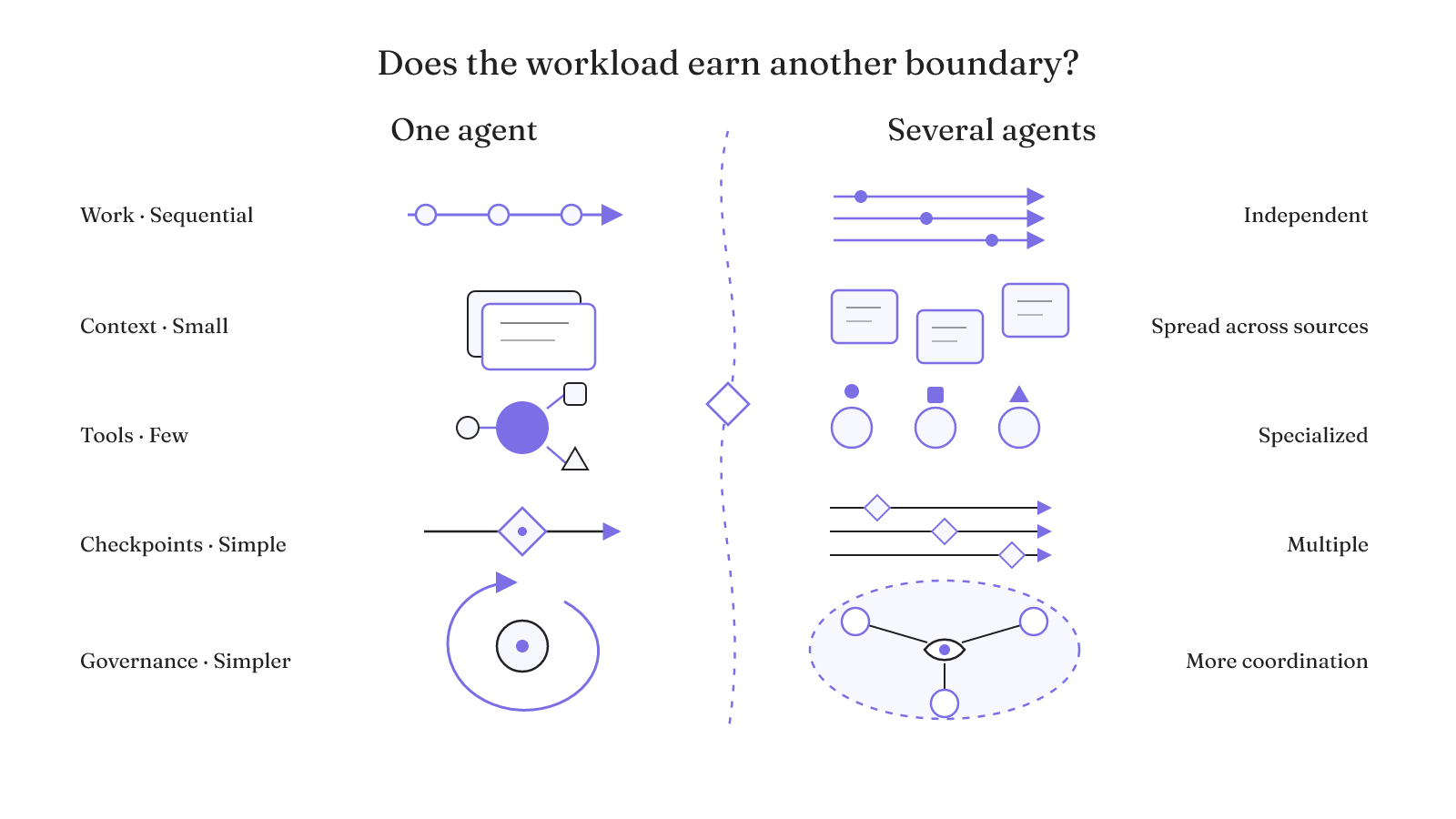
Start with one agent and evolve to multiple agents only when needed. Use the Multi-Agent Justification Test before drawing the orchestration diagram.
| Decision area | One-agent signal | Multi-agent signal |
|---|---|---|
| Work coupling | Work is sequential or needs tight back-and-forth through tool calls | Work can be divided into independent or parallel parts |
| Context breadth | Context is small enough for one working set | Context is large and spread across sources |
| Tool breadth | The agent needs only a few tools | Specialized work needs several tools |
| Checkpoints and failure impact | The automation is simple | The work has multiple decision checkpoints or high failure impact |
| Specialist boundary | One prompt and policy boundary remain clear | Another agent materially improves capability isolation, policy isolation, prompt clarity, or trace legibility |
| Operating consequences | Governance is simpler for a well-defined sequence | The split changes governance, cost control, coordination design, and production risk |
Architecture patterns follow the workload
Once several agents are justified, topology still has to follow the work. Multi-agent systems can use centralized, decentralized, hierarchical, or swarm-based architectures. Those families describe how decisions and interactions are arranged. They do not rank the systems by maturity. A fuller single-agent and multi-agent architecture comparison can help you examine the proposed split before selecting one of these families.
A workload matrix offers more specific mappings. Subagent and router patterns fit parallel execution and large-context domains. Skills and handoffs fit single and repeat requests in that matrix. These mappings are useful as workload patterns, not as a universal framework ranking.
The architecture name should come after the operating question. If the work needs parallel branches, the design must account for how those branches are started, observed, and joined. If a repeated request can be handled through a skill or handoff, a larger mesh of agents does not follow automatically.
The selected topology now creates a control problem. Every added decision-maker needs a way to exchange information, a bounded role, and an observable place in the execution path.
Coordination needs an explicit control layer
Coordination is an engineering surface, not a side effect of putting several agents in the same workflow. Agents may exchange information through direct messages, shared-memory stores, queues, formal communication languages, or structured natural-language prompts.
Direct messaging provides an explicit path between agents. A shared-memory store gives several agents a common communication surface. A queue provides another path for exchanged information. Formal Agent Communication Languages and structured natural-language prompts provide two more ways to carry those interactions. The selected mechanism should appear in the architecture as a named communication protocol, because multi-agent deployments require explicit protocols as well as explicit roles.
Agent orchestration is the control layer that coordinates multiple agents so their work can proceed safely and predictably at scale. That layer needs explicit role boundaries, communication protocols, continuous monitoring, and built-in oversight. The role boundary says which agent owns a responsibility. The protocol names how information crosses the boundary. Monitoring observes the deployment, and oversight supplies a place for control.
Domain specialization can narrow the system by assigning each agent limited, role-specific responsibilities. A bounded specialist has a defined part of the work. The message path then carries information across that boundary. Monitoring observes the interaction, while oversight provides a control surface around it.
This view changes the design conversation. “Research agent” and “writer agent” are labels. The architecture lives in the details: which message path they use, what each role may do, what the monitor observes, and where oversight can intervene. If those details are missing, the diagram names several actors without specifying their coordination.
Our guide to multi-agent orchestration architecture goes deeper into that control layer. Before adopting a topology, write down the role boundary and communication path for every agent. That small exercise makes the real coordination surface legible.
State, token use, and testing become design constraints
Decomposition adds operating costs that are easy to miss in a prototype. Conversation state can contain tool results that refer to ephemeral resources. Those references can remain in the saved state even when the resource is not available in the same form. That makes perfect checkpoint resumption difficult. A checkpoint can preserve the conversation and still lack what is needed to resume the earlier execution exactly.
Checkpoint design therefore has to account for both the stored conversation and the resources named inside it. The relevant question is not only whether state was saved. It is whether execution can resume when some tool results point to ephemeral resources.
Multi-agent workflows also consume more tokens than a single agent call. Monitor token use for the actual design, alongside its execution caps and retry limits.
Testing becomes harder for a separate reason. Multi-agent interactions are non-deterministic and difficult to test reliably. Record the interaction as part of the test, along with the resulting response. This gives the event log a full trace while the agent's working set stays focused on inference.
Keep the audit record separate from the agent's active context. Full traces belong in an event log, while the working set should carry only what the agent needs for inference. The full trace and the inference context have different jobs. The event log holds the trace. The working set carries the smaller set of information needed for the agent's current inference.
Together, these constraints define a practical coordination budget. Account for resumable state, token use, test coverage across non-deterministic interactions, and trace storage as part of the proposed architecture.
How should autonomous agents control consequential actions?
Consequential actions need controls at the point where authority is exercised. Production guardrails can operate at input filtering, tool use, and human-intervention stages. Input filtering applies a control as material enters the system. A tool-use guardrail applies when the agent acts through a tool. Human intervention creates a separate control surface where execution can return to a person.
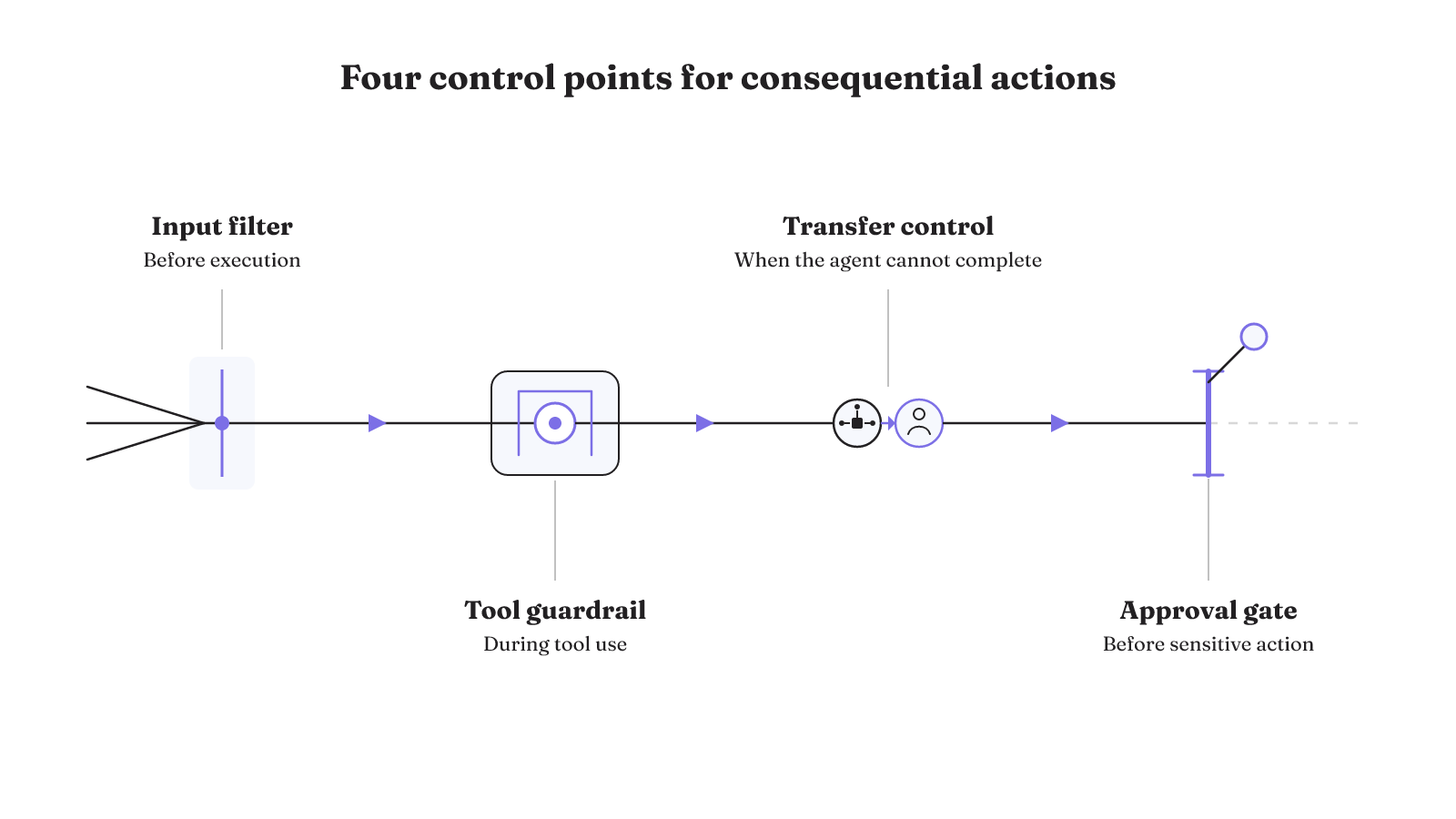
These stages place controls around different parts of the execution path. Input filtering, tool-use guardrails, and human intervention each remain a named control surface.
A human-intervention mechanism lets an agent transfer control when it cannot complete a task. That transfer gives the person control of a task the agent could not finish. For irreversible or sensitive actions, a high-risk action gate can pause execution until a reviewer explicitly approves the next step. The pause keeps the pending action at the approval boundary until the reviewer decides whether it proceeds.
The orchestrator also needs hard operating limits. It should set execution caps and retry limits, monitor token use, and alert a human when costs exceed a threshold. An execution cap limits how far the run can continue. A retry limit bounds repeated attempts. Token monitoring exposes use during execution, while the threshold defines when the alert goes to a person.
A useful control review therefore covers four concrete questions:
- What input filtering applies before execution?
- What guardrails apply when an agent uses a tool?
- When can the agent transfer control because it cannot complete the task?
- Which irreversible or sensitive actions pause for explicit approval?
This review is about authority, not agent count. A single agent can require a high-risk gate. A multi-agent system adds more boundaries where control and oversight must remain explicit.
Recovery must account for the whole agent state
Recovery is where coordination debt becomes visible. Errors can compound in agentic systems. A failure at one step can send later execution onto different trajectories and produce unpredictable outcomes. In a multi-agent design, the effect may extend beyond the agent that encountered the failure.
Multi-agent recovery must detect, contain, and recover from failures while accounting for interdependencies and collective state across agents. Detection identifies the failure within the running system. Containment addresses the failure before recovery proceeds. Recovery then has to account for dependencies between agents and the state held across them.
That collective scope matters because the agents interact. A failure can change the later trajectory, and connected agents may already hold state from the affected execution. Recovery covers more than the first failed step. It covers the interdependent work and collective state involved in the changed trajectory.
That is a higher bar than retrying one failed call. The recovery design must match the topology that created the failure surface. Apply a coordination budget to your proposed multi-agent design, then test a failure at a real handoff or checkpoint. If you cannot identify the shared state, containment boundary, and approval point, return to the orchestration architecture guide and make those controls explicit before adding more agents.