Key takeaways
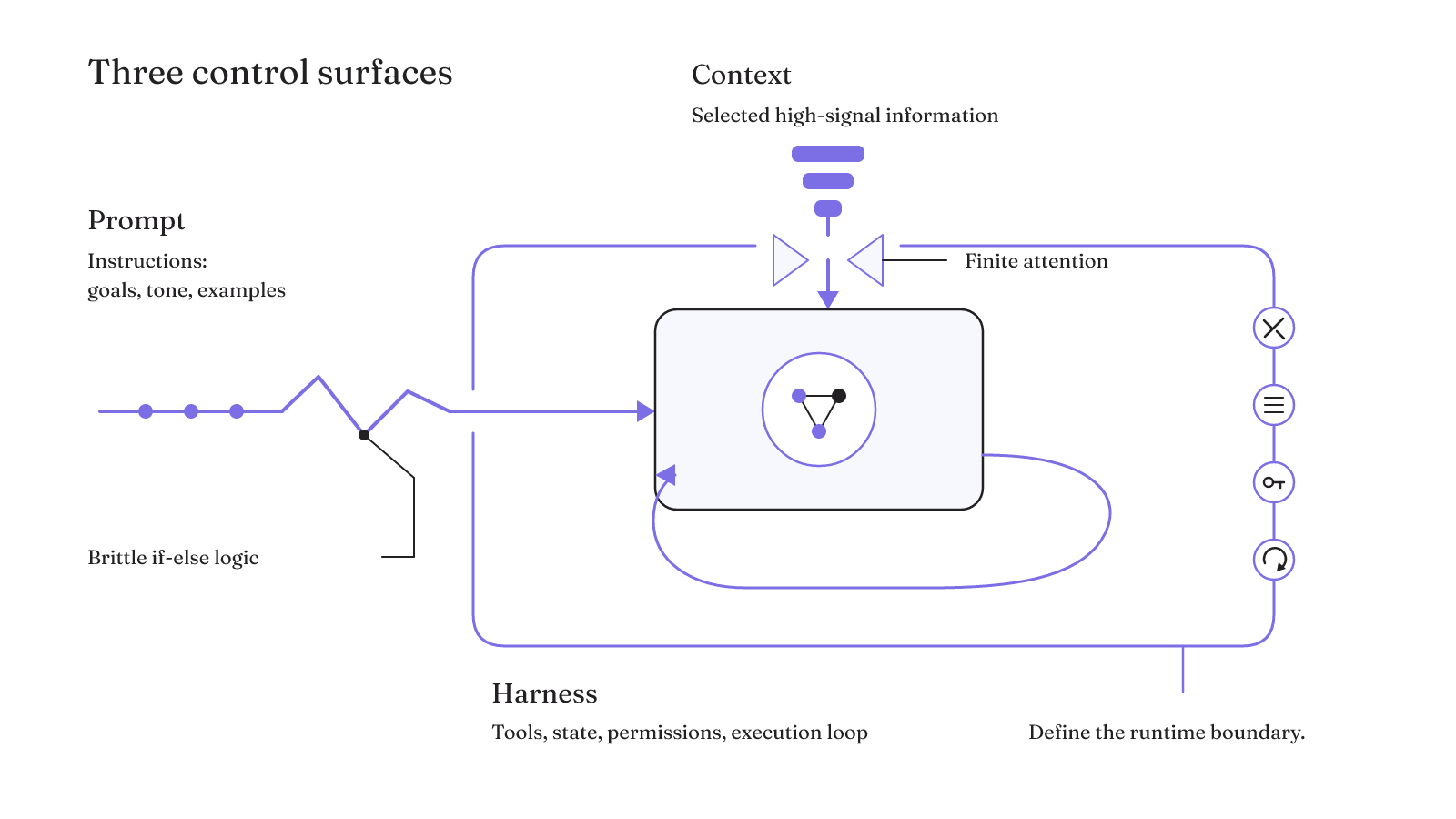
Prompt engineering shapes the model's instructions, including its goals, tone, and examples. Context engineering curates the information entering the model's limited attention. Harness engineering controls the runtime around the model, including tools, state, permissions, context, and the execution loop.
The distinction matters most when an agent fails. A weak answer might reflect unclear instructions, missing information, or a runtime decision that the prompt could never enforce. The output alone does not identify which one happened. You need to inspect the surface that could have produced the failure.
Prompt engineering vs context engineering vs harness engineering at a glance
A useful boundary is what each discipline can directly change. It is not a maturity ladder, and the labels can overlap in practice. Use the narrowest scope that matches the control you need.
| Engineering scope | What changes | Concrete controls | Practical limitation |
|---|---|---|---|
| Prompt engineering | Model instructions | Tone, goals, examples, message roles | Hardcoded if-else logic makes prompts brittle and hard to maintain. |
| Context engineering | Information available at a step | The information entering the model's limited attention | Context is finite, so selection matters. |
| Harness engineering | Runtime and control layer | Tools, context, state, permissions, execution loop | "Harness" can mean everything except the model, so define the relevant agent category and runtime boundary. |
Is context engineering better than prompt engineering?
No. They change different inputs to model behavior. Prompt engineering tells the model how to act. Context engineering decides what information the model can attend to while it acts. A system may need either change, or both, but one label does not outrank the other.
Prompt work is the right place to look when the desired behavior is unclear. Instructions can set goals, tone, and examples of correct responses. They can also carry different levels of authority through the instructions parameter or message roles. That makes prompt structure part of the control surface, not just wording polish.
Good instructions need the right altitude. Vague guidance leaves the model without concrete signals, while instructions should still leave room for model reasoning. One practical structure separates background, behavioral instructions, tool guidance, and output format. If an agent writes an unhelpful answer because "be accurate and concise" gives it too little direction, clearer instructions and examples address the missing behavioral signal.
Those sections also make the kind of instruction explicit. Background and goals establish the task. Tool guidance tells the model how it should work with available tools. Output-format guidance defines the requested shape of the response. This structure can clarify the model's directions without turning the prompt into a large set of hardcoded branches.
Context work begins with a different failure. Suppose the instructions are clear, but the agent receives a long transcript that omits the one identifier needed for the task. Rewriting the tone or output format does not restore that information. Context engineering aims for the smallest set of high-signal tokens that gives the model the best chance of producing the desired result.
Now change the example. The transcript contains the identifier, but it arrives with a large amount of unrelated material. The context problem is selection: the model's attention is finite, and the useful input is not simply the largest input. The context engineer's target is a smaller, higher-signal set for that step.
That means the practical question is not which discipline sounds more advanced. Ask what is absent. If the model lacks a concrete signal for the desired response, inspect the instructions. If the necessary fact is missing, buried, or displaced by low-signal material, inspect context selection. Our context engineering reference develops that attention-budget view in more detail.
What does harness engineering control beyond context?
Harness engineering controls the model's execution environment, not only what appears in its prompt. In a hosted agent, external systems govern execution, state, permission, observability, and verification. Those systems decide what the model can do and what happens around each model call.
Permissions show the boundary clearly. A prompt can tell an agent to seek approval before a sensitive action. The enforceable control belongs outside voluntary model compliance. Sensitive actions should pass through deterministic permissions, hooks, or approval mechanisms. The model can propose the action, but the harness can prevent execution until the required condition is satisfied.
Risk classification can also live outside caller-controlled text. A trusted tool registry can own engineering-controlled risk metadata, and the system can evaluate that metadata before it evaluates arguments supplied by a caller. In that design, changing an argument does not change the tool's trusted risk class. The permission decision has an authority source that the request itself does not control.
Picture the control path for one tool request. The model proposes a tool call with caller-controlled arguments. Before those arguments determine how the request proceeds, the runtime checks trusted risk metadata from the registry. A sensitive classification can route the action through deterministic permission, hook, or approval controls. The enforcement does not depend on the model remembering and obeying a sentence in its prompt.
This is why context and harness engineering are related but not interchangeable. Context is one thing the runtime manages. The harness also manages tools, state, permissions, and the loop that advances or stops execution. For hosted agents, that wider control layer can include observability and verification as well.
State and execution also remain runtime concerns when the text sent to the model stays unchanged. External systems govern whether work continues, what state survives, which permission applies, and what can be observed or verified. Those controls define the environment in which the model acts.
The harness engineering definition is useful when you need a stable term for this runtime scope. The broader agent harness guide goes further into the architecture around the model.
How do you diagnose the control surface behind a failed run?
Start with the sequence of decisions and actions, not just the final response. The same poor result could follow a task misunderstanding, the wrong tool being exposed, omitted context, incomplete instructions sent to a subagent, bad stopping behavior, a retry, or an approval decision. The answer by itself cannot tell those paths apart.
Imagine an agent returns an incomplete report. Its final text shows what was produced, but not why. The action sequence can show which tools were available and which one the agent selected. It can show what context was present at that point, whether the agent stopped before another required action, and whether an approval state prevented execution. Those are separate diagnostic observations, even though they end in the same visible result.
Compare four runs with that same incomplete report. In one, the required tool was never exposed. In another, the tool was available but the necessary context was omitted. A third run had both but stopped too early. A fourth reached a sensitive action and paused for approval. The output may look equally incomplete, while the recorded sequence identifies a different control surface in each run.
Tracing records what the harness did. A useful trace preserves enough of the trajectory to inspect decisions and actions instead of reconstructing them from the output. Once that record exists, evaluations can determine whether harness behavior was correct, safe, and efficient.
The two functions work together. A trace without an evaluation tells you what happened but does not supply the test of acceptable behavior. An evaluation without the trajectory can score the result while missing how the system reached it. Tracing and evaluation together make failures diagnosable and improvements repeatable.
Correctness, safety, and efficiency can each be part of the evaluation of harness behavior. The trace supplies the behavior to inspect. The evaluation supplies the criteria applied to that behavior. Keeping both lets a later run be assessed against the same kind of record instead of relying on an impression of the final prose.
That diagnosis points back to the appropriate surface. Task misunderstanding or incomplete subagent instructions may lead you to the prompt. Omitted information points to context assembly. Tool exposure, stopping, retries, and approval behavior belong to the runtime record. This is a diagnostic starting point, not a universal failure taxonomy.
How should an agent resume after a pause or failure?
An expected approval pause is not the same as a runtime or validation failure. When an agent pauses for human approval, execution should resume from the same state, not begin as a new turn. The pending action and its surrounding state remain part of the run.
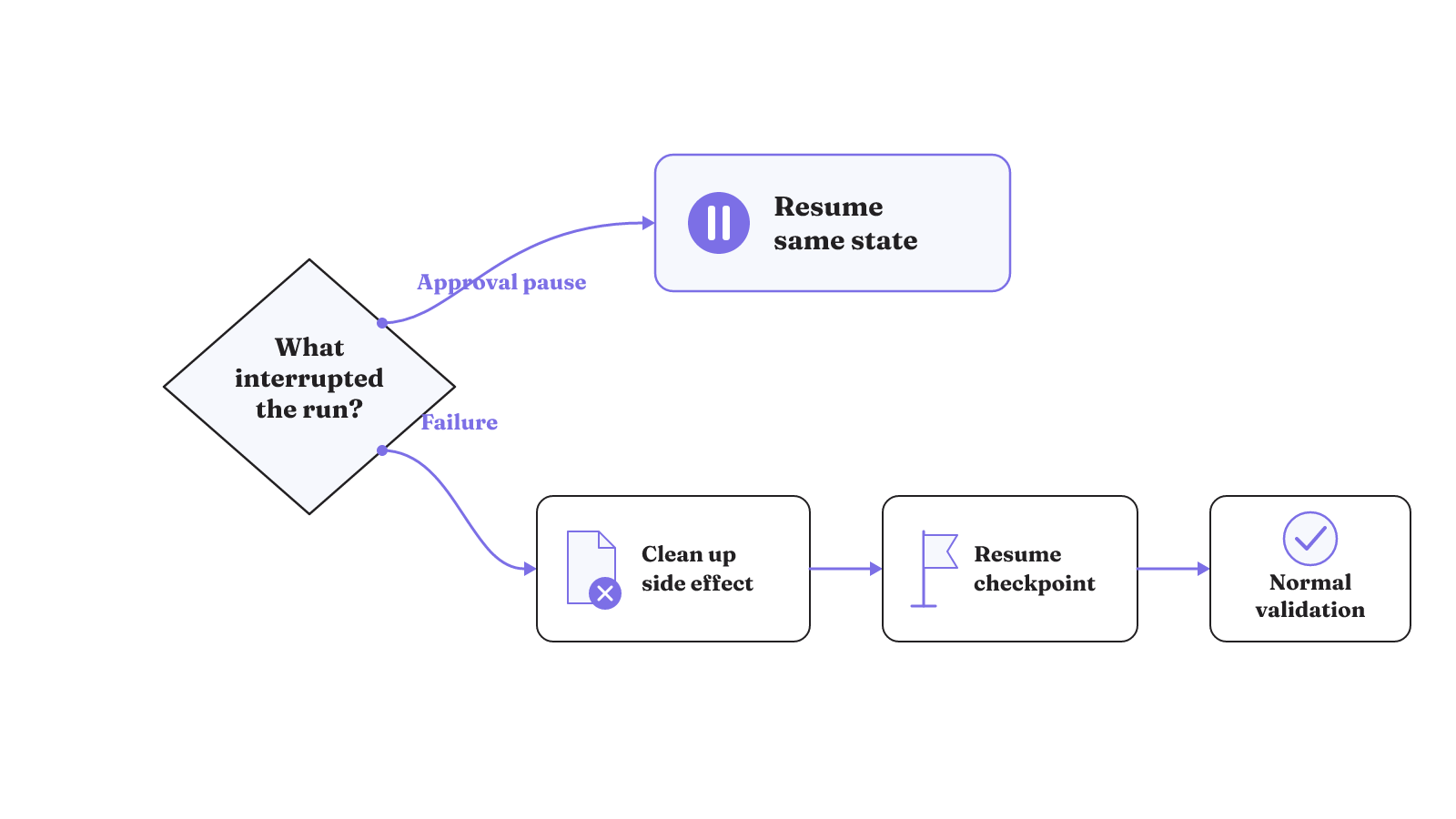
Failures need recovery controls. Checkpoint-based recovery saves state at successful stages so a workflow can resume from its last checkpoint instead of starting over. A checkpoint gives the runtime a known position from which to continue after the failure has been handled.
Consider a workflow in which one agent creates a file and a later agent fails. A compensating action can remove the created file before the system retries. The workflow can then resume from a saved successful stage. This keeps the retry from inheriting that earlier side effect while preserving work captured by the checkpoint.
The order is concrete. A successful stage saves a checkpoint. A later step creates the file, then the following agent fails. The compensating action cleans up the file. Execution resumes from the saved checkpoint, and the recovered output proceeds to the normal validation. Each control has one runtime job: preserve progress, clean up the side effect, resume, and test the result.
Recovery does not lower the quality bar. Recovered output should face the same criteria and standards as a successful run. Otherwise the recovery path becomes a quieter route around the normal checks.
These controls answer different runtime events. Approval preserves and later resumes an expected state. A checkpoint preserves completed progress across a failure. A compensating action cleans up a prior side effect before retry. Validation tests the recovered result. Clear event handling makes the run legible without pretending every interruption is the same kind of problem.
The distinction changes the recovery path. An expected approval pause carries the same state forward when approval arrives. A failure can return execution to the last successful checkpoint after any required cleanup. In both cases, the system retains an explicit place from which execution continues.
Evaluate outputs and trajectories
Output evaluation and trajectory evaluation answer different questions. An agent response can be scored by an LLM judge using flexible criteria. Trajectory evaluation examines tool use and action sequences with scoring functions. The first assesses what the agent returned. The second assesses what the agent did along the way.
That distinction matters when a good-looking answer follows a questionable path, or when a poor answer hides an otherwise useful sequence. A response score cannot stand in for a tool-use record. A trajectory score does not replace judgment of the final response. Agent evaluation can inspect both outputs and action sequences, with criteria suited to each object.
Context changes also need their own test. Transcript replay can compare next-turn accuracy with and without context trimming. The comparison can use exact entity or identifier matching for details that should survive, alongside a reasoning rubric for answers that cannot be judged by exact text alone. This turns context trimming into a measured change instead of a guess about what the model probably needs.
A replay test can run the same next turn in two conditions: one with the original context and one with trimmed context. Exact entity or identifier matching checks whether specific details remain correct. A rubric-based reasoning score assesses the quality of reasoning. Together, those measures compare what trimming changes without treating every answer as an exact-string task.
Memory systems benefit from the same posture. They improve through measured iteration, not upfront complexity. Begin with a behavior you can observe, then compare what happens when memory or trimming changes. The evidence may support keeping a detail, removing it, or changing how it is selected.
Measured iteration also puts complexity after an observable need. A memory change can be tested through replay, and its effect can be compared with the earlier condition. That creates a specific basis for another change to memory or context selection.
Our agent evaluation reference connects these views. For a failing system, the practical split is simple: score the answer for the result, inspect the trajectory for tool use and actions, and replay context changes against measures that fit the information you need to preserve.
Start with clear instructions and well-defined tools
The best implementation sequence starts with the foundations that each control surface actually owns. Reliable agents pair capable models with clear, structured instructions and well-defined tools. That gives you an instruction surface you can inspect and a tool surface whose purpose is explicit.
Begin with one agent. Orchestration should match the system's complexity, moving to multiple agents only when the work requires it. Adding more agents also adds more instruction handoffs and action sequences to inspect. The case for that added structure should come from the system's needs.
Deployment can also begin at a small scope, validate with real users, and expand capabilities over time. This creates an opportunity to observe actual runs before the system carries a wider set of actions. The resulting traces and evaluations can show whether the problem sits in instructions, selected information, or runtime behavior.
That sequence keeps the implementation tied to observed use. Start with a limited capability, validate it with real users, and add capabilities over time. When more complexity is needed, you can decide whether it belongs inside one agent or requires multiple agents. The orchestration choice follows the system's complexity.
Guardrails should cover the surfaces where control is needed. They can span input filtering, tool use, and human intervention. A filter at the input surface serves a different function from a permission around a tool or an approval pause inside a run. Give each control a clear enforcement point.
Clear instructions do not replace those guardrails. Tool guardrails operate at tool use, while human intervention operates as part of the run's control path. Input filtering has its own surface. Treating them as runtime controls keeps enforcement attached to the action or intervention they govern.
From there, change the smallest surface that can address the observed problem. Clarify instructions when behavior lacks concrete direction. Tune context when high-signal information is missing or crowded out. Change the harness when the problem involves execution, state, permissions, observability, recovery, or the loop itself.
If runtime control is the part you need to design, read our agent harness guide. Use it to inspect the controls around your model, then choose one failure trace and identify the first enforceable surface you would change.