Key takeaways
- Traditional RAG handles basic retrieval and generation.
- Agentic RAG can loop, select tools, and refine queries.
- Broader agents can reason through ambiguity and act across tools.
- Add multi-step agency only when simpler systems fall short.
The useful distinction in RAG vs agentic AI is not which label sounds more advanced. It is what responsibility you are putting into the system. RAG introduces relevant data to a language model. Agentic RAG embeds autonomous agents inside that retrieval pipeline. Broader agentic AI can take multi-step action across tools.
The LLM vs RAG vs agentic AI comparison looks at the system around the model. A "RAG AI agent" means an agentic RAG system here: autonomous agents are embedded in the retrieval pipeline. Our retrieval-augmented generation definition covers the underlying retrieval concept, while the comparison below stays with the architecture decision.
RAG vs agentic AI at a glance
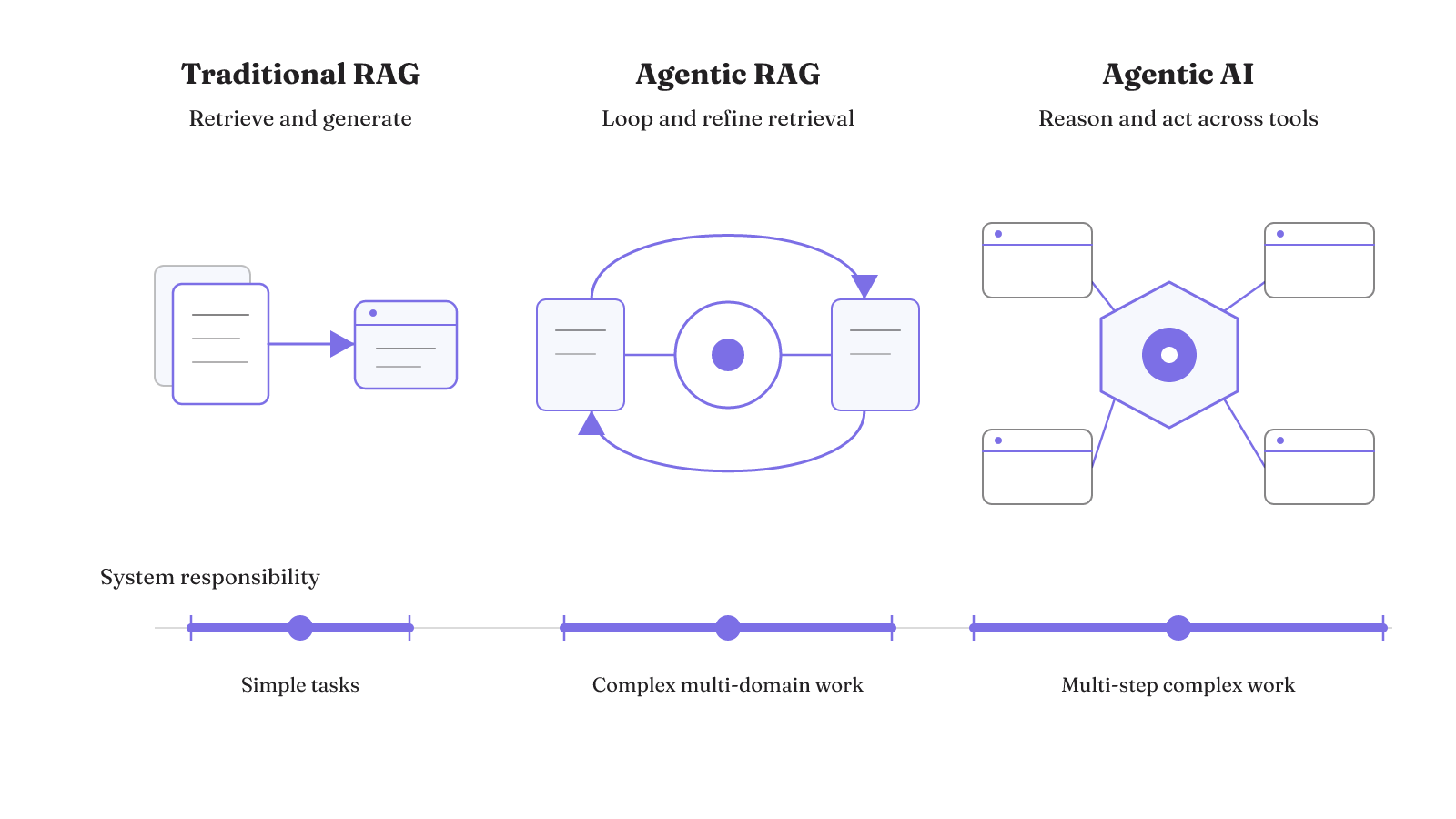
Traditional RAG, agentic RAG, and broader agentic AI solve different kinds of work. The architecture changes first at retrieval, then at action authority.
| Architecture | Core behavior | Suitable workload | Resulting system responsibility |
|---|---|---|---|
| Traditional RAG | Basic retrieval and generation | Simpler tasks that need basic retrieval and generation | Retrieve relevant material and generate from it |
| Agentic RAG | Embeds autonomous agents in the RAG pipeline | Complex, multi-domain tasks that need collaborative reasoning | Run autonomous retrieval behavior and collaboration |
| Broader agentic AI | Reasons through ambiguity and acts across tools | Multi-step work with complex decisions, unstructured data, or brittle rules | Carry multi-step work across tools with a high degree of autonomy |
How is RAG used in agentic AI?
RAG is used inside agentic AI when retrieval becomes part of a loop instead of a single fixed pass. An agentic RAG workflow can select tools, refine queries, and loop until it reaches a high-quality result. Retrieval still supplies information to the model, but an autonomous agent now changes how that retrieval work runs.
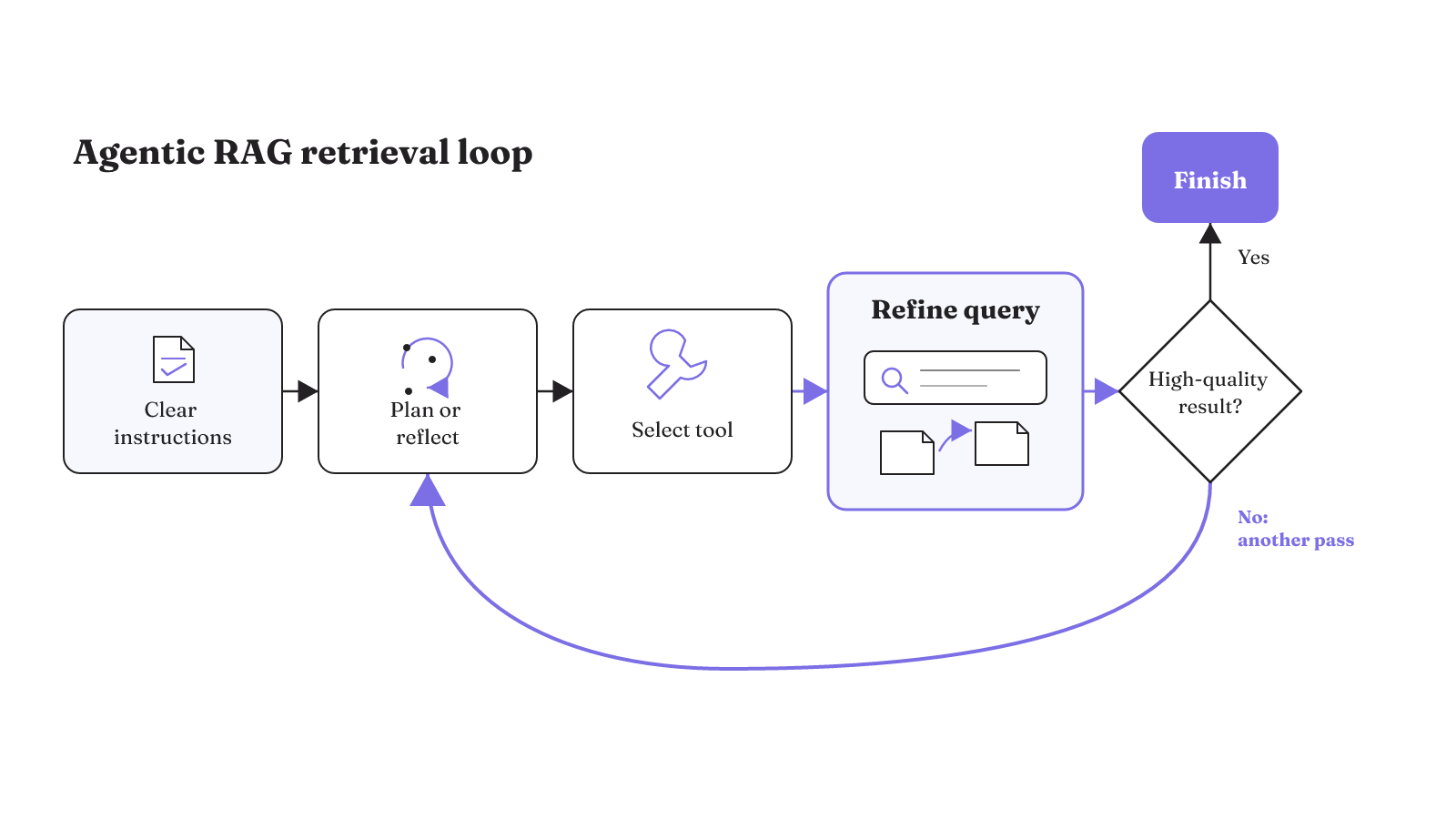
The agentic RAG architecture can use four broad patterns: reflection, planning, tool use, and multi-agent collaboration. A compact walkthrough looks like this:
- Clear instructions define the work. Those instructions reduce ambiguity, improve decision-making, and reduce workflow errors.
- The agent can plan its approach or reflect on what it has so far.
- It can select a tool and refine the query used to retrieve information.
- It can make another pass through the loop until it reaches a high-quality result.
That loop does not require one universal architecture. Documented agentic RAG architectures include single-agent, multi-agent, hierarchical, corrective, adaptive, and graph-based systems. The taxonomy matters because "agentic" does not tell you whether one agent is adapting retrieval, several agents are collaborating, or a graph is shaping the work.
The four patterns and the architecture families answer different design questions. Reflection and planning are behaviors the system can use. Tool use and multi-agent collaboration describe other ways it can carry out the work. Single-agent, multi-agent, hierarchical, corrective, adaptive, and graph-based systems describe architecture forms in which those patterns can appear. The label "agentic RAG" alone does not select one of them.
A graph-based workflow provides a scoped agentic RAG example. Graph-based agentic RAG can support scenario-based modeling for risk analysis. In that example, the graph-based architecture and scenario modeling are the supported mechanism and use. It is not a measured verdict that graph-based retrieval is the right design for every risk workload.
If the loop itself is unfamiliar, our agent loop definition isolates that mechanism without collapsing it into the wider category of agency.
Is RAG still relevant?
Yes. RAG remains relevant when the job is to bring organization-specific or domain-specific data into a language model. It is a more cost-effective approach than retraining a foundation model to introduce that data.
That makes traditional RAG a valid architecture for simpler retrieval and generation tasks, not merely a temporary stage on the way to an agent. If retrieval answers the workload, adding autonomous planning or action does not change the underlying need for relevant information. It changes the machinery around that need.
One product-specific document workflow makes the retrieval role concrete. For text documents, ChatGPT Enterprise places relevant text beside the prompt and uses a search system to access additional information. Its text-document search works well for specific questions, but it can struggle with summarizing very large documents or comparing multiple large files.
The example is narrow but useful. A system can use retrieval for a specific question without becoming a broad action-taking agent. It also shows why "uses retrieval" is not a complete description of an architecture. You still need to ask whether the workload needs one retrieval-and-generation pass, autonomous changes to retrieval, or action across tools.
The retraining comparison has a precise scope. It concerns introducing organization-specific or domain-specific data to a language model. It does not turn every language-model task into a retrieval task. For document work, the practical question is also narrower: does the system need to answer a specific question, summarize a very large document, or compare several large files? The named search approach has different documented results across those jobs.
RAG and agentic AI are not mutually exclusive categories. Agentic RAG embeds agents inside a RAG pipeline. The decision is how much agency the retrieval problem actually needs.
When is more agency worth it?
More agency is worth considering when a simpler solution has fallen short. The strongest design rule in this comparison is also the least glamorous: add a multi-step agentic system only when simpler solutions cannot do the work.
That rule matters because autonomy is not free architectural detail. It introduces extra model calls, orchestration overhead, harder evaluation, and broader governance requirements. When retrieval or rules can solve the workflow, autonomy adds unnecessary spend. An agentic RAG system has to earn those costs by solving a retrieval problem that the simpler design cannot.
The error model also changes. In an agentic system, one failed step can move the agent onto a different trajectory and produce an unpredictable outcome. A failure is no longer confined to one isolated response when later steps depend on the earlier path.
So, is agentic RAG worth it? There is no universal threshold. The defensible test is whether the workload needs autonomous retrieval behavior such as loops, tool selection, query refinement, or collaborative reasoning, and whether that need repays the added model calls, orchestration, evaluation, governance, and error exposure.
If basic retrieval and generation solve the task, traditional RAG fits. Agentic RAG is suited to complex, multi-domain work that requires multi-agent collaborative reasoning. Broader agents can act across tools and handle multi-step tasks with a high degree of autonomy.
You can make that test concrete without inventing a universal score. First, determine whether retrieval or rules can solve the workflow. If they can, autonomy adds unnecessary spend. If a simpler solution has fallen short, identify the autonomous behavior the workload needs. Then account for the four added burdens and the chance that one failed step changes every step that follows. The case for agency rests on that full tradeoff, not on the number of agent features in the design.
More agency changes the control problem
The sharpest boundary is not whether a system uses RAG. It is what the system is allowed to do with the result. A read-only retrieval agent, an agent that prepares an action for approval, and an agent that changes another system have different risk profiles.
Read-only retrieval keeps the agent's role with finding and presenting information. Preparing an action adds a proposed operation but leaves approval outside the agent. Changing another system gives the agent state-changing authority. Those are distinct control problems, so a single "agentic" label is not enough to describe the risk.
Authority also changes the consequence of hostile or misleading input. Prompt injection can arrive through user input or external data and hijack agent behavior. In a retrieval system, external documents can therefore be part of the input surface. Once tools are available, hijacked behavior can reach beyond generated text.
Tool permissions form the other half of that control boundary. Overly permissive tools can let agents perform unintended actions or access unauthorized resources. The issue is not simply that a tool exists. The agent's permission scope determines which resources and actions that tool exposes.
High-impact action without appropriate human oversight is excessive autonomy. That makes the progression from retrieval to approval preparation to state change a practical architecture test. The closer the system moves toward changing external state, the more consequential prompt injection, tool authority, and oversight become.
Treat authority as a concrete property of each tool connection. Does the agent only retrieve information, prepare an operation for approval, or change another system? Can the tool reach resources outside its intended scope? Can user input or an external source redirect the agent's behavior? Those questions follow the paths named by the security risks: injected instructions, overly broad access, unintended action, and missing oversight for high-impact work.
This is why the agentic AI category needs more than a capability description. Reasoning through ambiguity and acting across tools can fit complex, multi-step work. It also creates a control surface that a read-only retriever does not share.
Where should humans stay in the loop?
Human oversight is not a switch that must be either always on or always off. Human-AI configurations range from fully manual to fully autonomous. A system can make decisions autonomously, defer decisions to an expert, or provide an additional opinion to a human decision-maker.
The right configuration depends on the action and the system's maturity. Human intervention is especially important early in an agent deployment. It helps identify failures, uncover edge cases, and establish an evaluation cycle. Early oversight is therefore part of learning how the agent fails, not only a response after a visible failure.
Two concrete triggers make that boundary enforceable. First, retry and action limits can define failure thresholds that trigger human intervention. An agent does not need unlimited attempts to prove that it can finish. A limit gives the harness a point at which control returns to a person.
Second, sensitive, irreversible, or high-stakes actions should trigger human oversight until confidence in reliability grows. That trigger attaches oversight to consequence. It avoids treating a read-only retrieval step and an irreversible action as if they carry the same burden.
These configurations also clarify the role of approval preparation. The agent can prepare an action while the decision is deferred to an expert. In another workflow, the agent's output can serve as an additional opinion while the human makes the decision. Full autonomy is one possible configuration, not the definition of a useful agent system.
The range also avoids a false choice between manual work and full autonomy. Autonomous decision-making, expert deferral, and an additional AI opinion are all recognized configurations. You can assign the decision to the system, return it to an expert, or keep the person as the decision-maker with the agent contributing another view. Each configuration gives the human a different role.
The practical design task is to make these boundaries executable. Retry limits, action limits, and high-stakes triggers need a place in the harness where they can stop the loop or route the work to a person.
Guardrails and evals belong in the architecture
Agency is incomplete without the controls that make its behavior legible and bounded. Production agents need guardrails across input filtering, tool use, and human-in-the-loop intervention. These are parts of the system design, not cleanup added after the agent can call tools.
Input filtering addresses one route by which hostile instructions can enter. Tool controls address what the agent can do after it interprets an input. Human intervention provides a boundary for failures and consequential actions. Together, those controls cover the path from what enters the system to what it is allowed to change.
Planning should also be visible. Explicit planning steps support transparency, giving the system a legible record of the path it intends to take. The interface between the agent and the computer needs its own engineering work as well. Thorough tool documentation and testing should support that interface, so tool use is treated as a defined contract rather than an opaque capability.
Some operations need another control. Irreversible, financial, administrative, or externally visible agent operations require independent validation to avoid high-impact action abuse. That validation is separate from the agent deciding that its own action is acceptable.
Evaluation closes the loop between observed failure and system change. Investing in agent evals early turns failures into test cases, helps prevent regressions, and replaces guesswork with metrics. A failed trajectory can become a durable case that checks whether a later version repeats the same failure.
The architecture should therefore name five controls before authority expands: input filtering, visible planning, documented and tested tool interfaces, independent validation for high-impact operations, and failures converted into evaluation cases. Those controls do not make every action safe by declaration. They make the agent's behavior easier to inspect, limit, test, and route to a human where the action requires it.
Before you add another loop or tool, compare the wider set of AI agent architecture patterns against the work your system actually needs to do.