Key takeaways
- RPA fits repetitive work with predictable inputs.
- Agents fit complex decisions and unstructured data.
- Add multi-step agency only when simpler systems fall short.
- A hybrid can combine RPA bots, AI agents, and human oversight.
The useful RPA vs agentic AI decision is rarely a vote for one platform. It is a decision about each step in a workflow. Some steps need repeatable execution. Others need judgment across changing inputs. Once an agent may choose and perform actions, its permissions, state, side effects, intervention points, and recovery path become part of the architecture.
What are RPA, agentic AI, and APA?
Robotic process automation, or RPA, uses software robots to automate repetitive, rule-based tasks. Data entry and system integration are two common examples. The script determines what the robot does, which makes RPA a natural fit when inputs and actions are predictable.
An agent is a system that independently accomplishes tasks on a user's behalf. Agentic AI adds a goal-driven, adaptive execution model. It can reason over unstructured data and adjust to changing conditions. That scope is broader than running a fixed sequence, but the word "agentic" does not remove the need for an engineered workflow around the model.
Agentic process automation, often shortened to APA, describes a wider orchestration scope. APA can coordinate AI agents and human workers across an end-to-end process, while an RPA robot can automate an individual task. So RPA vs APA is not simply old technology versus new technology. One term describes task automation; the other describes orchestration across a larger process.
That difference prevents a category error. Replacing one scripted task with an agent is not the same decision as coordinating an entire process. APA can include agent work and human work across that process. RPA can remain responsible for an individual task inside it. The orchestration layer does not determine that every task must use the same execution model.
Intelligent automation is broader again. It combines RPA, artificial intelligence, business process management, and increasingly agentic AI to automate end-to-end workflows. This makes "Agentic AI RPA" a potentially confusing phrase. Agentic AI and RPA can participate in the same system, but they do different work inside it. RPA executes predefined rules. An agent can select actions while pursuing a goal. APA and intelligent automation describe ways those parts may be coordinated.
Use the terms at the scope they actually describe. For an individual task, ask whether a software robot should follow a rule or an agent should pursue a goal. For a process, ask how RPA, agents, and people are orchestrated. Intelligent automation names a combination of automation approaches. It does not settle the execution model for any single step.
Those definitions matter because an end-to-end label can hide the most consequential design choices. You still need to decide which component owns each action, what it may access, and what happens when execution goes wrong. Our AI agent architectures research takes up the wider system design.
RPA vs agentic AI at a glance: map the control boundaries
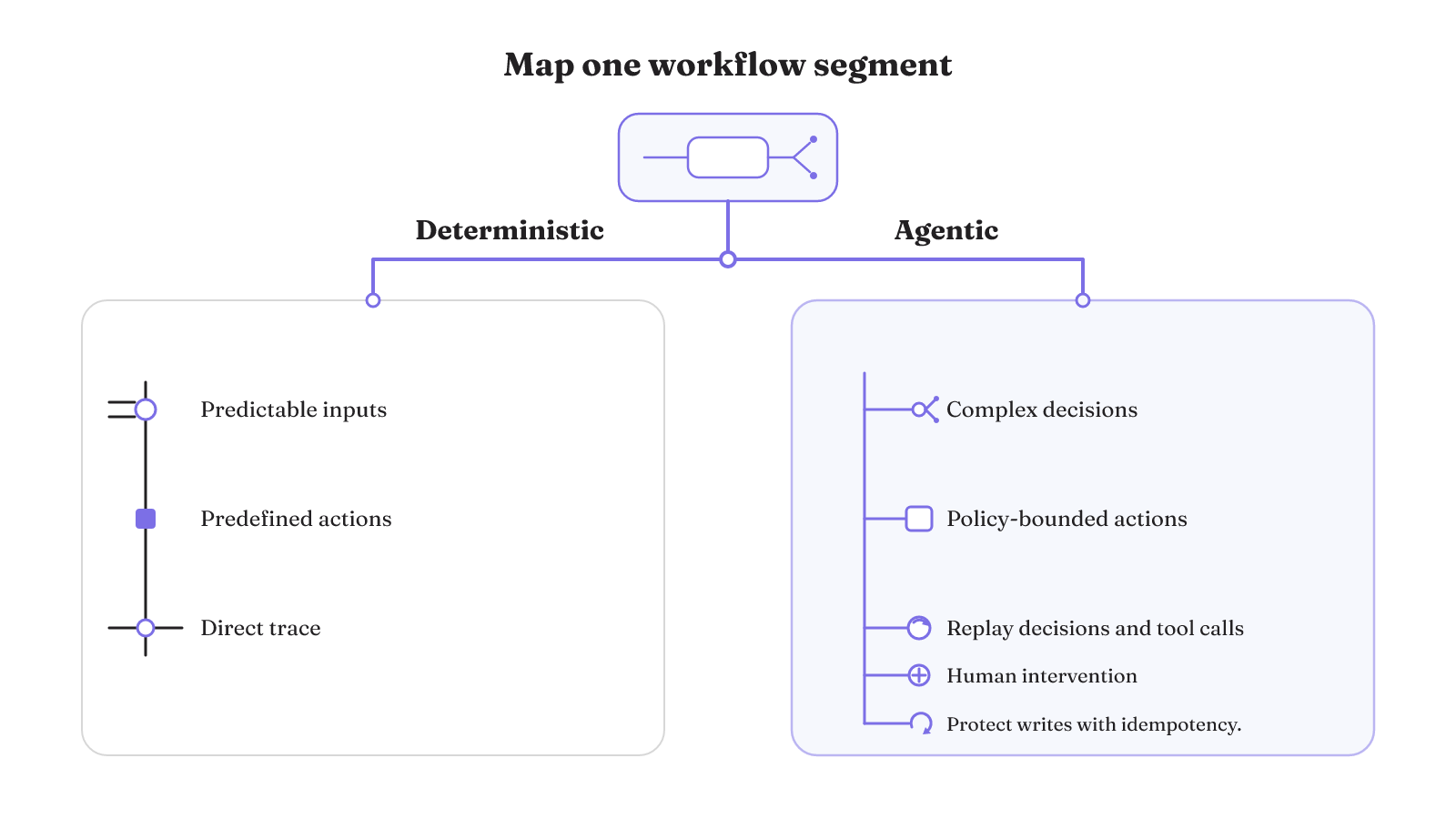
Split one live workflow into meaningful segments, then assess each segment across the seven boundaries below. Deterministic execution can serve steps where consistency is needed, while AI can serve steps that need reasoning. Agents are suited to complex decisions, unstructured data, and rule-based systems that have become brittle.
| Control boundary | Question for this workflow segment | Deterministic condition | Agentic control |
|---|---|---|---|
| Input variability | Are inputs predictable, or does the step face complex decisions and unstructured data? | Keep the step scripted when inputs are predictable and the task is repetitive. | Use an agent where reasoning over ambiguity is required, with an explicit boundary for uncertainty. |
| Action selection | Does the step follow a script, or select actions while pursuing a goal? | Keep the predefined action sequence when it covers the task. | Constrain which systems, actions, and thresholds are available through policy as code. |
| Permission scope | Which systems and actions may this step reach? | The script performs its defined rule-based actions. | Grant only the systems and actions permitted by policy, with thresholds where needed. |
| Human intervention | When must execution transfer to a person? | The predictable rule-based step stays within its script. | Transfer control after configured retry or action thresholds, or before sensitive, irreversible, or high-stakes actions. |
| Observability | Can you reconstruct what happened? | RPA steps can be traced directly. | Make inputs, decisions, tool calls, and outputs reconstructable through observability and replay. |
| State and side effects | Can the system see both progress and real-world changes? | The scripted step carries out predictable actions. | Observe workflow state and side effects directly to catch duplicate actions or runaway reasoning loops. |
| Retry or recovery | Can a failed write run again without duplicating work? | Protect write operations with idempotency keys. | Record prior execution and do not naively retry partially completed write mutations. |
RPA's operating bargain is cheap repetition and ongoing script maintenance
RPA earns its place through repeatability. Deterministic rules can execute at low marginal cost as volume grows. Agentic workflows, by contrast, can carry higher per-task inference and compute costs for routine work. If a high-volume step receives predictable inputs and follows stable rules, adding model-driven action selection can introduce expense without solving a reasoning problem.
That economic fit has a maintenance condition. Scripted RPA can break when systems change, which creates maintenance work. Its limited adaptability also means a change may require a development cycle. A script that is cheap to run can still demand attention when the interface or system it depends on changes.
Execution cost and maintenance cost answer different questions. The first asks what routine runs cost as volume grows. The second asks what happens after a system change. Deterministic rules retain their low marginal cost at volume, but a broken script still has to be changed through a development cycle. A fair assessment keeps both parts of that bargain visible.
This is RPA's operating bargain. You get deterministic, traceable execution for repetitive work, and you accept that the script must be maintained as its environment changes. That is a limitation, but it is not an argument to replace every script with an agent. It is a reason to compare script maintenance with the cost and control obligations of agentic execution at that specific step.
The cleanest boundary is the need for reasoning. Keep a stable, repetitive step deterministic. Consider an agent when the step must interpret changing or unstructured inputs, make a complex decision, or act across several tools. Then account for the larger surface that comes with that flexibility.
You can make that comparison at the segment level. If predictable inputs still reach a repetitive, high-volume task, the core RPA fit remains intact. If changing conditions have made the script brittle, maintenance pressure is real. That pressure creates a reason to reassess the segment, but it does not establish that an agent will have lower cost or less operational work.
Agentic flexibility expands both the workflow and the risk surface
Agentic AI can reason through ambiguity, act across tools, and handle multi-step tasks with a high degree of autonomy. It can also adjust to changing conditions and reason over unstructured data. These capabilities make agents candidates for work that a brittle collection of rules cannot cover cleanly.
The wider action surface changes the security and governance problem. An agent may require broader data access for reasoning, which raises privacy and security considerations. Agent workflows also carry prompt-injection and data-leakage risks. A workflow that can read more context and use more tools needs explicit limits on both.
Auditability changes too. RPA steps can be traced directly, while agentic reasoning may be harder to audit. High-stakes agent decisions therefore need logs, approval workflows, and human review. An agent should not become an opaque bridge between an input and an irreversible action.
Acting across tools may solve a real workflow problem. Broader data access separately brings privacy and security considerations that require governance. For high-stakes decisions, the supported controls are logs, approval workflows, and human review. These controls make the agentic segment a larger engineering commitment than a capability comparison alone suggests.
Prompt injection and data leakage are separate failure risks. Their presence does not erase the value of reasoning over unstructured data, but it does change the acceptance criteria for the workflow. The agentic segment has to be assessed for the useful work it can perform and for the data and actions exposed while it performs that work.
The same discipline applies to the loop around the model. An agent loop can continue through reasoning and tool use, so its stopping and transfer conditions need to be part of the design. More possible actions are useful only when the harness keeps those actions legible and bounded.
How do you make agentic steps legible and hand work back to a person?
Keep the agent design simple enough to inspect. Effective agent design exposes planning steps, documents and tests tools, and avoids needless complexity. That gives engineers a visible relationship between the instructions, the plan, the tool interface, and the resulting action.
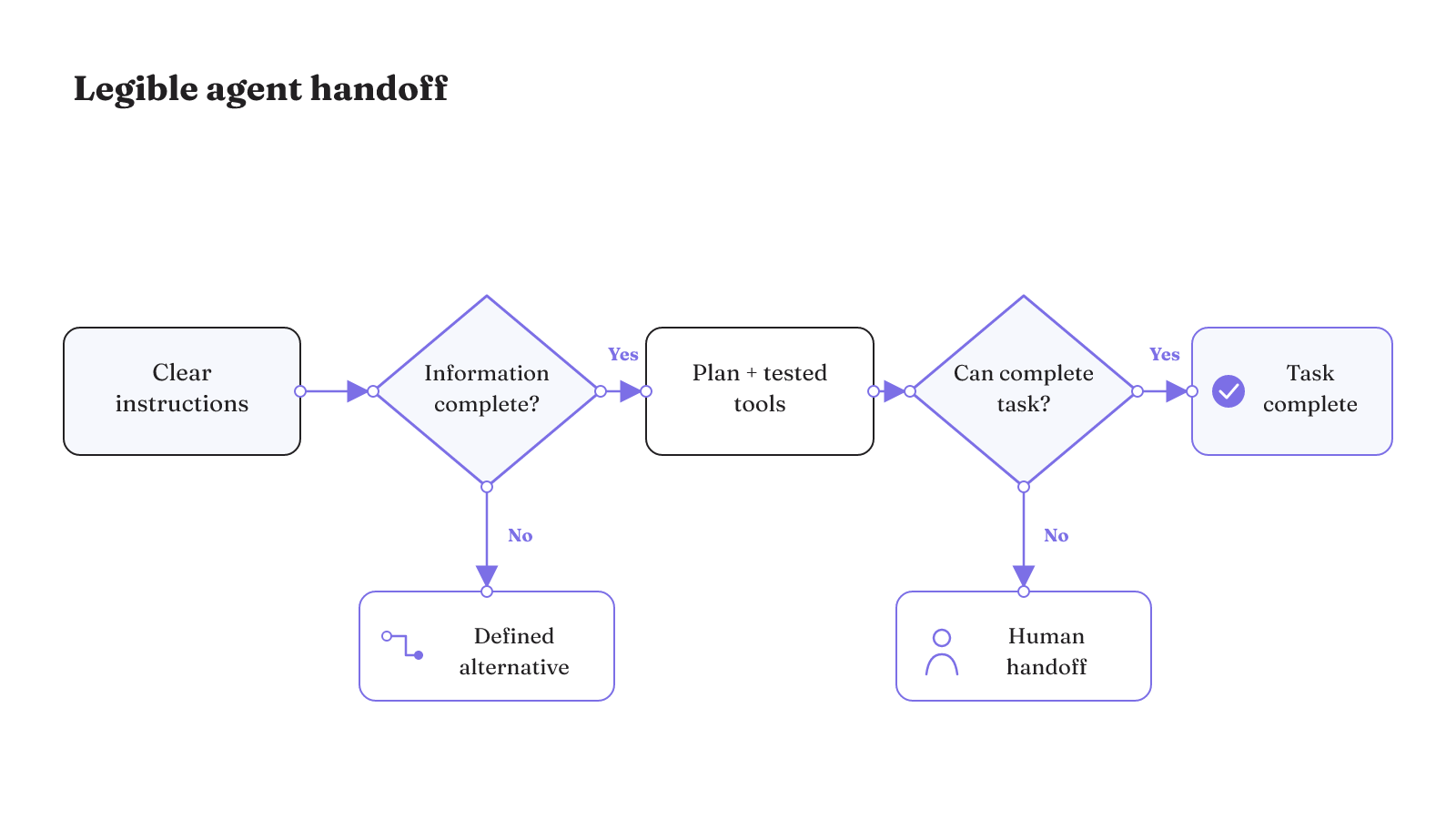
Clear instructions reduce ambiguity and improve decision-making, workflow execution, and error rates. The routine also needs conditional branches for incomplete information and unexpected questions. For example, a branch can detect that required information is incomplete and keep the agent from continuing down the normal route. That branch should lead to a defined alternative, not leave the model to invent the missing condition.
Instructions, branches, and tools solve different parts of the problem. Instructions give the agent a clearer basis for decisions. Conditional branches account for incomplete information and unexpected questions. Thorough tool documentation and testing support the interface between the agent and the computer. Keeping these parts explicit makes it possible to inspect how the system moved from an input to an action.
Some cases still need a person. A human-intervention mechanism lets the agent transfer control when it cannot complete a task. It also helps a team identify failures and edge cases early in deployment. The handoff is part of execution, not an apology after the system has exhausted every possible action.
Transfer of control should preserve the distinction between an incomplete case and a finished one. If the agent cannot complete the task, the human-intervention mechanism hands the work over. Early in deployment, those transfers also help reveal failures and edge cases. They show where the routine, a conditional branch, or the tool interface did not cover the case.
Useful intervention triggers are concrete. Exceeding configured retry or action thresholds can trigger a transfer. So can an attempt to perform a sensitive, irreversible, or high-stakes action. Approval can also be tied to the action type, including payments, refunds, access provisioning, vendor onboarding, and external communications.
The handoff needs enough legibility for a person to continue. Agent observability and replay should make the inputs, decisions, tool calls, and outputs reconstructable. A planning trace without the tool call is incomplete. A tool call without the input and resulting output is equally hard to review. For the wider system design, our guide to building agentic AI systems develops these harness concerns beyond a single workflow segment.
Can agentic AI completely replace RPA?
No universal replacement follows from their capabilities. Multi-step agentic systems should be added only when simpler solutions fall short, after simple prompts have been optimized and evaluated comprehensively.
A hybrid architecture can combine RPA bots, AI agents, and human oversight. The RPA bot can keep a predictable task. The agent can take the segment that requires reasoning. A person can retain control at the defined intervention points. The resulting design follows the workflow's boundaries instead of treating autonomy as an upgrade by default.
The exception tail can erase the value of a high automation rate
A headline automation rate can hide the expensive part of the workflow. A process that automates 90 percent of cases may still have poor economics when the remaining 10 percent contains the most complex cases and requires costly rework. The unresolved tail deserves the same attention as the happy path.
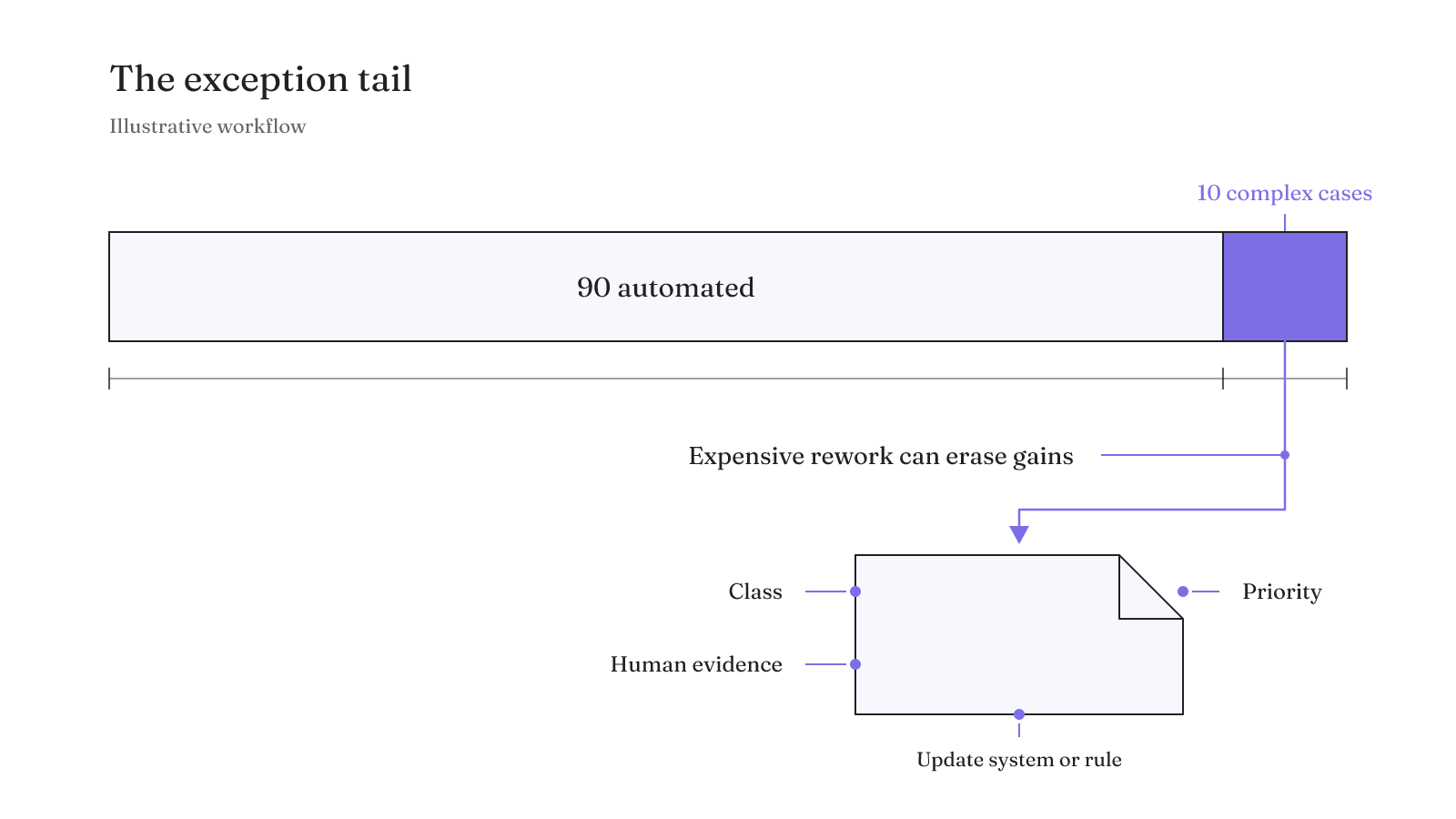
That example changes what you measure. A high automation rate describes the share of cases handled automatically. It does not remove the cost of the remaining complex cases. If those cases produce expensive rework, the economics can remain poor even though the headline percentage looks strong.
Exception design should define four things: the exception class, the evidence supplied to a person, its priority, and whether the resolution updates the system or a rule. These fields turn "send it to a human" into a recovery path that the rest of the workflow can use.
The class tells the system which variation occurred. The attached evidence gives the person the material needed for that case. Priority determines how the case enters the work queue. The final field captures whether the resolution should change the system or a deterministic rule. Together, these choices make exception work visible instead of allowing it to disappear behind an automation percentage.
The last field also creates a disciplined choice after resolution. Some resolutions update the system. Others update a rule. Recording that outcome gives the exception a defined relationship to future execution. Without those four fields, a human handoff can finish the immediate case while leaving the automation unchanged and the same exception unclassified.
Run the control-boundary matrix against one live workflow before replacing a deterministic step. Mark where inputs become variable, where action selection begins, which permissions expand, and where state or side effects can survive a failure. Then define the intervention trigger and recovery path for that segment. If the agentic case still holds, use our guide to building agentic AI systems to carry the design into the surrounding harness.