Key takeaways
Agentic AI and AI Agents: A Primer for Leaders is a beginner course listed at six hours. It covers agent fundamentals and basic custom GPTs. Before enrolling, decide whether you need fluency or preparation for production choices about architecture, permissions, evaluation, governance, oversight, and recovery.
What does Agentic AI and AI Agents: A Primer for Leaders include?
The course listing describes a beginner-level, flexible, self-paced course with two modules and an estimated six hours to complete. Its stated goals are to explain how AI agents work, help learners evaluate AI solutions, and give learners hands-on experience building basic agents with custom GPTs.
That makes the primer a compact starting point. The enrollment decision gets harder when you also care about credentials, assessment, system design, or the responsibilities that begin after an agent can take action.
The six-hour estimate and self-paced format make the commitment easy to identify. The learning scope still deserves equal attention. The listing promises an explanation of how agents work, help evaluating AI solutions, and introductory building practice. Those outcomes answer a fundamentals question. They do not, by themselves, settle which system-level decisions you may need to make.
Certificates, fees, and assessment details
Completing the enrolled work earns an electronic certificate. Enrollment also provides access to all courses in the associated Specialization. Some assignments in the primer are AI-graded, and assignment data is handled under Coursera's Privacy Notice.
The access terms need a careful read because the course and the wider Specialization are related but not interchangeable. The Agentic AI and AI Agents for Leaders Specialization cannot be taken for free. Learners who cannot afford its fee may apply for financial aid. More broadly, selected learning programs may offer financial aid or a scholarship when that option appears on the program description page. Availability is conditional, so the relevant program page is the place to see whether the option appears.
The Specialization does not itself carry university credit. An institution may still choose to accept its certificate for credit, but that is an institution-level choice. The electronic certificate therefore records completion of the enrolled work. It does not, on its own, establish university credit or readiness to operate an agent system.
Before enrolling, separate three questions that are easy to blur together:
- Do you want access to this single primer or to the associated three-course Specialization?
- Does the program page show a financial-aid option that applies to your situation?
- Do you need a completion certificate, or do you need academic credit that a particular institution has agreed to accept?
Those questions settle the access and credential side. They do not settle what kind of system the course is preparing you to reason about.
A concise terminology table for models and agents
The cleanest boundary is behavioral. A model maps a prompt to text. An agent surrounds a model with a system that can perceive, decide, act through tools, and react to results repeatedly until it meets a goal.
| Term | What it does | Observable behavior |
|---|---|---|
| Model | Maps a prompt to text | Produces text from the prompt |
| Agent | Uses a model inside a surrounding system | Perceives, decides, acts through tools, and reacts to results until a goal is met |
This distinction matters when you evaluate a leadership course. Learning how a model responds is not the same task as deciding what an acting system may access, what state it may change, or how its behavior will be checked. Our comparison of AI agents and agentic AI develops that boundary for readers who need more terminology before making an architecture decision.
The model is one component of the operating system
An AI agent architecture has a reasoning model at its center and a surrounding harness of six components. This map separates the model from the system that plans work, acts, keeps context, runs the loop, applies constraints, and moves data.
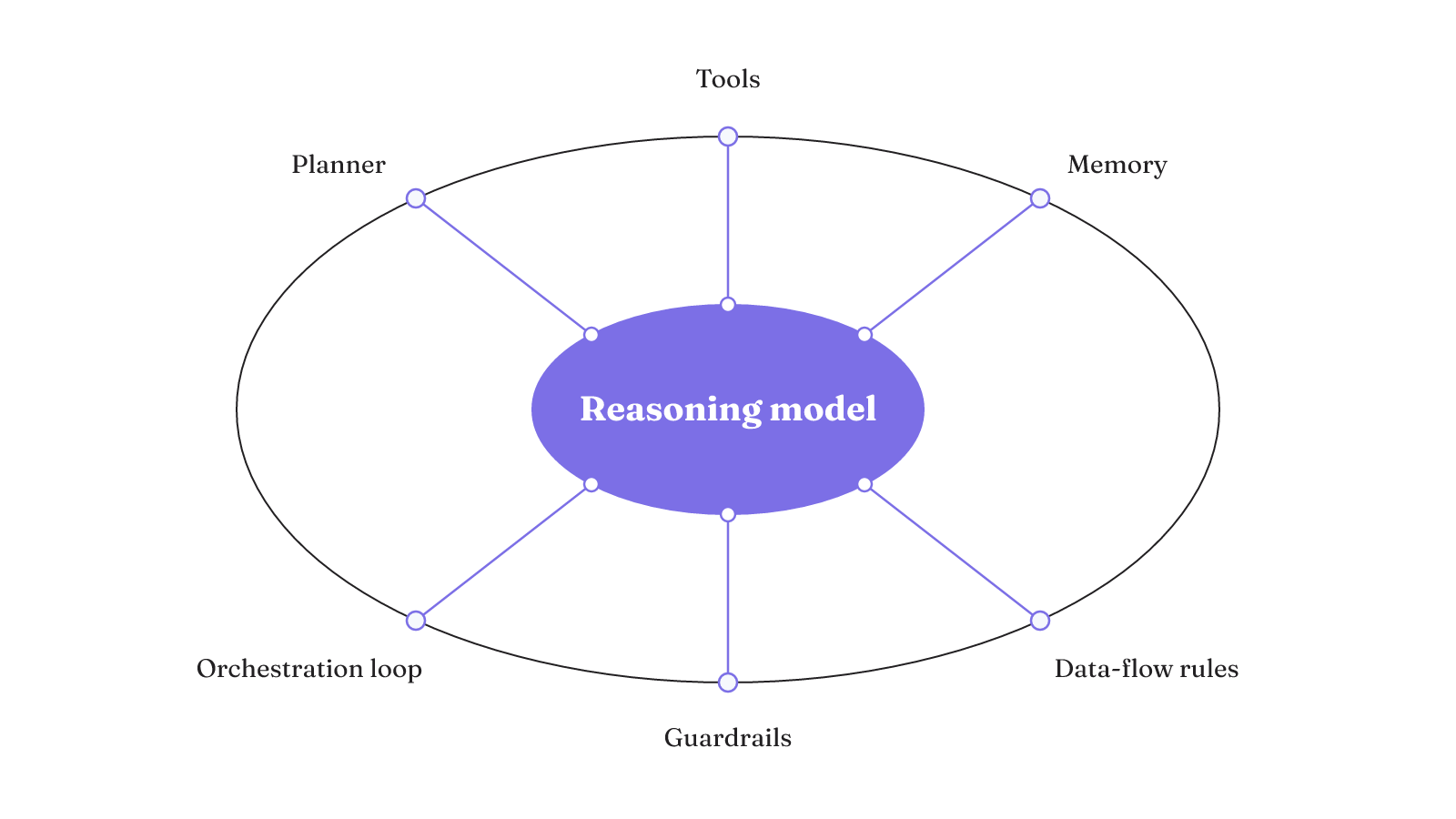
| System position | Component | Role in the architecture |
|---|---|---|
| Center: model | Reasoning model | Produces the reasoning output used by the system |
| Surrounding harness | Planner | Organizes the work the agent intends to perform |
| Surrounding harness | Tools | Let the system act beyond text generation |
| Surrounding harness | Memory | Holds information the system can use across its work |
| Surrounding harness | Orchestration loop | Carries the system through repeated decisions, actions, and results |
| Surrounding harness | Guardrails | Constrains how the system behaves |
| Surrounding harness | Data-flow rules | Governs how information moves among these components |
The model-versus-harness map changes the course-fit question. If you only need an introduction to agent concepts, a short primer can match that goal. If you must choose an architecture, you also need to decide when prompt-response is insufficient and whether a single-agent, multi-agent, or workflow-based design matches the business value and complexity involved. Our guide to building agentic AI systems focuses on that broader systems view.
This is where a simple architecture preference becomes an operating decision. The choice is not only how many agents appear in a diagram. It includes whether the job needs an agent at all, which architecture fits the work, and whether the added complexity is justified by business value. A course aimed at that decision needs room for the surrounding system, not only the reasoning model.
Use a course-fit scorecard before you enroll
| Decision area | Competence to assess | Primer outcome to compare | Fit signal |
|---|---|---|---|
| Conceptual foundation | Explain how agents work | Agent fundamentals for informed decisions | Strong match when shared vocabulary is the goal |
| Solution evaluation | Judge proposed AI solutions and opportunities | Evaluate solutions, identify impact, and distinguish innovation from hype | Match when the decision is early solution screening |
| Hands-on scope | Build a basic agent experience | Basic agents built with custom GPTs | Match for introductory practice |
| Architecture | Choose prompt-response, single-agent, multi-agent, or workflow-based designs | No architecture outcome is stated in the course description | Seek added depth when architecture choice is required |
| Authority and permissions | Set controls for identity, data, memory, tools, outputs, and approval | No permissions outcome is stated in the course description | Seek added depth when the system can access data or act through tools |
| Execution-path evaluation | Test task completion, tool calls, retrieval, state changes, constraints, and recovery | No execution-path evaluation outcome is stated | Seek added depth when acceptable behavior matters as much as completion |
| Governance | Address governance, integration depth, and scalability | No production-governance outcome is stated | Seek added depth for operational deployment decisions |
| Human approval | Define oversight triggers from capability, impact, autonomous risk, and compliance needs | No human-approval outcome is stated | Seek added depth when actions cross consequential boundaries |
| Recovery | Plan for override, incident response, recovery, decommissioning, and change | No recovery outcome is stated | Seek added depth when the system changes state or must be stopped safely |
Read the scorecard as an enrollment boundary, not a verdict on teaching quality. Direct matches support an introductory goal. Rows marked for added depth identify production responsibilities that require more study, including execution-path evaluation. A course can be useful for fundamentals without being the whole preparation for an acting system.
For a broader route through these topics, our agentic AI learning paths organize study by goal, depth, and practical scope.
Which AI program for leaders fits the depth you need?
There is no universally best AI program for leaders. The best fit is the one whose published duration and stated learning scope match the decision you need to make.
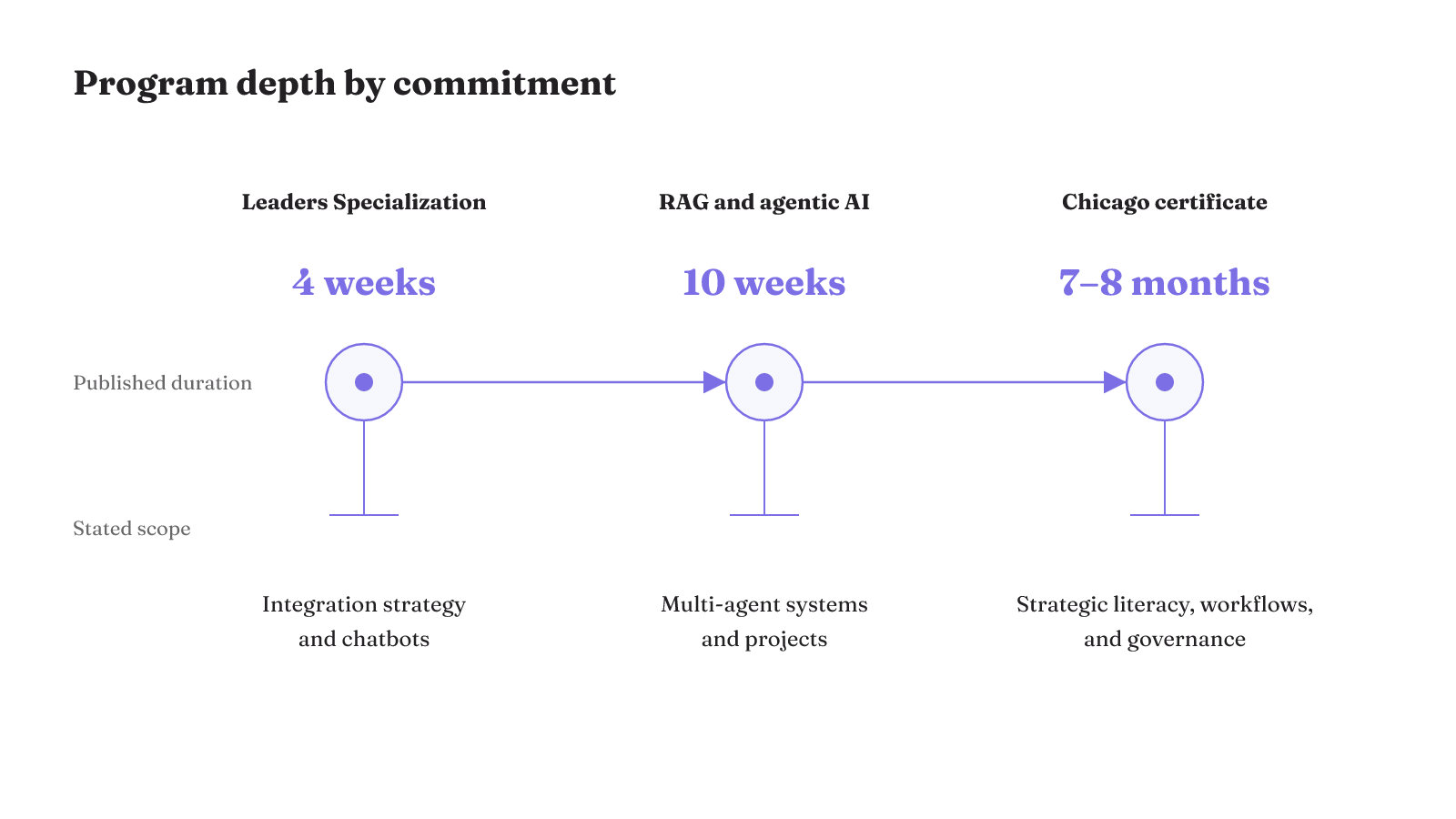
- Agentic AI and AI Agents for Leaders Specialization: a beginner-level, three-course series listed at four weeks with three hours of study per week. It aims to teach leaders how to guide agent integration strategy and how to design and deploy agents as chatbots for organizational automation.
- University of Chicago online leadership certificate: a seven-to-eight-month program listed at $15,000. Its stated scope includes strategic AI literacy, high-value use cases, workflows, and governance frameworks.
- UCSB's RAG, Agentic AI for Leaders: Systems, Design & Impact: a ten-week live online program. Its listed scope includes multi-agent architecture, production-workflow tooling, more than 40 demonstrations, more than 10 guided practices, seven course-end projects, and a capstone.
The commitments are materially different. A four-week beginner series suits a different learning goal from a seven-to-eight-month leadership certificate or a ten-week live program with projects. Duration alone does not decide the fit. The stated learning scope tells you whether the program centers on strategic literacy, chatbot deployment, architecture, practical tooling, governance, or project work.
Our comparison of agentic AI programs can help you match those formats to the work you expect to own. If your responsibility includes a deployed agent, evaluation depth deserves particular weight.
How should leaders judge an agent after it ships?
Judge an agent by more than whether it eventually completes the task. Evaluation should also test whether the execution path was acceptable, including tool calls, retrieval, state changes, constraints, and recovery behavior.
A useful production evaluation bundle has four dimensions:
- Regression protection. Turn observed failures into test cases. Early investment in evaluations can prevent regressions and replace guesswork with metrics.
- Trace-shaped cost. Count completions, context growth across turns, retrieval, paid API use, and blind retries. Two completed runs can consume different amounts of resources.
- Model and workflow latency. Separate model response time from delays caused by serial tools, user round-trips, and polling. A fast model can still sit inside a slow workflow.
- User trust and control. Evaluate the person's sense of trust and control, not only the relevance of the answer.
These measures make failure more legible. A task can finish while using an unacceptable tool call, changing the wrong state, costing too much through retries, or leaving the user without enough control. The evaluation target is therefore both the result and the route the system took to reach it.
Turn failures into durable tests
An observed failure can become a test case. Running that case again after a system change turns one bad result into regression protection. Over time, this practice replaces a vague sense that the agent is improving with metrics tied to failures the system has already shown.
Cost needs the same trace-level view. Completion count is only one input. Context can grow across turns, retrieval and paid APIs can add cost, and blind retries can consume more resources. Latency also needs two measurements: model latency and workflow latency. Serial tools, user round-trips, and polling belong to the workflow measure even when the model itself responds quickly.
Trust and control complete the bundle. A relevant answer is not the only thing a person judges. Evaluation also needs to examine whether the person experiences enough trust and control while the system works.
Governance continues across the system lifecycle
Governance is ongoing work, not a gate that disappears after launch. The NIST AI Risk Management Framework Core organizes that work into four functions: govern, map, measure, and manage. NIST also describes AI risk management as continuous, timely, and active throughout the system lifecycle.
Those functions give leaders a durable set of questions. Governance establishes how risk work is organized. Mapping establishes the context in which the system operates. Measurement examines the risks that have been identified. Management addresses those risks over time.
The risk itself has two parts: the likelihood of an event and the magnitude of its consequences. That definition prevents a common shortcut. A plausible event is not automatically the highest priority, and a rare event is not automatically harmless. Both likelihood and consequence magnitude belong in the decision.
Post-deployment plans can include user input, appeal and override, decommissioning, incident response, recovery, and change management. These mechanisms keep governance attached to the system as its behavior and operating context change.
The lifecycle view also changes when governance work happens. Governing, mapping, measuring, and managing are not confined to design. They remain active after deployment, when monitoring, overrides, incidents, system changes, and eventual decommissioning become part of the operating record. A one-time launch decision cannot perform that continuous work.
What does bounded autonomy look like in practice?
Bounded autonomy means an agent is observable, testable, reversible, and constrained around the actions it may take. One risk-tiering scheme makes the idea concrete: information-retrieval systems receive automated monitoring, workflows with reversible actions receive real-time guardrails, and systems involving financial transactions require human review of all decisions.
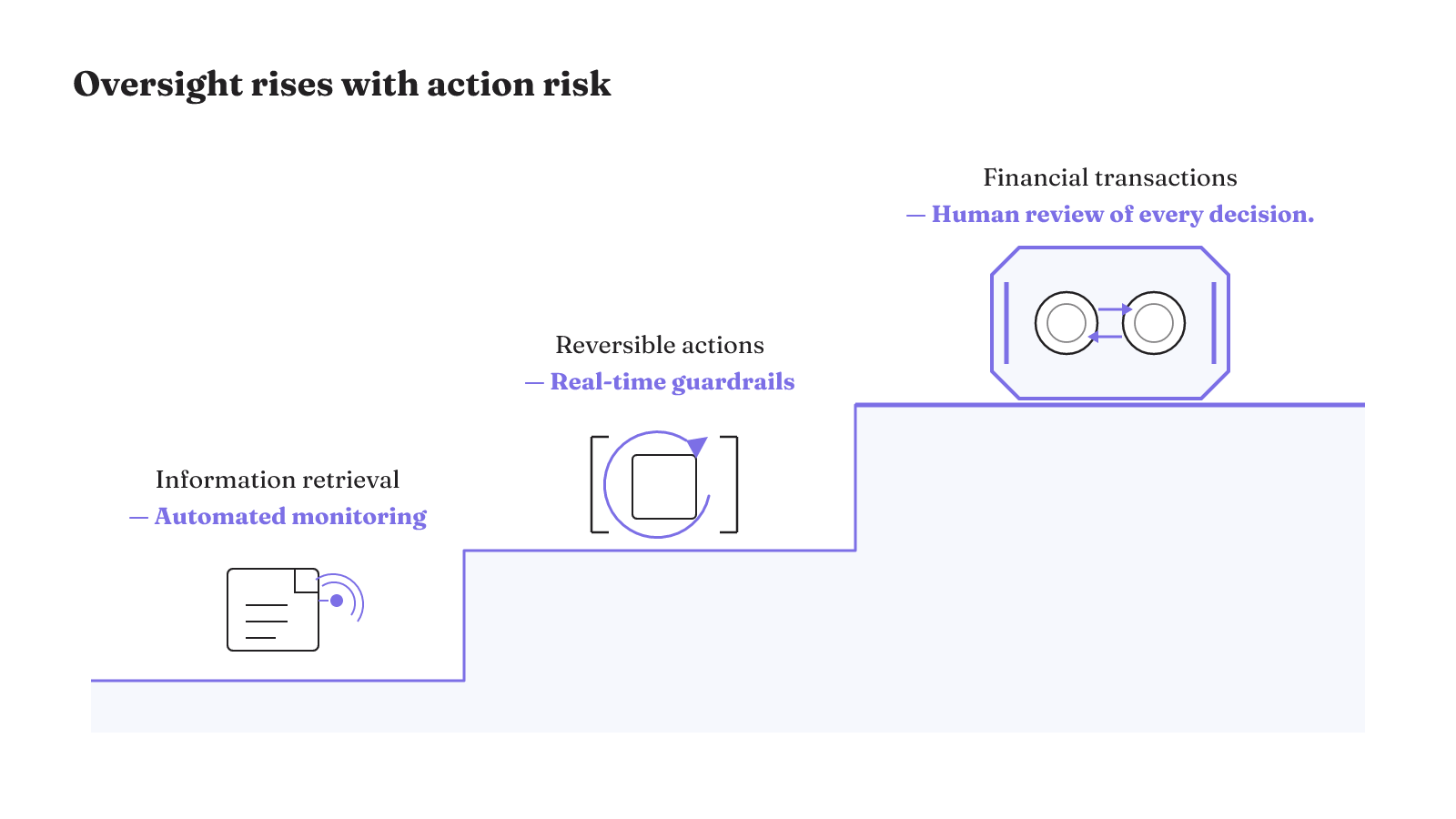
The point is not to maximize agent independence. Oversight changes with the action category. An assessment can examine tool access and capabilities, possible financial and operational impact, autonomous-action risk thresholds, human-oversight triggers, and compliance requirements.
That assessment gives autonomy a concrete boundary. Capability and tool access describe what the agent can do. Financial and operational impact describe what its actions can affect. Risk thresholds and oversight triggers determine where automated operation gives way to guardrails or human review. Compliance requirements add another constraint on that boundary.
A real implementation also depends on the information and permissions around the model. The Washington Post's Analytics team uses a network of agents for content, subscription, and advertising questions. Those agents reference internal documentation, metric definitions, aggregated tables, and permission logic. The example makes the surrounding system visible: useful agent behavior depends on what the agents can reference and what permission logic governs their work.
Use the course-fit scorecard before you enroll. If the primer's stated outcomes match your decision, it offers a compact beginner route. If you must own architecture, permissions, evaluation, governance, oversight, or recovery, choose a learning path that addresses those responsibilities directly.