Key takeaways
- Predictive AI forecasts from historical patterns.
- Generative AI creates information and can produce inaccurate output.
- Agentic AI plans multi-step work and can change connected systems.
- Physical AI applies machine learning to robots, where safety, cost, and productive output matter.
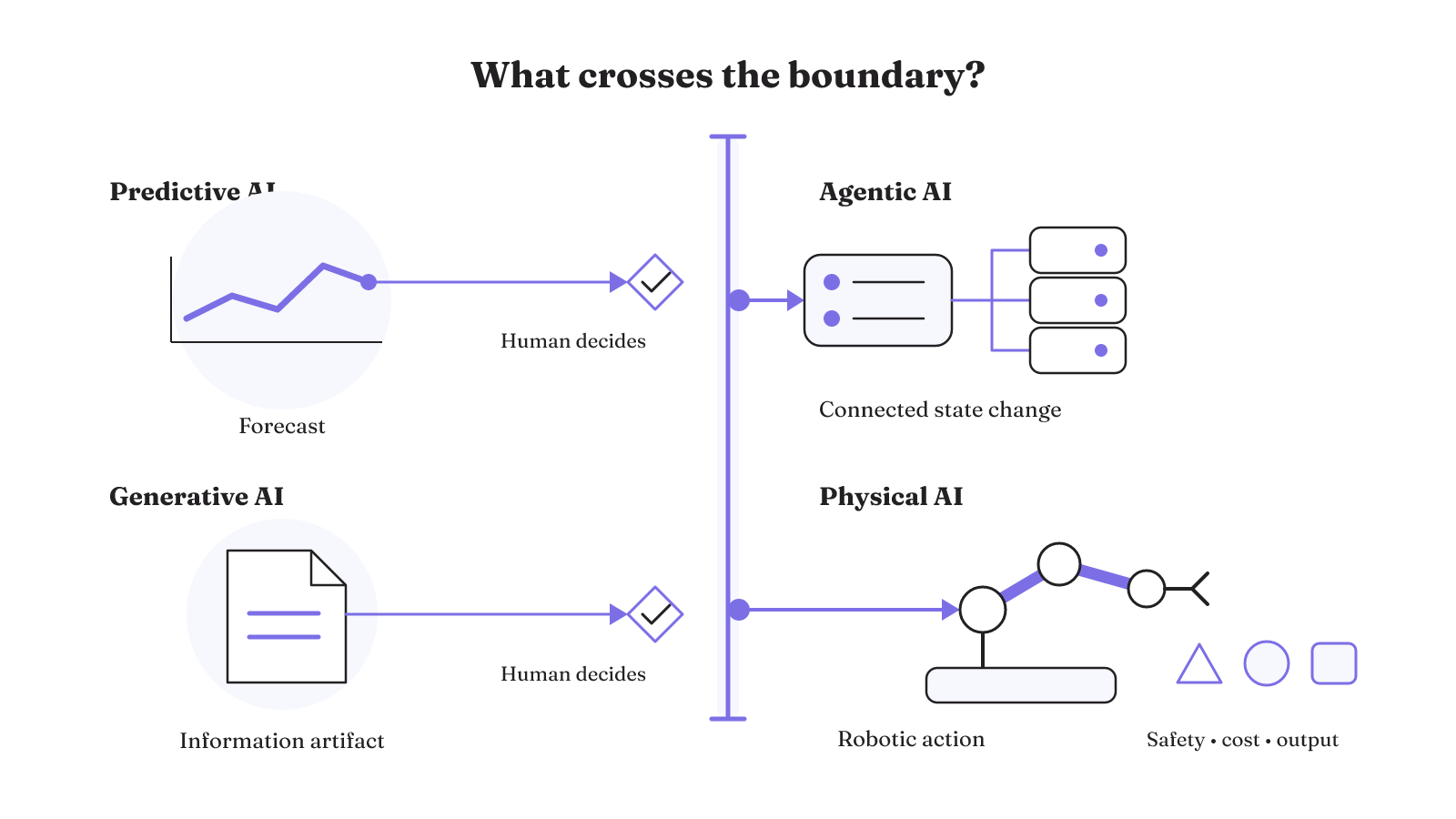
The practical question in agentic AI vs generative AI vs physical AI is not which label sounds most advanced. It is what crosses the system boundary. A forecast informs a decision. Generated content gives a person an artifact. An agent may act on connected software. A robotic system can produce physical consequences. Each boundary creates a different control problem.
Agentic AI vs generative AI vs physical AI at a glance
This comparison also includes predictive AI, which is often part of searches for traditional AI vs generative AI vs agentic AI. Predictive AI uses patterns in historical data to forecast future events. It is a useful baseline, but it is not a synonym for every traditional AI system.
| Category | Primary output or action | State and consequence boundary | Feedback and detection | Reversibility boundary | Control question |
|---|---|---|---|---|---|
| Predictive AI | Forecast from historical patterns | Produces a prediction for a later decision | Which historical patterns produced the forecast, and how will later outcomes be compared with it? | Has a person acted on the forecast, or does it remain an information output? | Are the historical patterns appropriate for this forecast? |
| Generative AI | New or transformed information, such as text or images | Produces an information artifact and can generate inaccurate or nonsensical output | Which inaccurate or nonsensical outputs will be detected before a person acts? | Can a person reject the information artifact before using it? | How will inaccurate output be detected? |
| Agentic AI | Plans and coordinates multi-step action toward a goal | Can change connected software or world state without a human intermediary | Which evaluations, runtime monitoring, and incident records will expose a failed action? | Can every direct software or world-state change be stopped, rejected, or reversed? | What authority, access, guardrails, evaluations, monitoring, and incident response does it need? |
| Physical AI | Applies advanced machine-learning models within robotic systems | Affects robotic performance, with safety, cost, and productive output at stake in manufacturing | Which intervention logs and incident reports will record what happened? | Can the named human use a tested override to stop and escalate operation? | What task, environment, and human exposure define the safety case? |
These are not four rungs on one maturity ladder. The categories describe different outputs and action boundaries. Physical AI also has a large gap between academic embodied-AI research and what manufacturers and robotic-system integrators can implement in real settings, according to NIST's work on physical AI and robotics. That implementation gap matters when you evaluate a robotics proposal. Separate the machine-learning claim from the robot's real operating task. Then test whether the proposed system is adaptable, easy to task, safe alongside people, and quick to integrate into the enterprise.
Where does the LLM end and the agent system begin?
An LLM can drive an agent, but the model is not the whole agent system. In narrow, task-specific automation, agents can be modular systems driven by language models. The system around them adds tool integration, prompt design, planning, action, and ways to adapt across a task. Agent frameworks can provide structure for that planning, action, and adaptation.
The cleanest boundary map separates three questions that product labels often blur:
| Boundary | Question | What belongs here |
|---|---|---|
| How it is built | What drives and structures the system? | An LLM or image model can drive a modular agent. Agent structures add tools, prompts, reasoning enhancements, planning, action, and adaptation. |
| What it can do | Does it return information or act through connected tools? | A model can create an output for a person. A tool-enabled agent can plan multi-step work and act toward a goal. |
| Where it is deployed | What scope and environment contain the work? | An agent resource can be reusable while remaining scoped to the caller's project. Deployment context determines where its capability is used. |
A system can carry three accurate descriptions at once. It may be LLM-driven in construction, tool-enabled in capability, and project-scoped in deployment. Those descriptions are compatible, but they are not substitutes. Saying that a system uses an LLM answers how it is built. It does not say whether the system only produces information or also plans and acts. Calling it an agent describes a capability, but does not identify its deployment scope. How a system is built, what it can do, and where it is deployed are separate classification problems.
That distinction is especially useful when a product combines model output with tools. Generative AI can be a precursor to an agent. The agent layer adds the structures that connect generation to a course of action. A specific API can even expose an agent as a reusable resource scoped to a project. That tells us something about deployment scope, not a universal fact about every agent architecture.
For a deeper treatment of this seam, read our note on where the model ends and the agent system begins.
Can a conversational system mix scripted and AI behavior?
Yes. A conversational system does not have to be purely scripted or fully agentic. A hybrid can route routine interactions through scripted handling and use AI capability for complex interactions.
Consider a queue with two kinds of work. A routine interaction follows an established script. A more complex interaction is routed to the AI path. The point is not that one path is more advanced. Each path handles a different query shape inside the same deployed system.
For conversational systems, the choice between a scripted chatbot and an AI agent depends on query complexity, compliance requirements, budget, and customer expectations. Neither is universally better. A hybrid is useful when the workload genuinely contains both routine and complex interactions.
This is also why category names should not replace architecture diagrams. A conversational interface may contain scripted behavior, generative behavior, and agentic behavior at once. The meaningful question is which path handles a given interaction and what that path is allowed to change. Our comparison of agentic AI and traditional automation develops that distinction further.
What changes when software can act?
The consequence surface expands when software can act through connected systems. Software agents can call APIs, query databases, and modify infrastructure or entire environments. Security teams then have more resources and paths to defend than they would with an isolated information artifact.
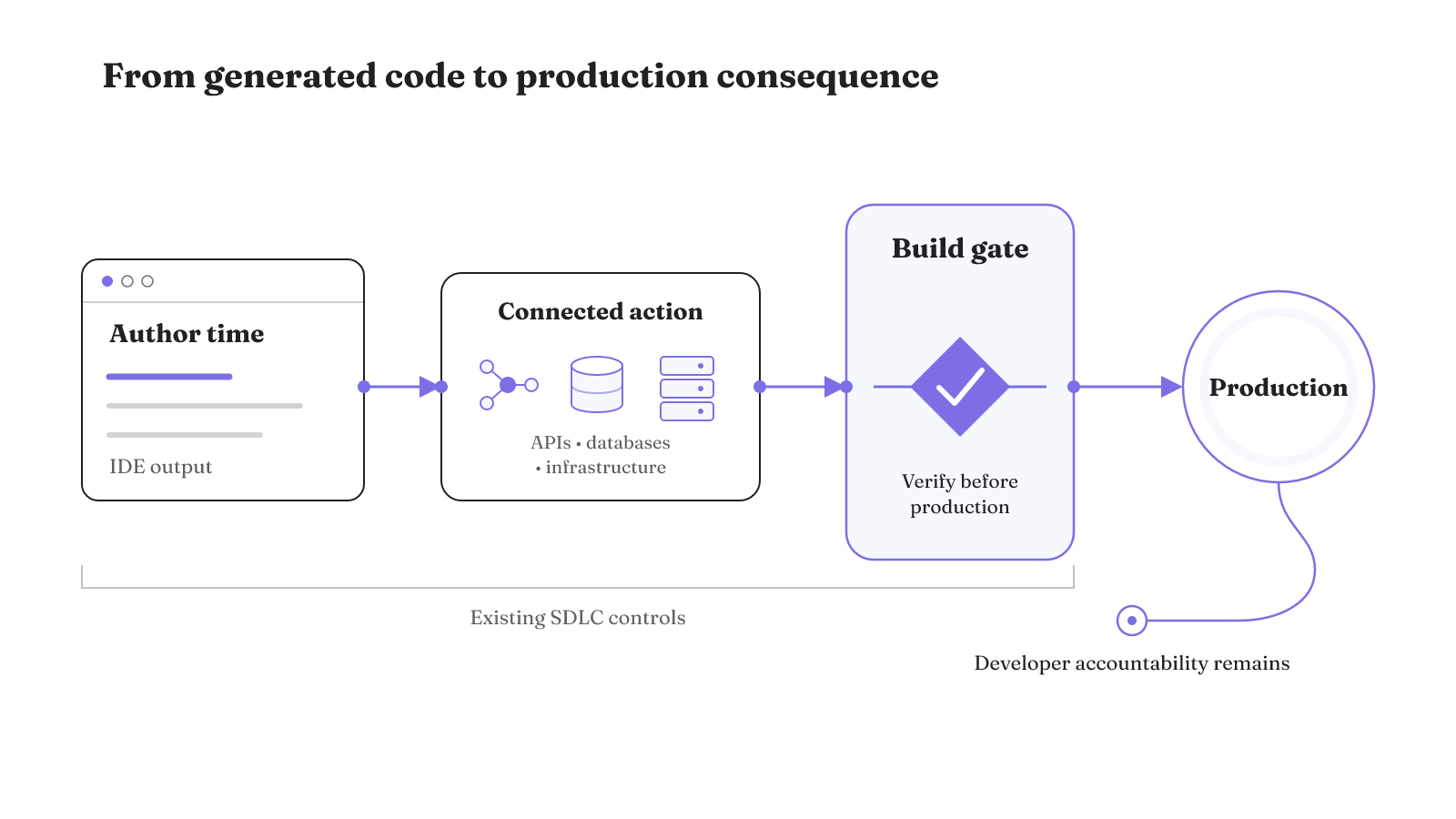
Coding agents make this boundary concrete. Their work can move through a software-action path:
- Author time: controls shape what an AI coding agent produces inside the development environment.
- Connected action: the agent may call APIs, query databases, or modify infrastructure and environments.
- Build time: verification and gates decide what can reach production.
- Production accountability: developers remain accountable for the security of the software they ship.
The build gate matters because generated code and production code do not have the same consequence surface. Author-time controls influence output while it is being created. Build-time controls verify and gate what reaches production. Existing secure software development lifecycle controls remain important when coding agents enter the workflow. The control framework for AI coding agents describes these layers directly.
Introducing a coding agent does not replace the existing development lifecycle. It adds a new source of output and connected action inside that lifecycle. The established controls still matter, while author-time and build-time controls address where the agent's work is shaped and where production access is gated.
Delegating part of the work does not delegate away developer accountability. That boundary should shape the architecture from the start: connected resources are part of the system being controlled, and production remains a gated state. For more patterns behind those choices, see our guide to AI agent architectures.
Control and oversight solve different problems
Control acts before or during execution. It aims to prevent or constrain failure in real time. Oversight is a governance function or an after-execution activity. It emphasizes detection, remediation, records, and incentives that shape future behavior. A research analysis of control and oversight draws this operational distinction.
Both views are needed once an agent can act. Capability mapping asks what the agent can do beyond its explicit design so that misuse and dual-use risks can be identified and mitigated. Risk assessment then examines concrete failure surfaces: unauthorized actions, intent drift, downstream consequences, credential and privilege limits, real-world harm, and the records needed for audits or incident analysis.
Those surfaces answer different operational questions. Unauthorized action and intent drift concern what the agent attempts. Credential and privilege limits concern what it is able to reach. Downstream consequences and real-world harm concern what follows from the action. Audit and incident records preserve what happened for later analysis. A risk assessment needs the full path from attempted behavior through available authority to resulting consequence and record.
A compact way to hold the distinction is:
- Control: limit authority and access, constrain execution, and apply runtime guardrails before or while an action occurs.
- Oversight: monitor what happened, detect problems, support remediation, preserve incident records, and use those findings to influence future prevention.
Monitoring alone cannot prevent an action that has already happened. Runtime control alone cannot explain a failure after the fact. The harness needs a clear account of both jobs, scaled to the actions the agent is actually able to take. The core concepts are collected in our agentic AI glossary.
Context is part of the agent system
Context engineering controls what an agent sees at each step. Its purpose is to give the agent enough information to decide while avoiding wasted tokens and drift. That makes context an operating part of the agent system, not just a long prompt placed in front of a model.
Three mechanisms keep the working context bounded:
- Retain critical state. Carry only critical variables or outputs from one step to the next.
- Route task-specific context. In a multi-agent workflow, give each subagent only the slice of shared context it needs.
- Prune stale inputs. Remove irrelevant, outdated, or non-essential material from the prompt.
These mechanisms solve different parts of the same problem. Retained state preserves the variables or outputs that later work depends on. Selective routing limits what each subagent receives. Pruning removes material that no longer helps the current decision. Together, they define the information boundary for each step.
This boundary also makes failures easier to inspect. When an agent drifts, the transcript can show which context it received at that step. When a subagent gets information that does not belong to its task, the routing boundary is visible. The agent-building guide on context engineering describes these practices as controls over state, shared context, and prompt contents.
Context design does not prove that the resulting behavior is reliable. It makes the information path explicit enough to test, which leads to the next engineering obligation: evaluation.
How do you test an agent before failures pile up?
Start evaluations early and turn observed failures into test cases. Without evaluations, teams can get trapped in reactive fixes and struggle to tell a regression from noise. Early evaluation replaces guesswork with metrics.
A practical failure-to-evaluation loop is:
- Capture an observed failure.
- Recreate it as a realistic task.
- Define an unambiguous success criterion.
- Apply thoughtfully combined graders.
- Review the agent transcript.
- Run the case again as a regression check.
Useful evaluations also need sufficiently difficult problems. If every task is easy, the evaluation cannot expose the behavior that needs work. The test set and graders should be refined as the system changes and new failures appear. The agent evaluation guidance from Anthropic emphasizes realistic tasks, clear criteria, combined graders, hard problems, iteration, and transcript review.
Physical AI moves the consequence boundary into robotics
Physical AI brings machine learning into robotic systems, where software decisions meet physical tasks, environments, and people. In manufacturing, robots need to be adaptable, easy to task, safe in partnership with humans, and quick to integrate. NIST's robotics and autonomous systems program frames those needs around practical manufacturing deployment.
A robot is not safe in the abstract. Its safety case must match the exact task, the environment, and the people exposed. That case also needs an explicit responsibility model across the manufacturer, integrator, and operator. A named human should be able to stop and escalate operation.
The deployment record should make the boundary inspectable:
- Define the exact task and operating environment.
- Identify the people exposed during operation.
- Allocate responsibility across the manufacturer, integrator, and operator.
- Name the human who can stop and escalate operation.
- Record known limits, intervention logs, and incident reports.
- Document data controls and evidence that the human override was tested.
These records are evidence for trustworthy robot deployment. They connect system limits and interventions to a specific operating setting. They also keep responsibility from disappearing between the organization that made the robot, the one that integrated it, and the one operating it.
Advanced machine-learning models can improve robotic-system performance while also creating challenges in both the machine-learning and robotics parts of the system. In manufacturing, the consequences include cost, safety, and productive output. Those stakes explain why a compelling research demonstration is not the same thing as a deployable manufacturing system.
The same capability can require different controls
The category still does not determine the complete control burden. Operational context matters. In regulated GxP environments, risk assessment for agentic AI depends on how the capability is deployed, not on its technology features alone. The same capability can require substantially different validation in different uses.
A scientific-literature-review agent shows the difference:
| Deployment use | Stated control level |
|---|---|
| Summarizing literature for an internal meeting | Low risk |
| Supporting research direction | Human review checkpoints |
| Supporting a drug-approval submission | Comprehensive controls because the work affects regulatory decisions and patient safety |
The agent may have the same literature-review capability in all three cases. The deployment changes what depends on its output, so it changes the validation burden. The GxP guide to building AI agents uses this example to show why operational context must be part of the assessment.
The capability name therefore cannot set validation once for every use. An internal summary, support for research direction, and support for a regulatory submission place the same capability in different operating contexts. The assessment has to follow the deployed use and the decisions that use can affect.
This is the final boundary to keep clear. A model label tells you too little. An agent label still tells you too little. You need to know how the system is built, what it can do, where it is deployed, and what state it can change. Then the controls can meet the real consequence surface.
Read where the model ends and the agent system begins and apply that boundary to the system you are designing.