Key takeaways
- Agentic coding can include planning, writing, testing, and modifying code.
- Match execution scope to the task, then inspect permissions, persisted context, verification, recovery, and cost.
- Keep human review and testing in the loop, especially for larger changes and legacy codebases.
What makes an agentic AI coding tool different?
Agentic coding delegates a chain of work to an AI agent: planning an approach, writing or modifying code, testing the result, and taking actions across the surrounding technology stack. Yes, agentic AI involves coding. The important change is that the system can act on code and tools instead of stopping at a suggestion.
That distinction separates an agentic AI coding assistant from a narrower completion interface. The meaningful question is not whether a product uses the word "agent." It is how much of the chain it can execute, where that execution happens, and what authority comes with it.
There are several concrete agentic AI tool examples, but they do not all delegate the same unit of work. A completion server, a terminal pair programmer, a repository agent, and an autonomous workspace create different review and failure surfaces. We treat the surrounding agent harness as part of the choice because the model is only one component of the working system.
Task scope determines the coding setup
Start with the task you intend to hand over. A bounded completion does not need the same execution surface as a multi-file change that can run commands. This map describes four patterns, not a universal ranking of products.
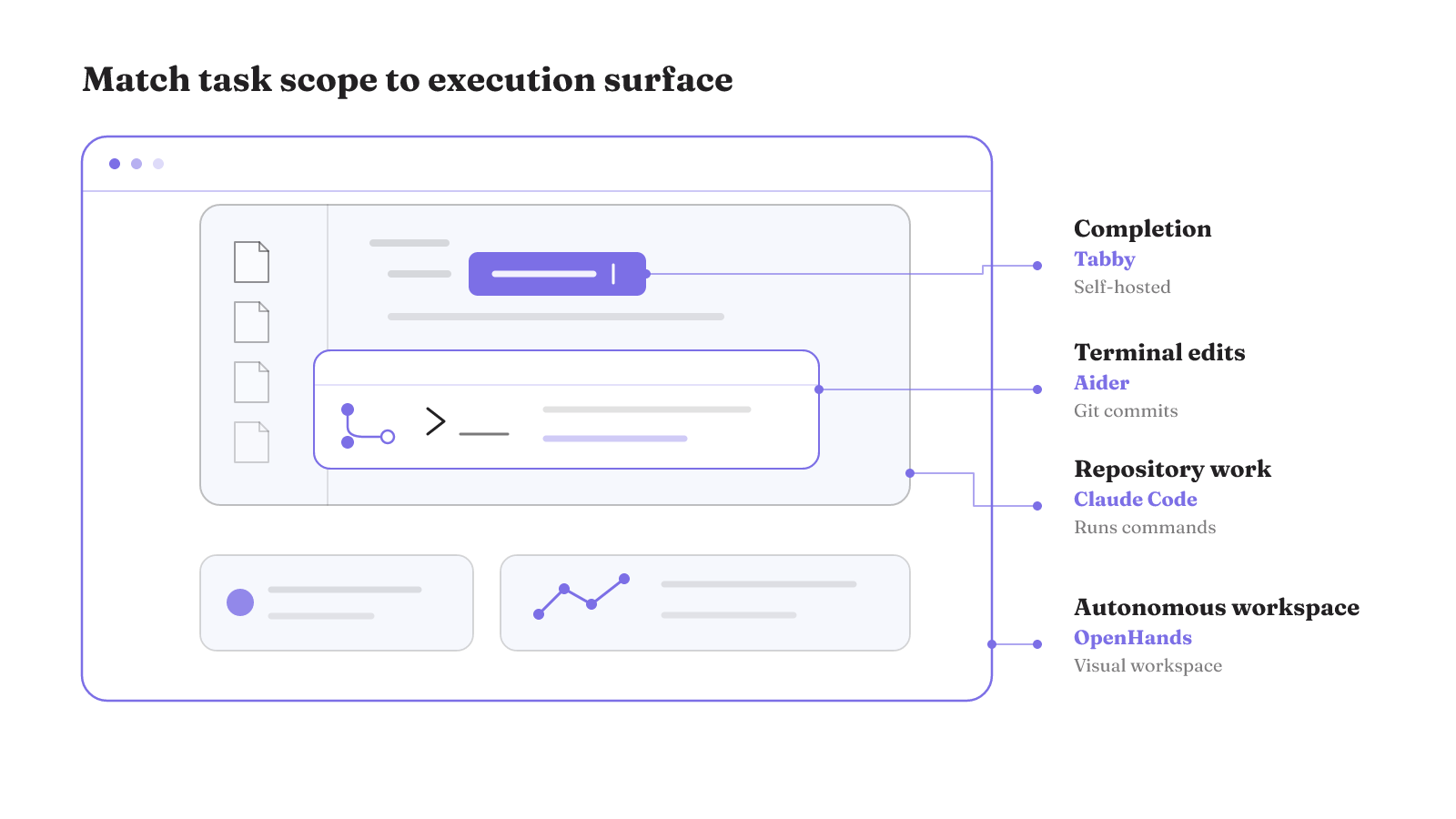
| Task scope | Setup pattern | Named example | Control or ownership fact |
|---|---|---|---|
| Bounded code completion | Self-hosted completion server with IDE plugins | Tabby | Presented as Apache-2.0, with local-model support and an air-gapped deployment option |
| Reviewable edits from a terminal | Terminal pair programmer | Aider | Presented as Apache-2.0 and self-hostable, with BYOK or local-model support and Git-native edits recorded as commits |
| Multi-file repository work | Repository-aware command execution | Claude Code | Can navigate a codebase, edit multiple files, write, test, debug, and run commands to verify its work |
| Longer autonomous work in a visual environment | Autonomous-agent workspace | OpenHands | Presented as MIT-licensed, with a visual workspace, self-hosting options, and BYOK or local-model support |
Read the map from the task outward. Name the smallest unit of work you need to delegate, then decide whether the setup gives that unit the right amount of authority. A completion, a reviewable edit, a multi-file change, and autonomous workspace work place different demands on the person reviewing the result. Giving Claude Code access to a codebase and files introduces risk, including prompt-injection risk. Its ability to work across files and run commands does not settle whether that access fits your task. Keep code quality, speed, and productivity out of this comparison until you test those outcomes directly; an execution pattern alone cannot establish a universal winner.
If terminal and IDE workflows are the live choice, our Aider vs Cline comparison narrows that interface decision. For editor-centered alternatives, the Antigravity vs Cursor comparison covers that separate pairing.
Score the control boundary before the feature list
Once the task scope is clear, inspect the operating contract around the agent. We use six criteria because each exposes a different way the work can escape review, lose continuity, become hard to undo, or cost more than expected. They also keep task alignment, verifiability, steerability, and adaptability visible in the human-agent loop. This is a selection scorecard, not a performance benchmark.
| Criterion | Item to inspect | Documented mechanism | Failure-drill prompt |
|---|---|---|---|
| Execution surface | Where the agent and inference run | Codex runs on developer laptops through a CLI, IDE extension, or desktop app, while a cloud model handles inference | If the session fails, which work happened locally and which part depended on the cloud model? |
| Permission and isolation boundary | Filesystem and network access | Codex workspace-write keeps network access off by default; Claude Code sandboxing establishes filesystem and network boundaries | What files can the agent change, and what network access is actually enabled? |
| Persisted context | State that survives a reset | Planning-with-files keeps an active plan, findings, and progress on disk; its files persist across /clear, compaction, and session death | After context is cleared or the session dies, what project state remains? |
| Verification path | What can be checked before and after execution | A living Codex execution plan can be checked before a long implementation begins | Can you inspect the intended approach before execution and test the resulting change afterward? |
| Recovery mechanism | How an alternate attempt is preserved | Claude Code's /branch and fork-session options preserve the original session while another approach is tried | If the approach is wrong, what exactly remains available for comparison or recovery? |
| Usage meter | What activity consumes allowances | Copilot cloud-agent sessions use Actions minutes and AI credits; private-repository code review also uses Actions minutes | Which actions consume credits, model usage, compute time, or review minutes? |
Run the failure drill before adoption
Ask these questions against one representative task, with the permissions you would actually grant:
- Where does the agent execute, and where does model inference happen?
- Which filesystem and network boundaries apply to its commands and subprocesses?
- Which plan, findings, and progress survive a context reset or dead session?
- Can you verify the intended approach before a long implementation starts?
- Can you preserve the original session while trying an alternate approach?
- How are agent work, code review, model tokens, and compute usage charged?
An undocumented row should stay open. Do not fill it with a nearby feature that answers a different question. A session branch, for example, records one recovery mechanism at the session level. It does not answer which file changes or external effects can be reversed. Likewise, a network destination rule is not the same thing as enabling network access.
The six rows should not be averaged into a single score. A task that requires no network access can treat a network-off default as a workable boundary. Another task may require network-dependent commands and a documented configuration. The acceptance rule comes from the task, while the product documentation supplies the mechanism you compare against it.
Is there a free agentic AI coding tool?
Yes. GitHub lists a no-credit-card Copilot option with 2,000 completions per month, Copilot CLI, and community support. It gives you a way to start with completions and CLI access.
An agentic AI coding tool can plan an approach, write or modify code, test the result, and act across the surrounding technology stack.
What can go wrong in AI-generated code?
The dangerous failure is often code that looks reasonable during a quick scan. AI-generated code can reverse the handling of an edge case while keeping the main path plausible. It can also call an API that does not exist in the library version used by the project.
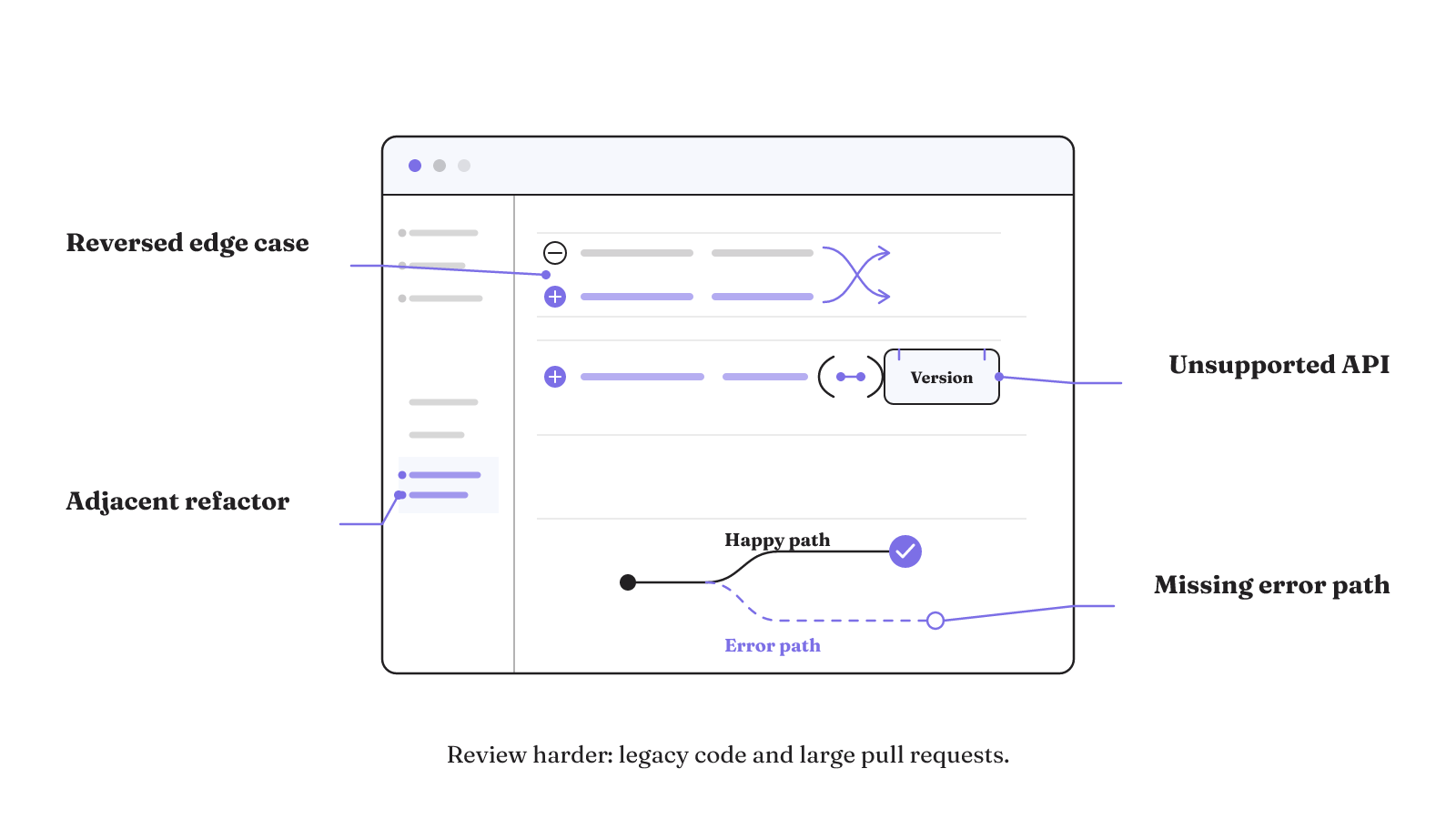
Two other failures widen the review boundary. A generated change can silently refactor adjacent code outside the requested task. It can also implement the happy path while leaving other paths without error handling. A passing demonstration of the main path does not answer either concern.
A practical review needs to account for four distinct failure modes:
- Edge-case logic: plausible-looking code can handle an edge case backwards.
- Version mismatch: generated code can call APIs absent from the project's library version.
- Task spillover: generated changes can silently refactor adjacent code outside the requested task.
- Missing paths: generated code can implement the happy path while omitting error handling elsewhere.
These checks do not replace broader review and testing. AI-generated code needs human oversight and testing, with especially thorough review for legacy codebases and larger pull requests. Look for reversed edge cases, nonexistent version-specific APIs, adjacent refactors, and omitted error handling.
This changes how much work you should delegate in one attempt. A larger pull request raises the amount of generated behavior a person must understand, while a legacy codebase raises the importance of existing constraints. The review boundary should expand with those known conditions, even when the agent reports that its command or test completed.
The review also needs to preserve the original task boundary. A plausible implementation may still include an adjacent refactor that was never requested. A working happy path may still leave error paths unhandled. Test output for one path and a clean-looking diff are different review signals, and neither removes the need for human oversight.
Before accepting a generated change, compare the requested task with the full change, examine the library version behind any called API, and include error paths in testing. Review legacy codebases and larger pull requests more thoroughly. The goal is not to prove that every generated line is wrong. It is to look where plausible code can mislead a quick review.
Repository context is part of the tool choice
An agent can only apply project knowledge that reaches its working context. Repository structure therefore affects the quality of the interaction, not just the convenience of navigation.
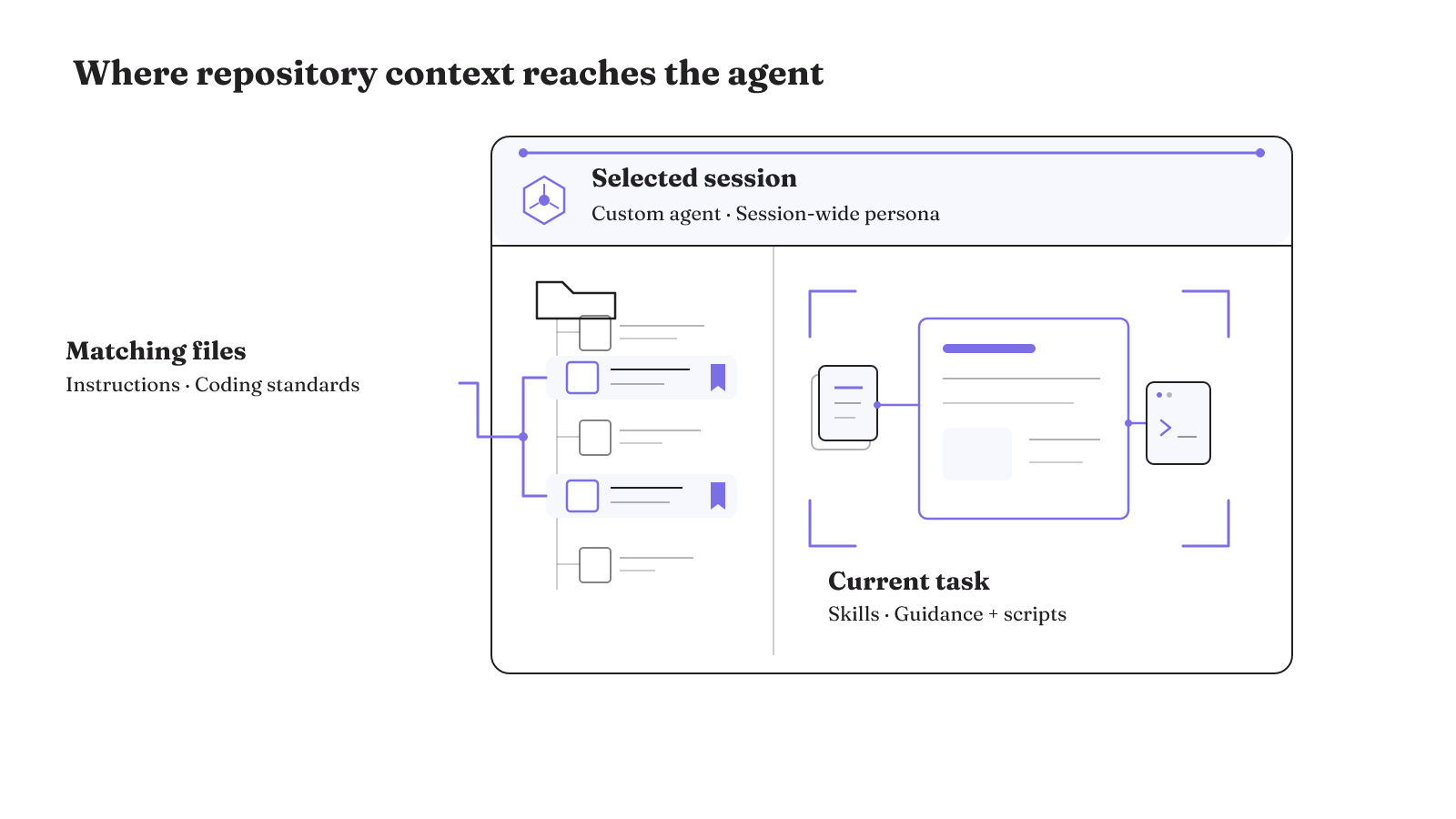
Pattern-scoped instruction files offer one precise mechanism. They can add relevant conventions only when an agent touches matching file paths, without consuming context for unrelated work. A repository can also communicate project knowledge through documentation hierarchies, formal specifications, single-source-of-truth discipline, and conformance testing.
The context can be divided into three layers:
- Instructions carry coding standards tied to file patterns. They appear when the matching paths are involved.
- Skills hold specialized guidance for a type of task and may include scripts.
- Custom agents provide explicitly selected, session-wide personas.
The layers solve different context problems. File-pattern instructions put local conventions near relevant files. A skill packages guidance around a kind of work. A custom agent shapes the selected session more broadly. Treating all three as one large prompt would erase those useful scopes.
Before comparing context-window size, inspect what the repository can communicate in durable form:
- Is project knowledge arranged in a documentation hierarchy?
- Which file patterns have their own coding standards?
- Do formal specifications state expected behavior?
- Where is the authoritative project information the agent must use?
- Do conformance tests express rules the implementation must satisfy?
Those questions do not assume that every repository needs every mechanism. They reveal whether the coding setup can receive precise project knowledge through more than a transient conversation. They also separate repository preparation from model capability.
This repository view also gives you a better comparison question. Do not ask only how much context a model accepts. Ask how the setup selects relevant project knowledge, where that knowledge persists, and whether specifications and conformance tests can make the expected behavior inspectable. The open-source coding-agent comparison can help when ownership of that surrounding stack is central to the decision.
Is agentic coding worth it for your task?
The honest answer is task-dependent. Results are partly contradictory about whether AI agents complete useful tasks or accelerate people. More autonomous steps are not, on their own, proof of faster engineering work.
On realistic coding tasks drawn from large, high-quality open-source repositories, models slowed human developers. Productivity claims should retain that task context.
There is also a separate operating-cost issue. Agentic workflows may call their underlying language models multiple times, which can increase computational cost. A setup may therefore complete a broader chain of actions while consuming more model calls. Productivity and metered usage remain separate parts of the decision.
Use a representative task to make the choice concrete. Define the files and commands the work requires, the state that must survive interruption, the review and tests a person will perform, the recovery mechanism available after a bad attempt, and the meter attached to execution. Then compare the setup against that contract. This does not predict a universal winner, but it makes the authority and review burden visible before consequential work begins.
Test value at the task level
Useful task completion and human acceleration are separate questions. Judge a setup on the outcome your task needs, not on autonomy alone.
Use the four interaction dimensions as a compact evaluation frame:
- Task alignment: Did the work stay aligned with the task you assigned?
- Verifiability: Could a person inspect the plan and resulting change?
- Steerability: Could a person redirect the work when the approach needed to change?
- Adaptability: Could the interaction adjust as the task developed?
Track metered usage beside that evaluation. Repeated model calls can increase computational cost, while Copilot documents separate use of Actions minutes and AI credits for its cloud agent. Human time and computational cost are not interchangeable measures, so keep both visible.
If you want to own more of the harness around the model, compare open-source coding agents by the stack you will own.