
Key takeaways
- Match orchestration to workflow complexity, risk tolerance, and scale.
- Inspect dependency health before bringing a repository into your environment.
- Test failed-call retry and checkpoint-based workflow resume as different recovery behaviors.
At Rifty, we treat an agent as a model plus its harness. The model supplies general intelligence. The harness supplies context, memory, tools, permissions, execution paths, evaluation, observability, and recovery. We use that system boundary to inspect agent repositories.
Start with the work. Then ask what the repository lets the agent do, what it records, where it stops, and how it recovers. Popularity still belongs in the inspection, but it gets one field. It does not stand in for control, state, security, evaluation, or cost. The same method works for a single AI agent project on GitHub and a multi-AI-agent project on GitHub.
When does a multi-agent repository fit the workload?
A multi-agent repository fits when its coordination model matches the work's complexity, risk tolerance, and scale. “Multi-agent” is a description of the architecture, not a verdict on whether that architecture is appropriate.
AI agent orchestration is the control layer that coordinates multiple agents so they can work safely and predictably at scale. It adds governance, shared context, and execution control across those agents. Those responsibilities are the substance of orchestration. The number of named roles or agents is not.
Start by describing the workload without framework labels. How complex is the workflow? What level of risk can it carry? At what scale must it operate? Those three conditions determine the appropriate orchestration approach. A repository should give you enough material to inspect how its coordination design answers them.
Separate coordination from delegation. List the agents the project coordinates, then locate governance, shared context, and execution control in its materials. These are the responsibilities orchestration adds across autonomous agents. Compare that operating design with the workflow's complexity, risk tolerance, and scale. A design can be transparent about task coordination and still carry the engineering burden of prompts, tools, tests, operations, and collaboration. The fit decision includes both the coordination design and the work required to operate it reliably.
AgentTeams provides a concrete example of a distinct coordination model. Its project materials describe an open-source collaborative multi-agent operating system that uses Matrix rooms for transparent, human-in-the-loop task coordination. That is a specific operating shape. You can compare it with the communication, visibility, and human-control needs of your workload without turning the project into a universal recommendation.
The engineering burden belongs in the decision. Reliable multi-agent research systems at scale require careful engineering, comprehensive testing, detailed prompt and tool design, robust operations, and collaboration among teams that understand current agent capabilities. Multi-agent decomposition has to earn that work. Put the documented coordination model beside the workflow's complexity, risk tolerance, and scale. That is the selection test.
For a broader architecture comparison, our guide to open-source AI agent frameworks keeps the workload and control contract at the center of the choice.
How to evaluate open source AI agents on GitHub
Evaluate a repository with the same eight inspection fields every time. Record what you actually observe instead of converting a star count, category label, or feature claim into an operating conclusion. This keeps unlike projects comparable without pretending they have all been tested in one benchmark.
| Inspection field | Repository evidence to find | Decision it informs | Observed result |
|---|---|---|---|
| Orchestration fit | Documented governance, shared context, and execution control | Whether the coordination design matches the workload | Record the repository evidence |
| Execution and cost limits | Execution caps, retry limits, real-time token monitoring, and a human cost-threshold alert | How the orchestrator bounds execution and runaway cost | Present, absent, or unclear |
| Checkpointed state | Checkpointing and workflow-state persistence | Whether workflow progress can persist | Present, absent, or unclear |
| Approval boundaries | Human approval before coding-agent workflows run | Where agent authority stops before a workflow runs | Record the approval point |
| Trajectory visibility | A complete record of outputs, tool calls, intermediate results, and interactions | Whether you can inspect the whole trial | Record what the trace retains |
| Dependency health | Dependency version, license, manifest file, and known-vulnerability status | What enters your dependency surface | Record the available fields |
| Usage-cost inputs | GitHub Actions minutes and AI credits, with AI-credit use based on model and processed tokens | Which usage inputs consume resources | Record each metered input |
| Popularity metadata | 2.8k stars, 35 watchers, and 773 forks recorded for kyrolabs/awesome-agents | Community attention as a separate observation | Record counts with their date |
The “observed result” column matters because documentation can answer a question clearly, partially, or not at all. “Unclear” is useful. It prevents an appealing label from filling a gap in what you know about the execution path.
Keep cost inputs concrete. Copilot cloud agent consumes GitHub Actions minutes and AI credits. Its AI-credit use depends on the model and the number of tokens processed during a session. Record each input separately instead of guessing a total bill.
Tool access changes the authority boundary
Tool access changes an agent from a system that produces text into one that can reach external surfaces. The repository inspection must therefore follow capability into authority: which tools exist, which resources they can reach, which credentials they receive, and where a human approval boundary applies.
Model Context Protocol is an open standard for connecting AI models to external tools and services. In Visual Studio Code, MCP servers can provide tools for file operations, databases, and external APIs. They can also provide resources, prompts, and interactive apps. In Visual Studio, MCP servers can extend agent capabilities with file access, repository management, and pull-request creation.
Those surfaces are concrete enough to inspect. Look for where the repository declares a tool, how the tool reaches a service, and what separates access to a file from permission to change a repository. Capability and permission should occupy different questions in your review.
Follow one tool path from declaration to action. Name the external service it can reach. Record whether it can read a file, operate on a database, call an API, manage a repository, or create a pull request. Then identify the credential or permission that makes the action possible. These questions keep a long tool catalogue from hiding the authority carried by one consequential integration.
Credential mediation is another visible design choice. Agent Vault describes itself as an HTTP credential proxy and vault for named AI agents as well as custom agents or harnesses. The DCP repository exposes a different boundary in its package structure. It separates vault, agent runtime, cryptography and policy, encrypted relay, Telegram approval, and desktop-vault responsibilities into distinct packages. These are two scoped examples, not claims that either design fits every workload.
Approval has a real operating tradeoff. When Copilot coding agent opens a pull request or pushes changes, it is treated like an outside contributor, and its GitHub Actions workflows require human approval before running. That approval protects access to tokens, secrets, and repository permissions. It also slows feedback about whether tests pass. Your repository review should preserve both sides of that boundary instead of scoring approval as simply good or bad.
Our analysis of an open-source agentic AI framework goes further into how execution paths and control contracts shape framework choice.
Evaluation must inspect risk, novelty, and silent failure
Agent evaluation needs automated checks, manual transcript review, and systematic human evaluation. A final answer can look acceptable while the path that produced it contains a failure that matters. The evaluation unit is therefore the complete trajectory, not only the last output.
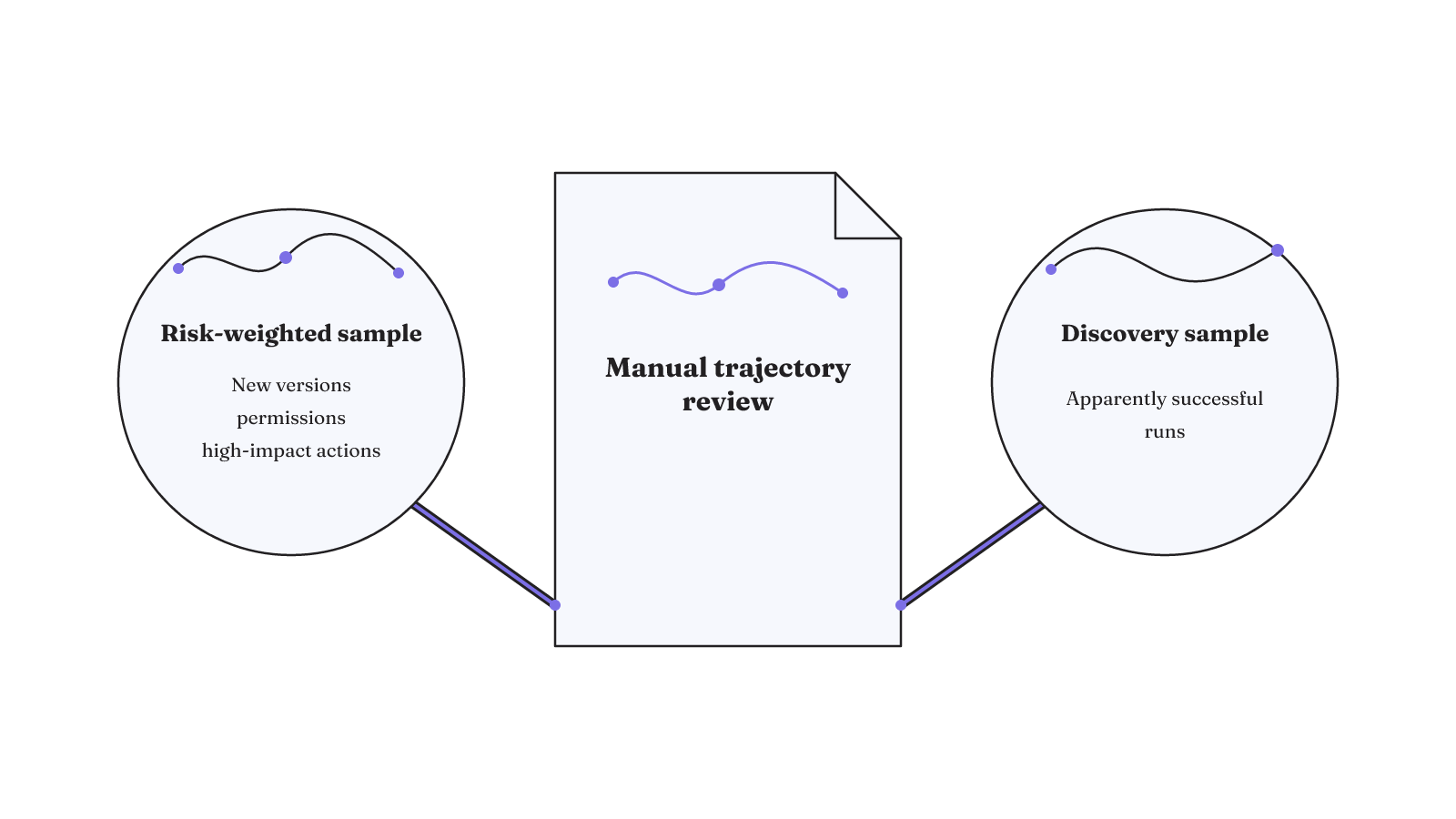
Human review should not sample every run as if it carried the same uncertainty. Heavier sampling should cover new agent versions, new tools, permission changes, high-impact actions, long trajectories, failed retries, grader disagreement, and out-of-distribution tasks. Each condition changes what the agent may do or makes an unusual path more likely to deserve attention.
Known failures are not the whole review queue. An evaluation program should retain a discovery sample of apparently successful runs. Reviewing only failures already identified by automated systems cannot uncover silent trace failures that those systems passed. This is the uncomfortable but useful part of evaluation: “success” is still a sampling category.
Risk testing also needs named categories. It includes testing a system's predisposition toward harmful content and its vulnerability to jailbreak attacks. GitHub's product-specific agent evaluations give a concrete example of the range: hate and unfairness, sexual content, violence, self-harm, protected material, jailbreak, and code vulnerability. The list belongs to that product's evaluation program, but it shows the level of specificity to look for in a repository's evaluation materials.
This changes how you read an eval folder or benchmark report. Look for the connection between the test, the trajectory retained for review, and the sampling rule that decides which runs reach a human. A transcript includes outputs, tool calls, intermediate results, and interactions, so manual review can examine more than the final response. Automated scores remain useful, but they do not replace manual transcript review or a deliberate discovery sample.
What does inspectable observability look like?
Inspectable observability makes agent behavior available as trajectories, traces, benchmarks, and persistent records. It gives an evaluator material to compare and review instead of reducing a run to its final response.
Agent Health offers a project example. Its materials describe an open-source evaluation and observability framework for AI agents, distributed as the @opensearch-project/agent-health NPX package. The project describes four mechanisms: automated trajectory comparison with an LLM judge, real-time OpenTelemetry trace visualization, structured benchmarking, and OpenSearch-backed persistence.
Treat those as observable repository claims to inspect, not a substitute for workload testing. The package name identifies the implementation surface. Trajectory comparison identifies the evaluation mechanism. Trace visualization identifies the live inspection surface. Structured benchmarks and persistent storage identify how comparisons and records can be carried across runs.
Search the repository for the package entry point, tracing setup, benchmark definitions, and persistence configuration. Those surfaces let you verify whether the four mechanisms described by the project are represented in code and configuration.
That separation helps you ask a precise question: does the repository retain enough of the execution path to investigate the failures your evaluation plan is meant to catch?
Recovery is a state problem, not a retry setting
Recovery is not proved by a retry option. In an agentic system, a minor issue can derail execution because a failed step can send agents down a different trajectory and produce an unpredictable outcome. The repository has to show what happens to workflow state around the failure.
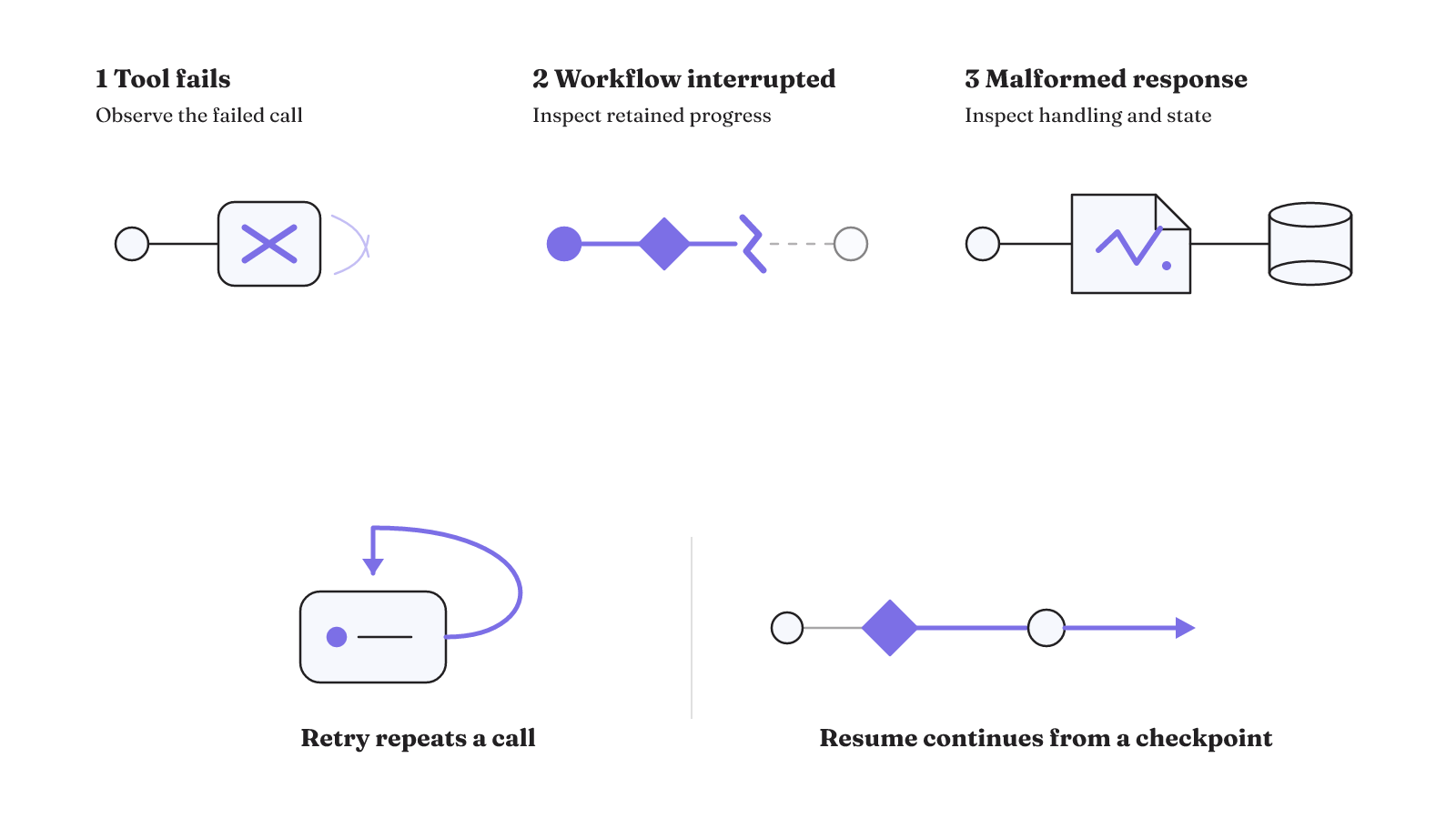
Use one scenario and run three distinct tests:
- Make a tool fail during a workflow and observe the failed-call behavior.
- Interrupt the workflow after some steps have completed and inspect what progress remains.
- Return a malformed model response and observe how the workflow handles it.
Recovery testing should cover tool failures, interrupted workflows, and malformed model responses. Together, these tests expose more than a happy-path demo because they disturb different parts of the execution path.
The key distinction is between retry and resume. Retrying a failed API call repeats that failed call. Resuming from a checkpoint continues from retained workflow progress. Without checkpointed progress, a resume can re-execute completed steps and corrupt state. Retry logic can therefore behave correctly while workflow recovery remains unsafe.
Checkpoint support can be visible before you run a failure test. Core agent-framework workflow implementations support checkpointing and workflow-state persistence. That establishes a concrete state capability in those implementations. The recovery test still has to show what retained progress does after a tool failure, interruption, or malformed model response.
Run all three disturbances against one workflow. During the tool failure, record the failed call and any completed steps. After interruption, inspect the retained checkpoint before resuming. For the malformed response, record how the workflow handles the response and what state remains. These observations separate call-level retry from workflow-level recovery without assuming that one proves the other.
Inspect the state implementation, checkpoint mechanism, and failure tests as one recovery surface. Do not infer checkpoint-based resume from a retry setting. Ask the repository to show where progress is written and what the workflow does after interruption.
What should you inspect before adopting the repository?
Inspect the dependency surface before the repository enters your environment. GitHub dependency review can catch insecure dependencies before introduction and expose license, dependent, and dependency-age information.
The dependency graph and dependency review answer concrete repository questions. The graph can show the version, license, manifest file, and known-vulnerability status for each dependency. Dependency review can expose license, dependent, and dependency-age information while catching insecure dependencies before introduction. Record the fields you can see instead of reducing this surface to a security badge.
Require five visible controls in your repository review:
- vulnerability scanning;
- suggested dependency updates;
- license information;
- dependency age; and
- continuous monitoring through the CI/CD pipeline.
Dependency-maintenance controls should scan for vulnerabilities, suggest updates, and run continuously through CI/CD. Record what the repository exposes and leave unknowns as unknowns.
Once you have inspected workload fit, control, state, authority, evaluation, recovery, dependencies, and cost, compare the open-source agent harnesses that fit your workload.