Key takeaways
- Traditional automation repeats predefined steps. Agentic AI chooses actions from current conditions.
- Add multi-step agency only after simpler, evaluated approaches fall short.
- A hybrid architecture can keep a workflow in control while an agent supplies adaptability.
The practical question is not whether an agent sounds more advanced. Ask whether the path can be encoded before execution, then examine the consequence of the actions the system may take.
The difference at a glance
| Signal | System behavior | Control choice |
|---|---|---|
| Predictable, high-volume work | Repeats an encoded path | Use a deterministic playbook |
| Novel conditions break fixed logic | Selects tools and chains actions at runtime | Use a bounded agentic step |
| Read-only intelligence work | Produces intelligence without a write action | Autonomous execution can fit |
| An action is irreversible, costly, regulated, or has a high blast radius | Creates a consequential side effect | Require an approval gate before the action |
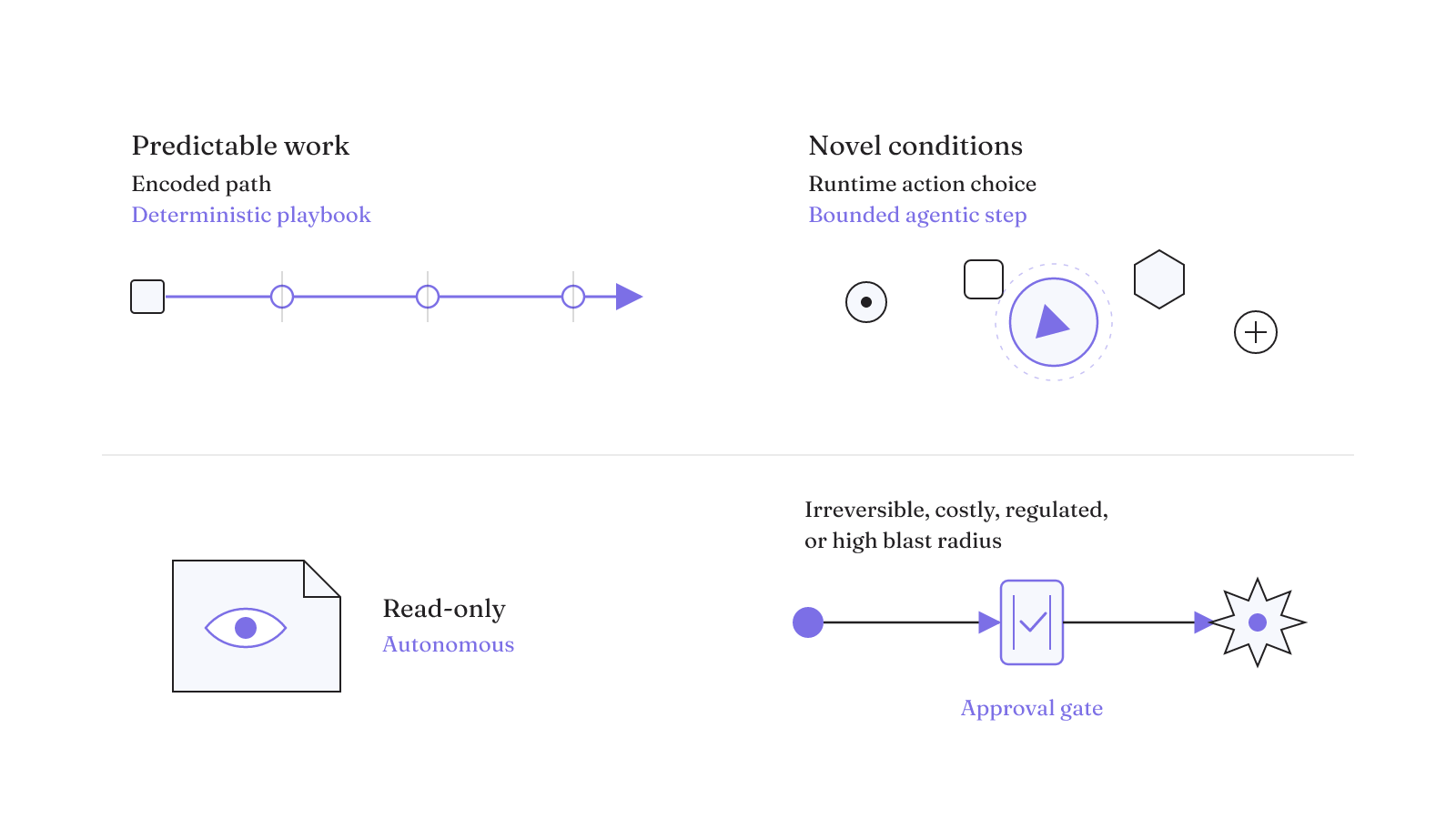
An approval gate places a verification checkpoint before a side effect. It does not remove the agentic step. It changes who authorizes the consequential action.
How does agentic AI differ from traditional automation?
Traditional automation follows steps encoded before the run. An agent evaluates what it observes and selects an action during the run. That operating difference is the cleanest answer to how agentic AI differs from traditional automation.
This gives you a more precise test than asking whether a workflow contains an AI model. A model can sit inside a predefined sequence while the workflow remains deterministic. The steps around the model still decide what happens and in what order. The agentic boundary appears when the system can evaluate its situation and select an action from that observation. The model is part of both designs. Runtime control flow is what separates them here.
Think about the mechanism. A conventional script receives an input and executes the same predefined sequence regardless of current conditions. An agent instead perceives its environment, processes information, and acts toward a goal. It may plan, execute, inspect what happened, and iterate toward that goal. The action path can therefore emerge while the system is running, rather than existing as a complete sequence in advance. Agentic workflows and agents express that distinction in different ways.
This also answers how agentic AI is different from traditional automation described as reactive AI. In the narrow, useful comparison, the reactive system follows its predefined response. The agent uses the situation it encounters to choose what to do. It can reason through ambiguity, act across tools, and handle multi-step tasks. That is a change in control flow, not a claim that every variable task needs an agent.
The word "autonomy" can hide this mechanism. The concrete behavior is action selection. An agent may choose a tool, act through it, process the new situation, and choose again while working toward a goal. Traditional workflow automation can still include sophisticated models, but its encoded sequence remains in charge of the run. This is the key difference between workflow automation and agentic AI.
The same boundary helps with broader questions about agentic AI and traditional artificial intelligence. If the traditional AI model sits inside a fixed workflow, the workflow still determines the path. Adding an agent harness gives the model a way to select and use actions toward a goal. For a closer look at the shape of that execution, the agent loop glossary follows the concept at the loop level.
Runtime choice does not make the surrounding engineering optional. An agent is only as effective as its tools. Tool quality and the control placed around tool use are part of the system, not implementation details to revisit after deployment.
When is traditional automation the better choice?
Traditional automation is the better choice when every step follows a predictable pattern that you can encode before execution. In that setting, runtime path selection adds complexity without answering a path problem.
Daily portfolio risk-report generation is a concrete example. It can use a deterministic workflow when every step follows a predictable pattern. The workflow does not need to form a new plan during every run. Its strength is that the path has already been decided.
That strength deserves equal weight in any comparison of workflow automation and agentic AI. Fixed workflows fit predictable work. Agents become relevant when the system must select among actions from the conditions it encounters. Architectural complexity is not a measure of progress.
Start with the simplest approach that can do the work. Current engineering guidance recommends evaluating simple prompts first and adding multi-step agentic systems only when simpler solutions fall short. This is a useful test for variable inputs too. Variation alone does not establish that the execution path must be chosen at runtime.
Agentic errors can redirect the whole trajectory
Runtime choice changes the shape of failure. In a multi-step agentic system, a failed step can redirect what the system does later. The problem is not limited to one bad output at one known location.
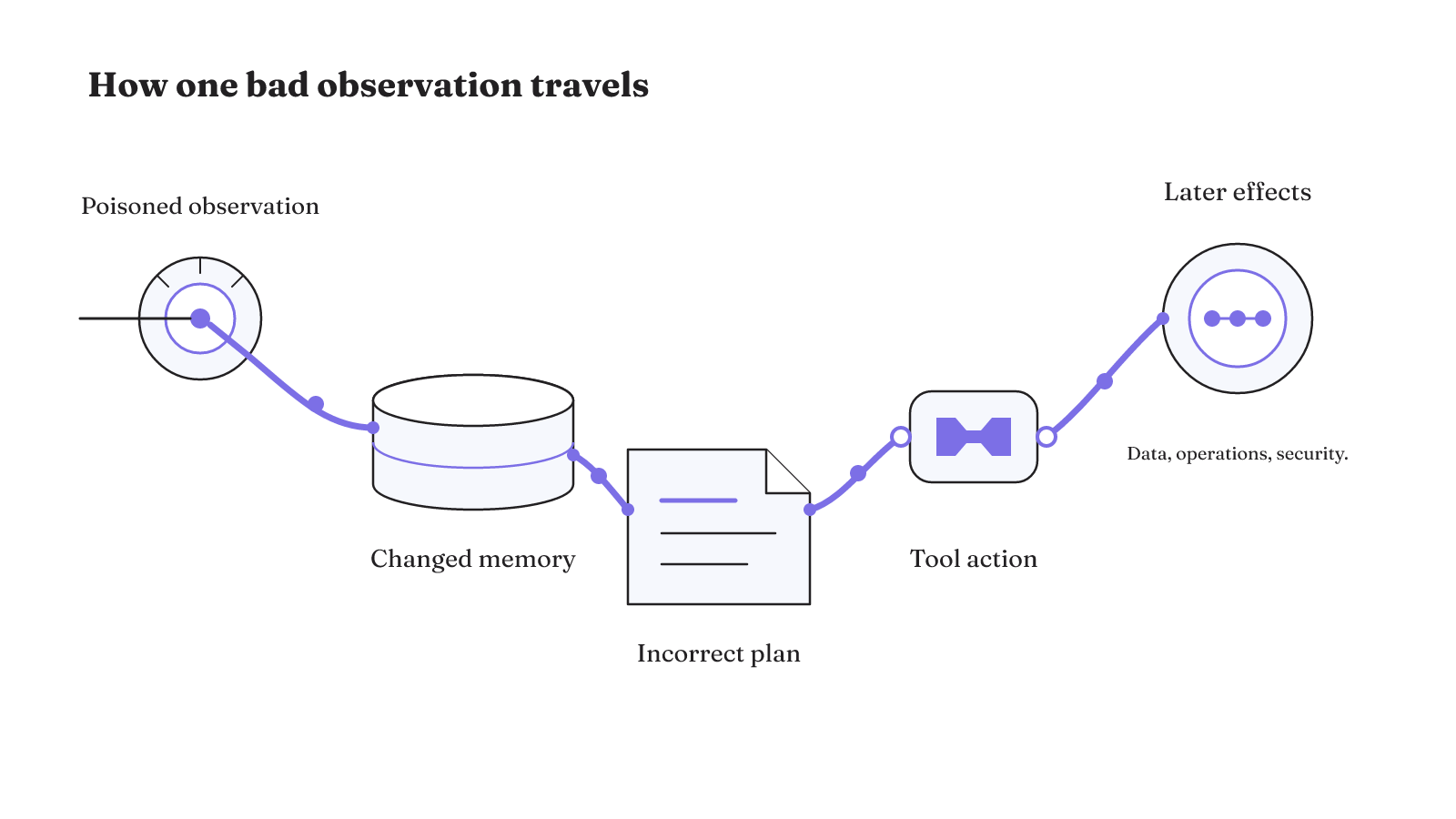
Errors can compound in agentic systems. If one step fails, the agent may explore a different and unpredictable trajectory. That means a local error can alter the later sequence of decisions and actions. Uncontrolled inaccuracies can also propagate through a multi-step workflow instead of remaining at the step where they began.
Propagation and redirection describe two useful failure shapes. Propagation carries an inaccuracy into later steps. Redirection changes the trajectory the agent follows after the failed step. A system that can select later actions from its current condition can encounter both. You need to know not only that an error occurred, but also which later choices were made after it.
Consider the full failure chain supported by an agent loop. A poisoned observation can alter memory. The changed memory can produce an incorrect plan. That plan can trigger a tool, and the result can influence later steps. Each stage carries forward the effect of the earlier observation.
This is why checking only the final prose response is too narrow for a tool-using agent. When a system can access tools, make decisions, and execute workflows, risk extends to actions affecting data, operations, and security. The output may be a recommendation, but the next step may be a write action or an external communication. Those are different consequences.
The difference is structural. A predefined workflow gives you a known path on which to place checks. An agent may select a path that was not authored as a complete sequence. You therefore need visibility into the trajectory that produced an action, along with controls that can constrain or stop the trajectory while it is still running.
None of this makes deterministic automation immune to error. Its advantage here is narrower: the execution path is known in advance. Agentic flexibility lets the system respond to conditions, but the same flexibility creates more possible trajectories for a failure to enter and spread through.
Production agents need layered controls
A production agent needs controls around inputs, tools, and human intervention. A single instruction in the prompt cannot cover every point where runtime choice meets the outside world.
Start at the input boundary. Input filtering is one layer of a broader production guardrail design. It governs what reaches the agent before planning and tool selection begin. Output validation belongs at system boundaries, including the point where one agent passes work to another.
Then restrict the action surface. Scope can be technically enforced with restricted tool access and time-bound credentials. These controls determine what the agent can reach and how long its authority lasts. They are stronger boundaries than a natural-language request to stay within scope. Output validation at agent-to-agent boundaries gives the receiving component a defined checkpoint before it accepts the result.
The planning layer should remain legible. Agent design guidance favors simplicity, visible planning steps, and thoroughly documented and tested tool interfaces. Visible plans let an operator inspect the route the agent intends to take. Tested interfaces reduce ambiguity at the point where a model turns a choice into a tool call.
Execution needs its own controls. Scoped credentials limit authority. Signed tool outputs provide a way to control what later steps accept. Strict stop conditions define when execution must end. Model-version pinning fixes the model version used by the system. Red-team tests exercise the controls, while rollback procedures provide a recovery path after an action. Immutable traces preserve the execution record for inspection.
These mechanisms solve different parts of the control problem. Access restrictions bound what an agent can do. Validation checks what crosses a boundary. Traces show what happened. Stop conditions end a run. Rollback procedures address recovery. Treating them as one generic safety layer makes it harder to see which failure each control is meant to contain.
Control ownership should follow the execution path. Before the run, input filtering governs what enters. At tool selection, restricted access and time-bound credentials constrain available authority. At a component boundary, output validation checks what moves forward. During execution, traces preserve the route while stop conditions can end it. After a bad action, rollback procedures define the recovery mechanism. The stack is concrete because each control meets a different part of runtime choice.
Evaluation closes the loop between observed failures and future behavior. Early investment in agent evaluations turns failures into test cases, helps prevent regressions, and replaces subjective impressions with metrics. A trace tells you what the system did during one run. An evaluation lets that run become a repeatable check. For a broader architecture view, AI agent architectures shows where these controls sit around agent execution.
That evaluation cycle can begin with an observed failure. Turn the failure into a test case, run the case again as the system changes, and use the resulting metric to identify a regression. This is more useful than relying on a general impression that the agent now behaves better. It also gives a failed trajectory a durable role in later engineering work.
Where should humans stay in the loop?
Keep humans at defined handoff points, especially early in deployment and before consequential actions. Human oversight works best here as an explicit control path, not an assumption that someone will notice trouble.
Early deployment is where human intervention can help identify failures, uncover edge cases, and establish an evaluation cycle. It also gives the system somewhere to transfer control when the agent cannot complete a task. The transfer condition should be concrete. Retry or action limits can trigger human intervention once the agent crosses the set failure threshold.
That produces a clear handoff mechanism. The agent attempts the bounded task. A retry or action counter records its progress. Crossing the limit stops further autonomous attempts and transfers control to a person. The limit does not claim that every failure will look the same. It establishes a point after which the agent may not keep trying on its own.
Approval gates address a different moment. A bounded human-in-the-loop workflow can let the agent propose an action and require a human to approve it. This keeps the agent's ability to form a recommendation while withholding permission to perform the action immediately. It is particularly relevant when the proposed action is irreversible, costly, regulated, or carries a high blast radius.
The reviewer needs enough visibility to make that approval meaningful. A review interface should expose why the recommendation was made, which data was considered, what alternatives were evaluated, and which business rules were applied. A bare approve button hides the judgment that needs review.
Each part of that view answers a concrete approval question. The reason explains the basis for the recommendation. The data shows what the agent considered. The alternatives reveal which other paths it evaluated. The business rules show the constraints applied to the choice. Together, those details expose the agent's proposed judgment before a person authorizes the action.
Human intervention and technical controls are complements. Restricted tools and credentials define the available action space. Retry limits define when the agent must stop. The review interface exposes the basis for the proposed action. The person then decides whether that action may proceed. If you are working through a concrete build, building agentic AI systems keeps that control question connected to the surrounding system.
Use workflows and agents together
You do not have to choose one control structure for an entire process. A hybrid architecture can keep a deterministic workflow in charge of control while an agent supplies runtime intelligence and adaptability inside a bounded step.
The workflow can decide when the agent runs, what input it receives, which tools it can use, and where execution returns afterward. The agent can select actions within that defined segment. Approval can still sit before a consequential side effect. This pattern preserves a predefined outer path while allowing runtime choice where fixed logic falls short.
Deployment can begin with a small capability, validate it with real users, and expand over time. That creates room to observe failures and build evaluations before increasing what the agent can do. It also keeps the architecture tied to a demonstrated need instead of treating full autonomy as the starting point.
Apply the matrix to one workflow you already understand. Mark whether its path can be encoded in advance, then mark whether each possible action is read-only or consequential. If the boundary still feels abstract, test it against a real agentic AI example and compare where runtime choice begins.