Key takeaways
- Agentic means a delegated, long-horizon task: real tools, many steps, iterating toward a goal.
- Real case: OpenAI's Codex became the primary work tool across every department.
- But 63% of technologists still keep agents supervised, not on autopilot.
Search "agentic ai example" and you get the same thing six times: a numbered list of examples of agentic AI by industry, presented as if every one runs itself. The lists are not wrong. They are just not useful, because they hand you cases to memorize and no way to judge the next system you meet. This page does the opposite. Here is a test you keep, a few real and current examples of AI agents, and one decision the listicles never give you.
What makes something an agentic AI example
Start with the plain version. An agentic AI example is a system you hand a goal, not a prompt. It runs on its own for minutes or hours, calls tools, acts in its environment, and keeps iterating until it reaches the goal. That is the real shift. The unit of work moves from a short chatbot turn to a delegated, long-horizon task.
None of this works without the model underneath. Frontier models are defined in part by their ability to reason through hard problems, write software, and drive agents that use digital tools on their own. That tool-use capability is the floor. Below it you do not have an agent. You have a text box.
There is no single agreed definition, and vendors stretch "agentic" to cover ordinary automation with a language model bolted on. That is exactly why you need a test, not a longer list.
The test: genuinely agentic, or automation with an LLM on top
Run four questions on any system someone calls agentic:
- Did you delegate a goal, or send a single request?
- Does it run over many steps, not one turn?
- Does it use real tools and act, or just talk?
- Does it check its own results and iterate?
Now run it on the two systems everyone already has in mind.
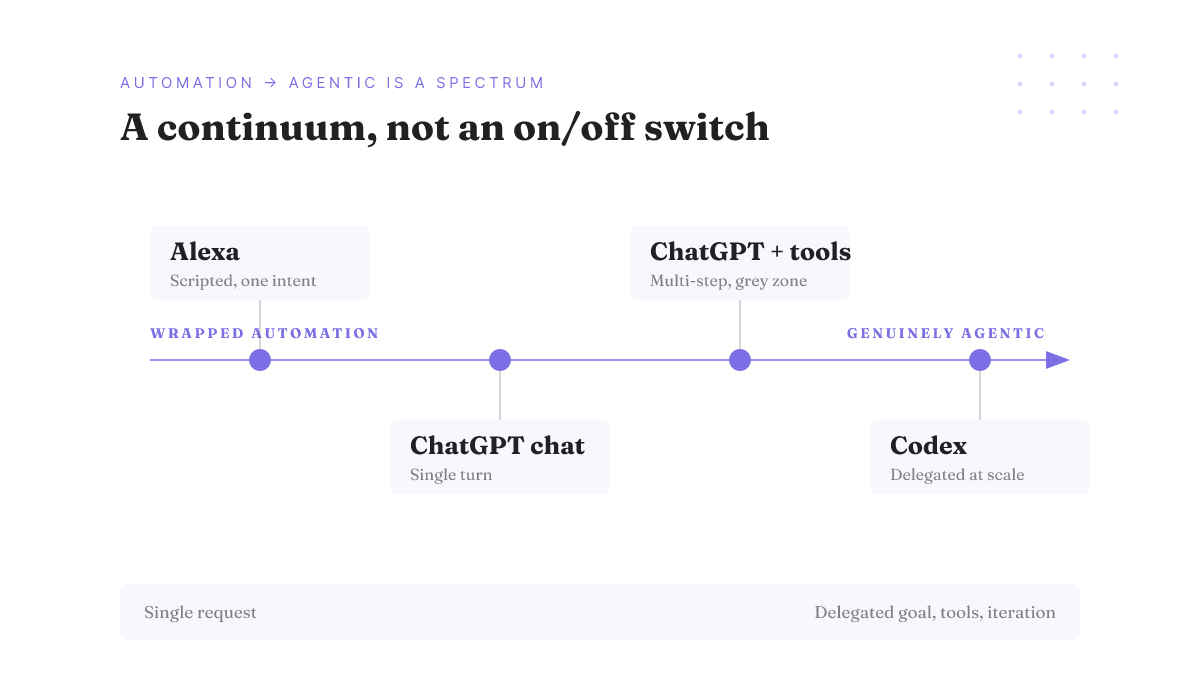
Is ChatGPT an agentic AI? In its plain chat form, no. You send a message, it answers, the turn ends. That is single-turn response, not delegated work. Point the same product at a task, give it tools, and let it run over many steps, and it crosses into agentic territory. The label depends on the mode, not the brand.
Is Alexa an example of agentic AI? Mostly no. It matches your request to a scripted action: play a song, set a timer, read the weather. One intent, one response, no iteration. A voice assistant that booked a flight by itself, checking prices and rebooking when a leg fell through, would pass. The one you own today does not.
The line is a spectrum, not a switch. A scripted assistant that makes one tool call sits in the grey zone, and reasonable people will argue the edge cases. The test does not remove the argument. It tells you which question you are actually arguing about.
Forget the "five types" lists, think in patterns
You will see posts promising "the 5 types of agentic AI." There is no canonical five. The honest way to carve it up is by pattern, and the patterns you actually meet are few: a single supervised agent doing delegated work, a team of agents in collaborating roles, a control-oriented graph for non-linear logic, and a data-grounded agent that looks things up before it acts. Learn those four and any new "type" someone markets to you slots into one of them, or reveals itself as automation wearing the label.
A real example, and the leash that comes with it
Here is a current one that is easy to check against the test. At OpenAI, Codex went from under 10% of the average worker's token use through August 2025 to the primary AI tool for work across every department, including non-technical ones like Legal and Recruiting. That is delegation at scale. People hand whole tasks to an agent and get work back, not autocompleted sentences.
Now the part the listicles skip. Adoption jumping does not mean the humans left the room. 63% of technologists still rarely or never let agents run fully unattended, and the industry is settling into single-agent workflows where a person reviews the output. So read the Codex story correctly. It is an agent that got trusted with more, not an agent that got left alone.
Both numbers are a snapshot of 2026, not a permanent state. Treat them as where things stand, and do not stretch them into "agents are autonomous now." They are not.
Agentic AI in finance and banking, and the governance clock
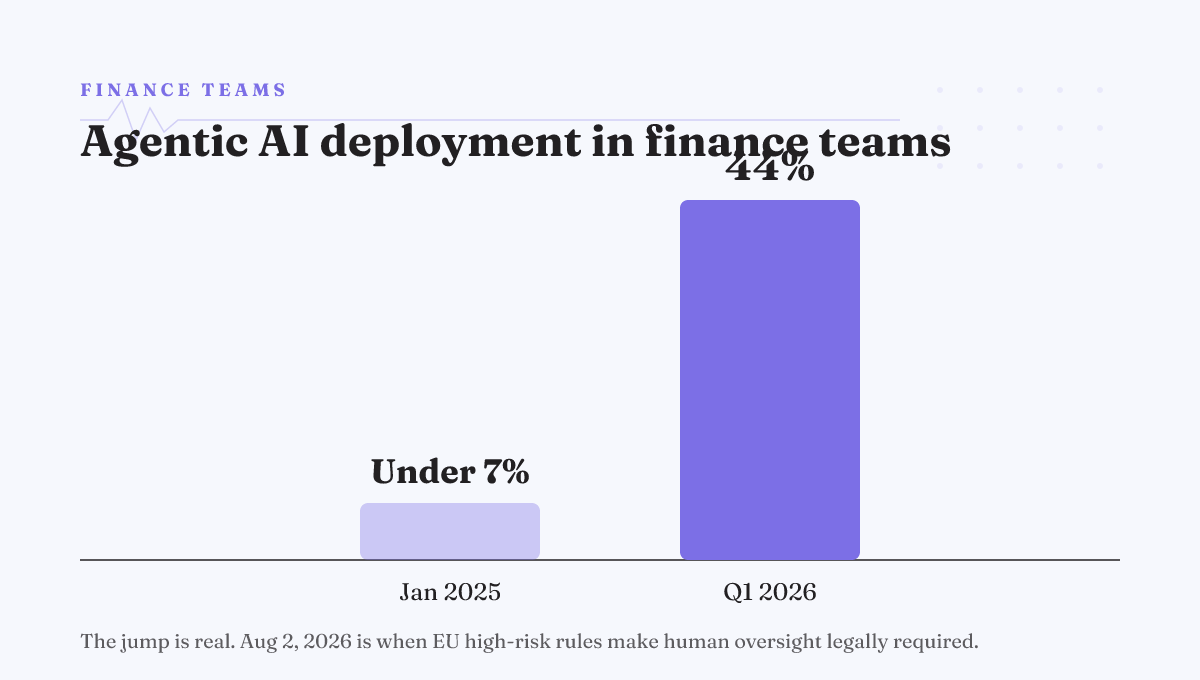
Finance is where you can watch the definition land in a regulated domain. Agentic AI deployment among finance teams rose from under 7% in January 2025 to 44% by the first quarter of 2026. In banking that means agents that plan and run multi-step work with limited supervision: fraud checks, anti-money-laundering monitoring, credit decisions. That is the clearest real-world answer to what agentic AI examples in banking actually look like.
It is also where governance stops being optional, and this is the part no use-case list mentions. The EU AI Act is the first comprehensive legal framework on AI, setting risk-based rules for the people who build and deploy these systems. Its high-risk provisions become fully enforceable on August 2, 2026. After that date, explainability, human oversight, and auditability are legal requirements for uses like fraud detection and credit scoring, with penalties up to 35 million euros or 7% of global annual turnover, whichever is higher.
One caveat for a global reader: this is EU law, not a worldwide default. If you operate in the United States or elsewhere, the Act still reaches you the moment you have EU users or EU data, but your home regulator may set a different bar. Watch August 2, 2026 if the EU is in scope, and map your own jurisdiction's rules alongside it.
Agentic AI in software development
For builders, software development is the example set that hits closest to home. Early 2026 marked a shift from generative text completion to what people now call "agentic engineering," where agents navigate a codebase, reason about it, and architect changes with minimal human intervention. That is a change in kind, not just better autocomplete. Codex is the proof of it in daily use.
Read "minimal human intervention" as the direction of travel, not today's median team. Most engineering groups still sit against that same 63% reality. The agent drafts, a human reviews and merges. The gap between the demo and the merge queue is where the supervision lives.
Which framework you would actually reach for
This is where "show me example code" and "which Python framework, which GitHub repo" really point. The honest answer is a decision, not a snippet. The landscape expanded sharply in 2026. OpenAI, Anthropic, and Google each shipped agent development kits, Microsoft rebuilt AutoGen, and the ecosystem now spans more than 120 tools across roughly 11 categories. That is too many to try, so match the framework to the job.
Here is the map that holds up:
| The job | Reach for |
|---|---|
| Agents in collaborating roles (a team) | CrewAI or AutoGen |
| Tight control over non-linear logic (branches, state, retries) | LangGraph |
| Grounding an agent in private or real-time data (RAG) | LlamaIndex |
On "what is the most popular agentic AI": there is no single winner, and picking one by fame is the wrong move. If you want a rough signal of mindshare, LangGraph is among the most-starred, with roughly 37,000 GitHub stars. Read that as popularity, not proof it fits your job.
Why not paste example code here? Because the choice is consequential and it churns fast. Someone who built the same research agent six ways, across the main Python frameworks, found only two held up under a real build. Runnable code copied from a blog goes stale in weeks and hides that failure. Go to each framework's own docs for the current, working example, then choose by the job in the table above. If you want the choice framed by the harness rather than the feature list, that is a separate read on AI agent frameworks.
When one agent is enough, and when a build earns a second
Now the decision the listicles never hand you: one agent or several?
Default to one supervised agent. That is where most of the industry actually sits, with 63% keeping a human in review. A single agent with good tools and a person checking output solves more real workloads than the multi-agent demos suggest.
Add a second agent only when the work genuinely splits into different roles that collaborate: a researcher and a writer, a planner and an executor, a maker and a checker. That is the job CrewAI and AutoGen exist for. If your logic is one path with branches and retries rather than a team of roles, you do not need more agents. You need control, which is LangGraph's job. If the agent keeps guessing at facts it should look up, ground it in your data with something like LlamaIndex instead of adding headcount.
More agents is not more capability. Each one you add brings coordination cost and new failure modes: agents waiting on each other, looping, or disagreeing. Most workloads do not earn the second agent. Make it prove it does. The deeper mechanics of that live in building agentic AI systems.
The checklist to keep
Keep this and run it on the next system someone calls agentic.
- Did you delegate a goal, not send a single request?
- Does it run over many steps, not one turn?
- Does it use real tools and act in its environment?
- Does it check its results and iterate toward the goal?
- Does the work split into collaborating roles, or is one agent enough?
Four yeses on the first four questions, and it is genuinely agentic. Mostly no, and it is automation with a language model on top, whatever the marketing says. The last question decides single versus multi. Reach for more agents only when the work truly splits into roles. Default to one, supervised, because that is where the reliable work is.
One honest limit. Passing this checklist means a system is agentic. It does not mean it is reliable, cheap to run, or safe to leave alone. A thing can be fully agentic and still wrong half the time, which is the whole reason 63% of teams keep a hand on it.
So here is where this leaves you: a test you can run in ten seconds, and a decision you can defend in a design review. The examples will keep changing. Codex will be old news, the finance numbers will move, the framework leaderboard will reshuffle. The test does not move. If you want the layer beneath it, the piece on what actually makes an agent autonomous goes deeper on the supervision line these examples keep bumping into.