Key takeaways
- Generative AI produces output for a person to use.
- Agentic AI can coordinate multistep work and act without a human intermediary.
- Add delegation only after simpler prompts fall short, and only with clear objectives and tools, limited data, and reversible errors.
Agentic AI versus generative AI at a glance
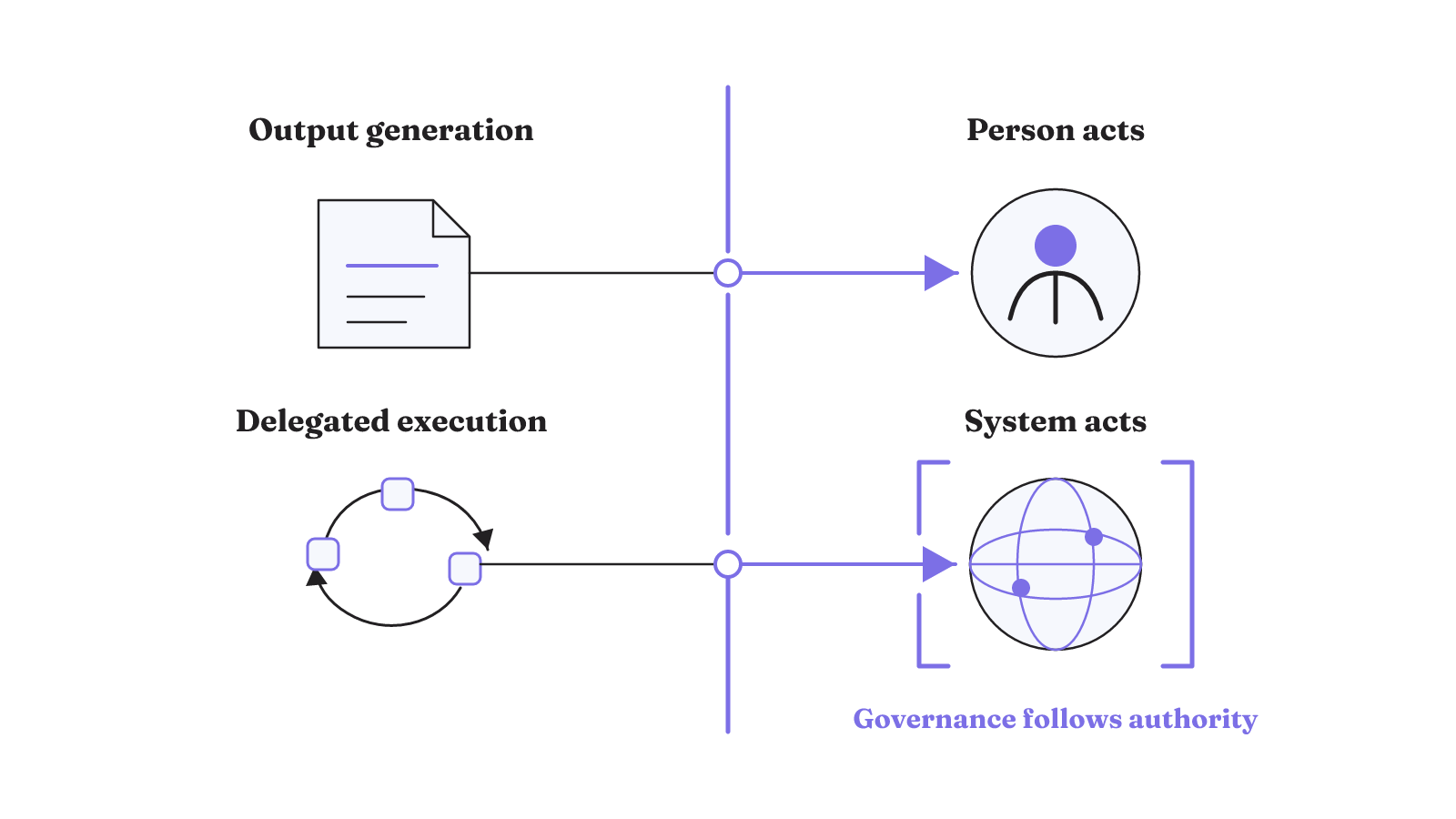
The difference between generative AI and agentic AI is not a contest between two levels of intelligence. It is an operating boundary. Generative AI answers questions, while agents solve problems. An agent can act on a person's behalf with substantial independence. That changes the design work around the model.
| Criterion | Generative AI | Agentic AI | Design consequence |
|---|---|---|---|
| Output | Creates, summarizes, or transforms information | Plans, coordinates, and completes multistep tasks | Decide whether a person or the system carries work forward |
| Core behavior | Reacts to input and creates output | Makes decisions and takes action to keep a process moving | Define what the system may decide |
| Independence | Produces an answer for a person to use | Can perform a workflow on a person's behalf with substantial independence | Set authority boundaries before execution |
| World-state change | Leaves the consequential action to a person | Can change world state without a human intermediary | Control access, identity, and runtime behavior |
| Governance | The person remains between output and action | Governance covers authority, access, evaluation, guardrails, monitoring, and incident response | Build oversight and recovery around delegated action |
The model is only one part of agentic behavior
A capable model does not become an agent merely because a product label says so. Advances in reasoning, multimodality, and tool use have enabled LLM-powered agent systems. The model supplies important capability, but the surrounding system determines what information reaches it, what actions it can take, and how those actions connect to a larger workflow.
Start with context. Context engineering curates the information entering the model's limited attention budget at each step. That step-specific framing matters because an agent does not make one isolated generation. It works through a sequence. The information needed for one step may not be the information needed for another. A useful harness therefore has to decide what enters the model's attention each time the loop runs.
That creates a context decision inside every pass through the loop. The immediate question is not how much information the system can collect. It is which information should enter the model's limited attention budget for this step. Curating that input keeps context tied to the work the model is doing now. When the loop advances, the context decision happens again for the new step.
Tools form a separate layer. An agent's effectiveness depends on the tools it receives. If the task calls for an action, the relevant capability has to exist at the tool boundary. That boundary also makes the system's authority concrete: the available tools define the actions the agent can attempt.
Tool design therefore changes more than convenience. It changes what work is possible inside the loop. A model without an effective tool can still generate text about an action, but the agent's effectiveness depends on whether its tool set supports the required work. Tool review belongs beside task review because the objective and required tools both have to be clear before delegation is a suitable candidate.
The interface between the agent and the computer deserves the same care as any other production interface. Effective implementations emphasize simple design, visible planning steps, and documented, tested agent-computer interfaces. Visible planning gives an operator something inspectable. Documentation makes the available action surface legible. Testing checks whether the interface behaves as expected when the agent uses it.
These interface practices also separate three questions that are easy to blur in a demo. Can the model form a plan? Can the agent express that plan through the interface? Has that interface been documented and tested? A convincing response from the model answers only the first question. Agentic behavior depends on the surrounding path from plan to computer action.
These mechanisms explain why an agentic system is more than a prompt wrapped around a model. The model produces the next decision or instruction inside a loop. Context, tools, and interfaces shape what that decision can use and what it can do. Our note on where the model ends and the agentic system begins examines that boundary more closely.
Agentic AI examples include web action, collaboration, and autonomous decisions
Agentic AI examples become useful when they name an observable behavior. "Uses AI" tells us very little. Acting on the web, coordinating several agents, or making an autonomous operational decision tells us what kind of system we are evaluating.
One current product-surface example is ChatGPT agent, which can take actions on the web. The precise name matters. This capability belongs to ChatGPT agent, not to every interaction or surface carrying the ChatGPT name. The behavior to notice is action: the system can do something on the web instead of stopping after it generates guidance for a person.
A second example is collaboration. Multi-agent systems are networks of agents that collaborate to solve complex problems. This is an architectural pattern, not a maturity score. More agents do not settle whether the design is suitable. They establish that coordination among agents is part of the system being built. For a sharper boundary between the terms, see our comparison of AI agents and agentic AI.
A third example appears in financial risk management. Agentic AI can continuously analyze market trends and make autonomous decisions about position limits or credit exposure from real-time data. The relevant difference is not the industry label. It is that analysis feeds an autonomous decision about a live operational boundary.
The three examples expose different forms of delegation. Web action delegates activity on a web surface. A multi-agent system delegates parts of a complex problem across collaborating agents. The financial-risk example delegates autonomous decisions about position limits or credit exposure. Classifying the behavior this way keeps the architecture visible. It also avoids treating every system that generates a plan as a system that can carry the plan out.
These examples also show why the comparison cannot stop at content quality. Once a system can act, coordinate, or make an operational decision, the builder has to decide whether delegation is warranted at all.
Which is better, GenAI or agentic AI?
Neither is categorically better. Start with the simpler design. Add a multistep agentic system only when simpler prompts and solutions fall short. The first design decision is therefore whether generation has failed to meet the task, not whether an agent appears more advanced.
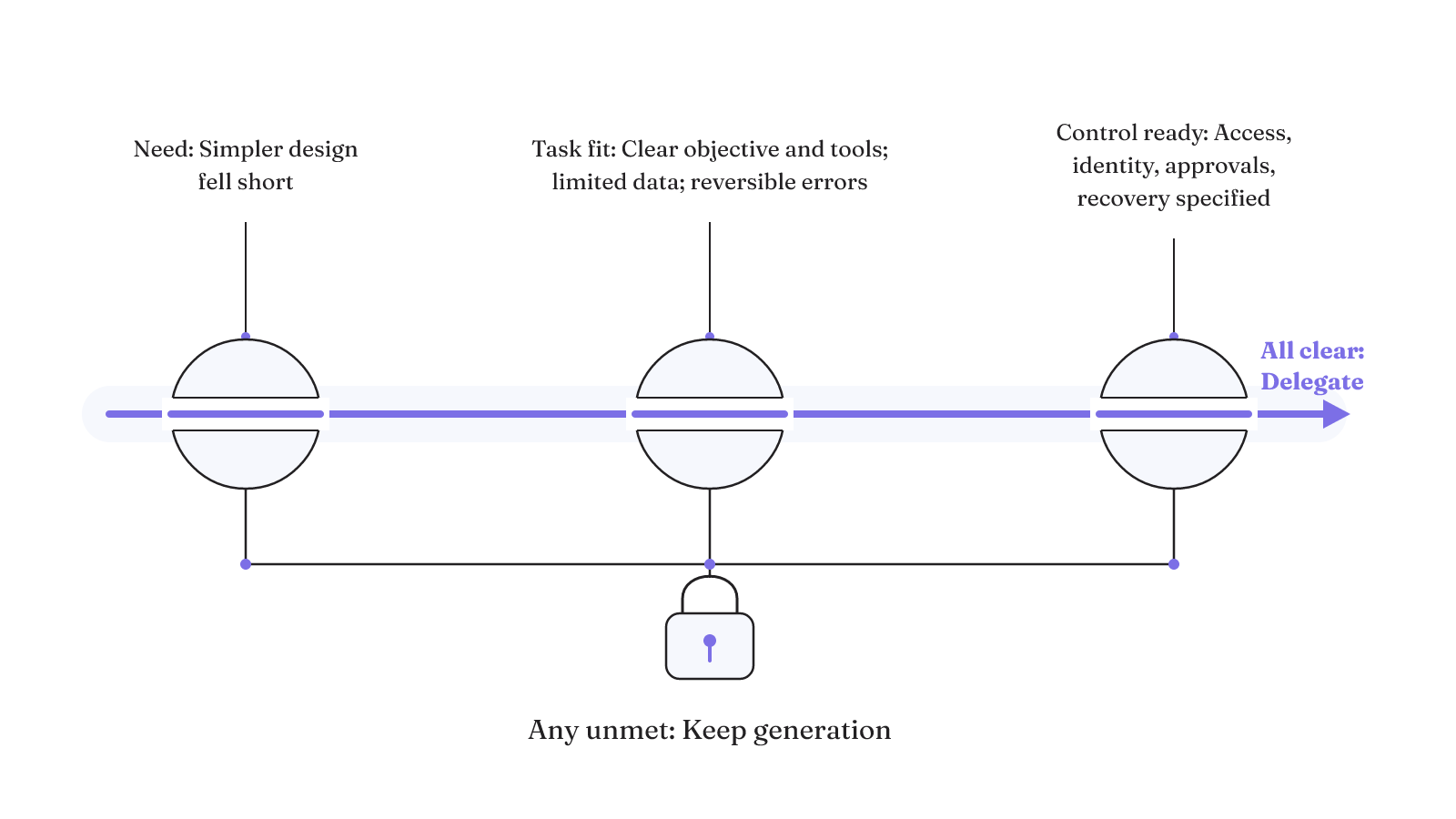
Use three gates before treating a process as an agent candidate:
- Need: The simpler prompt or solution has fallen short.
- Task fit: The objective and required tools are clear, permitted data is limited, and incorrect actions can be detected and reversed.
- Control readiness: Tool access, identity, approval points, and recovery actions can be specified before deployment.
The second gate comes from a concrete agent-candidate test. The same guidance recommends beginning autonomous agents with bounded, reversible workflows and defining their tool access, identity, approvals, and recovery before deployment. This makes reversibility part of selection, not a patch added after the workflow is live.
Each gate can stop the design for a different reason. A task may not need an agent because a simpler prompt still works. It may need multistep work but lack a clear objective, suitable tools, narrow data access, or reversible errors. It may fit the task test while its access, identity, approval points, or recovery actions remain undefined. Those are architecture findings, not reasons to call the agent more or less intelligent.
There is also a limit to what current demonstrations establish. Evidence for autonomous-agent operation remains immature because many published demonstrations examine short tasks in controlled settings instead of sustained enterprise operation. That does not turn the decision into a blanket rejection. It raises the burden on the harness: define the task, constrain authority, and make failure visible before delegating it.
If delegation clears those gates, the system still needs a deliberate workflow design. Our guide to building agentic AI systems develops that engineering question.
Delegated action raises the security stakes
The security boundary changes when model output can trigger action. A harmful generation can mislead a person. A manipulated agent can carry the instruction into the system's action surface.
The attack path is concrete. Malicious instructions encountered on the web can manipulate ChatGPT agent. Because that product surface can take direct actions, a successful prompt-injection attack can have greater impact. The risk comes from the connection between untrusted input and action authority.
Agent security therefore has to cover several failure modes at once: prompt injection, unauthorized data access, non-deterministic behavior, and permission sprawl. The corresponding security controls include identity controls, least privilege, input and output validation, runtime monitoring, and human oversight for high-risk actions.
Human oversight is not a person watching an opaque run and hoping to notice trouble. Meaningful oversight requires visibility into the agent's intent, identity, permissions, and impact before action. The person also needs enforceable authority to pause, reject, or stop the agent. Without that authority, visibility is observation, not control.
The timing of that visibility is part of the control. The reviewer needs the agent's intended action, acting identity, permissions, and likely impact before the action occurs. The authority must also be executable. A pause has to pause the run; a rejection has to block the action; and a stop has to end the behavior. These are the conditions that turn a human checkpoint into meaningful oversight.
This is where an abstract autonomy setting becomes a set of engineering decisions. Identity says which actor is operating. Permissions limit what that actor can reach. Validation checks material entering and leaving the system. Monitoring exposes runtime behavior. Human authority creates a real intervention point. Together, these controls address the action surface that distinguishes delegated execution from generated output.
Security review can follow the same action path. Begin with the input the agent encounters. Check the identity and permissions under which it operates. Validate its input and output, monitor behavior while it runs, and place human oversight at high-risk actions. This follows the supported control set without assuming that any single guardrail can cover prompt injection, unauthorized access, non-determinism, and permission sprawl by itself.
How do you evaluate an agentic system?
Evaluate both the result and the route taken to reach it. A plausible final message is not enough. Agent task-success evaluation should ask whether the system completed the task, preserved its constraints, left valid evidence, and followed a valid trajectory.
Those checks catch different failures:
- Task completion: Did the agent finish the assigned work?
- Constraint preservation: Did the run remain inside the rules that governed the task?
- Valid evidence: Did the agent leave evidence that supports the claimed completion?
- Trajectory validity: Did the sequence of steps constitute a valid path through the work?
The trajectory matters because an agent can produce an acceptable-looking result after taking an invalid route. It can also claim success without completing the task. Evaluation should therefore track false completion and continued activity that does not advance the task. False completion tests the system's claim about its result. Non-progressing activity tests whether the loop is doing useful work at all.
Recovery needs its own measure. Agent recovery rate tracks how often the system finishes safely after an error, interruption, stale state, or changed environment. That question is distinct from first-pass success. A workflow can encounter disruption and still recover safely, or it can keep operating from an invalid state.
False completion deserves its own check because it can look like success in a simple dashboard. The agent says the task is done, but the evaluation still asks for completion, preserved constraints, valid evidence, and a valid trajectory. Non-progressing activity creates the opposite shape: the run continues, but its activity does not advance the task. Both belong in evaluation because an end state alone does not reveal them.
Taken together, these checks make evaluation inspectable. The outcome says whether the task finished. Constraints and evidence say whether the completion is supportable. The trajectory shows how the system got there. Recovery shows what happened after the run stopped following its expected path. If the architecture uses a workflow as well as an agent, our note on agentic workflows versus AI agents helps separate those units before you define the evaluation target.
Stopping and recovery need explicit mechanisms
An agent loop needs a defined way to stop even when its own planning does not converge. Two simple controls address the shape of the loop: step-count caps and total timeouts. A step-count cap limits how many times the system can continue planning or calling tools. A total timeout limits how long the run can remain active. Both can constrain infinite planning loops and cascading tool calls that consume excessive resources.
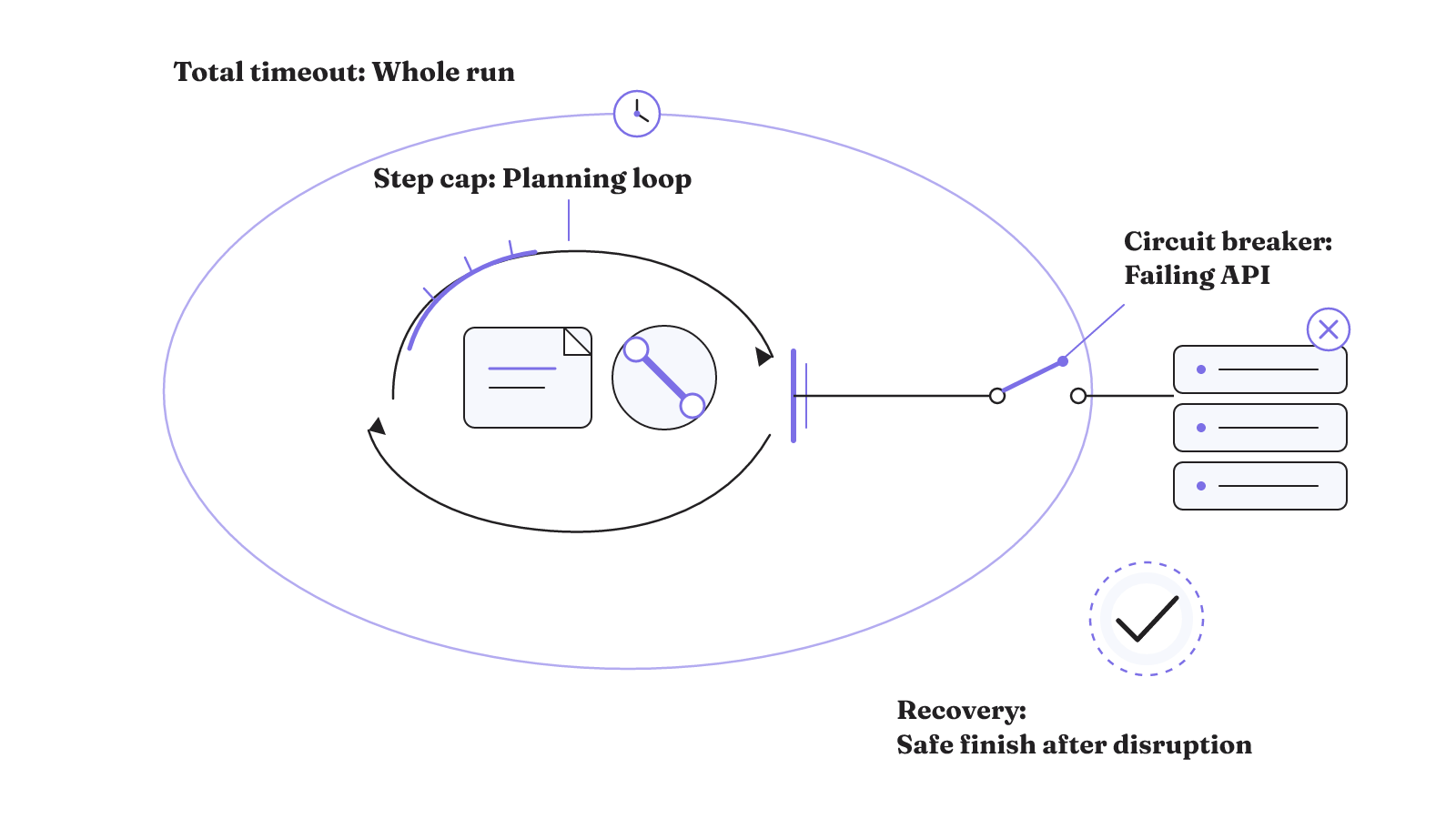
External dependencies need another control. A circuit breaker can prevent an agent from repeatedly calling a failing API. The failure mode is different from endless internal planning. The agent may still have a coherent plan, but the service it needs is failing. The breaker stops repeated calls at that boundary.
Place each mechanism around the behavior it is meant to constrain. Count steps around the planning and tool-use loop. Measure total time across the complete run. Put the circuit breaker around calls to the external API. This keeps the stopping condition tied to a visible signal: too many steps, too much elapsed time, or repeated calls to a failing dependency.
These mechanisms answer three operational questions before a run begins:
- How many steps may this loop take?
- How much total time may this run consume?
- When should repeated API failure stop further calls?
Stopping a bad run is part of control, not a substitute for recovery. The evaluation still has to measure whether the system can finish safely after an error, interruption, stale state, or changed environment. The harness needs both boundaries: a mechanism that halts activity and an evaluation that shows whether safe completion remained possible afterward.
Use the delegation threshold on the next workflow you design. Start with generation. Add delegated action only after simpler prompts and solutions fall short. Before deployment, write down the objective, tools, data limits, reversibility, identity, approvals, and recovery actions.