Key takeaways
- AI agents independently perform tasks for users.
- In AI agents vs agentic AI, agentic AI shifts work toward delegated, long-horizon tasks.
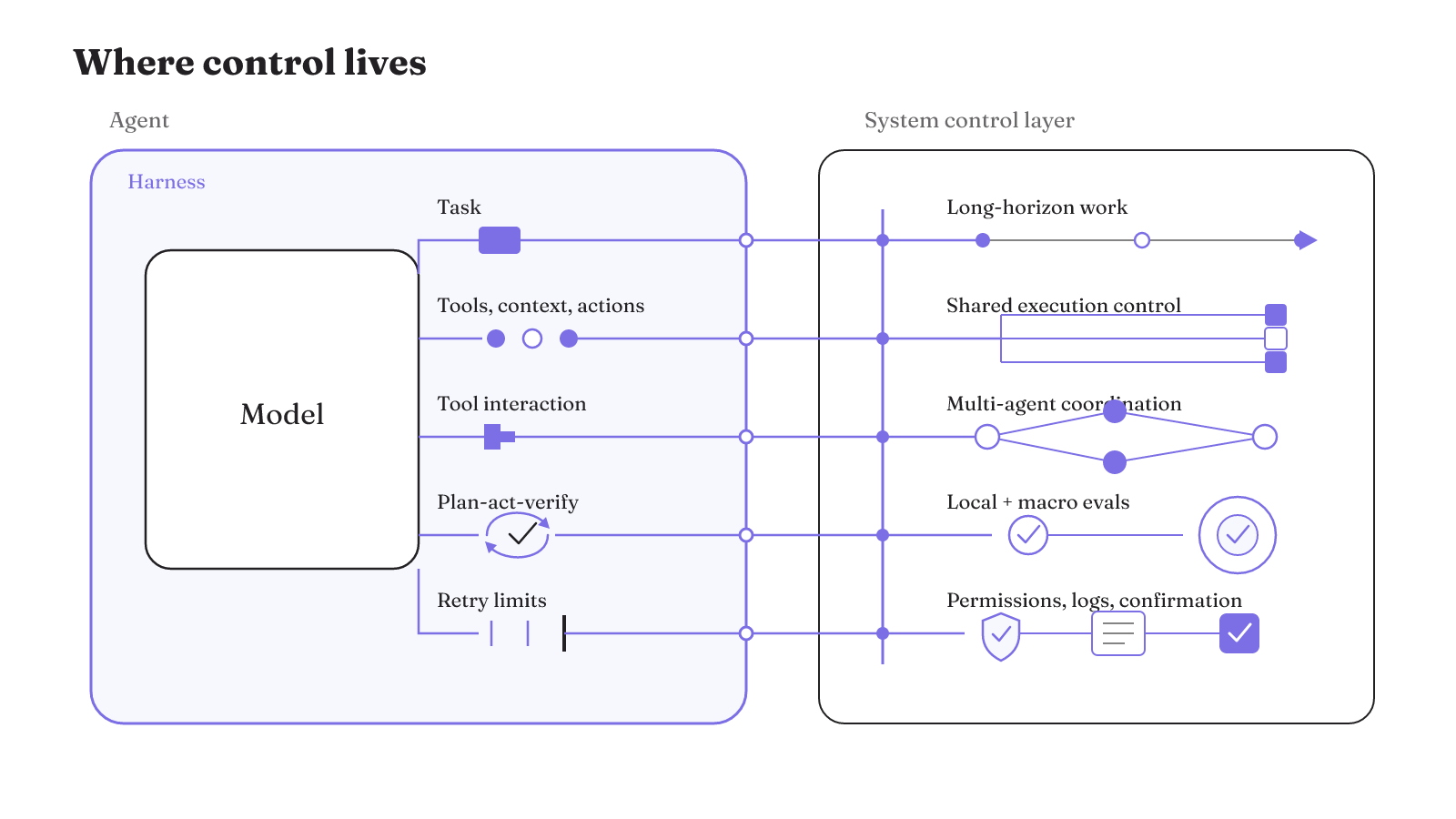
- Our working definition is simple: an agent is a model plus its harness.
AI agents vs agentic AI at a glance
The key difference between AI agents and agentic AI is the boundary you inspect. An agent is the task-performing unit. Agentic AI shifts attention toward sustained work and the controls around it. Use observable mechanisms, not the category label, to resolve what has actually been built.
| Inspection point | Agent-level question | System-level question | Observable mechanism |
|---|---|---|---|
| Unit of work | What task does the agent independently perform for the user? | Has the unit shifted from one interaction to delegated, long-horizon work? | Task ownership and duration |
| Model-and-harness boundary | Which tools, context, and actions sit around the model? | Where does shared context and execution control live? | The harness around the model and its outside-world loop |
| Coordination | Does one agent call tools and interact with an environment? | Does a control layer coordinate multiple agents? | Governance, shared context, and execution control |
| Verification | Does an independent check follow each planned action? | Are local agent risks also evaluated at system scale? | A plan-act-verify loop and agent-level plus macro evaluations |
| Limits or oversight | What stops retries and execution? | Where are permissions, audit logs, and human checkpoints enforced? | Execution caps, retry limits, security permissions, logs, and explicit confirmation before consequential actions |
Is agentic AI the same as an AI agent?
Not reliably. The difference between an AI agent and agentic AI cannot be settled by finding two tidy definitions. The term agentic AI is used inconsistently enough that a label or demonstration is not an adequate evaluation test.
One use of agentic AI describes a predefined agentic workflow, where the path is set up to produce more predictable outcomes. Another use describes AI agents that autonomously plan, execute, and iterate toward a goal. Both implementation patterns appear under the same term. That makes “what is agentic AI vs AI agents?” an architecture question before it is a naming question.
Inspect four functions: how the system perceives information, reasons through decisions, accesses tools, and takes action. Start with perception and identify the information available to the architecture. Follow that information into reasoning, where decisions are made. Then locate the tools the architecture can reach and the actions it can take. These functions give you a concrete path through the implementation when the product description does not.
The path also exposes boundaries that a category name hides. Perception tells you what can enter the work. Reasoning tells you where a decision is formed. Tool access identifies how the architecture reaches beyond the model. Action identifies what the architecture can do after a decision. You can inspect all four without first deciding which marketing label is correct.
That approach also keeps the comparison fair. It does not assume every system called agentic AI has several agents, and it does not treat every multi-agent layer as the whole system. It asks where work and control live. Our guide to AI agent architectures develops that inspection beyond category names.
The phrase AI agent versus agentic AI is therefore useful only when it leads to a concrete boundary. Find the acting unit first. Then find the software that supplies its tools, context, coordination, verification, and limits.
What does a working AI agent look like?
A working agent is easier to recognize by what it does than by what it is called. Agents can operate independently for minutes or hours while they orchestrate tool calls, interact with environments, and iterate toward a solution. That is already more than a single model response, but it does not tell you how the whole surrounding system is governed.
ChatGPT agent provides a concrete product example. It can work with data reached through connectors. It can also work with websites that a user has logged into through takeover mode. Those capabilities locate an important part of the agent boundary: the agent is not working only with the text in its initial prompt. It can reach data and act through an authenticated web environment.
That access also creates a specific failure path. Malicious instructions encountered on the web can manipulate ChatGPT agent while it completes a task. This is prompt injection in operational form. The unwanted instruction arrives through material the agent encounters while working, not necessarily through the user's request.
The useful inspection point is the path from outside information to action. Which websites or connector data can enter the working context? Which actions can the agent take after reading that material? Where does control return to the user? For ChatGPT agent, explicit confirmation before consequential actions reduces harm from prompt-injection attacks, while takeover and pause controls let the user intervene.
This example shows why a demo is an incomplete classification tool. A visible action proves that an agent can complete that action in the demonstration. The architecture still has to expose access, intervention, and control around the work.
When does a multi-agent system earn its complexity?
Use multiple agents when the workload calls for capabilities that a multi-agent layer is designed to provide. A multi-agent system contains numerous agents working together to carry out tasks autonomously. It is one functional layer within a larger hierarchy of AI systems, workflows, and applications, not a synonym for that entire hierarchy.
The compact decision is whether the work requires any of these conditions:
- Parallel work: Do independent parts of the task need to run at the same time?
- Specialized tools: Do parts of the work require different tool sets?
- Large context: Does the task carry more context than one agent should handle?
- Multiple decision checkpoints: Does the work need decisions at several points?
Those are the cases in which multi-agent systems are recommended. They give you a clearer test than asking whether several agents sound more sophisticated. If none of the four conditions is present, the list has not established a reason to add a multi-agent layer.
The four conditions point to different architecture needs. Parallel work is about concurrent execution. Specialized tools are about dividing access by role. Large context is about distributing the information carried through the task. Multiple decision checkpoints are about where separate decisions occur. Name the requirement first, then see whether several collaborating agents are the appropriate functional layer for it.
Several agents also create a coordination requirement. Agents in a multi-agent system rely on shared communication and collaboration rules to perform optimally. The design must therefore account for how agents exchange work and cooperate. Adding another agent is not only another task performer. It adds another participant governed by those rules.
This is where the system boundary matters again. The agents do the assigned work. The multi-agent layer lets numerous agents collaborate. An orchestration control layer coordinates agents to work safely and predictably at scale, with governance, shared context, and execution control across them. Our examination of building agentic AI systems follows those boundaries through the complete architecture.
Multi-agent design adds specialization, parallelism, and fault isolation
A justified multi-agent design has three concrete mechanisms: limited roles, parallel execution, and failure containment. Each addresses a different property of the workload, so the architecture should make each one visible.
First, agents can be assigned limited, role-specific responsibilities. That supports domain specialization because an agent's responsibility is bounded to its role. The point is not the number of agent names in a diagram. It is whether responsibilities are actually divided by domain.
Second, parallel agents can reduce latency. Their capacity and capabilities can also be scaled individually. The implementation question is whether work is truly running in parallel and whether each agent can be scaled on its own. If the agents remain dependent on one serial path, the architecture has not exposed the parallel mechanism described here.
Third, a multi-agent design can isolate and contain a failure within one agent. That containment can improve performance and resiliency. The boundary is practical: a fault belongs to one agent instead of automatically becoming an unbounded fault across every role.
These are capabilities of the design, not a verdict that multiple agents are always better. The criteria from the prior decision still apply. Parallelism matters when the task needs parallel work. Specialization matters when responsibilities and tools differ. Failure isolation matters when the design actually contains a fault within one agent.
Multi-agent architecture therefore earns its place through mechanisms you can inspect. Look for limited responsibilities, concurrent execution with independent scaling, and a failure boundary. A diagram showing three agents does not substitute for those properties.
Production is where agentic systems fail differently
The most important gap is often between a working agent and a reliable production system. Agent code that works on a developer machine can require significant engineering before it becomes reliable in production. A demonstration settles whether one path worked. It does not settle how that path behaves across sustained operation.
Agentic errors also compound. An issue that would be minor in traditional software can derail an agent entirely. Agent-level evaluations expose risky local behaviors, while macro evaluations show what those risks become at system scale.
The requirements become specific at the system level. Reliable multi-agent research systems at scale require careful engineering and comprehensive testing. They also require detailed prompt and tool design, robust operations, and close collaboration among teams that understand current agent capabilities. This is the exact scope of the finding: scaled multi-agent research systems.
For agentic AI tools in enterprise settings, autonomous planning, action, and adaptation are not enough to establish readiness. Governance, integration depth, and scalability also matter. That does not make those factors a universal scorecard for every agent. It shows why a product's autonomous behavior and its operational readiness are separate questions.
Production inspection should follow the failure path. Can one flawed action shape the context for another? Can a tool result redirect later decisions? Does an error remain local, or can it propagate through coordination? The established mechanism is compounding error, and the established response is substantial engineering, testing, prompt and tool design, and operations at the multi-agent research-system scale.
The production question is not answered by the final result of one run. Inspect local agent behavior and the system-scale result. Those two views address different parts of an agentic operation without treating a working demonstration as proof of reliability.
Choose the smallest system that earns its complexity
Start with the smallest architecture that can do the work. Begin with simple prompts, improve them through comprehensive evaluation, and add multi-step agentic systems only when the simpler approach falls short. Complexity should answer an observed limit, not a preference for the more elaborate label.
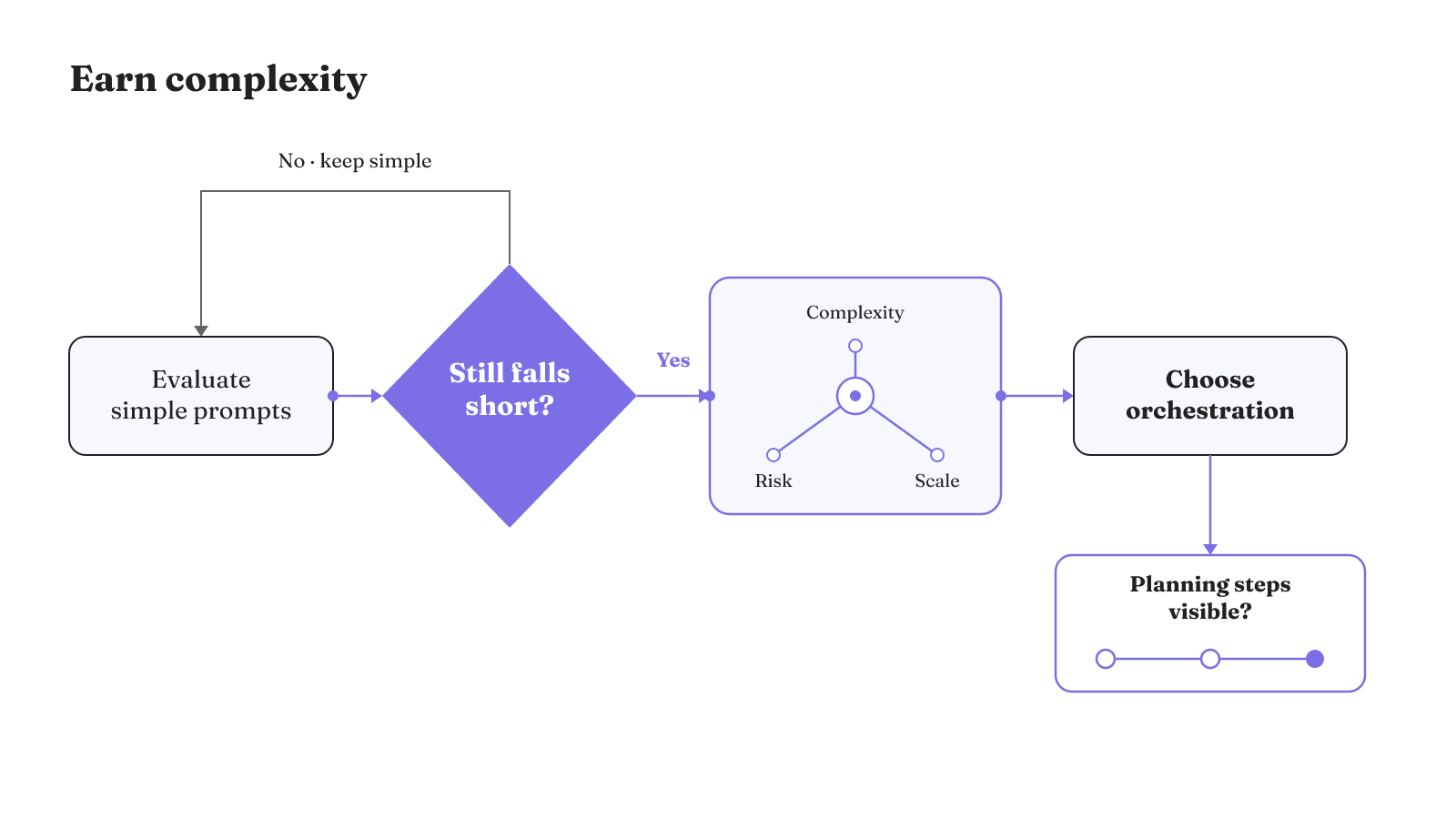
Use three questions to make that decision:
- Have evaluated simple prompts fallen short? Evaluation comes before escalation. If the prompt has not been assessed and improved, the case for a multi-step system has not been established.
- What are the workflow complexity, risk tolerance, and scale? The appropriate orchestration approach depends on those three conditions and should evolve as they change.
- Are the agent's planning steps visible? Agent design should make planning steps explicit so the work is transparent.
The sequence protects the architecture from two common classification mistakes. A capable agent does not automatically require a multi-agent system. A long-running system does not become understandable merely because it carries the agentic AI label. Evaluated need, operating conditions, and visible planning provide stronger grounds for the decision.
Planning visibility deserves a direct check because it is part of the agent design, not a label applied afterward. Look for explicit planning steps in the working system. If the planning remains hidden, the design has not met the transparency guidance, regardless of whether the surrounding product is described as an agent or as agentic AI.
As the workload changes, revisit orchestration. Workflow complexity may change. Risk tolerance may change. Scale may change. The appropriate approach is allowed to evolve with them. You do not need to predict the final architecture before you have evaluated the simpler one.
Then inspect the controls that make sustained work legible: execution caps, retry limits, verification, audit logs, permissions, and human confirmation. They reveal how agency is governed after the model starts acting. To test the distinction against an implementation, inspect a real agentic AI example and trace where the acting unit ends and the system begins.