Key takeaways
- Follow the request across its full path, including service boundaries.
- Give each agent an identity that makes its actions attributable.
- Record explicit human approval when an agent takes a sensitive action.
An AI audit trail earns its keep when you can reconstruct one consequential action. Start with the request, then follow the acting agent, its authority, the policy check, each execution event, any approval, the verification evidence, and the state that remained. At Rifty, we treat that continuity as a harness question. A folder of searchable prompts and outputs is not the evaluation target. The target is a joined path you can inspect after the action crosses a boundary or stops partway through. A single well-chosen action is enough to expose which joins are present and which records disappear at a boundary.
What makes an AI audit trail reconstructable?
A reconstructable AI audit trail preserves the path of the request. A trace provides the big picture of the full path that a request takes through an application. That path is the backbone of the review because it gives separate events a shared trajectory.
The harder test begins when execution leaves one process. An agent may call a service across a network boundary, and that service may generate its own events. Context propagation lets traces build causal information across those process and network boundaries. The evaluation question is therefore concrete: can you move from the original request into the downstream service and still see which execution belongs to that request?
Test that question from both ends. Begin with the original request and follow its trace into the downstream service. Then choose an event generated by that service and work backward to the request. The first direction tests whether the trajectory continues across the boundary. The second tests whether a downstream event retains enough causal context to find its origin. A one-way join leaves part of the reconstruction dependent on where you happened to begin.
This is the difference between finding an event and reconstructing an action. A useful review needs both the event and its place in the request path. Once the path is visible, you can inspect who acted, what decision context was present, which control ran, and what happened to state. Those are separate records, but the trace and propagated context give you a way to join them.
Use an eight-part reconstructability matrix
Run this matrix against one real agent action, preferably one that calls a tool, crosses a service boundary, or can change state. The goal is not to collect a larger field inventory. It is to see whether the records let you follow the same action without losing identity, control context, execution detail, or the final checkpoint.
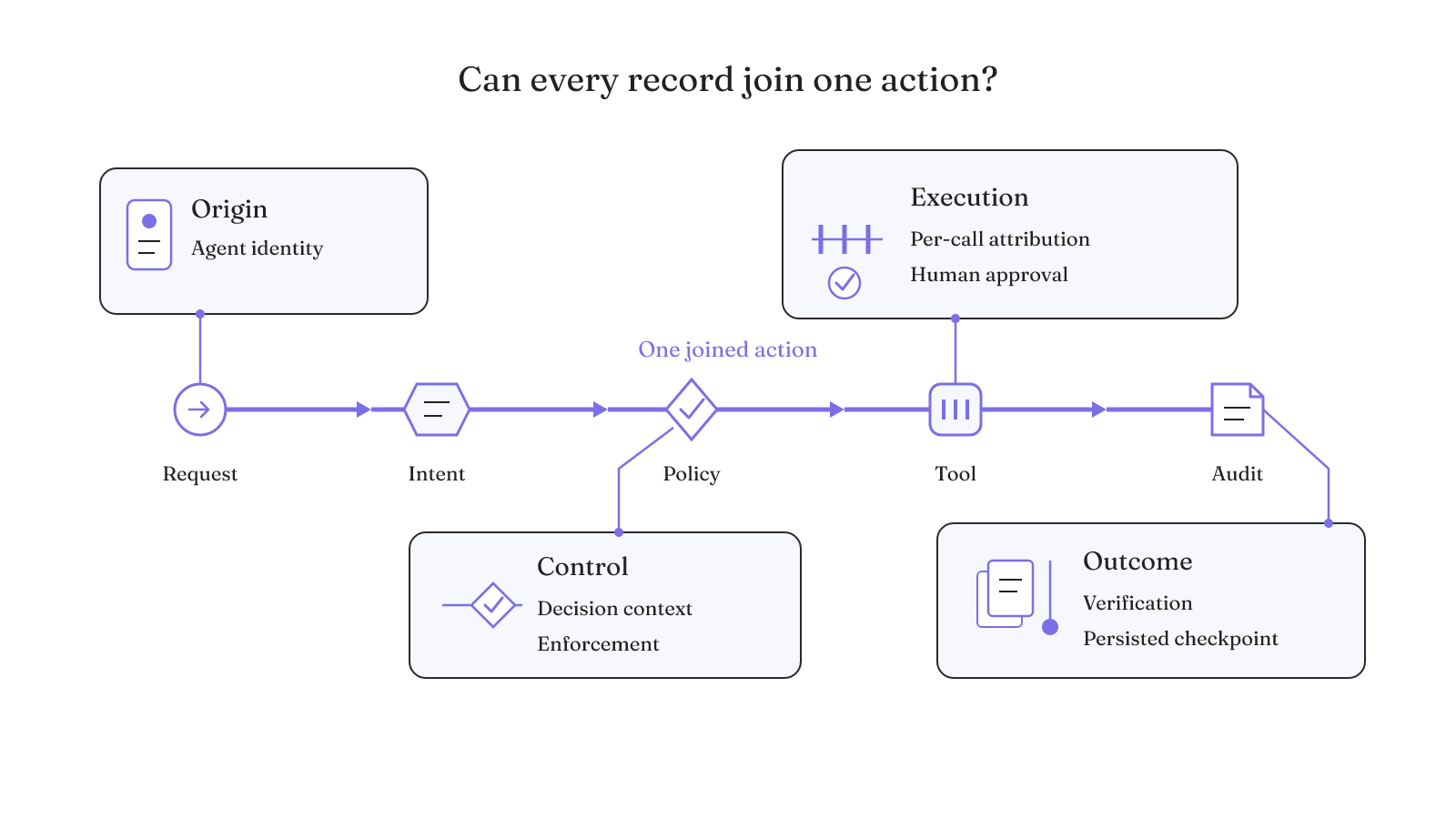
For each row, record one of three results: connected, present but unjoined, or absent. "Connected" means you can move from that record back to the same request and action. "Present but unjoined" means the record exists, but you cannot establish its place in the trajectory. "Absent" means the action has no inspectable record for that dimension. This distinction prevents searchable telemetry from receiving credit for continuity it does not provide.
| Dimension | Decision question | Record to inspect | Scoped example |
|---|---|---|---|
| Request-to-log flow | Can you connect the user request, intent classification, policy check, tool execution, and audit log? | The linked event flow from request through execution | A governance event flow can connect all five events. |
| Agent identity | Does the action name the agent that performed it? | The identity attached to the action | Each agent should have its own identity. |
| Decision context | Can you inspect the context used for the sampled action? | The preserved decision context and execution sequence | An audit-grade trail preserves decision context and execution sequence. |
| Enforcement result | Does the record show the result of the control applied to the action? | The enforcement result and integrity proof | Audit-grade records preserve the enforcement result and integrity proof for each sampled action. |
| Per-call attribution | Is each call attributable, or does the trail collapse activity into one session entry? | The identity and context attached to every call | A burst of 200 API calls in 30 seconds requires per-call attribution, not one session entry. |
| Approval | Is explicit human approval attached to the sensitive action? | The approval event and human authority | Sensitive actions require explicit human approval. An approval gate is the control point to inspect. |
| Verification | Can another run inspect the same evidence? | Representative log lines, filter predicate, and short action timeline | These verification artifacts make a telemetry change easier to verify and let a later agent run reuse the loop. |
| Persisted state | What state survived an interruption? | The last completed and persisted checkpoint | In a reported LangGraph Platform/API cancellation case, in-progress streamed state was not persisted. The backend retained the last completed and persisted checkpoint. |
Read the matrix as an engineering test, not a compliance verdict. It does not establish legal sufficiency, retention quality, tamper resistance, or a complete event schema. A blank or disconnected row identifies the precise record you cannot inspect. That is more useful than a broad claim that the system is "fully logged." It also keeps an implementation-specific case, such as the reported cancellation behavior, tied to the platform where it was observed.
Run the test once from the request and once from the surviving checkpoint. The forward pass asks whether each policy, execution, approval, and verification event belongs to the chosen request. The backward pass asks whether the persisted outcome leads you to the actor and the decisions that produced it. Record the first broken join in each direction. That gives an implementation team a bounded problem to investigate without treating every missing field as equally important.
How much logging does the risk justify?
The logging posture should match the risk of the use case. One governance implementation separates the decision into three practical levels. Low-risk internal productivity involving non-sensitive data can use fast-track approval and minimal logging. That is the lightweight end of the range, not the default for every agent action.
Moderate-risk use cases change the control posture. Customer-facing systems and operational data call for standard guardrails and audit trails in that same implementation. The reconstructability matrix still applies, but the expected records now include the controls and audit path around work that reaches customers or operational data.
High-risk use cases involving personal information, financial data, or regulated activity call for enhanced logging, human-in-the-loop control, and isolated environments. The human-control requirement is part of the control posture, while the audit trail records the action and the relevant surrounding events. Neither should be reduced to a single "approved" field with no path back to the action.
Begin measurement with the most significant identified risks. Risks or trustworthiness characteristics that cannot be measured should be documented. This gives you a defensible way to choose depth: identify the highest-consequence action, decide which parts of its trajectory must be inspectable, and record where measurement is unavailable.
Use the three descriptions as a classification check. Is the action limited to internal productivity and non-sensitive data? Does it sit in a customer-facing system or use operational data? Does it involve personal information, financial data, or regulated activity? Keep the answer attached to the specific use case. The matching logging and control posture can then be evaluated without assuming that every action needs the same depth.
Event volume is a separate question from risk. A small number of high-risk actions still falls under the enhanced-logging, human-control, and isolation posture. A large number of low-risk internal actions still fits the minimal-logging example when the work uses non-sensitive data. Classify the use case first, then inspect whether its records meet that posture.
Logs, traces, and context form the execution path
Suppose you begin with one log event from a tool call. The useful move is a log-to-trace pivot. In one documented interface, the associated trace identifies the span that generated the log and exposes the context of the entire request. From the other direction, the logs generated during a specific span can be viewed together.
Those views answer different parts of the same reconstruction. The log is the event you found. The span places it inside an operation. The trace opens the request path around that operation. With context propagation, traces, metrics, and logs can be correlated regardless of where they were generated. That correlation is what lets the investigation continue when the action has produced telemetry in more than one service.
The correlation check is simple to run. Choose a log generated during a specific span and open its associated trace. Confirm that the trace exposes the request context and identifies the span that produced the log. Then view the logs generated during that span. The result should be a navigable relationship, not three search results that merely share similar timestamps or text.
When you evaluate an agent harness, inspect the joins rather than counting signal types. Pick one tool execution and try both directions. Start from its log and locate the generating span and request trace. Then start from the span and gather the logs created during that operation. If either direction loses the request context, the records do not yet answer the reconstructability question for that action.
Grouping also needs an explicit scope. In one OpenAI governance implementation, a trace operation groups operations for debugging. That product-specific behavior is useful because it gives the debugging work a defined container. It does not, by itself, answer the identity, authority, approval, or persistence rows in the matrix. Those answers still have to come from their own connected records.
Identity and permissions make actions attributable
An execution path tells you what happened. Attribution also needs an acting subject and the authority applied to it. Governance can bound which tools an agent calls, what content it processes, and how much it can do while maintaining accountability through audit trails. The audit record should let you inspect those boundaries around the action you selected.
Those boundaries create three useful permission questions. Was this tool within the agent's allowed tool set? Was the content within the allowed processing scope? Was the amount of work within the bound placed on the agent? Keep the recorded policy check beside the execution it governed. Otherwise, the policy and the action can both be visible while their relationship remains unresolved.
Access control offers a plain model for the relationship. Policies govern access between active subjects and passive objects. An active subject may be a user or a system process acting for a user. The object may be a device, file, record, or domain. For an agent action, ask which subject acted, which object it reached, and which policy governed that access.
That subject-object record gives the trace an authority boundary. For example, a tool call that reaches a file should remain connected to the acting system process and the access policy governing the file. A record of the call without the subject leaves attribution unresolved. A record of the subject without the object and policy leaves its authority unclear.
If an agent crosses a service boundary, inspect the enforcement event at the layer where access was decided. Then connect that result back to the agent identity and request path. The subject-object relationship, tool boundary, and enforcement result should all point to the same action.
Where can sensitive data survive?
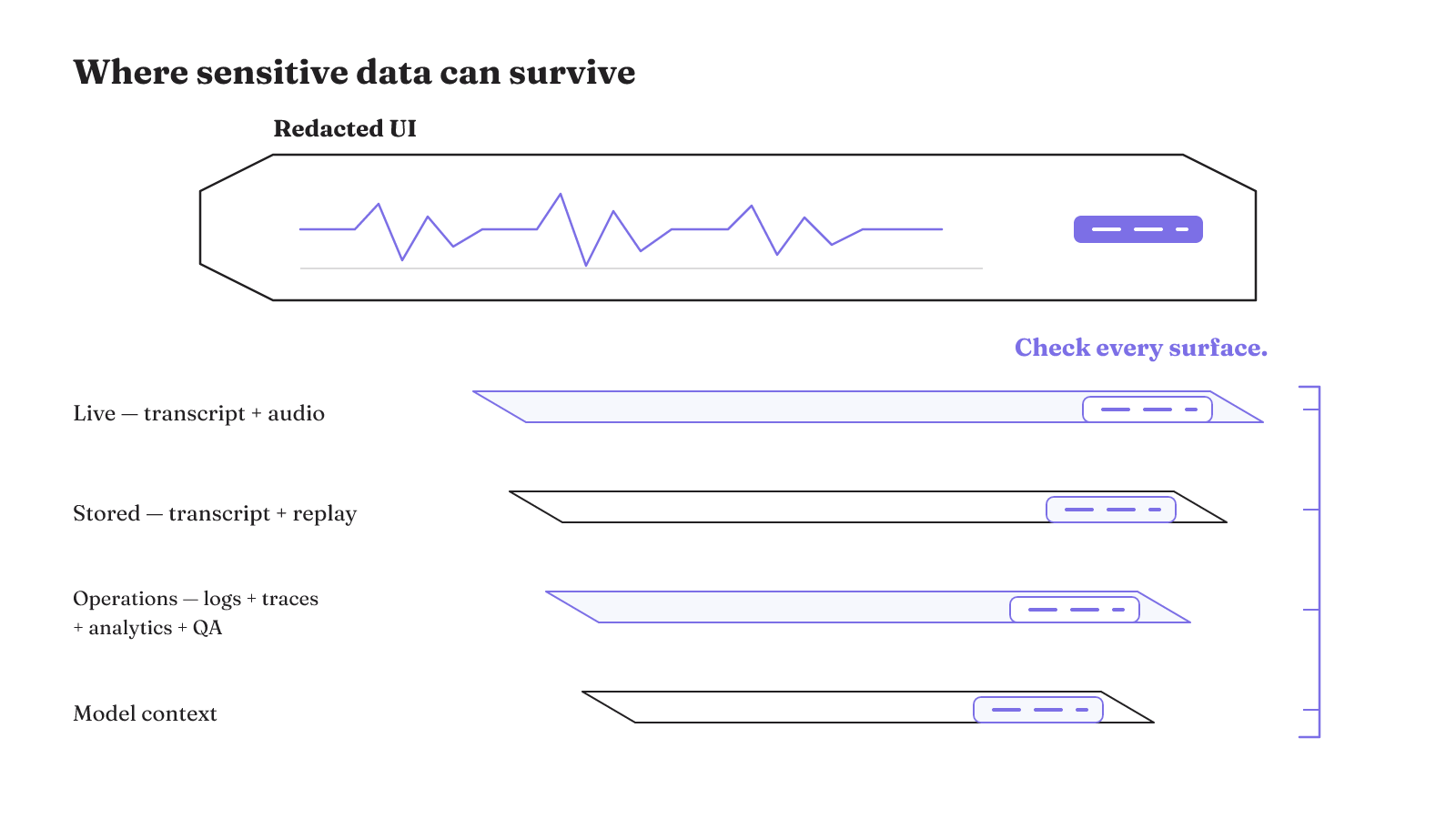
A clean interface does not settle where sensitive data remains. A redacted view can coexist with unredacted original data in underlying logs, traces, and recordings. The audit therefore needs to cover the handling event and the storage surfaces reached by the data, not just the text visible to an operator.
One documented gateway implementation can remove selected names, email addresses, card numbers, and health identifiers before a prompt reaches a model provider. Its rule can cover prompts, responses, or both. The gateway can also record that the redaction rule ran without storing the raw values. That record makes the handling step inspectable without copying the sensitive value into the audit event.
The gateway event answers two focused questions. Did the selected rule run on the prompt, the response, or both? Did its audit event avoid the raw value? Those answers belong beside the request path because the handling step happened before the prompt reached the provider. They do not answer what later systems retained, so the review has to continue across the other surfaces reached by the data.
Voice agents show why surface coverage matters. A spoken card number can pass through real-time transcription, final transcript storage, both audio channels, call replay, debug logs, traces and spans, analytics, review queues, and model context windows. These surfaces span the live interaction, stored transcripts and recordings, operational telemetry, review work, and model context. Redaction in one interface does not establish what exists in those other surfaces. Inspect each surface that the value reached and look for the redaction event that governed it.
Treat the visible interface as one surface in that path. An underlying log, trace, or recording may still contain the original data when the interface shows a redacted version. For the selected action, follow the data through every documented surface and record whether each surface contains the original value, a redacted value, or a handling event without the raw value.
The practical test is narrow and demanding. Choose one sensitive action and follow the value from input through every documented surface. Check whether the handling rule ran, whether its event avoids the raw value, and whether the remaining telemetry still connects the request, agent, policy, execution, approval, and persisted outcome. Then run the reconstructability matrix against that action. Before you define another evaluation loop, use our agent evaluation reference to keep the outcome and the trajectory in view.