Key takeaways
- An agent loop runs four steps on repeat: assemble context, reason, act, loop.
- The loop is the easy half. Where a human signs off is the hard half.
- Gate a human by how reversible each action is.
- A synthesis of public sources, not a first-party benchmark.
You already know the one-line version: an agent is a model that calls tools in a loop until the task is done. That definition is correct, and it is where almost every tutorial stops. The agent loop is the easy half. The half nobody writes down is the one that decides whether you can trust the thing in production: where a human still signs off once the loop is running on its own. This page reconciles the loop into one model, then adds that control layer, keyed to how reversible each action is.
What an agent loop actually is
The top results fragment the same idea. LangChain's loop-engineering writeup puts it plainly: at its core, an agent is a model calling tools in a loop until a task is complete. Oracle's developer breakdown says the same thing from the harness side. Within a single agent turn, the loop is a repeating cycle: assemble context, invoke the model to reason, then act on its tool calls before looping again.
So the four steps in the agent loop are assemble, reason, act, loop. That is the typical agent loop, and it is the same cycle whether you build it yourself or borrow one. The autonomous loop that powers Claude Code, for example, can be embedded in your own application through its Agent SDK, which runs the identical execution loop.
The minimal "model in a loop" definition is true but thin. It hides the parts that make a real loop work: memory across turns, retries when a tool fails, and a stop condition so the loop actually ends. Loop engineering, the discipline the LangChain and Oracle pieces circle around, is mostly about shaping those hidden parts well. The four steps are the skeleton. The judgment is in the rest.
Loop versus harness: the line most tutorials blur
People ask what the difference is between an agent loop and an agent harness, and the tutorials tend to smear the two together. Keep them separate and the whole architecture gets clearer.
The loop is the model-to-tool cycle inside a single turn. The harness is the outer layer that runs that cycle: it assembles the context, enforces the limits (token budget, max steps, a timeout), and decides when to stop. When you embed the Claude Code loop through its Agent SDK, the SDK runs the same execution loop, and the harness is everything you wrap around it. The boundary shifts by framework. Some SDKs fold harness duties into the loop itself, so treat the split as a useful frame, not a fixed spec. If you want the layer above the loop, that is the harness around it, and it is where most production control actually lives.
The control layer the tutorials skip
Here is the gap none of the ranking pages fill: once the loop runs on its own, where does a human still belong in it? "AI agents human in the loop" used to be a philosophy slide. It is now a wired-in mechanism.
The OpenAI Agents SDK pauses the run and returns interruptions when a tool call needs approval, then lets you resume later from the same saved run state. The approval surface is run-wide. It is not limited to the top-level agent. The same pause applies when the tool belongs to the current agent, to an agent reached through a handoff, or to a nested agent-as-tool call. That means a human sign-off is a design decision you make on day one, not a bolt-on you retrofit after an incident.
The tension is real, and you should feel it. Every approval gate adds latency and puts a person back in the path. Gate everything and you have rebuilt the manual work the loop was supposed to remove. So the question is never "gate or don't." It is which actions earn a gate. Governance raises the stakes here too: the EU AI Act, described as the first comprehensive legal framework for AI, makes shipping an agentic loop with no control layer a more expensive bet than it used to be. Reversible-by-default is not just good taste. It is turning into table stakes.
Where to gate the loop, by how reversible the action is
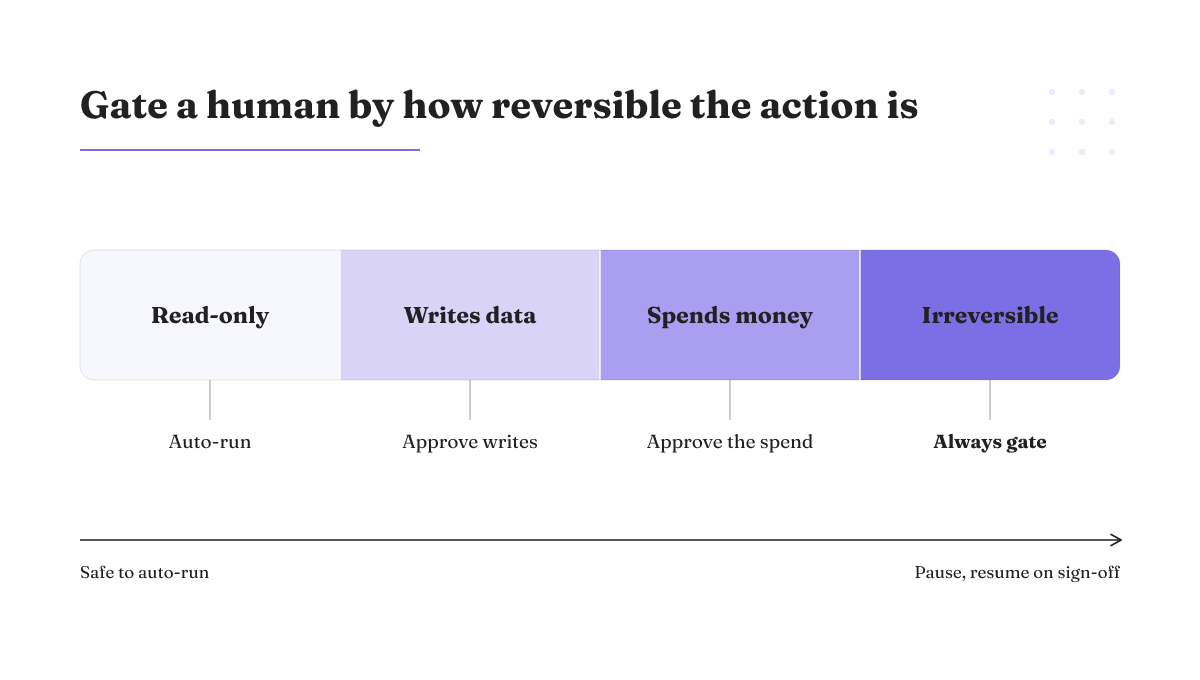
The clean way to decide is to sort each action the loop can take by blast radius. Read-only actions are safe to run wide open. Irreversible ones should never fire without a human. Everything in between is a judgment call you make once and encode.
| Loop action | How reversible | Gate a human? | How to wire it |
|---|---|---|---|
| Read-only (search, read a file, query data) | Fully | No | Auto-run, no pause |
| Writes data (update a record, save a draft) | Usually, with effort | Sometimes | Approve writes outside a safe sandbox |
| Spends money (place an order, call a paid API at scale) | Costs real money to undo | Yes | Approval-gated pause before the spend |
| Irreversible (send email, delete, deploy, move funds) | No | Always | Pause the run; resume from saved state on sign-off |
The "how to wire it" column maps straight onto the approval mechanism: auto-run is the default path, and a gated row is an approval-gated tool call that pauses and resumes. This is the same idea behind wiring guardrails into the loop rather than hoping the model behaves.
One honest caveat. These reversibility tiers are a reasoned framework, not a measured taxonomy. No first-party production dataset sets these thresholds, and your blast radius is not mine. A "writes data" action in a staging sandbox is harmless. The same action against a live customer record is not. Take the table as a starting shape and tune the rows to what your loop can actually break.
Choosing what to build the loop on
Ask "what should I build my agent loop on" in a community thread and you get a list with no decision attached. The frameworks question deserves better than a menu.
The open-source landscape as of mid-2026 is genuinely deep: LangGraph, the OpenAI Agents SDK, the Claude Agent SDK, Google ADK, Pydantic AI, CrewAI, Strands Agents, Mastra, the Vercel AI SDK, the Microsoft Agent Framework, Agno, and Smolagents all build agent loops. A smaller shortlist gets cited over and over as the production default, anchored by the vendor SDKs from OpenAI, Anthropic, Google, and a graph-based option like LangGraph. Treat that shortlist as one common cut, not a leaderboard, and ignore the star counts people rank it by. A repository's popularity is not evidence it fits your loop.
Choose by the job instead. The frameworks are not interchangeable. CrewAI and AutoGen are built for multi-agent collaboration, where several agents split a task and hand off to each other. If your loop is a single agent calling tools, that machinery is weight you do not need. If people ask you who the "big 4 AI agents" are, the honest answer is there is no official four. There are vendor-backed SDKs most stacks anchor on, and the right one is the one whose default behavior matches the loop you are actually building. If you are still weighing them, the framework guide walks the tradeoffs by job.
A minimal loop you can actually build
Strip it to the smallest real thing and the agent loop is short. In pseudocode, close to what you would write in Python:
while not done:
 context = assemble(history, tools, memory) # step 1
 step = model.reason(context) # step 2
 if step.is_final:
 done = True # stop condition
 else:
 result = run_tool(step.tool_call) # step 3: act
 history.append(result) # observe, then loop
That is the whole cycle: a model call, a tool call, an observed result, and a loop that ends on a real stop condition. Most SDKs give you this loop for free, in Python or JavaScript, so you spend your time on the tools and the gates rather than the plumbing.
You can also read a real one end to end. Small agent-loop repositories on GitHub put the entire cycle in front of you, and open-source coding agents like opencode let you trace how a production loop assembles context and decides when to stop. Reading one honest implementation teaches more than a dozen definition posts. Just remember a toy loop that terminates cleanly on your laptop hides the production behavior. A working example is not a shipped system.
How to tell your loop is ready to trust
Before you let a loop run on its own, three checks separate "it ran once" from "I trust it." They are reasoned checks, not a certification, but they catch the failures that hurt.
First, the loop has a real stop condition, not just a step cap you hope never hits. Second, the gate actually fires on irreversible actions. Test it by triggering one and confirming the run pauses instead of proceeding. Third, the run resumes correctly from saved state after an approval, picking up mid-task rather than starting over. This is the same discipline that separates a demo from an autonomous agent you can leave running.
A note on what these checks do not cover. Agent loops tend to break after they ship, in ways local testing misses: the wrong tool gets picked, a long-running conversation loses context, or token spend climbs when the agent gets stuck in a loop it cannot reproduce. Treat those as risks to watch and instrument for, not as settled facts. The point of gating by reversibility is that when one of them happens on an irreversible action, a human was already standing in the way.