Key takeaways
- Guardrails can control prompts, responses, and application actions.
- Provider filters do not enforce your business rules, data classes, or tool permissions.
- Every scoring threshold trades some blocked legitimate work against some attacks that pass.
An open-source guardrail is useful only at the boundary where it can enforce the policy you care about. Start with the failure you need to contain, then ask who owns the policy, what the control observes, and what happens after a bad decision. A long list of validators cannot answer those questions. A clear AI guardrail is part of a larger control path that also includes permissions, approvals, execution state, and recovery.
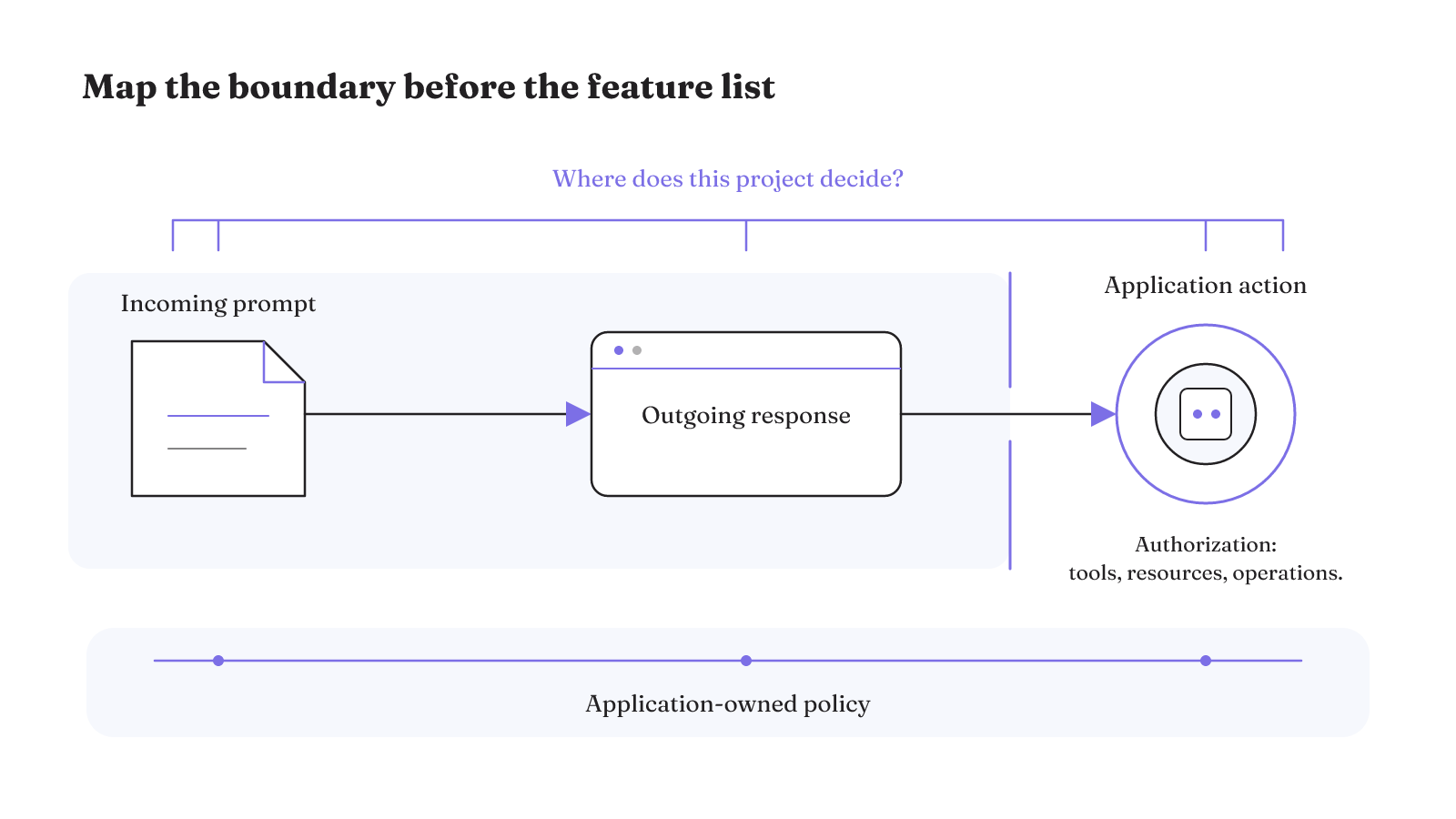
This changes the order of evaluation. Begin with an unwanted prompt, response, or action and trace where it can be stopped. Then separate the rule expressed inside a project from the rules your application still owns. Only after those boundaries are visible does a project feature become meaningful. The test is not whether a repository contains many controls.
Are there open-source guardrails for AI, and what does each one do?
Yes. There are open-source guardrails for AI, but the projects do not all control the same part of a system.
Guardrails AI adds guardrails to large language models and lists an Apache-2.0 license. Its scope can include specific output checks. For example, the project's Competitor Check validates whether generated text names competitors from a list supplied by the application. That is a concrete example of a policy expressed as a validator against model-generated text.
That example also shows what a project capability should look like during evaluation. The application supplies the competitor list, generated text is checked against it, and the validator answers that narrow policy question. If your required control concerns a different policy or a later tool action, the existence of this validator does not answer that requirement.
NeMo Guardrails is an open-source toolkit for adding programmable guardrails to LLM-based conversational systems. Is NeMo Guardrails the same as Guardrails AI? No. They are separate projects with different documented scopes. The useful comparison is not the similarity of their names. It is whether the control they expose sits where your failure can occur.
Another project named GUARDRAIL describes itself as a modular, layered, extensible framework for LLM application ecosystems, especially systems based on MCP. Its stated focus includes data exfiltration, data infiltration, unauthorized access, and resource abuse.
Those risk categories move the inspection beyond model text alone. For an MCP-based system, ask which component can prevent unauthorized access or resource abuse and which component owns the data boundary. The project's stated focus gives you a relevant candidate scope. Your application design still determines the exact operation, resource, and identity that must be constrained.
These AI guardrails open-source examples on GitHub span model output validation, conversational controls, and broader application or MCP risks. Project names therefore make a poor shortlist by themselves. Before integrating one, draw the path from untrusted input to model response to application action. Mark the exact point where the project makes a decision and the point where your own harness must still enforce one.
For a closer project-level treatment, our Guardrails AI deep dive examines where its controls belong without turning the category into a winner-take-all ranking.
How should you evaluate AI guardrails open source?
Evaluate AI guardrails open source by writing one adoption question for each control boundary. Use the same workload and failure case for every candidate so the answers describe the system you intend to run.
| Control axis | Adoption question | Concrete check | Why it matters |
|---|---|---|---|
| Enforcement point | Does the control act on the incoming prompt, outgoing response, or the application's next action? | Trace one disallowed case through all three points and record where enforcement occurs. | Guardrails can operate at each of these points, but a control at one point does not automatically cover the others. |
| Policy ownership | Which rules remain in the application? | List the business rules, data classes, and tool permissions that your harness must enforce. | Provider safety filters cover general harm categories, while application owners remain responsible for these local policies. |
| Classifier errors | What is the cost of a false block and a missed block? | Measure both outcomes on requests close to your policy boundary. | Every guardrail classifier has false positives and false negatives. |
| Risk, autonomy, and approval identity | Which capabilities and impact zones change the allowed autonomy, and who may approve a consequential action? | Review tool access, financial and operational impact, autonomy thresholds, approval triggers, and compliance requirements. Name the authorized approver for each trigger. | Agent-risk assessment can examine the relevant capabilities, impact zones, thresholds, triggers, and requirements. |
| Observability | Can you inspect the input and response that led to a decision? | Record prompt inputs and model responses for the path under test. | Those records can reveal risk, injection attempts, and tuning information. |
| Authorization | Where is each tool call, resource request, and operation bounded? | Attempt an operation outside the identity's allowed boundary. | Authorization defines those boundaries in an MCP-based system. |
| Restart recovery | Does paused execution survive a process restart? | Pause a session, restart the process, and test whether the session resumes. | AgentHandler's stateless sessions can be paused and stopped, but cannot resume after a process restart. |
Read the matrix from left to right. Begin with the boundary that must hold, then turn it into a check you can run against the candidate. A project may answer one row well and leave another row entirely to your harness. That is useful information, not an automatic rejection. It tells you what the integration must supply.
Prompt injection and data leakage define the first failure cases
Consider an agent that reads untrusted text before calling a downstream tool. Prompt injection occurs when malicious content in that text or data tries to override the system's instructions. It can target private data, steer a downstream tool call, cause a misaligned action, or change model behavior unintentionally. Put an attempted instruction override inside untrusted text, then inspect the prompt, response, and any downstream call. This shows whether the attack crossed from content into action.
The second path needs no attacker. A model can leak private data by sending more information to an MCP than the user expected or intended. A detector aimed only at malicious instructions misses that problem. Use an ordinary request in which the model can access private data, then inspect what it sends to the MCP. The failure is the over-sharing itself.
Run these as separate cases on the same tool path. The injection case tests whether hostile content changes behavior or reaches a call. The private-data case tests what information the model sends without hostile content. The result shows whether a candidate covers the input, the data boundary, the action boundary, or only one of them.
The distinction matters when you assign controls. Input filtering can inspect the hostile content, but the downstream call still needs an authorization decision. In the accidental case, the question is what data may cross the MCP boundary even when the request itself is ordinary. One shared tool path can therefore expose two different failures that need different acceptance checks.
How much legitimate work will the guardrail block?
A guardrail can reject attacks and still be too disruptive for the workload. Any filter that scores text will allow some attacks and block some legitimate requests. Adjusting the threshold cannot eliminate both outcomes.
False-positive rate measures how often the guardrail incorrectly blocks or transforms requests that policy says should be allowed. A set filled with easy benign prompts can make a damaging filter look excellent because it avoids the policy boundary where classification is hard.
Build a reviewed safe set concentrated near that boundary. Include requests that are allowed under the policy but resemble the material the control is meant to catch. Review the labels, then run each candidate threshold against that set and record both missed attacks and blocked legitimate requests.
A lower false-positive rate means little if candidates use different policies or different test populations. Keep the policy and population explicit, then decide how much false blocking the workload can bear.
The easy examples still have a place as a basic check, but they should not carry the acceptance decision. The boundary set is where allowed requests most resemble the material the guardrail is meant to stop. That is where an apparently small threshold change can become visible as blocked legitimate work.
Measure false blocks with the right denominator
Two rates answer different operating questions. False-positive rate is:
false blocks divided by all truly safe items
False discovery rate is:
false blocks divided by all items the guardrail blocked
The first measures disruption across the safe set. The second measures how much of the blocked queue was blocked incorrectly. Calling both numbers "false positives" hides which denominator changed.
Each label needs five fields: the user request, system role, policy version, relevant conversation context, and expected guardrail action. Together, they let a reviewer decide whether the item was truly safe under the policy being tested.
When a block is reviewed, compare the guardrail's action with the expected action. That keeps a labeling disagreement from being counted as a classifier error and lets one labeled set answer both denominator questions.
Keep the five fields on the item, not in a separate note that can drift away from it. The request and system role describe the immediate setup. The policy version fixes the rule being applied. The conversation context preserves the surrounding exchange, and the expected action states whether the guardrail should allow, block, or transform the request. Without that context, the denominator may be precise while the label underneath it is not reviewable.
Weak authorization leaves action paths open
A plan can pass ten individual agent-guardrail checks and still reach an outcome that nobody approved. Each check may validate a prompt, response, or intermediate step while the combined plan still arrives at an unauthorized action.
This matters around MCP because servers expose tools, resources, and operations that agents can trigger. Weak MCP authorization can permit unintended access or actions. Authorization must bound every tool call, resource request, and operation for the identity making the attempt.
Test with the identity and operation that will exist in production. Attempt access to a tool, resource, or operation outside the intended permission. The boundary should deny the call; another text warning from the model does not enforce access.
This is the difference between a model proposing an action and a harness authorizing it. The model may be able to produce the arguments for a call, but that capability does not grant permission to every resource or operation behind the server. Bind the decision to the identity, resource, and operation involved in the attempt.
Mitigations do not make agents perfect. Agents can still make mistakes or be tricked, so grant access cautiously and reserve consequential actions for explicit oversight. When permission alone is not enough, add an approval gate.
Which actions deserve an approval gate?
Sending an email, writing to a production database, and initiating a financial transaction warrant explicit oversight. Planning loops may retry an action before receiving a result, so approval needs a unique action ID and execution state.
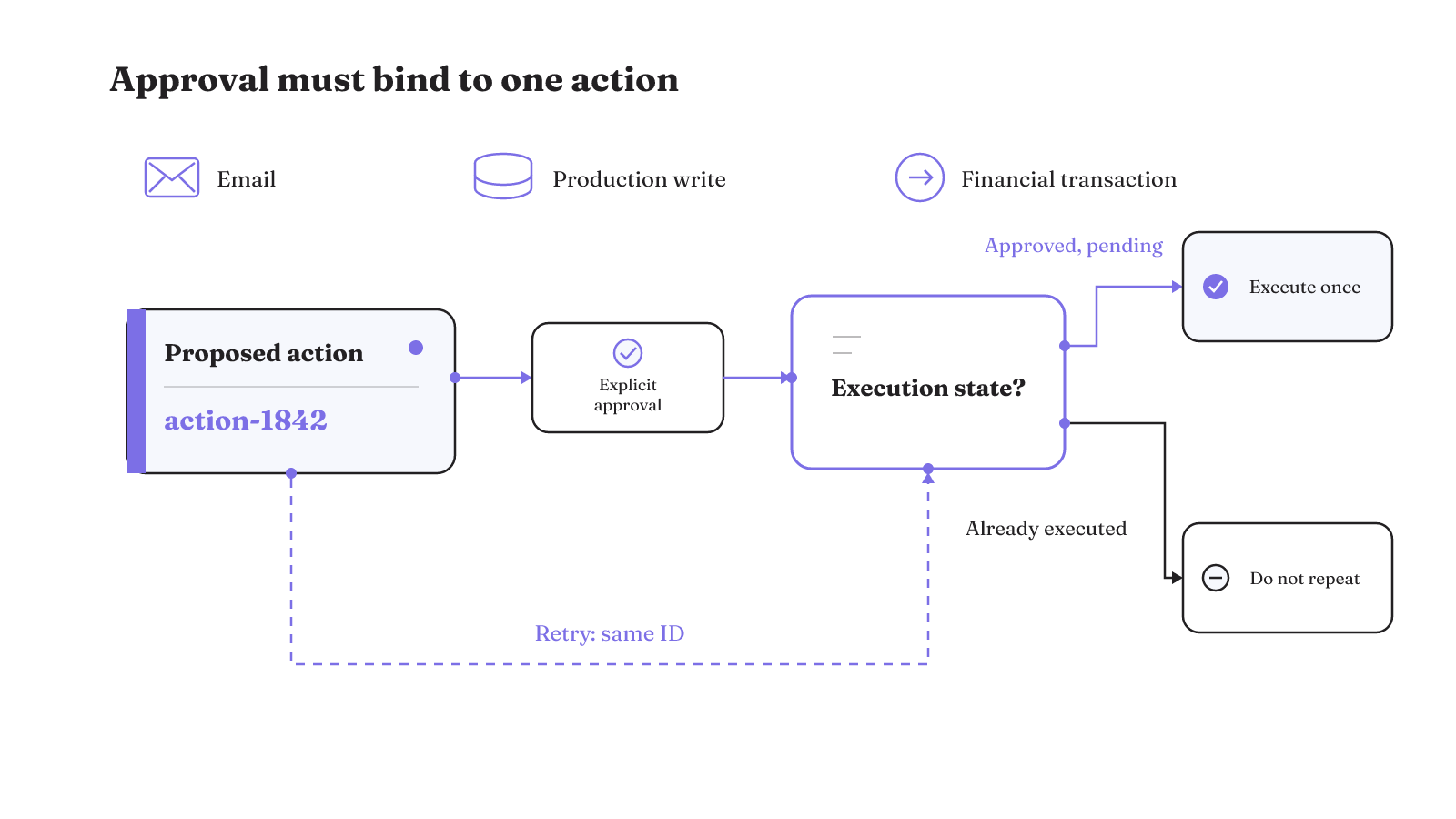
Suppose a proposed production write is assigned action-1842. Its record connects that ID to the approved state and the executed state. A retry carries the same ID, so the harness can see whether the approved action is still pending or has already run.
This makes the approval specific to one operation and keeps a retry from becoming a second execution. Without the action ID, "approved" does not say which operation received permission. Without execution state, the loop cannot tell whether that operation has already happened.
The same pattern applies to email and financial actions. Approval attaches to the risky action, not to a vague planning step. If the loop retries before receiving a result, it presents the existing identity again. The state can then distinguish an approved action awaiting execution from one that has already completed.
Layer controls in proportion to risk
A layered design can combine input filtering, output validation, retrieval hygiene, and agent tool restrictions. A separate risk process can classify sensitivity and regulatory scope, assess potential harm and likelihood, and apply controls proportional to the risks it prioritizes.
One concrete stack might filter incoming content, validate the model response, apply hygiene to retrieved material, and restrict the tools the agent can call. This design does not turn four controls into a guarantee. It gives each named failure surface an explicit control point that can be tested.
The stack still needs observation after deployment. Recording prompt inputs and model responses can expose risks and prompt-injection attempts, as well as information used to tune guardrails. Monitoring effectiveness and reporting status keep the risk process connected to what the controls actually do.
A guardrail risk process can then classify sensitivity and regulatory scope, assess potential harms and their likelihood, prioritize the risks, apply controls proportional to risk, monitor whether those controls work, and report their status. This sequence ties added complexity to a stated risk instead of to a generic desire for more layers.
Complexity is not free, and more framework is not always the better engineering choice. The author of GUARDRAIL notes that basic isolation, proper credential handling, and established HTTP security practices can provide more security value than a complex architectural framework in straightforward cases. That is a useful rejection test for a shortlist: if ordinary isolation and access control contain the failure, a larger guardrail layer has to justify its extra moving parts.
For the candidates that remain, write the decision as a control contract. Name the allowed action, authority boundary, approval identity, observable record, and recovery behavior. Our control-contract guide provides the structure for turning a shortlist into enforceable acceptance and recovery requirements.