Key takeaways
- If you are learning how to build multi agent systems in AI, begin with one evaluated agent and add complexity only when that baseline falls short.
- Add agents when the work requires parallel execution, specialized tools, large context, or several decision checkpoints.
- Define bounded roles, shared communication rules, authority, traces, evaluations, and recovery. Capable agents do not make coordination automatic.
When should you build a multi-agent system?
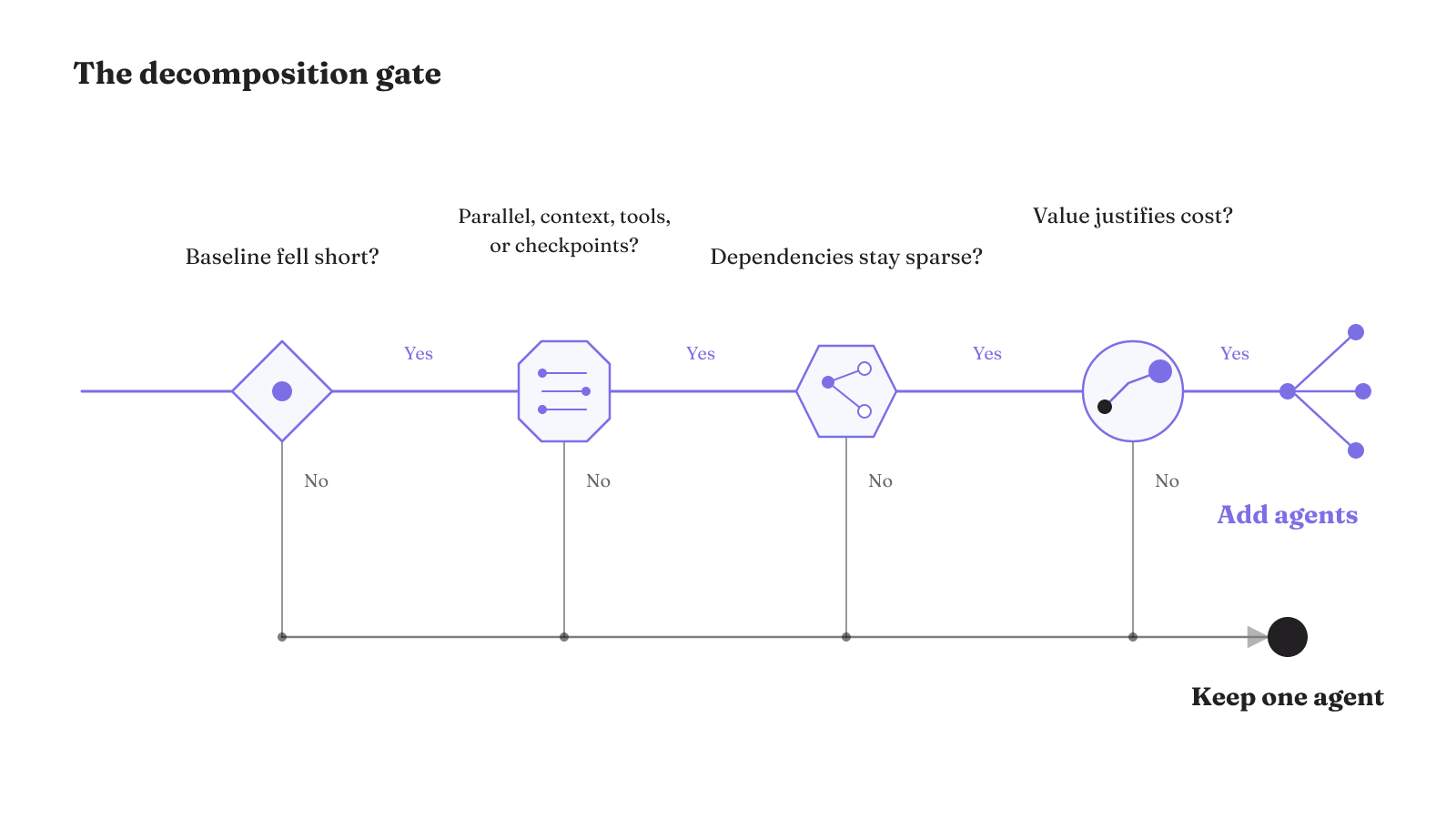
Make the architecture decision before choosing a framework. Use this matrix against the actual workload:
| Criterion | Single-agent signal | Multi-agent signal | Engineering consequence |
|---|---|---|---|
| Baseline performance | Simple prompts plus comprehensive evaluation have not fallen short | The evaluated baseline falls short | Evolve from one agent only when needed |
| Parallel work | Stay with the evaluated baseline | The task requires parallel work | Parallel agents can reduce latency and scale independently |
| Context and tool load | Stay with the evaluated baseline | The task needs large context, specialized tools, or numerous complex tools | Divide limited, role-specific responsibilities among specialists |
| Decision checkpoints | Stay with the evaluated baseline | The task requires multiple decision checkpoints | Define the checkpoints and coordination rules explicitly |
| Dependency shape | Every agent needs the same context, or agents have many dependencies | This criterion alone does not justify decomposition | Keep one agent when the poor-fit condition applies |
| Task economics | The task's value does not justify the cost of increased performance | The task's value can justify that cost | Compare increased performance with its added cost |
An extra agent is an operating commitment, not a default upgrade.
How to build multi-agent systems from a stable baseline
For beginners, the first build is not a team of agents. It is one capable model paired with clear, structured instructions and well-defined tools. That combination is the foundation of a reliable agent. The tool interface deserves the same engineering attention as the prompt because agent effectiveness depends on tool quality.
Document each tool thoroughly. Test the agent-computer interface, then include tool behavior in the evaluation. A clean tool boundary makes later decomposition more legible because each specialist will inherit a smaller set of actions with known inputs and outputs. Tool evaluation also exposes problems that a polished final response can hide.
If you are creating your own agentic AI, this baseline gives you four things to inspect separately: the model, its instructions, its tools, and the evaluations. Keep the instructions structured. Give the tools precise documentation, then test the interface through which the agent uses them. Evaluate the tools as part of the system, since a capable model cannot make an unclear or poorly tested tool effective. This is the beginner build worth stabilizing before a handoff is introduced.
A runnable sample can make the setup concrete. The linked multi-agent repository supplies a clone, directory, and installation sequence:
git clone https://github.com/niksacdev/multi-agent-system.git
cd multi-agent-system
uv sync
Use that sequence to inspect a working sample, then evaluate the model, instructions, and tools as separate parts of the build. The commands establish an environment. The architecture still has to answer who owns each task, which tools each role can use, and how one role transfers work to another. Those questions matter more than the framework label. Our guide to AI agent architecture patterns provides another way to reason about that structure.
Bound roles, handoffs, and protocol responsibilities
Give every specialist a limited, role-specific responsibility. A research agent, for example, should be defined by the research work it owns, not by a broad claim that it is an expert. Domain specialization is useful because responsibility has a boundary. Shared communication and collaboration rules then coordinate those bounded roles. Intelligence alone does not supply the rules.
A handoff needs enough routing information for the system to select the receiving specialist. In one documented agent pattern, handoff_description is a key routing input for collaboration through handoffs. Treat that description as part of the interface. It should identify the responsibility being transferred clearly enough for routing to operate on the stated role.
The role and handoff descriptions solve separate problems. The role limits what a specialist owns. The handoff description gives routing a stated description of where transferred work belongs. Shared communication rules govern how those specialists collaborate after the split. Keeping those responsibilities explicit prevents the word "agent" from hiding three different interfaces inside one label.
Protocol choices solve different parts of this design. Model Context Protocol standardizes access to external tools and contextual data, while Agent-to-Agent protocol covers peer coordination, negotiation, and delegation. MCP belongs at the tool-and-context boundary. A2A belongs at the peer relationship. Neither one defines your workload split, authority policy, evaluation, or recovery plan.
This gives the build a clean order. First assign limited responsibilities. Then write the shared rules and routing description. Add MCP where an agent needs standardized access to tools or context. Add A2A where peers need coordination, negotiation, or delegation. The protocol follows the boundary it serves.
That distinction also keeps the architecture honest. Connecting a model to more tools does not create another agent, and adding a peer protocol does not decide what a peer should own. Define roles first, state the routing input, and then select the protocol needed at each boundary. Our comparison of MCP servers and agents goes deeper on that line.
Where should human control sit?
Human control belongs in the production control path, including input filtering, tool use, and intervention. Production guardrails should cover all three. This turns oversight into an executable part of the harness instead of a general expectation that someone can step in.
Early deployment is where the transfer mechanism matters most. Human intervention can reveal failures and edge cases, support an evaluation cycle, and return control when an agent cannot complete its task. The concrete transfer condition is simple: the agent reaches work it cannot finish, and control moves to a person. That path should exist before the system encounters the condition.
Treat that transfer as a real execution state. The system is no longer progressing through ordinary agent steps, but the task has not disappeared. A human-intervention mechanism preserves a route for control to change hands. Early failures and edge cases can then feed the evaluation cycle named in the deployment guidance.
Permissions, audit logs, and human-in-the-loop checkpoints can also be designed into a multi-agent architecture. Together, they answer different control questions: what an agent may do, what the system records, and where execution can wait for a person. Guardrails can cover inputs and tool use around those checkpoints.
Input filtering, tool-use controls, and intervention also sit at different points in execution. The input can be filtered before work proceeds. Tool use can be governed when an agent attempts an action. Human control can take over when the system reaches its transfer condition. Designing all three produces an actual control path instead of one generic safety setting.
The control requirements rise for use cases involving personal information, financial data, or regulated data. Those cases call for enhanced logging, human-in-the-loop control, and isolated environments. This is an architecture requirement, not a prompt-writing detail. Once an approval pauses work, the system also has to preserve that pause across interruption and recovery.
Session memory is not durable execution
Saved conversation history does not make an agent durable. A durable operating layer needs an execution journal, idempotent tool boundaries, versioned prompts and tools, durable human approvals, and recovery tests. Multi-agent and complex single-agent systems also need debugging, observability, and evaluation tooling.
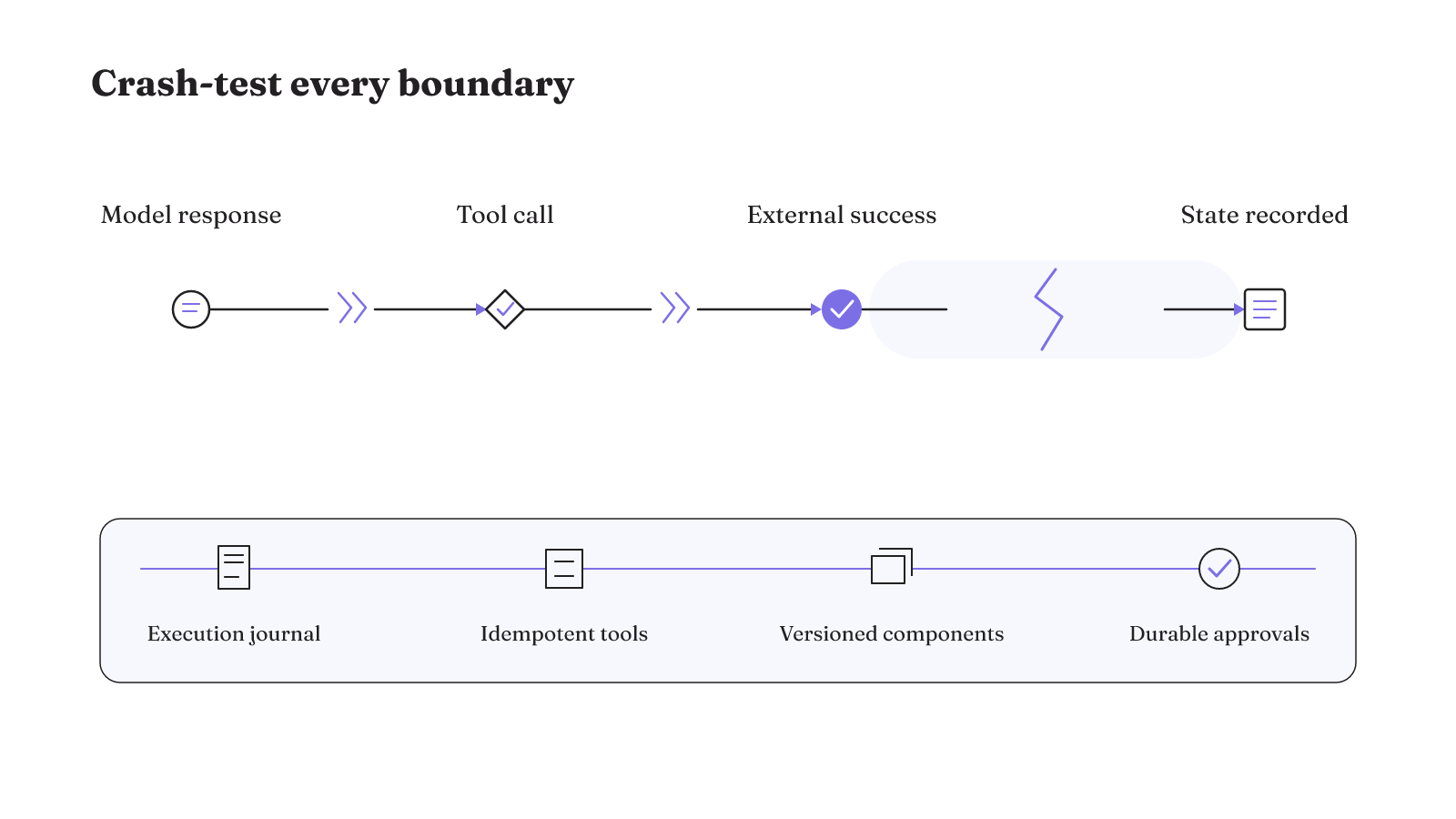
The distinction becomes concrete around side effects. If a runtime stops after an external API succeeds but before local state is written, context alone does not record a reliable execution boundary. An execution journal and idempotent tool boundary are the relevant controls. Versioned prompts and tools identify which system configuration produced the work, while durable approvals preserve a human decision through recovery.
Recovery testing should deliberately crash the runtime at specific interruption points: around model responses, tool calls, external API success, local state writes, approvals, trace export, version rotation, and outbound messages. These tests exercise the path where execution state can be lost or a side effect can be repeated. They make durability observable as behavior under interruption, not merely a memory feature described in the architecture.
Run those crashes on both sides of a boundary. Interrupt around the model response and the following tool call. Interrupt around external success and the local write that records it. Interrupt around the approval and the action it releases. Then exercise trace export, version rotation, and outbound messaging. The journal, idempotent boundary, component version, and durable approval give the recovery test concrete operating state to examine.
This operating layer is part of the cost identified in the matrix. Durable execution, debugging, observability, and evaluation are required whether complexity lives inside one sophisticated agent or across several agents.
How do you test a multi-agent system?
Test the execution path, not only the final answer. A useful trace begins with a visible planning step, follows a model call into a tool call, records the guardrail decision, captures the handoff, and continues inside the receiving agent. Agent-system tracing can span models, tools, agents, guardrails, and handoffs, so the whole trajectory can become the test surface.
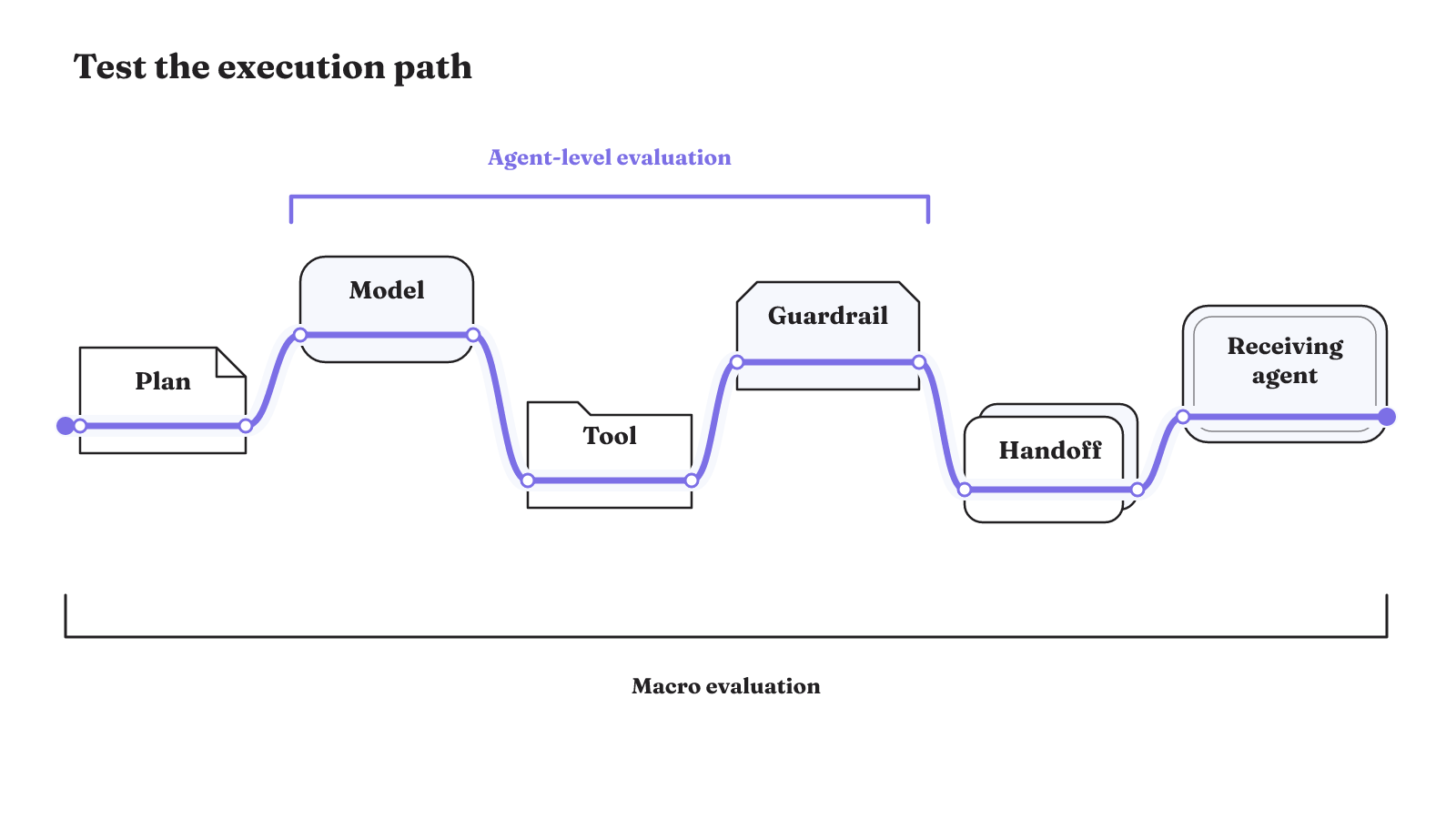
That trajectory matters because one failed step can send agents down different paths and produce unpredictable outcomes. A final answer may therefore conceal the point where execution diverged. Keeping planning steps explicit supports transparency, while the trace provides the sequence needed to locate the divergence.
Visible planning and end-to-end tracing answer different test questions. The planning step shows what the agent intended to do. The trace shows which model, tool, guardrail, handoff, and receiving agent actually participated. When a failure changes the trajectory, the two views let the evaluator inspect the planned route and the executed route without reducing the test to output quality.
Use two levels of evaluation. An agent-level evaluation examines risky local behavior inside a specialist. A macro evaluation examines how that risk appears across the system. The distinction is supported by evaluation guidance for agentic systems: local evaluations identify risky behavior, while macro evaluations show its system-scale expression.
Suppose a model call produces a plan, a tool returns data, a guardrail accepts the result, and a handoff routes it to another agent. The local evaluation can test the sending agent's tool choice or routing behavior. The macro evaluation can test the resulting behavior across the handoff and receiving agent. Both evaluations should retain the trace that connects their observations.
This distinction matters when local behavior appears acceptable in isolation. The agent-level evaluation still tests that local behavior for risk. The macro evaluation asks how the same risk appears once the system adds tools, guardrails, routing, and another agent. A multi-agent test plan needs both scopes because they inspect different units of behavior.
The same approach applies to failure recovery. Run the evaluation with deliberate interruption at the relevant execution point, then inspect the trace, journal, tool boundary, approval state, and recovered trajectory. This joins behavior testing to durability without treating a successful uninterrupted demo as the whole system.
Improve context and the harness as one loop
More context is not automatically better context. Context engineering should seek the smallest set of high-signal tokens that maximizes the chance of the desired outcome. That gives each role a focused context objective instead of an instruction to accumulate everything available.
Improvement should connect the evidence from execution back to the harness. One documented agent-improvement loop moves through traces, human feedback, evaluations, ranked harness changes, and implementation. The order matters operationally: traces capture behavior, people add judgment, evaluations test it, candidate changes are ranked, and selected changes are implemented.
The loop turns an observed trajectory into a controlled change process. Human feedback is attached after traces expose the behavior. Evaluations provide the test surface for candidate changes. Ranking keeps the proposed harness changes explicit before implementation. The implemented change then becomes part of the system that produces later traces.
Keep prompts, tools, routing descriptions, guardrails, and context selection inside that loop. Versioning then identifies the components under evaluation. Our work on agent iteration examines this as an ongoing harness problem, not a one-time prompt rewrite.
A controlled coding-agent pattern makes the architecture concrete
Coding work provides a clear example of bounded parallelism. Specialized agents can work in parallel while artifact-validation gates retain control over their outputs. The agents produce artifacts, and the gate checks those artifacts before they pass into the rest of the workflow. That is a concrete control boundary, not an assumption that collaboration will succeed.
Parallel agents can reduce latency and allow the capacity and capabilities of each agent to scale independently. A multi-agent architecture can also isolate and contain a failure within one agent. These are design possibilities, not automatic results of adding peers. The role boundary, validation gate, communication rules, and recovery path are the parts that make the separation operable.
Independent scaling changes what the operator can adjust. One specialist's capacity or capability can change without requiring every agent to change with it. Failure isolation creates a related architecture option: contain a failure within the individual agent that encountered it. Neither benefit removes the need to trace the handoff or validate the resulting artifact.
Symphony is an agent orchestrator that turns a project-management board such as Linear into a control plane for coding agents. The board provides the control-plane example. It makes work items available to the orchestration layer while agents execute the coding work. A separate documented pattern shows that specialized agents can parallelize development while artifact-validation gates control their outputs.
The control plane and validation gate govern different boundaries. The board organizes work for coding agents. The artifact gate governs whether an agent's output can continue through the workflow. Putting both in the design makes parallel execution visible at the work boundary and controlled at the output boundary.
The useful lesson is architectural. The work board, specialist role, execution trace, artifact gate, and recovery path are distinct parts of the harness. None should be hidden behind the statement that several agents collaborate.
Use the coordination-cost matrix on your current workload. If one evaluated agent has not fallen short, strengthen that baseline. If the workload clearly earns decomposition, define the second role and its boundary, then compare multi-agent orchestration architectures by their coordination budget.