Key takeaways
- Put human review on consequential tool actions, not on an agent as a whole.
- LangGraph interrupts pause execution while persistence keeps graph state available for a later resume.
- A resumed node runs again, so pre-interrupt work must be idempotent and side effects should follow approval.
A pause is not yet a control boundary. You also need a policy that decides which action deserves attention, persisted state that survives the wait, and a node that remains safe when execution resumes. That combination is the practical core of LangGraph human in the loop. The middleware checks each tool call against its configured policy. A call that requires review causes an interrupt.
Where to put the interrupt is a separate design question. You also have to arrange the work around it. The answer starts with the path a proposed tool call takes through policy, interruption, persistence, and review.
How does LangGraph human in the loop work?
Human-in-the-Loop middleware adds oversight to agent tool calls. It checks each tool call against a configurable policy. When the policy requires intervention, the middleware issues an interrupt and halts execution. LangGraph saves the graph state through its persistence layer, so the run can wait for a decision and resume later.
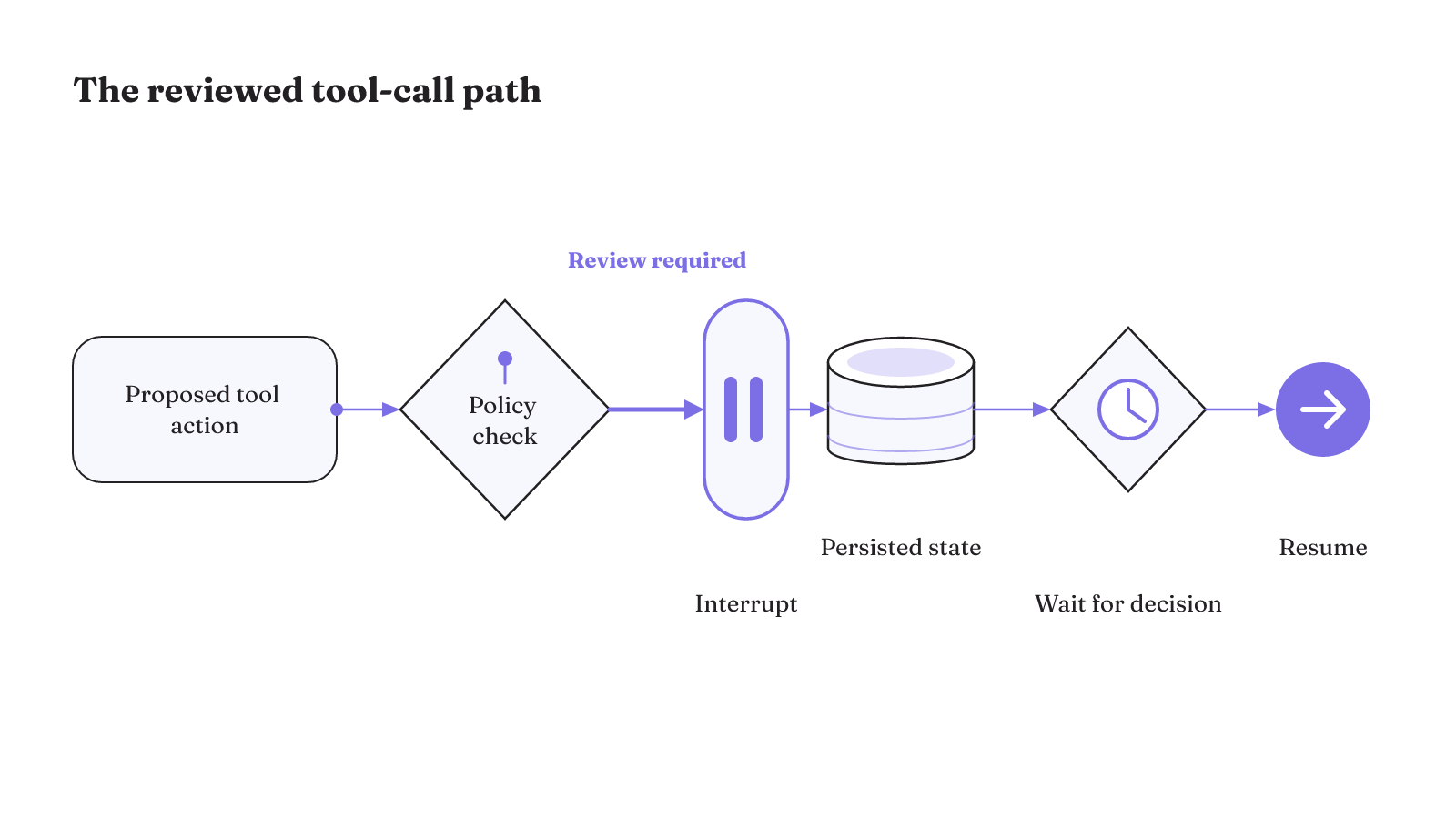
Consider the supported mechanism as a short trace:
- A model proposes a tool action, such as writing to a file or executing SQL.
- The middleware checks that tool call against its configured policy.
- If the action requires review, an interrupt halts execution.
- The graph state is saved through LangGraph's persistence layer.
- The run waits for a human decision, then resumes later.
That is how human-in-the-loop works in the middleware path. The policy controls whether a proposed action crosses the review boundary. The interrupt stops the run. Persistence keeps the state needed to continue. These are separate parts of one control path, and each has a concrete job.
You can also build a specialized workflow directly with the interrupt primitive and middleware abstraction. That option matters when a general tool-call policy does not express the review point you need. The primitive gives you the pause, while the surrounding workflow defines what state reaches that pause and what execution may follow it.
These two implementation routes give you a useful design choice. Human-in-the-Loop middleware checks tool calls against the configurable policy. It fits a control boundary expressed in terms of proposed tool actions. A specialized workflow can call the interrupt primitive directly and use the middleware abstraction around it. That route keeps the interrupt inside the workflow you define. Both still rely on persisted graph state when execution needs to pause and resume later.
The mechanism trace is also a practical test for your graph. Identify the proposed action. Identify the policy check that covers it. Locate the interrupt that halts execution. Then identify the state that LangGraph saves for the later resume. If any part is missing from the design, adding a review screen alone does not supply that part.
This answers the mechanical question of how to add a human-in-the-loop. It does not decide which actions deserve one. Applying the same review rule to every action can bury important decisions in routine approvals. The stronger unit of control is the individual action.
Place approval action by action
Human oversight should be decided action by action, not agent by agent. One agent can propose actions with very different consequences. A single label on the agent hides those differences, while an action-level policy can assign a gate depth according to the risk tier.
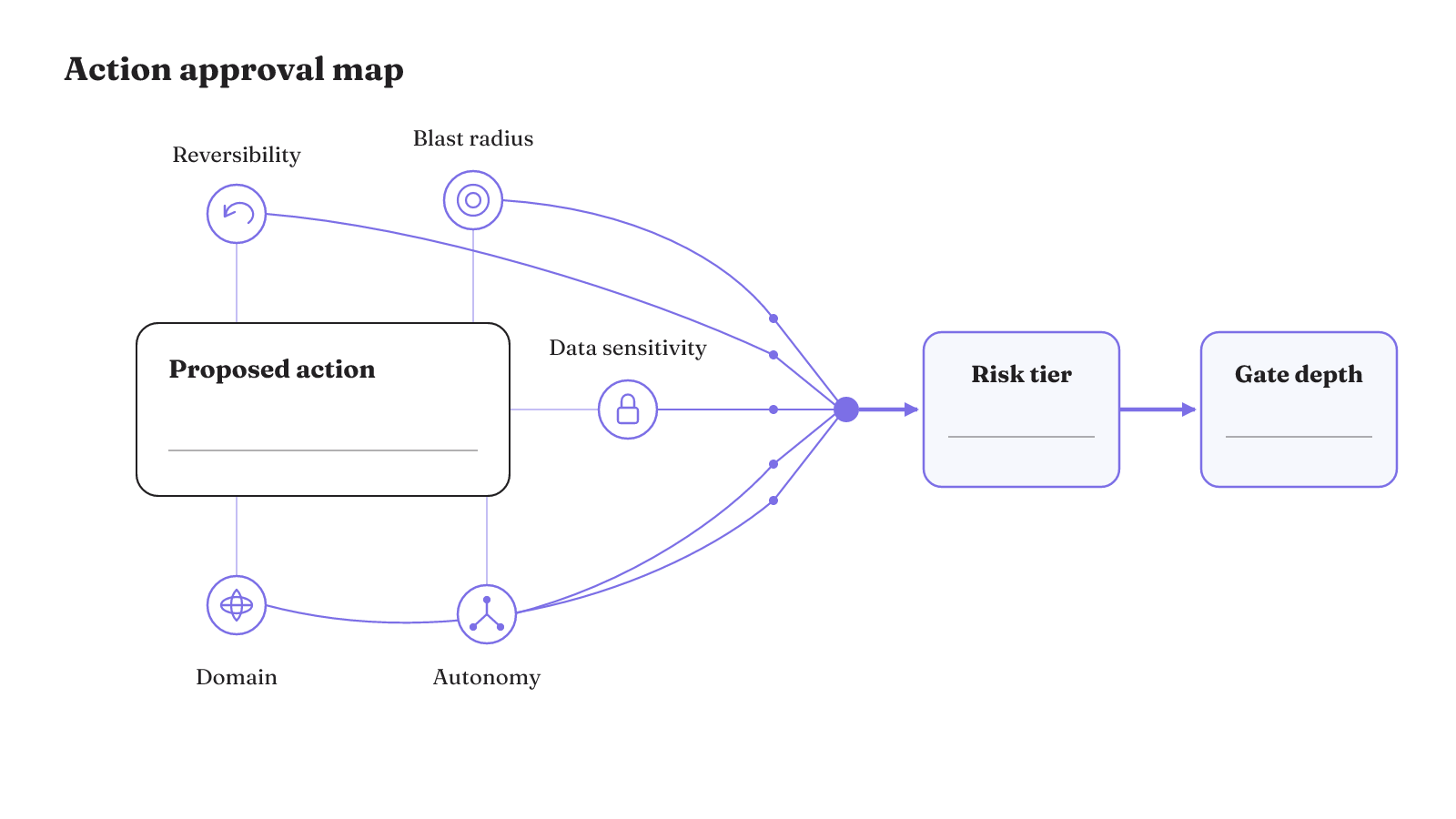
Five factors support that placement decision: reversibility, blast radius, data sensitivity, autonomy, and domain. The map below turns them into a fillable review record. Assess the proposed action, then assign its risk tier and corresponding gate depth.
| Factor | Action-level assessment question | Assigned risk tier | Gate depth |
|---|---|---|---|
| Reversibility | How cleanly can this action be undone? | Fill: ___ | Fill: ___ |
| Blast radius | How widely can this action affect other work or people? | Fill: ___ | Fill: ___ |
| Data sensitivity | What is the sensitivity of the data involved in this action? | Fill: ___ | Fill: ___ |
| Autonomy | How much direction can the action take without another decision? | Fill: ___ | Fill: ___ |
| Domain | What domain does the action operate in? | Fill: ___ | Fill: ___ |
Keep the assessment attached to the proposed action. The same agent does not need one permanent review label. Its actions are assessed separately, and gate depth is tied to the risk tier assigned to each one. This avoids treating an agent's identity as a substitute for the five factors that actually place the gate.
The balance is real. Too much review produces rubber-stamping. Too little review permits unapproved consequential actions. The goal is a gate that requests human attention when it is genuinely needed. Risk-based escalation can also deny by default when a review times out, instead of turning silence into permission.
Timeout behavior is part of the placement decision because the gate needs a defined result when no decision arrives. Risk-based escalation can use denial as that default. It can also tune the gates so human attention is requested only where it is genuinely needed. That keeps the timeout rule aligned with the same risk-based routing that placed the review point.
Error visibility and verification belong in the assessment too. Useful questions include how quickly an error will become visible, how cleanly the action can be undone, and what evidence would verify success. Those questions sharpen the five-factor map without pretending that one risk tier fits every workflow.
This placement method also clarifies the meaning of "agentic AI with a human in the loop." The human is not attached to every moment of execution. Review is attached to actions whose consequences justify it. Once that boundary is chosen, the engineering problem moves inward: the interrupted node must remain safe when it runs again.
Safe resume starts before the interrupt
The most important resume fact is easy to miss: LangGraph re-runs the node in which an interrupt was called. Any operation completed before that interrupt can therefore happen again when the node resumes.
An API update makes the failure mode concrete. If the node performs the update and then interrupts, resuming the node can perform the update more than once. The repeated call may overwrite the initial update or create duplicate records. The approval gate may work exactly as intended while the surrounding node still produces the wrong effect.
Follow the run in order. On the first pass, the node performs the API update before it reaches the interrupt. The interrupt pauses execution. When the run resumes, LangGraph re-runs that node, so the API update can run again. The danger is not only an identical duplicate. The later update can overwrite the first one, or the external system can receive another record.
The replay boundary needs three controls:
- Make pre-interrupt operations idempotent. Repeating an operation should not create a new effect each time the node re-runs.
- Put side effects after the interrupt. The consequential effect should follow the pause instead of preceding it.
- Separate side effects into their own nodes when possible. This keeps the review point apart from the operation that changes an external system.
The first control applies to any work that must happen before the pause. The second changes the order so the effect occurs after intervention. The third changes the graph structure, giving the side effect a node of its own. Together, they form a compact replay-boundary checklist for the checkpoint you are designing.
The controls also give each kind of work one clear location. Required preparation before the interrupt must tolerate a repeat. The side effect waits until after the interrupt. When the graph permits it, a separate node contains that side effect. This layout does not stop the interrupted node from re-running. It makes that replay safe by keeping repeatable work before the boundary and the external effect after it.
This is also why persistence and replay safety cannot be treated as the same feature. Persistence lets execution pause and resume later. Node replay determines what happens when execution returns. A saved state does not make an earlier side effect idempotent. You have to arrange the node so a replay cannot duplicate or overwrite external work.
For a LangGraph human in the loop example, draw the boundary as three blocks: idempotent preparation, interrupt, then side effect. If the side effect cannot sit after the interrupt in the same node, isolate it in a separate node. That small graph sketch exposes more than an interrupt-only demo because it shows what may repeat and what must wait.
How can FastAPI carry the review decision?
A working LangGraph and FastAPI example demonstrates a narrow but useful path. It pauses a LangGraph agent, waits for frontend input, and resumes execution in embedded mode with a React interface. That is enough to make the transport shape visible: the backend has paused work, the frontend supplies input, and execution continues.
For a LangGraph human-in-the-loop FastAPI design, keep that interaction path distinct from the policy and replay boundary. FastAPI can carry input between a frontend and backend. LangGraph still owns the interrupt, persisted graph state, and resumed execution described above. The node still needs idempotent pre-interrupt work and correctly placed side effects.
The demonstrated interface path has three visible moments: the agent pauses, the React frontend provides input, and the embedded LangGraph execution resumes. That is a useful human-in-the-loop example because it shows where the person enters the run. The policy check that caused the pause still belongs in the LangGraph design, as does the state saved for resumption.
Authentication is another explicit part of the HTTP boundary. FastAPI can use OAuth2 to authenticate a frontend to a backend with a username and password. In FastAPI's demonstrated security dependency, a missing Authorization header or one without a Bearer token receives an HTTP 401 Unauthorized response.
That gives the frontend-to-backend request a concrete authentication path. The frontend can authenticate with the backend through OAuth2 using a username and password. The demonstrated dependency then checks the request's Authorization header for a Bearer token. Its 401 response covers both a missing header and a header that does not contain that token.
That security behavior is useful because a review decision arrives as an API request, not as an abstract human intention. The example establishes the pause, frontend-input, and resume path. The FastAPI documentation establishes a separate authentication mechanism and the response produced by that demonstrated dependency when the Bearer authorization header is absent or invalid.
The implementation choice is now clearer. Use the interface to carry the decision, but keep approval policy, saved graph state, authentication, and replay-safe effects visible as distinct engineering responsibilities.
Can agentic AI stay autonomous with humans in the loop?
Yes. High autonomy can shift a person's role from performing every step to deciding which direction the system should take next. Human involvement becomes a routed control point, not a requirement to manually execute the whole workflow.
An example from a different framework makes that split concrete without turning it into a claim about LangGraph. A Microsoft Agent Framework fraud workflow uses a typed risk assessment. It automatically clears low-risk alerts and sends high-risk alerts to a human review checkpoint. The workflow combines checkpointing, parallel execution, type-safe messaging, OpenTelemetry observability, and event logs.
In that Microsoft example, interrupted work resumes from its last saved state. A failed agent or executor restarts from its checkpoint without re-running completed steps. Those are properties of the named Microsoft workflow, not LangGraph recovery guarantees. Their value here is architectural: typed risk routes work, a checkpoint marks the human decision boundary, and the event log keeps the path visible.
The example separates three decisions that are often compressed into one idea of oversight. A typed assessment classifies risk. That classification sends low-risk alerts through the automatic path and high-risk alerts to the human checkpoint. Saved state supports later resumption, while checkpoint recovery handles a failed agent or executor without repeating completed steps. The named workflow joins those mechanisms with parallel execution, type-safe messaging, OpenTelemetry observability, and event logs.
LangGraph implements the control path through its own middleware, policies, interrupts, and persistence. The shared design question is where human judgment changes the direction of a run. The five placement factors provide a way to choose that point action by action. The replay checklist then keeps the chosen LangGraph boundary safe when its node resumes.
Assessing autonomy can include three practical questions: how quickly will errors become visible, how cleanly can actions be undone, and what evidence would verify success? These questions keep autonomy connected to recoverability and verification. They also prevent "human in the loop" from becoming a blanket label that says nothing about where control actually sits.
Agentic AI can therefore retain substantial autonomy around a human checkpoint. The person supplies direction where the routed risk calls for it. Routine work does not need to become a sequence of approvals, and consequential work does not need to pass without one.
Define the run, then log every decision
An approval gate is easier to inspect when the run starts with a clear contract. An agent run should begin with a contract that defines what it is trying to do. That goal gives the later review decision a concrete frame.
Keep the record compact:
Run contract
Goal: [define what this run is trying to do]

Decision record
Action under review: [identify the proposed action]
Outcome: [approval, denial, or override]
Approval, denial, and override decisions should all be logged. The log preserves the review path while the contract preserves the purpose of the run. Together they make it possible to inspect both what the system was trying to do and how human judgment changed its course.
That record belongs beside the checkpoint design, not in a separate governance exercise. Use the approval gate reference while you define the policy, and keep human-in-the-loop control tied to the action's blast radius. Then place those gates inside the agent loop, with idempotent preparation before each interrupt and consequential side effects after it.