Key takeaways
Agents handle ambiguous, multi-step work across tools. MCP servers expose tools and data, and MCP clients connect applications to those servers. An agent can call an MCP server. A direct API has no reasoning layer or protocol overhead, making it useful when execution needs predictable latency. One system can combine these components.
The cleanest way to compare MCP servers vs agents is to stop treating them as substitute products. Ask four questions of each component: what role does it perform, what connects to it, where does it fit, and what does it cost to operate? The answers show whether the system needs a reasoning loop, a standard capability interface, a direct execution path, or a combination.
MCP servers vs agents: which layer owns what?
An agent is not the same as an MCP server. Agents reason through ambiguity, act across tools, and handle multi-step tasks, while an MCP server exposes data and tools. MCP itself is the open connection standard; an MCP server is a component that exposes capabilities through it, and an MCP client is the application that connects. Function calling adds model-led tool selection before direct execution. A direct HTTP API has no reasoning layer or protocol overhead.
| Layer | Role | Connection path | Best fit | Cost or limitation |
|---|---|---|---|---|
| LLM | Works from training-time knowledge | Needs another component to reach outside systems | Model work that does not itself require outside interaction | Cannot interact with the outside world on its own |
| Agent | Reasons through ambiguity and handles multi-step tasks | Acts across tools | Work that requires multi-step decisions across tools | Requires capable models, clear instructions, and well-defined tools |
| MCP client | Connects the application to MCP servers | Opens the client-to-server connection | Applications that need server-exposed capabilities | Adds a protocol participant to the path |
| MCP server | Exposes data and tools | Receives connections from MCP clients | Sharing discoverable capabilities through MCP | Connected definitions and results can consume context |
| Function or tool call | Lets the LLM select a tool | Adds model-led selection, then executes the tool directly | A direct tool execution path that still needs model selection | Adds an LLM reasoning step |
| Direct API | Calls an HTTP endpoint directly | No reasoning layer or protocol overhead | Time-sensitive paths that need predictable latency | Authentication, rate limits, and schema changes still need handling |
Reliable agency depends on the surrounding orchestration
Connecting a model to tools does not, by itself, make the resulting agent reliable. The foundation is a capable model, well-defined tools, and clear structured instructions. The harness around those pieces must then decide how work moves, what context is assembled, what state persists, and what happens when execution fails.
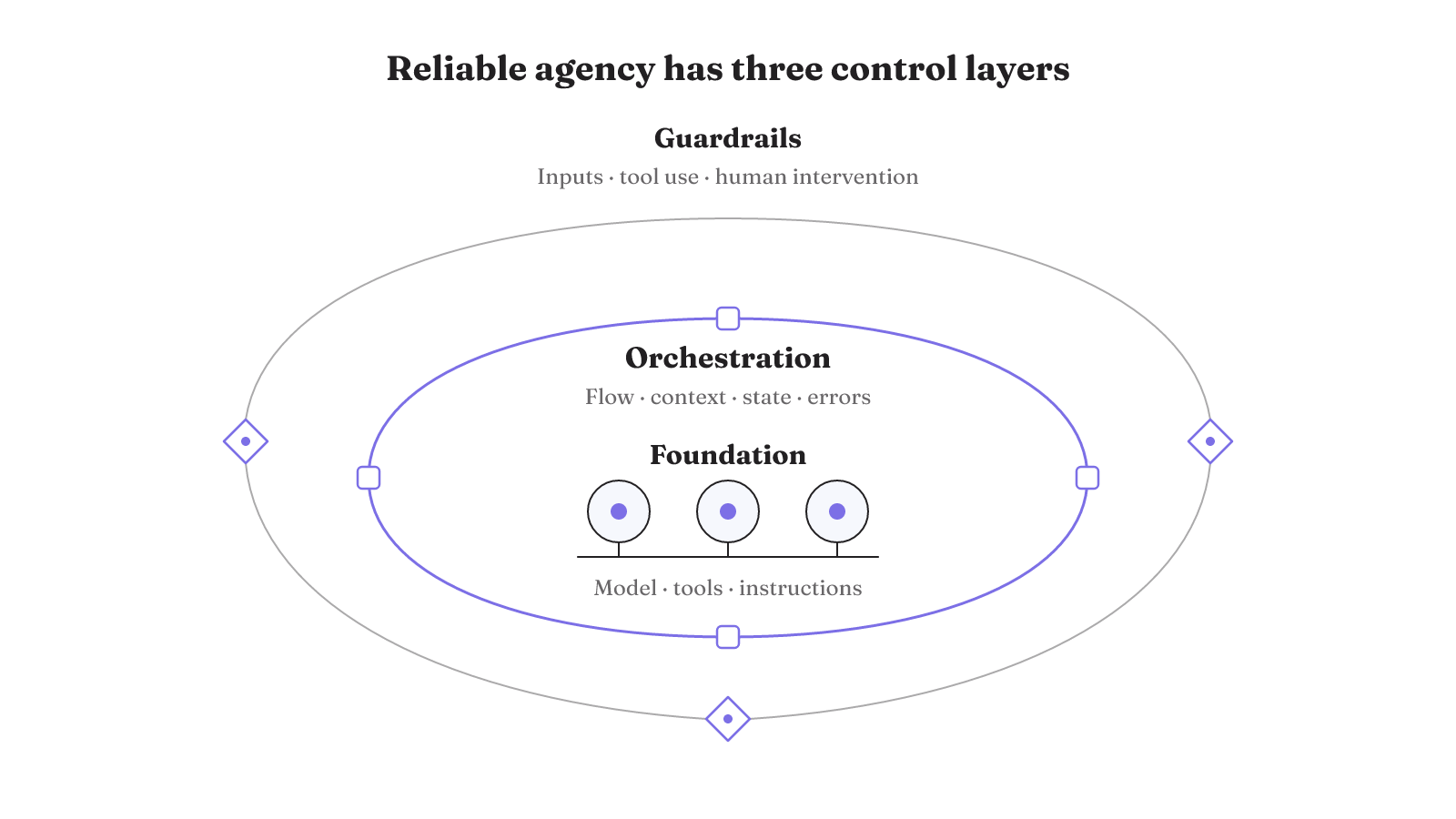
An orchestrator manages control flow, context assembly, state, and error handling. That makes orchestration a different concern from capability exposure. An MCP server can present a tool, but the orchestrator determines when the surrounding system reaches that tool, what information arrives with the call, and how errors enter the flow.
Those four orchestration jobs answer different operating questions. Control flow governs how work moves between steps. Context assembly supplies the information used at a step. State carries the work that must persist, while error handling governs failures. Keeping those jobs in an explicit orchestrator makes the control path visible even when an individual step gives the model room to decide.
A practical control chain has three levels:
- Model, tools, and instructions form the foundation. The model must be capable enough for the task. Tools need clear definitions, and instructions need a structure the model can follow.
- Orchestration contains the course of work. Control flow, assembled context, durable state, and error handling sit around individual model and tool steps.
- Guardrails constrain consequential paths. Production guardrails cover input filtering, tool use, and human intervention.
This is where a controlled harness earns its keep. Production orchestration can combine deterministic structure with LLM flexibility inside individual steps. The workflow can keep a fixed outer shape while a model handles the part that benefits from judgment. Agent interfaces should also favor simplicity, transparent planning, and thoroughly documented and tested connections between the agent and the computer.
Interface quality deserves its own check. A well-defined tool tells the model what it can call, while the agent-computer interface is the executable boundary around that call. Prioritizing simple interfaces, visible plans, documentation, and testing gives the team concrete surfaces to inspect. Those surfaces sit alongside model capability and instructions; they do not disappear when the connection happens through MCP.
Complexity should arrive only when the work demands it. Add multi-step agentic systems only when simpler solutions fall short. Start with a single agent, then move to multiple agents only when needed. That sequence keeps coordination from becoming the architecture before the underlying task has justified it.
When should you use MCP instead of a direct API?
Use MCP when multiple AI systems need to share the same standardized, discoverable tools. Use a direct API when the path is time-sensitive and predictable performance matters. An agent project can use both at different layers, so this decision does not need to govern the entire system.
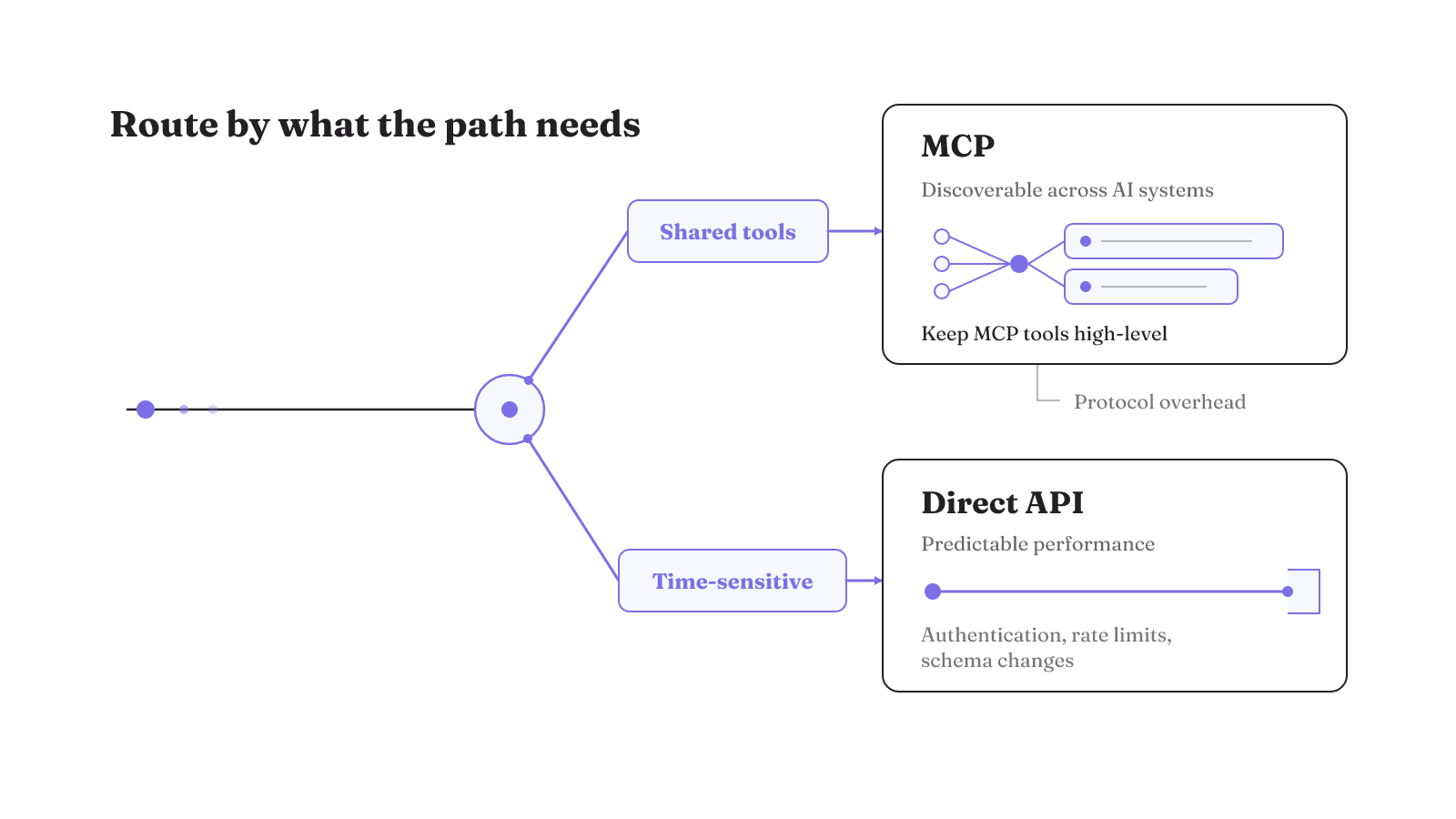
The MCP vs API choice has three concrete decision points:
- Shared tool access favors MCP. MCP is most valuable when several AI systems need the same tools through a discoverable interface.
- Predictable performance favors a direct API. MCP adds JSON-RPC communication, tool discovery, and session management. Direct API calls avoid that protocol overhead and offer a more predictable path for time-sensitive execution.
- The MCP surface should stay task-oriented. A smaller set of high-level tools is preferable to automatically exposing every low-level API endpoint.
The third point is easy to miss. Standardizing a connection does not require turning every endpoint into an MCP tool. The interface can expose a smaller group of high-level, task-oriented tools. The API can remain at a lower architectural layer, while MCP provides the shared and discoverable interface used by AI systems.
Neither route removes operational work. Production API integrations bring authentication, rate-limit, and schema-change complexity. MCP adds discovery and session management to the connection path. Those costs are different, and the right one depends on whether shared discoverability or predictable execution is the stronger need.
This is also why MCP does not replace an API. Agent projects can use command-line interfaces, APIs, and MCP at different architectural layers. A direct API can serve a fixed, time-sensitive route while MCP exposes a shared tool surface elsewhere. If you are also weighing packaged agent instructions, keep that as its own boundary; our Agent Skill glossary covers that narrower term.
For a mixed architecture, make the choice route by route. A path shared across several AI systems can use MCP for standardized discovery. A time-sensitive path can call the API directly. A tool that needs model-led selection can use function calling. These methods can occupy different layers in the same agent project without being forced into a single integration pattern.
Can an agent use multiple MCP servers?
Yes. Individual agents can process inputs, call tools and MCP servers, and generate responses. MCP provides a protocol for an agent to reach many tools and systems, while routing and orchestration determine how those connections participate in the larger flow.
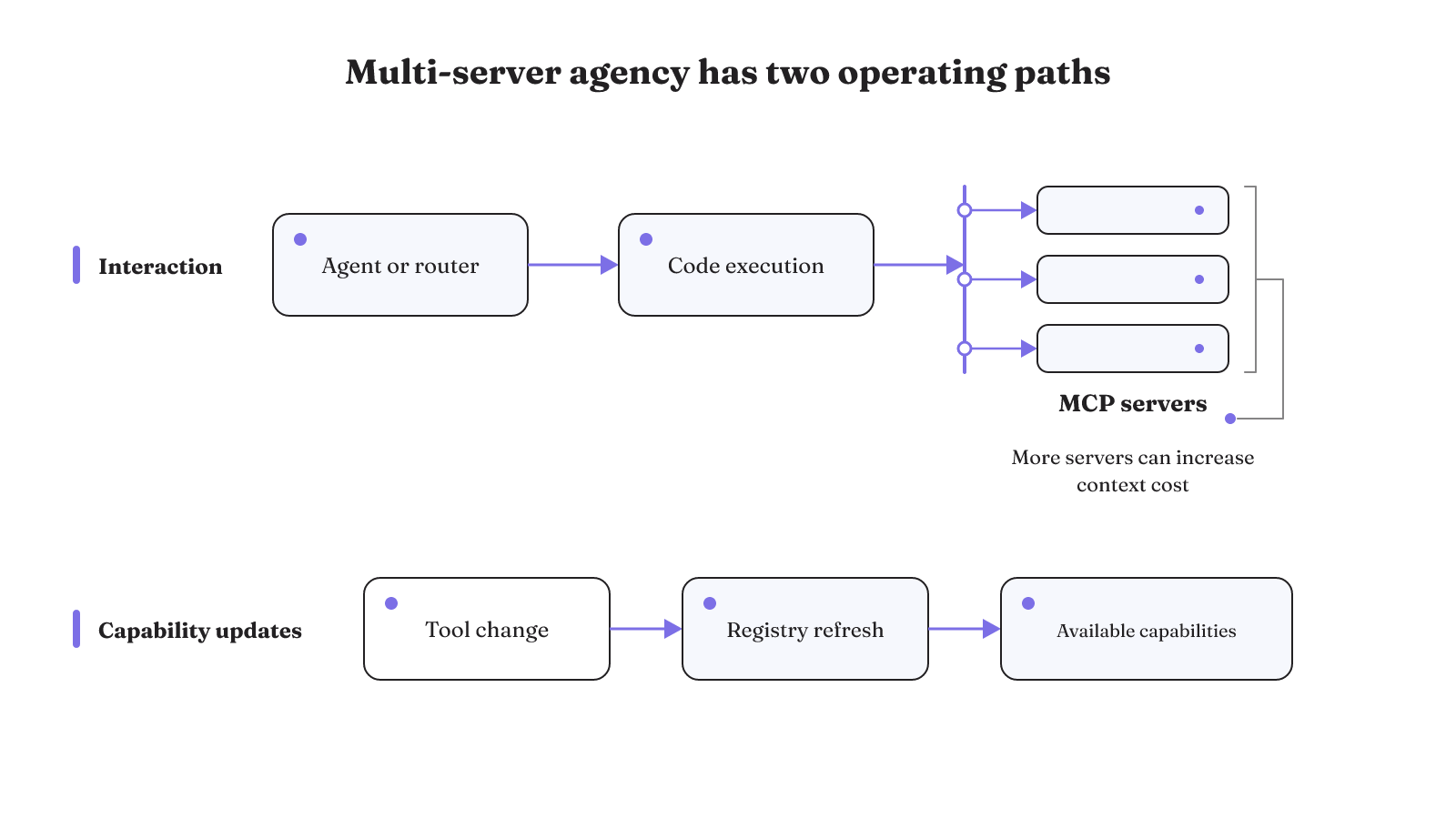
Several composable patterns can connect models to MCP servers, including map-reduce, orchestration, evaluator-optimizer, and routing. The choice of pattern changes how work is divided, but the basic control path remains legible:
- The agent or routing pattern reaches the MCP servers needed for the work.
- The servers expose their tools and data through the protocol.
- Code execution can use familiar programming constructs to interact with those servers more efficiently.
- The application can listen for MCP tool changes, refresh its registry, and update the model's available capabilities during an ongoing conversation.
The number of connections affects the agent's working context. When too many MCP servers are connected, tool definitions and results can consume excessive tokens and reduce agent efficiency. Multi-server design includes both connectivity and context efficiency.
Code execution and registry updates solve different operating problems. Code execution lets an agent use familiar programming constructs to interact with servers more efficiently. Registry notifications keep the model's available capabilities current when tools change during a conversation. Routing connects the servers, but the definitions and results that enter the interaction still carry the context cost.
An MCP connection is also a permission boundary
Connectivity carries authority. Remote MCP servers can let models access, send, and receive data and take actions. A server that has not been verified by the model provider remains a third-party service governed by its own terms. The protocol connection does not settle whether that service should receive data or exercise a tool.
Prompt injection becomes a security concern when a model can reach an MCP server or connector with access to sensitive data or actions. The permission design should follow the action path, not stop at the fact that a server speaks MCP.
For OpenAI configurations, the concrete control path uses two settings together:
allowed_toolslimits which server tools are available.require_approvalplaces an approval flow in front of sensitive actions.
These controls narrow what the model can reach and gate the actions that carry more consequence. They are product-specific configuration controls, not a universal spelling for every MCP client.
Permission scope and approval are separate controls. allowed_tools defines the available tool set. require_approval governs whether a sensitive action must pass through approval. Using both lets the configuration constrain availability and place human intervention on the actions that need it.
Server origin is another part of the decision. Prefer an official remote server hosted by the underlying service provider over a third-party proxy server. Official hosting is a useful selection criterion, but it does not remove the need to inspect data access, available tools, and approval requirements.
Treat the server connection as an action surface. Identify which data can cross it, which tools can act, where approval applies, and who operates the remote endpoint. That turns a broad question about whether MCP is safe into a set of controls attached to the actual path.
The hosting check belongs beside those controls. A provider-hosted official server is preferred to a third-party proxy, while an unverified remote server remains a third-party service under its own terms. Data access, action scope, prompt injection, approval, and server origin all remain visible parts of the connection decision.
Model placement shifts workload and responsibility
After choosing the connection path, decide where model-led decisions run. Server-side, client-side, and hybrid MCP architectures distribute workload and responsibility differently. This is independent of whether the application uses one server or several.
Server-side placement
Placing a model server-side reduces client workload, but it increases server complexity. This pattern moves more of the model work away from the client. The server then carries the added complexity created by that placement.
Client-side placement
Placing the model client-side supports dynamic decisions, but it increases client responsibility. The client holds more of the decision work and must carry the extra responsibility that comes with it.
Hybrid placement
A hybrid MCP architecture distributes logic to combine stability with adaptability. Instead of assigning all model-led work to one side, it divides that logic across the architecture. The value is the combination, but the split itself must remain clear enough to operate.
GitHub examples include basic and agent-backed servers
Public GitHub projects make the boundary visible in code. One basic MCP example implements both a server and client for tools, resources, and prompts. It shows the protocol components as separate parts: the server exposes capabilities and the client connects to them.
A different public implementation shows that an agent can itself be exposed through an MCP-server interface. This is the useful answer to "MCP vs AI agent": the categories can be nested. An agent may consume MCP capabilities, and an agent may also sit behind a server interface. Interface shape does not erase the agent logic behind it.
The two repository shapes answer different implementation questions. A server-client pair shows the connection between protocol participants. An agent-backed server shows that the exposed MCP interface may have agent logic behind it. Repository labels alone do not tell you which shape you are looking at; the implementation boundary does.
When reviewing MCP servers vs agents on GitHub, first identify which of those shapes the repository implements. Then inspect the capability surface, connection path, permission scope, context cost, and recovery implications. Our GitHub MCP server scorecard turns those checks into a practical review before you connect your next server. For the protocol underneath the code, use our definitions of an MCP server and the Model Context Protocol.