Key takeaways
- Retrieval selects and supplies knowledge.
- MCP describes a structured, model-agnostic interface for discovering and using tools and data sources.
- The two can be composed. A retrieval tool can be exposed through an MCP server.
The Model Context Protocol vs RAG decision becomes clearer when the system is drawn as a path. Retrieval sits in the knowledge path. MCP sits at an interface boundary. A system may use one or compose both.
Is MCP better than RAG? That depends on the job being designed. Retrieval addresses knowledge selection. MCP describes tools and data sources so a model can discover and use them through a structured API. A retrieval tool behind an MCP server keeps both responsibilities in view.
Model Context Protocol vs RAG: is MCP a form of RAG?
The architectural answer is more useful than a categorical identity verdict. MCP is an open protocol for describing tools and data sources in a model-agnostic format. It lets LLMs discover and use those capabilities through a structured API. Retrieval selects knowledge. A repository can expose that retrieval capability through an MCP server.
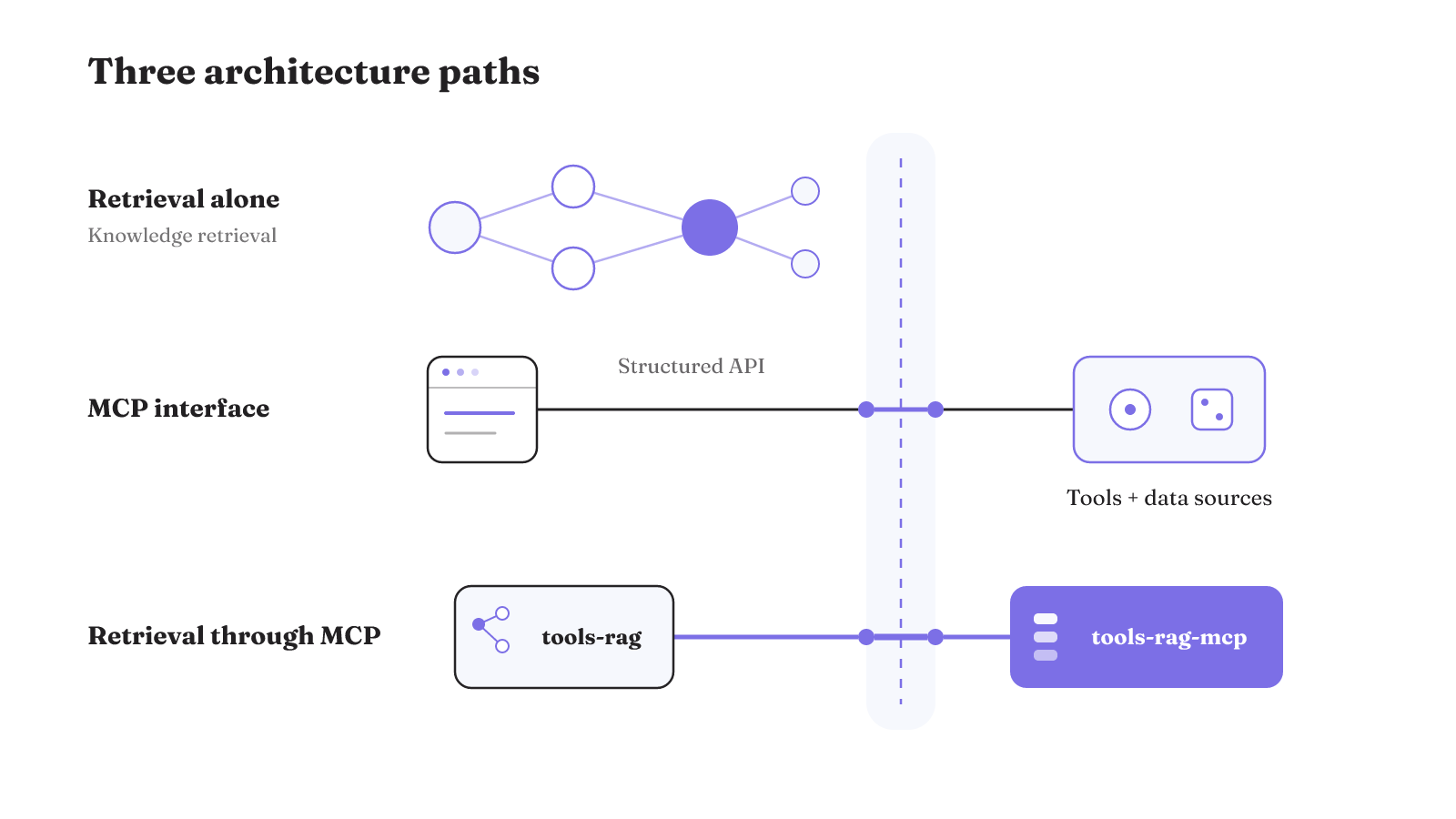
| Architecture path | Primary job | System boundary and interface | Concrete implementation pattern |
|---|---|---|---|
| Retrieval alone | Select and supply knowledge | Knowledge path, including traversal and freshness | A retrieval planner follows relationships and gathers evidence |
| MCP interface | Make tools and data sources discoverable and usable | Model-facing, structured API | A LangGraph agent can be exposed as an MCP tool |
| Retrieval through MCP | Retrieve knowledge and expose that capability | Retrieval remains in the knowledge path; MCP supplies the interface | tools-rag provides retrieval tools and tools-rag-mcp provides the corresponding server |
The first row isolates knowledge selection. The second isolates capability exposure. The third shows their composition without merging their responsibilities.
Retrieval depth and freshness stay inside the knowledge path
Putting retrieval behind an MCP server does not answer the hard retrieval questions. A direct, single-hop query can miss important facts spread across a graph. Multi-hop retrieval can follow relationships and aggregate evidence across several hops. That is a property of the retrieval method, not the interface used to expose it.
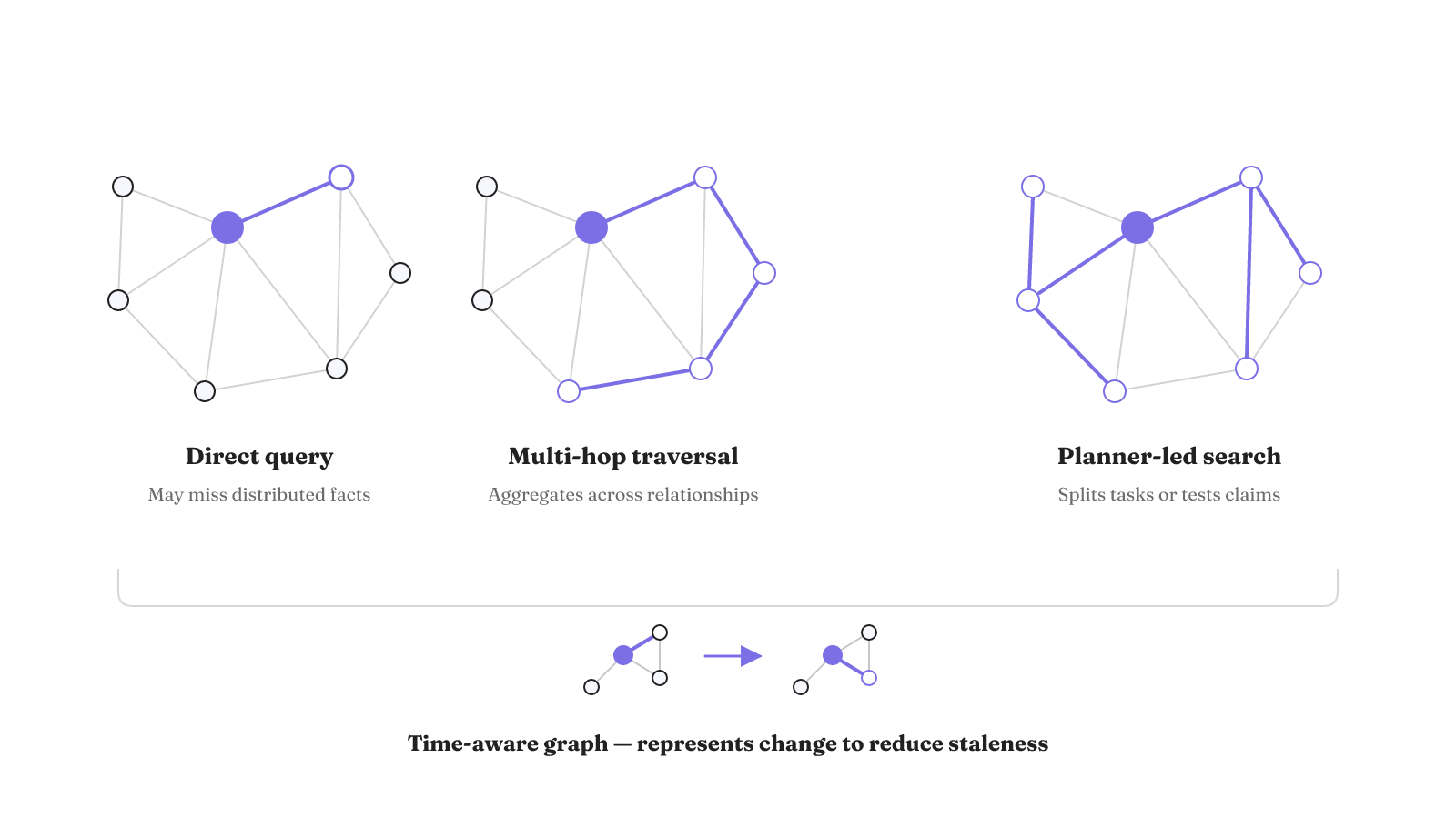
The knowledge path has four distinct mechanisms worth reviewing:
- Direct query. The system makes a single-hop request. In graph-shaped data, that request may miss facts distributed across the topology.
- Multi-hop traversal. Retrieval follows relationships iteratively and gathers evidence across several hops.
- Planner behavior. A planner may split a query into sequential subtasks. Another planning approach may propose claims to confirm, refute, or evolve.
- Temporal representation. A knowledge graph that does not capture change over time risks supplying outdated facts and producing errors or misinformed decisions.
Together, these mechanisms separate retrieval quality into traversal depth, planner behavior, and temporal freshness. A one-hop request, a multi-hop traversal, and a planner-led search can produce different knowledge paths. A graph that represents change over time addresses another part of the problem: whether the facts remain current.
MCP can expose the retrieval capability, but the MCP description does not settle those choices. The retrieval implementation still owns traversal, planning, and temporal knowledge. Our agentic RAG glossary provides a compact reference for the retrieval side of that boundary.
Can RAG run behind an MCP server?
Yes, repository structure shows a clean way to compose them. In one GitHub tool collection, tools-rag provides Retrieval-Augmented Generation tools and tools-rag-mcp provides the corresponding MCP server. The same collection uses a package pattern that separates core tool logic from the MCP server implementation.
The package names make the boundary visible. Retrieval remains in the core tool logic. The MCP package exposes that logic through the protocol. This is a practical Model Context Protocol and RAG GitHub pattern, not a feature contest between the two.
Separating the packages does not assign every runtime responsibility. Tool invocation, failure detection, and recovery still need named owners in the complete system. Our MCP server architecture guide follows that boundary from the model-facing interface into the acting system.
A short LangGraph implementation note
LangGraph Agent Server provides one concrete MCP path. It implements MCP over Streamable HTTP and can expose a LangGraph agent as an MCP tool to a compliant client that supports that transport. The /mcp endpoint uses the same authentication as the rest of the LangGraph API.
In the documented LangGraph path, the MCP implementation does not support sessions, and each /mcp request is stateless and independent.
This example is useful because the call path can be written in one line:
LangGraph agent -> MCP tool -> Streamable HTTP client
This path also clarifies an MCP vs RAG vs agent comparison. Here, the agent is exposed as a tool through MCP. Retrieval is not implied by that interface. Our guide to agentic AI and LLMs examines the model and acting-system boundary in more detail.
Authorization is a separate control boundary
Once a capability is exposed through an MCP server, authorization becomes its own design surface. MCP authorization secures access to sensitive resources and operations exposed by servers. When a server handles user data or administrative actions, authorization restricts its endpoints to permitted users.
Consider a client that discovers two server capabilities: one reads user data and another performs an administrative action. The tool description tells the client that the capabilities exist. Authorization determines whether the user may access the endpoints that expose them. Retrieval quality cannot answer that permission question, and a useful retrieval result does not grant authority to act.
MCP uses standardized authorization flows between clients and servers. Its design is not tied to one identity system and follows OAuth 2.1 conventions. That gives an architecture review concrete items to inspect without assuming that every implementation shares one setup.
Authorization and session behavior should not be collapsed into one checkbox. Authorization governs permitted access. Session behavior concerns state between requests. In the documented LangGraph path, requests are stateless and independent while the endpoint shares authentication with the rest of the API.
The Model Context Protocol glossary keeps the protocol definition close at hand while you draw these boundaries.
Review the composed path by boundary
A composed retrieval-through-MCP path is easier to reason about when the review follows the call from knowledge selection to capability exposure and execution. The questions below are deliberately scoped. They help reveal missing owners without asserting that one protocol or package supplies the answer.
Retrieval quality and freshness
Start inside the knowledge path:
- Can a direct query reach the needed facts, or are they distributed across relationships in a graph?
- Does retrieval need multi-hop traversal to gather evidence across those relationships?
- Would a planner split the query into sequential subtasks or propose claims to confirm, refute, or evolve?
- How does a knowledge graph represent facts that change over time?
The answers belong to the retrieval implementation. Exposing that implementation through MCP does not select the traversal depth or planner behavior. It also does not update time-sensitive facts inside a graph.
MCP authorization and session behavior
Now inspect the client-server boundary:
- Which endpoints expose sensitive resources or administrative actions?
- Which users are permitted to reach each endpoint?
- Which standardized authorization flow connects the MCP client and server?
- Which identity system is used with the OAuth 2.1 conventions?
- Does the selected implementation preserve session state or treat requests independently?
- If an MCP endpoint shares authentication with a broader API, is that the intended boundary for this workload?
These prompts separate permission from continuity. The authorization decision concerns endpoint access. The session question concerns state across calls. A design can answer one clearly and leave the other unresolved.
Tool execution and recovery ownership
Finish with the acting path:
- Which component invokes the tool?
- Which component performs the external operation?
- Where is a failed or interrupted call detected?
- Which component decides whether the call may be retried?
- What result must cross the MCP interface so the caller can handle failure?
These questions are especially important when package boundaries and runtime boundaries do not match. A core retrieval package can be separate from its MCP server package, while the host, server, and external tool still participate in one execution. Naming the owner of each step prevents the interface description from being mistaken for an end-to-end recovery design.
Write a boundary record before choosing the implementation
A short boundary record turns the review into an architecture input. Write one record for each capability the model may use. Keep the entries concrete enough that another engineer could draw the call path without guessing what a label means.
Use this template:
Capability and caller
- Capability being exposed:
[tool or data source] - Component that discovers it:
[client or host] - Component that invokes it:
[named component]
Knowledge path
- Retrieval owner:
[named component or none] - Query path:
[direct, multi-hop, or planner-led] - Planner job:
[sequential subtasks, claims to test, or none] - Time-sensitive facts:
[what changes and where that change is represented]
MCP boundary
- MCP server:
[named server] - Exposed tool or data source:
[name used by the client] - Client-server authorization flow:
[chosen flow] - Endpoint permissions:
[permitted users for sensitive resources or administrative operations] - Session behavior:
[state carried between requests or independent requests]
Execution and recovery
- Operation executor:
[named component or external system] - Failure detector:
[named component] - Retry decision owner:
[named component] - Result returned across the interface:
[success and failure information]
The blank entries are useful. If the team can name a retrieval package but not the component that detects a failed tool call, the missing answer is in execution ownership. If endpoint permissions are clear but session behavior is blank, permission has been designed while continuity has not. If the MCP server is named but traversal and freshness are blank, the interface is visible while the knowledge path remains underspecified.
The record also keeps implementation-specific facts narrow. For the documented LangGraph path, you can enter Streamable HTTP, shared LangGraph API authentication, and independent /mcp requests. For the package-split example, you can enter tools-rag as the core retrieval package and tools-rag-mcp as its server package. Neither entry should be copied into an unrelated architecture without checking that implementation.
Run the record in two passes. First, trace a successful request from discovery through the returned result. Second, trace a failed or interrupted request and fill every execution and recovery blank. The second pass does not assume that MCP provides recovery. It identifies which component must own the decision in the system being designed.
Hybrid systems add more than one cost meter
Iterative hybrid paths may make several calls per request, so their costs can accumulate quickly.
Keep the operating-cost review small and observable:
| Review item | Supported control |
|---|---|
| Cost surfaces | Track model inference, vector database operations, embedding generation, and external tool API calls |
| Monitoring detail | Attribute spending by component, request type, and user when applicable |
| Per-request limits | Cap retrieval operations, tool invocations, and iteration rounds |
| Redundant work | Use caching to reduce repeated operations |
| Model allocation | Use smaller, faster models for tool selection and orchestration, and reserve larger models for final response generation |
Model Context Protocol vs RAG is therefore a boundary decision before it is a feature comparison. Draw the retrieval path, the MCP interface, and the composed path as separate rows. Then review freshness and retrieval quality inside the knowledge path, authorization and session behavior at the implementation boundary, and execution ownership across the full call graph.
When that map exposes an unclear handoff, compare it against our MCP server boundary guide and mark the component that owns the call, permission, failure, and recovery.