Key takeaways
- Start with the simplest design that can do the work.
- Decompose for a concrete need, such as parallel work or specialized tools.
- Budget for handoffs, context, authority, telemetry, retries, and recovery.
For multi agent orchestration architecture design, the diagram is the easy part. The real decision is whether the value of decomposition earns the operating obligations it creates. Treat those obligations as a budget before you choose a pattern or framework.
What is the architecture of a multi-agent system?
A multi-agent system combines numerous agents that work together to carry out tasks autonomously. That definition is useful, but it leaves open the architectural question: what lets those agents act as one system instead of a loose collection of model calls?
The answer is a component stack. At the work layer, agents perform their assigned tasks. Domain specialization gives each agent limited, role-specific responsibilities. Around them, communication carries requests and results. An orchestration layer can integrate planning, policy enforcement, state management, and quality operations. These are separate operating concerns even when a framework exposes them through one interface.
Role boundaries turn a broad goal into limited assignments. Planning determines the work to assign. Policy enforcement governs what the system permits. State management preserves the information needed across execution, and quality operations inspect the work. This stack is not a claim that every system needs a fixed number of layers. It is a way to make responsibility visible before several agents begin exchanging work.
Communication protocols provide a standardized connective layer across agents and systems. Two protocol roles are especially useful to distinguish. Model Context Protocol standardizes an agent's access to external tools and contextual data. Agent-to-Agent protocol governs peer coordination, negotiation, and delegation. One connects an agent to capabilities and context; the other structures work between agents.
This distinction changes what you inspect. Tool and context access belong to one protocol surface. Coordination, negotiation, and delegation belong to another. If a design compresses both into a single arrow, expand that arrow until you can see which responsibility it carries.
That component stack gives a practical answer to "What is the architecture of a multi-agent system?" It has agents, bounded roles, communication, and orchestration concerns for planning, policy, state, and quality. The exact topology can change, but those concerns still need owners. Our guide to AI agent architectures puts that architecture decision in the broader harness around a model.
The presence of these components does not prove that a workflow needs all of them. First decide whether one agent has actually reached a useful limit.
When does a workflow need multiple agents?
A workflow has earned decomposition when the work requires parallel execution, specialized tools, large context, or multiple decision checkpoints. Those are concrete fit tests, not a universal score. If none applies, adding agents may create coordination work without solving a real workload constraint.
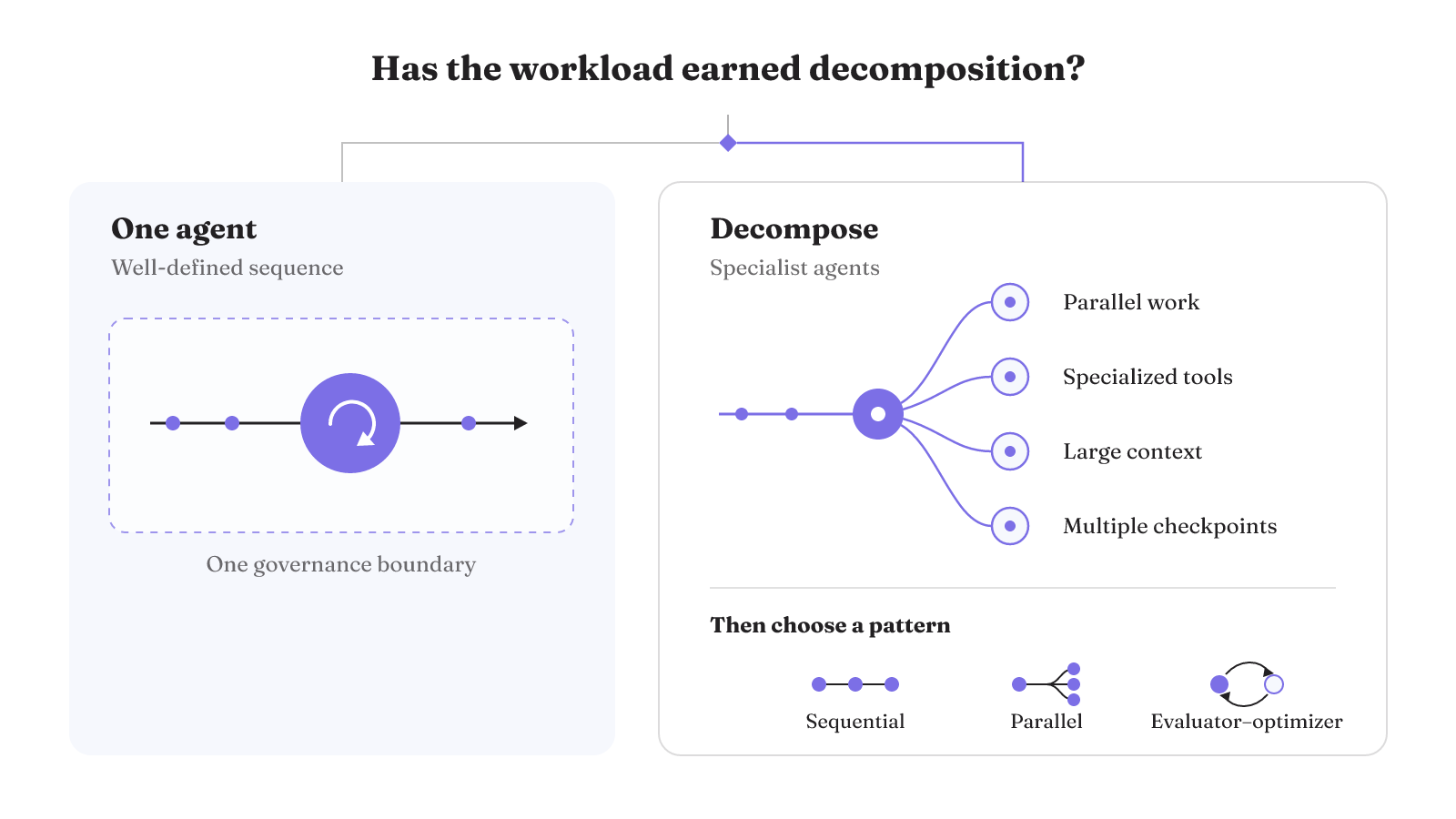
Test the workload in that order. Can one agent complete a well-defined sequence? Does the work need specialties with different tools? Is the context large enough to justify role-level separation? Are there several points where a decision must be made? These questions do not produce a numeric verdict. They force the proposed decomposition to answer a real workload need.
Consider a well-defined task whose steps run in sequence. A single agent is simpler to govern and cost-effective for that kind of work. It becomes a weaker fit as cross-functional complexity grows. In contrast, a process-driven workload may need several specialties or independent branches of work. Multi-agent systems can distribute that work across specialized agents, supporting scalability, fault tolerance, and parallel execution.
Parallel execution has a specific architectural value: it can reduce latency while letting the capacity and capabilities of individual agents scale independently. That does not make parallelism the default. It makes parallelism one reason to accept decomposition when the workflow contains work that can run that way.
Once the decomposition decision is justified, pattern selection becomes narrower and more useful. The available choices include sequential, parallel, and evaluator-optimizer patterns. A sequential pattern can preserve ordered work across agents. A parallel pattern can run separate branches at once. An evaluator-optimizer pattern separates production from evaluation. These descriptions identify the responsibility shape; they do not establish a universal ranking or threshold.
A multi-agent orchestration architecture design example
Put the two workload shapes side by side. In the first, one agent completes a well-defined sequence under one governance boundary. In the second, specialized agents handle distinct parts of a process, with some work running in parallel and decision checkpoints between stages. The second design earns attention only because the workload calls for specialization, parallel work, large context, or multiple checkpoints. The architecture choice then affects governance, cost control, coordination design, and production risk.
Multi-agent orchestration architecture design needs a coordination budget
| Design area | Value or need | Added obligation | Concrete design check |
|---|---|---|---|
| Simpler-design limit | State where the simpler solution fell short. | Every added agent needs a reason to exist. | Identify the missing need: parallel work, a specialized tool, large context, or multiple decision checkpoints. |
| Handoff ownership and context transfer | Delegation moves work to a role-specific agent. | A handoff needs a receiving owner, progress monitoring, and escalation when stalled. | Name the receiver. Use full state transfer or structured checkpoints when a summary would make it request upstream information again. |
| Shared-context scope | A shared store can package definitions, policies, lineage, quality signals, and traces for reuse. | Sub-agents need role-scoped context, not unrestricted access to every document, memory, and tool. | List what the role receives and what stays outside its context. |
| Permissions and delegation | Permissions, audit logs, and human checkpoints can be designed into the system. | Each tool call needs an authorization boundary that respects delegated authority. | In the Cedar with OAuth 2.0 example, verify agent capability, the delegation path, and the originating user's authority. |
| Cost telemetry | Cost can be analyzed by workflow, successful workflow, role, retry, failed workflow, and verifier share. | Cost records must line up with debugging records. | Attach cost to the same workflow, task, agent run, tool call, and retry units used for debugging. |
| Retry safety | Retrying abandoned or failed work can repeat an external effect. | Ticket creation, refunds, email, document changes, and customer-record writes need idempotency or deduplication contracts. | Require an idempotency key or deduplication rule before retrying a side effect. |
| Compensation | A workflow may partially complete before a later step fails. | Recovery must distinguish committed changes, partial-completion signals, compensating actions, and irreversible actions needing human resolution. | Record the commit action, partial signal, available compensation, and irreversible boundary. |
| Recoverability | Interrupted work needs a legal path back into execution. | Recovery requires durable state and a way to detect abandoned work. | Put a durable checkpoint before external side effects, store artifact references, define heartbeat or lease behavior, and use a resumable state machine with legal transitions. |
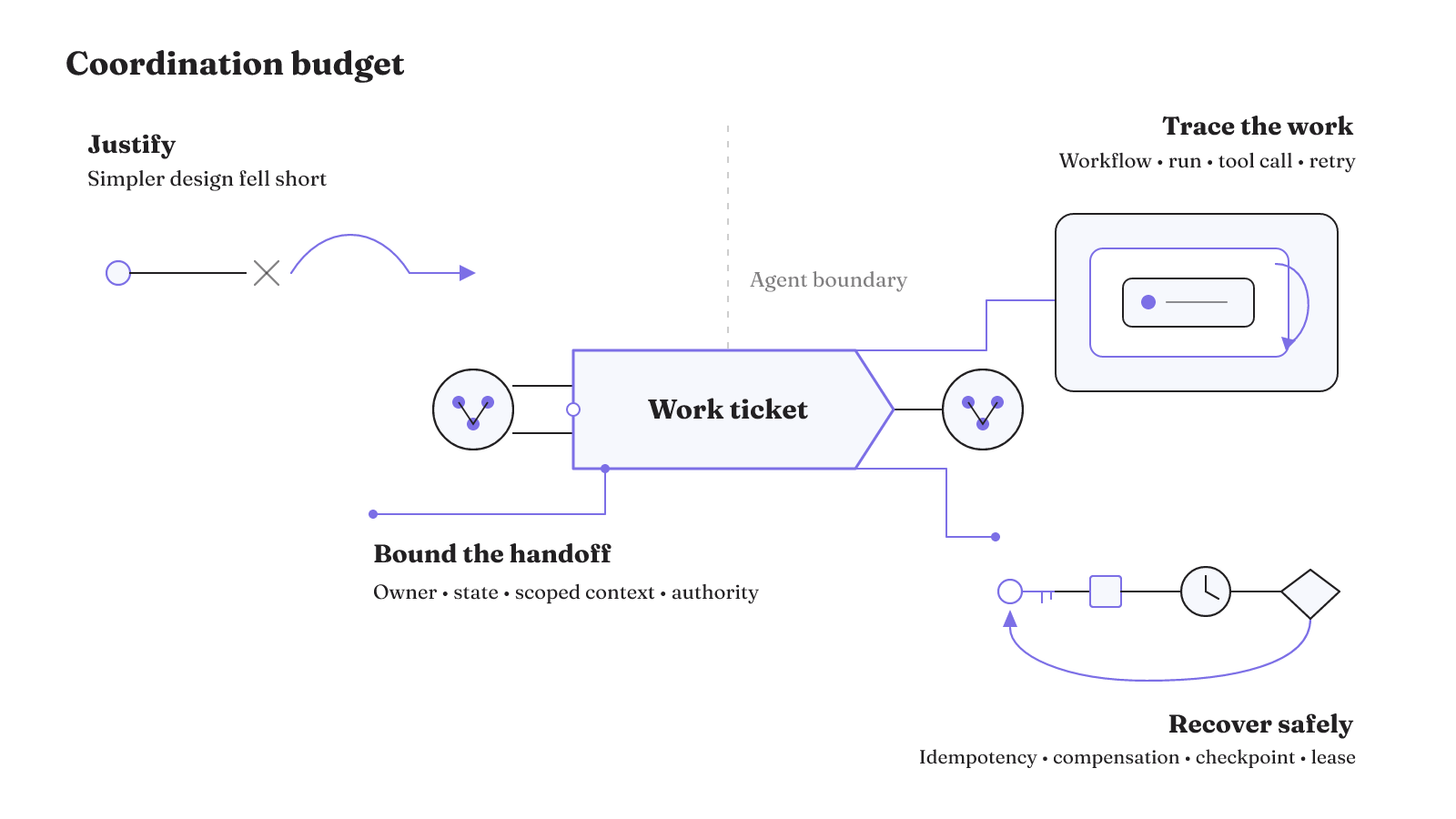
If a row has value but no concrete check, the architecture still has unfinished operating work. Our coordination cost glossary gives that tradeoff a compact name.
Coordination overhead changes the production risk
More agents create more communication. That coordination can bring communication overhead, message congestion, and performance bottlenecks unless the workflow is carefully managed. Moving from one agent to many also changes performance, cost, and governance. These are production properties of the design, not details to leave until deployment.
The failure path can also bend earlier than an architecture diagram suggests. One step fails. The agent takes a different trajectory. Later behavior now follows that changed path and can produce an unpredictable outcome. In a multi-agent workflow, the changed result may also become another agent's input. The original failure and the handoff remain separate events, but both belong in the operating model.
Suppose the failed step changes the work passed forward. Monitoring must reveal the failed step and the new trajectory; cost telemetry must still attach later runs and retries to the same debugging units. This does not make every failure recoverable. It makes the change in trajectory visible enough to investigate.
This is why message paths alone are a weak picture of multi AI agent architecture. You also need to see the work unit, its owner, the state passed across the boundary, and the control that detects failure. Otherwise, a clean arrow hides both traffic and trajectory risk.
Architecture choice therefore affects governance, cost control, coordination design, and production risk. The coordination budget does not assign a numerical cutoff. It forces those consequences into the decision before a topology feels settled.
Handoffs need readiness and version checks
Imagine a sender placing work on a queue while the receiving agent is not ready. Even if the receiver is running, its queue filter may not match the payload metadata. If the message arrives, protocol-version skew may still cause the receiver to interpret it incorrectly. These are three distinct boundary failures: receiver readiness, queue-filter mismatch, and version compatibility.
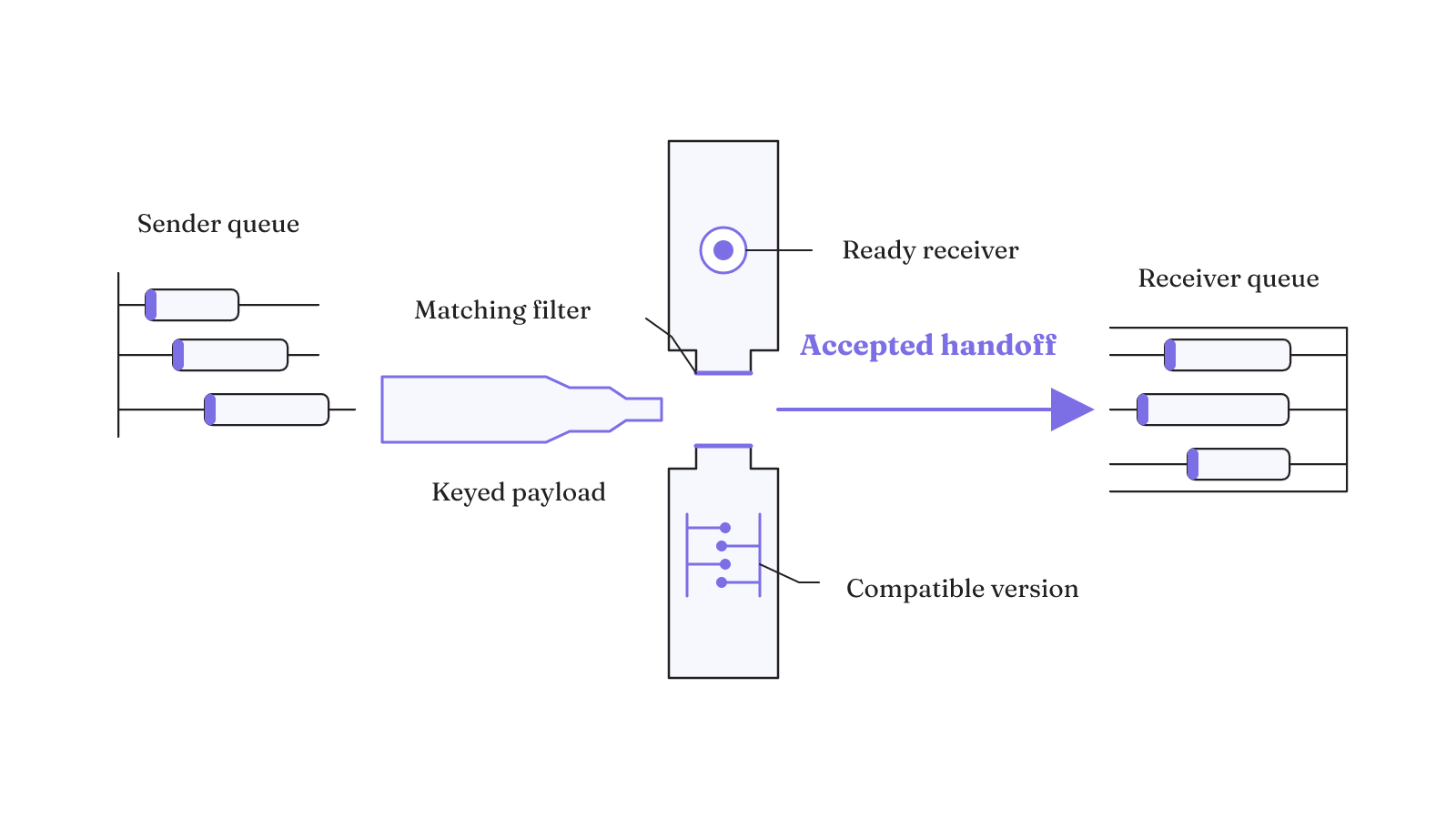
A handoff design therefore needs explicit readiness checks and protocol version negotiation. Readiness answers whether the receiver can take the work now. Filter alignment answers whether the right receiver will accept it. Version negotiation answers whether sender and receiver share a compatible message contract.
Treat all three as acceptance conditions at the boundary. A live receiver with a mismatched filter is not ready for that payload. A matching filter does not solve version skew. Passing one check cannot stand in for the other two.
That boundary is where an orchestration pattern becomes an operating protocol. Our orchestrator-worker glossary is useful when you need to separate the delegating role from the worker that receives the task.
Monitoring, evaluation, and oversight belong in the initial design
Multi-agent deployments need explicit role boundaries, communication protocols, continuous monitoring, and built-in oversight. These controls belong in the architecture because a long-running black-box agent cannot be effectively debugged after a late failure. Observability has to exist while the work is unfolding.
A compact control stack starts with role boundaries and protocols. Monitoring then records what the workflow is doing. Oversight adds deliberate control points. Evaluations turn observed failures into test cases, help prevent regressions, and replace subjective impressions with actionable metrics. Together, these controls make behavior inspectable without pretending that monitoring and evaluation are the same job.
Assign each control a concrete subject. The role boundary applies to an agent. The protocol applies to a communication path. Monitoring applies to execution. An evaluation applies to observed behavior, and oversight applies at a deliberate checkpoint. This keeps a general claim such as "we have observability" from masking a missing control.
Human-in-the-loop checkpoints are also a deliberate production design choice for improving safety and reliability. Multi-agent systems can place those checkpoints alongside security permissions and audit logs. The useful design question is not whether a human appears somewhere in the diagram. It is which checkpoint exists as an explicit control and what work reaches it.
Early evaluation work has a compounding operational value that is supported without predicting a business outcome. A failure becomes a test case. That test can guard against a regression. The resulting metric gives you something more actionable than an impression that the agent "seems better." This control loop belongs beside planning and execution, not after every architecture choice has hardened.
These requirements also change how you compare agent orchestration tools. Pattern support matters, but so do the controls that expose progress, capture failures, and place oversight inside the run.
What do GitHub implementations reveal about recovery?
Public implementations make abstract labels testable. In the open-multi-agent implementation, the MemoryStore interface supports per-run checkpoint and resume. It writes task-grained snapshots when tasks complete. That is a concrete checkpoint boundary, not a general promise that every part of an in-flight run is durable.
For architecture review, write that boundary in plain language: completed tasks are snapshotted. Work inside the current task is not. That sentence tells you much more about interruption behavior than a feature label saying only "resume supported."
The same implementation documents the limit. If execution is interrupted during a task, that task restarts because its conversation history, tool-call state, and turn count are not persisted mid-task. Task-level checkpointing can therefore repeat a long or expensive task when interruption happens before completion. The snapshot still has value, but its boundary determines what recovery actually means.
This is the useful way to examine multi agent orchestration GitHub projects: inspect the exact behavior behind words such as "checkpoint," "resume," and "observability." Do not use repository popularity as a substitute for that inspection.
A separate public example, the claude-code-hooks-multi-agent-observability repository, implements real-time monitoring for Claude Code agents through hook event tracking. It demonstrates a specific monitoring mechanism. It does not establish the recovery semantics of the checkpoint implementation above.
The distinction is practical. Event tracking can expose activity. A checkpoint defines saved execution state. Recovery depends on where that saved state begins and ends.
Start with the smallest transparent design
Start with one real workflow, not an architecture category. Apply the coordination-budget worksheet and identify the first row your simple design cannot satisfy. If decomposition is justified, choose the smallest pattern that answers that need and keeps the new boundaries visible.
Then run a three-part design check. First, expose planning steps so the system's plan is transparent. Second, document the tools that form the agent-computer interface. Third, test those tool interactions thoroughly. Simplicity, visible planning, and tested tool use are part of the design, not polish added after the agents can call each other.
You can compare the result with our production-minded guide to AI agent architectures. Keep the design only if you can name why each agent exists, what crosses every boundary, and how the workflow resumes after failure.