Key takeaways
- "Agent orchestration tools" is two unrelated markets, not one shortlist.
- Branch one: parallel coding-agent runners built on git worktrees.
- Branch two: enterprise multi-agent runtimes for production.
- Route to your branch first, then rank inside it.
You typed a commercial query and expected a ranked shortlist. What you got is a mess, because the same three words point at two products that barely touch. Sort out which one you need, and the shopping gets easy.
The one question that decides which list you're reading
Start with a clean definition. IBM calls agent orchestration the coordination of multiple specialized AI agents inside one system, all working toward shared goals. That definition is fine. It also describes only one of the two markets people mean when they search for these tools.
Here is the split. One camp runs several coding agents on a single repository at once. The other coordinates specialized agents inside a live production service. The 2026 landscape divides that cleanly into managed enterprise platforms and open-source SDKs, and publishers openly admit the category means different things to different readers. None of the popular lists asks which one you need first.
So ask it yourself. One question routes you.
| Your situation | Coding-runner branch | Enterprise-runtime branch |
|---|---|---|
| The routing question | Are you running several coding agents on one repo? | Are you coordinating specialized agents in production? |
| Example tools | parallel-code, FleetCode-style runners | Rasa, IBM watsonx Orchestrate, LangGraph, Microsoft Agent Framework |
| First thing to evaluate | Isolation depth between agents | Fit with your existing cloud and stack |
A few tools blur this line. And "pick by your stack" is a first cut, not a final call. You still have to test it. But get the branch right and you stop comparing tools that were never competing for the same job.
Why the best agent orchestration tools lists disagree, and which to discount
Open the highest-ranked lists and you'll spot a tell. The vendor who published the ranking often sits at number one in it. That is a placement artifact, not an evaluation result: the apparent consensus across the search results is partly vendors voting for their own product.
This doesn't make those products bad. It means you verify the order independently before you trust it. Read a self-ranked list for its evaluation axes, not its podium.
Currency is the other trap. The framework-decision guide many people still link is dated April 2025. That is 15 months old now. It predates a real change: AutoGen is now in maintenance mode, community-managed with no new features per its own README, and Microsoft now points new projects to Microsoft Agent Framework instead. A guide that old still names AutoGen as a live default.
The open-source field has moved on. The current framework landscape spans LangGraph, the OpenAI Agents SDK, the Claude Agent SDK, Google ADK, CrewAI, Microsoft Agent Framework and more, each with a different sweet spot. If your source predates that list, it is describing a field that no longer exists.
Coding-runner branch: scoring the inventory nobody scored
In this branch your job is narrower and more concrete. Running several coding agents at once, firing up multiple Claude Code or Codex instances in parallel, has moved from novelty to a real working practice.
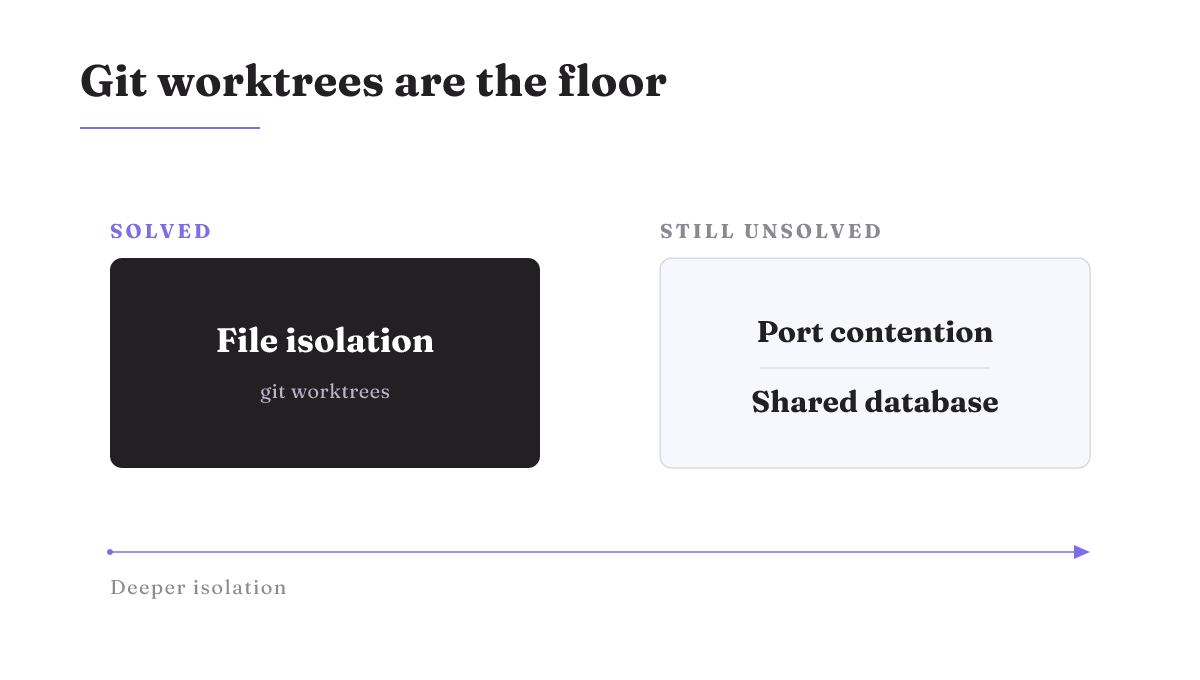
These runners share one isolation trick: git worktrees. Each agent gets its own working tree of the repo, so two agents don't overwrite each other's files. That part is table stakes. The coordination layered on top is where they actually differ.
There is a curated, current inventory of these runners, but it ranks nothing. Stars are the only selection signal it hands you. So score them yourself on three axes:
- Isolation depth. Git worktrees are the floor. What, if anything, sits above file isolation?
- CLI-runtime coverage. Does it drive Claude Code, Codex, and Gemini CLI, or just one?
- Coordination model. Can agents hand off and merge work, or only run side by side?
For a concrete reference point, parallel-code is one active runner: about 880 stars, 1,078 commits, and a last commit in mid-July 2026. That tells you it's maintained. It does not tell you it wins.
Two honest limits sit under all of this. Git worktrees isolate the filesystem, not ports or databases, so two agents can still collide on a dev port or the same test database, and no runner's handling of that is settled yet. And this read rests on public repo signal, not a bake-off we ran on a real codebase. For a deeper pass on picking a runner, see our guide to choosing AI coding agents.
Enterprise-runtime branch: pick by your stack, then by governance
Different branch, different math. The enterprise multi-agent orchestration tools split into two camps: managed platforms like Copilot Studio, Bedrock AgentCore, Vertex AI Agent Builder, Agentforce and watsonx Orchestrate, and open-source SDKs you wire together yourself. The practical first cut is to pick by the stack you already run.
That first cut is not the hard part. The hard part shows up after the demo. The gap between a laptop prototype and a production agent is filled with infrastructure decisions: model hosting, guardrails, memory, identity controls, and observability. That is where tool choice actually bites.
The pressure is real. A widely-cited Gartner prediction holds that more than 40% of agentic-AI projects will be canceled by 2027, largely because teams underestimate the governance and integration work that only surfaces once the demo ends. Those cancellations land on the integration and governance seams, not on which orchestration tool won the shortlist, which is exactly why you pick by stack first and weigh governance second.
Picking by stack trades best-of-breed for lock-in. That is often the right trade for a production system, but it is a trade, so make it on purpose rather than by default. Our framework comparison goes deeper on the managed-versus-open-source call.
Do you need an orchestrator at all?
Before you shop, a cheaper question. Maybe you don't need multi-agent anything yet.
Three patterns cover most production systems: sequential, hierarchical or supervisor, and swarm. The defensible default is smaller than any of them. Start with a single agent plus tools. Move to multi-agent only when a specific reason forces it, like genuinely parallel work or truly separate specializations.
The cost of jumping early is concrete. A single agent needs a prompt, a model, and maybe some tools. A multi-agent system needs coordination primitives, and choosing the wrong framework can force you to rewrite the orchestration layer within months.
One thing is not a differentiator: protocols. MCP standardizes how agents discover and invoke tools, and A2A standardizes agent-to-agent messaging. Both are baseline plumbing now, supported broadly, so they don't separate one serious tool from another. How you structure the agents themselves matters far more, and our note on agentic teams covers that shape.
Single-agent-plus-tools does hit a ceiling on genuinely parallel or specialized work. When you hit it, you'll know. Until then, one agent is cheaper to run and much cheaper to debug.
What no published page can answer yet
Some gaps are honest to name. No public source resolves how each coding runner handles port and database contention once you get past git-worktree file isolation. That is the next isolation axis, and it is mostly unmapped.
And no published bake-off scores these runners on a fixed rubric. Stars and commit counts are proxies for maintenance, not quality. Until someone runs the named runners on one real repository and scores isolation, runtime coverage, and coordination side by side, the shortlist in this branch rests on judgment, not measurement. We have not run that bake-off here either, and we won't pretend the read is more than public signal.
Where control, not just coordination, is the real problem
If you're in the enterprise branch, notice what the Gartner pressure and the infrastructure gap have in common. Both are governance problems wearing an orchestration costume. The projects that get canceled rarely fail at coordination. They fail at control: something irreversible ships, and no operator signed off.
That is the problem Rifty works on. It is harness engineering: function-level, reversible, legible control layers around agentic AI, so nothing irreversible happens without an operator's sign-off. Not more autonomy. More control over the autonomy you already have. Our take on the operator's harness has the full argument.
Honest boundary: if your real goal is fanning out coding agents across git worktrees, an open-source runner fits better than anything we build, and you should use one. Rifty aims at the control end of the enterprise branch, and it is by introduction only. If that is your problem, that is your next step.