Key takeaways
- Start with one agent. Add agents only when the workload requires them.
- Choose by workflow complexity, risk, scale, and authority boundaries.
- Keep adaptive work inside deterministic controls. More autonomy adds operating burden.
The practical rule for agent orchestration open source projects is simple: choose the smallest architecture that can do the work and remain under control. A predefined workflow, one adaptive agent, and a multi-agent system carry different demands for state, verification, recovery, and observation.
That rule changes how you compare software. Feature breadth does not settle the architecture. The workload does. We look for the point where added adaptation or coordination earns the extra model calls, context handoffs, and control surfaces it creates.
Agent orchestration open source options: what is available?
Yes, there are open-source AI agent orchestration tools. Agent orchestration is the control layer that coordinates multiple agents so they can work safely and predictably at scale. It adds governance, shared context, and execution control across those agents.
The available software spans different levels of abstraction. One open-source Python framework offers both high-level abstractions and low-level APIs for building production-ready multi-agent workflows. The high-level surface and the low-level API are two ways into the same construction problem. Neither one decides whether the workload needs several agents.
Read package boundaries before feature lists
Open Multi-Agent gives a more concrete view of a package boundary. Its @open-multi-agent/core package includes an orchestration runtime, tools, memory, checkpoints, traces, a command-line interface, and an offline Run Viewer. Core users can keep traces locally and inspect them in that viewer. The separate @open-multi-agent/otel package adds optional integration with a centralized OpenTelemetry stack.
This is the level at which an agent orchestration GitHub review becomes useful. Identify which package owns runtime execution, memory, checkpoints, and traces. Then separate core functions from optional integrations. In Open Multi-Agent, local traces and the offline viewer belong to core, while centralized OpenTelemetry integration is optional. That package split is more precise than a generic claim that the project "has observability."
Turn those details into evaluation questions. Does the runtime expose memory and checkpoints where the workload needs them? Can you inspect a local run without adopting the centralized integration? Which capabilities are present in the core execution path, and which arrive through another package? These questions do not produce a universal winner. They reveal the operating surface you would actually take on.
The distinction also keeps unlike tools out of one feature contest. A high-level workflow abstraction answers how you construct coordination. A runtime package, trace viewer, and telemetry integration expose how you execute and inspect it. Compare the mechanism that answers your workload, not the total number of boxes a project can check.
That is also why “What are the best agent orchestration tools?” has no useful answer as a popularity list. The appropriate approach depends on workflow complexity, risk tolerance, and scale, and it can evolve. Tool evaluation should follow that architecture decision. If the distinction between fixed and adaptive execution is still unclear, our guide to agentic workflows versus AI agents isolates that choice.
Which orchestration architecture is the smallest fit?
The best agent orchestrator for a workload is the smallest one that fits its complexity, risk tolerance, and scale. Start with a single agent, then move to multiple agents only when the workload needs that structure. Predefined workflows favor predictable execution. Agents can handle open-ended work, but they bring more unpredictability and resource use. The autonomy that makes an agent useful also introduces new risks.
We use eight questions to keep this decision tied to operating reality. The matrix compares a simpler-system signal with the obligation that arrives when orchestration expands. It is a selection method, not a framework scorecard.
| Decision axis | Fit question | Simpler-system signal | Added-orchestration burden |
|---|---|---|---|
| Workload shape | Is the work predictable or open-ended? | Predefined workflows favor predictable execution. | End-to-end agents suit complex decisions, unstructured data, or brittle rule-based systems, with more unpredictability and resource use. |
| Execution pattern | Must tasks run in order, or can they run independently? | One agent is the starting point. | Sequential and handoff patterns accumulate cost; concurrent patterns can spike resource use; manager-led planning has variable cost. |
| State and recovery | Must interrupted work resume from saved progress? | Saved progress and resume are not workload requirements. | AgentCheckpoint persists and resumes state while saving progress through a task sequence. |
| Authority boundaries | Where can adaptation act without approval? | Deterministic boundaries contain autonomy where it is useful. | Production agents need guardrails across input filtering, tool use, and human intervention. |
| Verification | What proves that an action is ready? | A fixed verification loop is enough. | A coding-agent loop can make a change, run tests, lint, and builds, feed failures back as context, fix them, and repeat until checks pass. |
| Observability | Can you locate the point where execution diverged? | Cross-agent tracing is not required. | Traces connect model calls, retrieved context, tool activity, handoffs, and state changes so engineers can locate divergence. |
| Context transfer | What must cross each agent boundary? | No cross-agent handoff is required. | Each handoff can resend context, charging again for the same information as it moves through a chain. |
| Operating burden | What limits bound a run? | One agent can perform the workload. | Added agents multiply calls; controls include retry caps, per-agent token budgets, and a maximum step count before human escalation. |
When does multi-agent orchestration earn its cost?
Multi-agent orchestration earns its coordination tax when the work benefits from decomposition enough to justify the extra handoffs and execution layers. Parallelization helps when tasks are independent. Work with dependencies cannot run all of its steps at the same time, so extra agents do not erase the sequence.
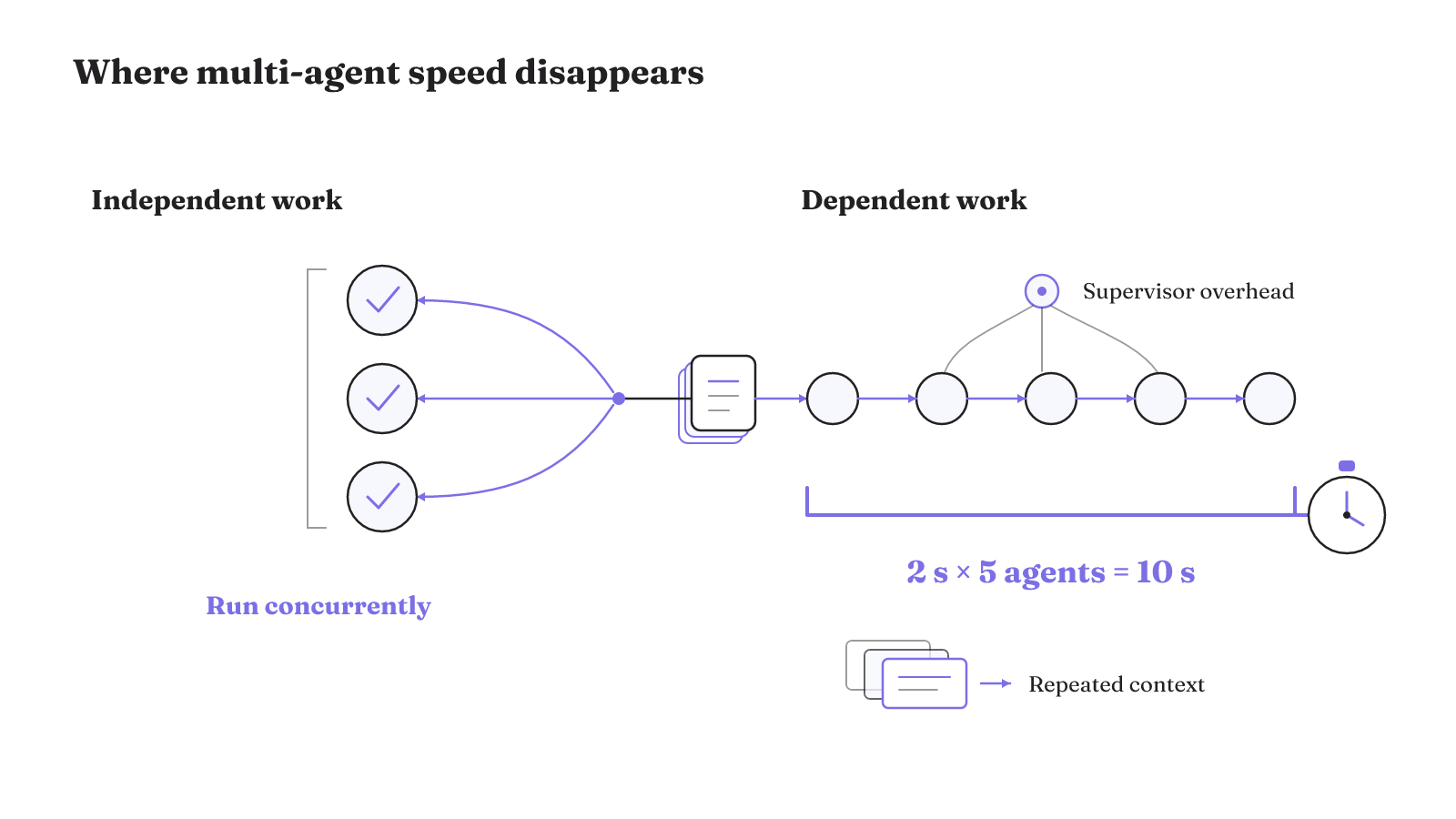
The latency arithmetic can be plain. Five sequential agents taking two seconds each produce a ten-second response. That example does not include a measured framework overhead. It simply shows what a chain does: the time from dependent steps accumulates.
A supervisor adds another coordination layer. It consumes resources without directly producing the visible output. Agent boundaries can also make the same context incur token cost repeatedly as information moves through the chain. The choice is not "parallel or slow." It is whether the workload contains enough independent work to benefit from parallel execution, and whether the remaining dependent path still fits the response time and resource envelope.
Draw the dependency before choosing the pattern. Work that can proceed independently is a candidate for concurrent execution. Work that needs an earlier result remains on a dependent path. This keeps the throughput benefit attached to the part of the workload that can actually run in parallel.
Then account for coordination that does not appear in the final output. The supervisor's model call still consumes resources. A handoff may send context that an earlier agent already received. The dependent path still carries the time from each sequential agent. These are not reasons to reject multi-agent orchestration. They are costs that the decomposition has to justify.
The fit can change within one workload. Independent branches may run concurrently while a dependent sequence stays sequential. The supported tradeoff remains the same: concurrency can raise throughput and resource consumption, while sequential work limits concurrent use and accumulates cost across steps.
This is where multi agent orchestration open-source designs should be judged by execution shape, not agent count. Split work because the parts can operate independently or require distinct authority. Do not split it merely because the framework makes another agent easy to declare. Our position is that multi-agent decomposition has to earn its coordination, authority, verification, and recovery costs.
Control operating burden before it spreads across agents
Once several agents are justified, control resource use at the agent boundary and at the whole-run boundary. Three controls address different parts of that burden:
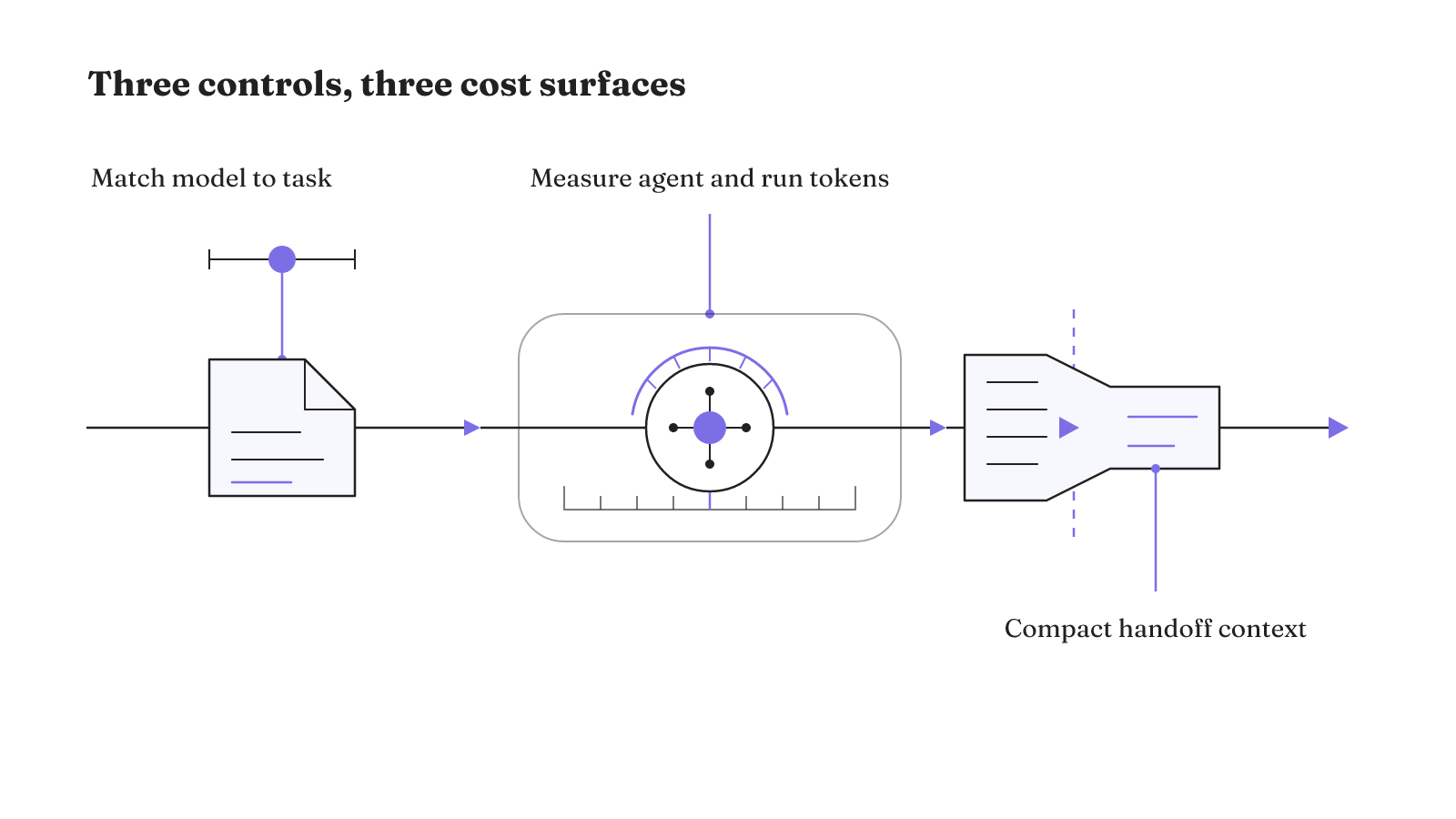
- Match the model to the task. Classification, extraction, and formatting can often use smaller, less expensive models without reducing overall quality. Each agent should use a model suited to the complexity of its assigned task.
- Measure tokens by agent and run. Monitoring token consumption at both levels identifies which agents and orchestration patterns consume the most.
- Compact context between agents. Context compaction reduces the token volume passed through the orchestration.
These controls are more useful when ownership is explicit. Per-agent measurement identifies the expensive worker. Per-run measurement shows the cost of the pattern as a whole. Compaction addresses what crosses a boundary, while model selection addresses the work done after the handoff.
Use the measurements to narrow the problem. If one agent accounts for the most token consumption, inspect whether its model matches the task complexity. If the orchestration passes a large volume of context between agents, compaction targets that transfer. The two controls act on different parts of the run, so one does not stand in for the other.
Model choice can also vary inside a single orchestration. Classification, extraction, and formatting do not have to inherit the model used for a more complex agent task. Matching each model to its job keeps the choice tied to task complexity instead of making one model the default for every step.
Keep hard run limits close to these measurements. Retry caps, per-agent token budgets, and a maximum workflow step count can bound cost and latency before escalation to a person. They do not replace workload fit. They make the operating envelope visible after a multi-agent design has earned its place.
Good gates need clear outputs and a rejection path
Good gates put review where risk requires it and make rejection an executable outcome. A risk-dependent gate can use human review, conditional branches, threshold checks, or a secondary auditor agent. The mechanism can change with the boundary. The key is that preparation remains separate from execution.
A gate should receive an output that is clear enough to judge. It should also define what happens when that output fails. Without a rejection path, review becomes a pause rather than a control. Vague outputs make the decision hard to apply, while too many gates create friction across routine work. All three failure modes add drag without adding protection.
Check the gate as an execution branch. Name the prepared output. Choose one of the supported review mechanisms for the risk: a human review step, conditional branch, threshold check, or secondary auditor agent. Then make rejection lead somewhere definite in the orchestration. The useful test is whether the system can continue correctly after the gate says no.
Gate count matters too. A high-stakes boundary can justify review without placing the same pause on every routine step. The gate pattern supports this separation because the agent can prepare work without executing the consequential action unilaterally.
This gives human intervention a specific role. It can sit at a consequential action instead of interrupting every step. Our AI delegation framework develops that authority question further. In the orchestration itself, the immediate design job is narrower: name the prepared artifact, select the gate mechanism, and preserve a real reject branch.
How do you put agent orchestration into production?
Start small, validate the deployment with real users, and add capabilities over time. That production path keeps the architecture able to evolve without assuming that a multi-agent design is the starting point.
When a workload does require several agents, the orchestration layer can integrate planning, policy enforcement, state management, and quality operations. Those functions help support coherence, transparency, and accountability when orchestration logic, governance, and observability work together. This is the harness around the agents, not just the code that routes one message to another.
Build the control layer around a real run
“How do you do AI agent orchestration?” is an execution question before it is a framework question. Begin with the smallest agent deployment. Put it in front of real users. Add capabilities over time as the workload requires them. This sequence lets the orchestration approach evolve with complexity, risk tolerance, and scale.
For a multi-agent run, assign the layer that will handle planning, policy enforcement, state management, and quality operations. The goal is not to maximize the number of orchestration components. It is to know which part of the harness owns each production responsibility.
Separate tool access from peer coordination
Keep the protocol boundary clear as well. The Model Context Protocol and Agent-to-Agent protocol solve different connection problems:
- Model Context Protocol standardizes how agents access external tools and contextual data.
- Agent-to-Agent governs peer coordination, negotiation, and delegation.
That separation prevents tool access from becoming a vague stand-in for agent coordination. It also gives you a cleaner way to decide where policy, state, and quality operations belong in the wider orchestration layer.
Map each connection to the right boundary. External tools and contextual data use the Model Context Protocol role. Coordination, negotiation, and delegation between peers use the Agent-to-Agent role. Planning, policy, state, and quality still sit in the orchestration layer around those protocol interactions.
Before adding another capability, validate the current run with real users. Before adding another agent, check whether the workload now requires it. Production orchestration should evolve through those observed needs, with governance and observability remaining part of the system as it expands.
For production evaluation, apply the fit matrix to one real workload. Mark its execution shape, authority boundaries, verification path, recovery needs, observability, context transfers, and run limits. Then compare open-source agent harnesses by control and recovery, using the smallest viable architecture as your baseline.