Key takeaways
- Agentic AI developers should earn complexity. Start with simple prompts and add multi-step behavior only when simpler solutions fall short.
- Readiness means bounded work, enforceable permissions, safe escalation, and an auditable recovery path.
- Compare total cost across models, tools, infrastructure, maintenance, evaluation, and human review.
What does agentic AI development actually build?
Agentic AI development builds more than a model call. An agentic system is a goal-directed, tool-using decision maker that operates in a closed loop. It receives a goal, plans work, acts through tools, observes what happened, and decides what to do from there. The model matters, but the surrounding system determines what the model can see, change, remember, and verify.
Consider a multi-step technical due-diligence task. Planning breaks the goal into research steps. Execution uses tools to gather material. Memory preserves relevant findings as the work continues. Verification checks the work before it is accepted. Safety monitoring watches the path, while telemetry records what the system did. These are not optional labels around the model. Reliability comes from defined components for planning, execution, memory, verification, safety monitoring, and telemetry, along with validated least-privilege interfaces and explicit control loops.
That structure also explains what you can build with agentic AI. Supported applications include technical due diligence, market analysis, healthcare, and finance, especially when the work requires planning, synthesis, and tool use across several steps. A useful agentic AI example should therefore reveal the loop around the model, not just the final response.
The practical unit of review is the whole operating system around that loop. A polished result says little about what happens when a tool fails, state changes, permission is missing, or the run needs a human decision.
When you inspect a system, follow one goal through the loop. Identify the planning component, the tools used during execution, the memory carried between steps, the verification point, and the telemetry left behind. Then inspect the interfaces between those parts. Least-privilege access should be validated, and the control and assurance loops should be explicit. This view keeps the architecture tied to work the system can actually perform.
A Development Readiness Scorecard for agentic AI developers
Evaluate agentic AI developers by asking for inspectable conditions, not confidence or a feature tour. The scorecard below has no numerical weights or hiring cutoff. Its method is simple: inspect evidence from the system against each condition, then decide whether the gaps are acceptable for the work and its risk.
| Readiness area | Evidence to inspect | Condition that must hold |
|---|---|---|
| Workflow and permission boundaries | A narrowly defined workflow and enforceable permissions, hostile-input handling, and an audit path | The agent stays inside its authority, escalates when authority or information is missing, and leaves a recovery trail |
| Stateful integration | A multi-step run that writes to the target system and preserves state | The integration can write back and keep the state needed across the workflow |
| Execution-path evaluation | Tool calls, retrieval, state changes, constraints, recovery behavior, and the final result | Evaluation judges task completion and the path taken |
| Governance controls | Audit trails, approval gates, role-based access control, and recorded actions | Agent actions remain attributable and reviewable |
| Escalation and recovery | A handoff containing context, completed actions, unresolved issues, and an escalation reason | The agent stops and hands off when it cannot verify a fact, lacks authority, meets conflicting data, hits a retry or uncertainty limit, or faces a high-impact exception |
| Operational signals | Task success, policy violations, tool errors and latency, retries, fallbacks, cost, human escalation, and memory or retrieval signals | Operators can inspect behavior, failures, cost, and intervention across real runs |
| Deterministic calculations | Code-produced calculations and traceable outputs | Work requiring deterministic numerical accuracy is performed by code, not delegated to the language model |
| Evaluation operations | Automated suites on changes, plus cost, latency, and observability integration | Changes can be evaluated while operating cost and runtime behavior remain visible |
The scorecard also has a real limit: evaluation suites cover only a finite set of scenarios. Passing the suite cannot settle every future case. Use it to expose the system's tested behavior and untested edges, then match those edges to the consequences of the work.
How should you build an agentic AI?
Start with the smallest design that can do the job. The sound sequence is to begin with simple prompts, improve them through evaluation, and add multi-step agentic behavior only when simpler solutions fall short. This gives complexity a reason to exist.
If you can build your own agentic AI, the first gate is not framework choice. It is whether the simpler solution has failed on the actual task. The second gate is whether the workload justifies decomposition. Workload, context, tools, opportunities for parallel work, checkpoints, boundaries, authorization, testing, and cost should determine whether the design uses one agent or several. We begin from a simple design because extra agents bring more coordination, authorization, testing, and operating cost.
Implementation quality is visible in the seams. The design should expose planning steps. The agent-computer interface should have thorough tool documentation and testing. If specialist agents collaborate, their handoff descriptions should explicitly support routing. Without that contract, “multi-agent” names a topology but does not show how work moves safely between specialists.
A design review can now ask three concrete questions. Did a simpler solution fall short after evaluation? Does the workload justify extra planning, tools, parallel work, or checkpoints? If specialists are involved, does each handoff have an explicit description that supports routing? A “yes” to the first question does not decide the topology on its own. Context, boundaries, authorization, testing, and cost still belong in that choice.
This is also where a developer's judgment becomes visible. Keeping the design simple does not mean hiding its reasoning. Planning steps should remain exposed, while tool documentation and tests make the computer interface inspectable. Added components should correspond to a workload need, not a desire to make the diagram look more agentic.
These gates also clarify how an agentic AI is built: establish the task, prove the simpler path insufficient, expose planning and tool use, and add specialist routing only when the workload warrants it. Detailed implementation choices can then follow the same control-first logic used for building agentic AI systems.
State and integration decide whether long runs hold together
A long-running agent needs more than a larger prompt. Its harness must manage context, tool use, and subagent coordination. Its infrastructure must support files, code execution, intermediate results, and reliable operation across multiple days. Those requirements turn “memory” from a feature label into a question about which state persists and where the next step can recover it.
The pieces have to remain available across the run. Files may carry inputs or outputs. Code execution may perform part of the work. Intermediate results may feed a later step. Context, tool use, and any subagent coordination still need management as the run continues. A short demonstration that starts and finishes in one sitting does not show those multi-day operating conditions.
Integration pressure can arrive much faster than a person expects. A content-analysis or bulk-update agent can generate thousands of CMS requests in minutes. Configurable programmatic rate limits and clear limit responses allow graceful retry. Rate limits can become a hard throughput ceiling even when the model and workflow are behaving as designed.
Ask to see a run that crosses more than one step, writes to its target system, preserves intermediate state, meets a limit response, and resumes through the intended path. That test joins the durable state question to the real interface the agent must use. For a deeper implementation path, our guide to building agentic workflows that stop, resume, and recover stays close to these mechanics.
How do evaluations turn failures into progress?
Early evaluation turns an observed failure into a reusable test. That can speed development, prevent regressions, and replace subjective impressions with metrics. The important move is to evaluate while the system is still changing, not wait for a polished demo and judge it by feel.
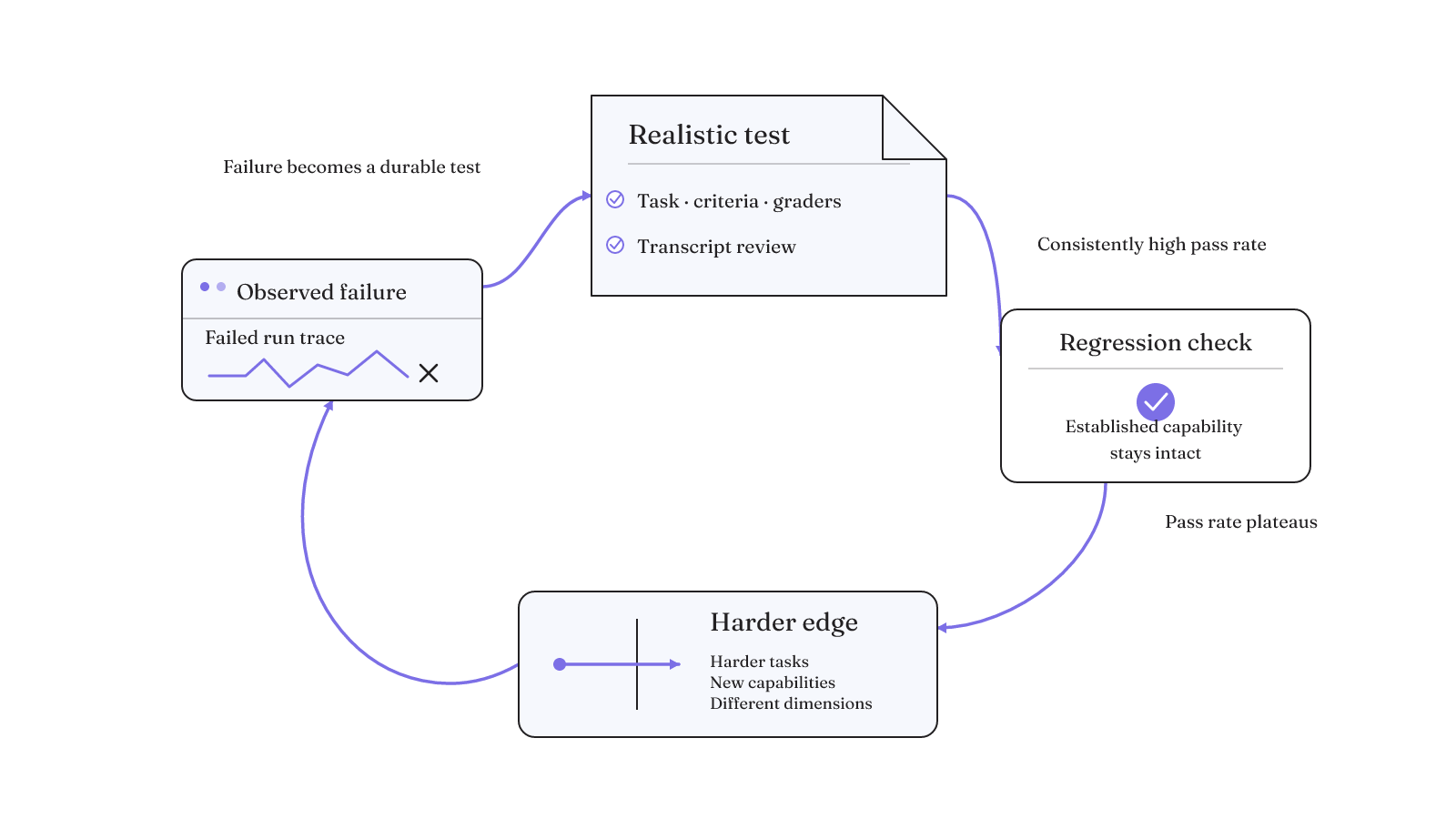
Good agent evaluations use realistic tasks drawn from observed failures. They set unambiguous success criteria, combine graders thoughtfully, include problems difficult enough to expose differences, and review transcripts. Transcript review matters because a correct final answer can hide poor retrieval, the wrong tool call, an unsafe state change, or a recovery path that never worked. Evaluation must cover both the result and the path.
The test set should be hard enough to reveal useful differences. If every task passes easily, the suite offers little information about the system's current edge. The criteria should also make success clear before the result is judged. Combined graders can cover different dimensions, while transcript review exposes how the system reached its answer.
A practical evaluation cycle has four parts:
- Convert failures observed during development or operation into test cases.
- Run realistic tasks with explicit success criteria, suitable graders, and transcript review.
- Turn capability evaluations with consistently high pass rates into regression tests that check whether established capabilities remain intact.
- Change the suite when pass rates plateau and similar tasks stop revealing new failure modes. Add harder tasks, new capabilities, or a different evaluation dimension.
This cycle keeps the suite useful as the system changes. It also makes a developer's evaluation practice inspectable: you can examine the tasks, criteria, graders, transcripts, regression checks, and the process for expanding coverage. If you are still building the vocabulary needed to review those choices, agentic AI learning can help ground the discussion in system behavior instead of role titles.
There is a useful shift as the suite matures. A capability test that passes consistently can protect established behavior as a regression check. The active edge of evaluation then moves to harder tasks, new capabilities, or different dimensions. Old tests keep watching what the system should retain while new tests look for failures the current suite cannot expose.
Authority must match the risk of the action
Permission design starts by separating what an agent may read from what it may do. An agent may need read access to gather context, while an irreversible write action should pass through human approval that can be reviewed at a glance. The difference belongs in the interface and the application controls, not in a polite instruction inside the prompt.
Automatic write actions should be bounded, authorized, observable, and reversible or idempotent. For high-impact actions, confirmation, approval, or application-level controls outside the model should generally hold the boundary. A concrete review should therefore show the permitted write target, the authorization check, the recorded action, and the route used to reverse the change or safely repeat it.
This separates model behavior from system authority. The model may propose an action, but application-level controls can still require approval before a high-impact change occurs. Reversibility or idempotence also belongs to the write path itself. It should not depend on the model remembering to be careful.
Traces, usage, and monitoring expose different problems
Runtime visibility is not one dashboard. A trace can group related operations for debugging. A usage view can reveal a costly model-call step that deserves optimization. Monitoring can surface an issue, but it does not prevent the issue. Each view answers a different operational question.
Start with the trace when a run behaves strangely. Grouped operations let you inspect the connected work rather than isolated log lines. Then inspect usage at the step level. A run that succeeds may still contain a costly model-call step visible in usage data. The evidence should make that step visible instead of collapsing cost into one account-level total.
The distinction changes the repair. A grouped trace helps locate where related operations diverged. Usage data points to model-call steps that should be optimized. Monitoring tells you that a condition occurred, but it does not prevent the issue. Permission checks, retry limits, approvals, and recovery paths remain separate engineering work.
Evaluation has an operating cost too. Teams can control it by optimizing judge usage, reducing unnecessary model inference, sampling production traffic, caching repeated evaluations, and using deterministic scorers for structural checks. Those methods do not remove the need for evaluation. They give you levers for deciding where model-based judgment is useful and where a repeatable structural check can do the work.
Structural checks are a practical place to avoid unnecessary judge calls. Repeated evaluations can be cached, and production traffic can be sampled instead of evaluated in full. Together with reduced unnecessary inference, these controls keep evaluation expense visible as part of system operation.
Visibility should lead to a control or a repair decision. Because monitoring only reveals a problem, permission checks, retry limits, approvals, and recovery paths still need their own implementation.
What should change when you build internally or hire?
The decision to build internally or hire does not change the system conditions you need to inspect. It changes who must supply the capability and evidence. Match the controls to the project's risk, then compare the complete cost of operating the result on representative work.
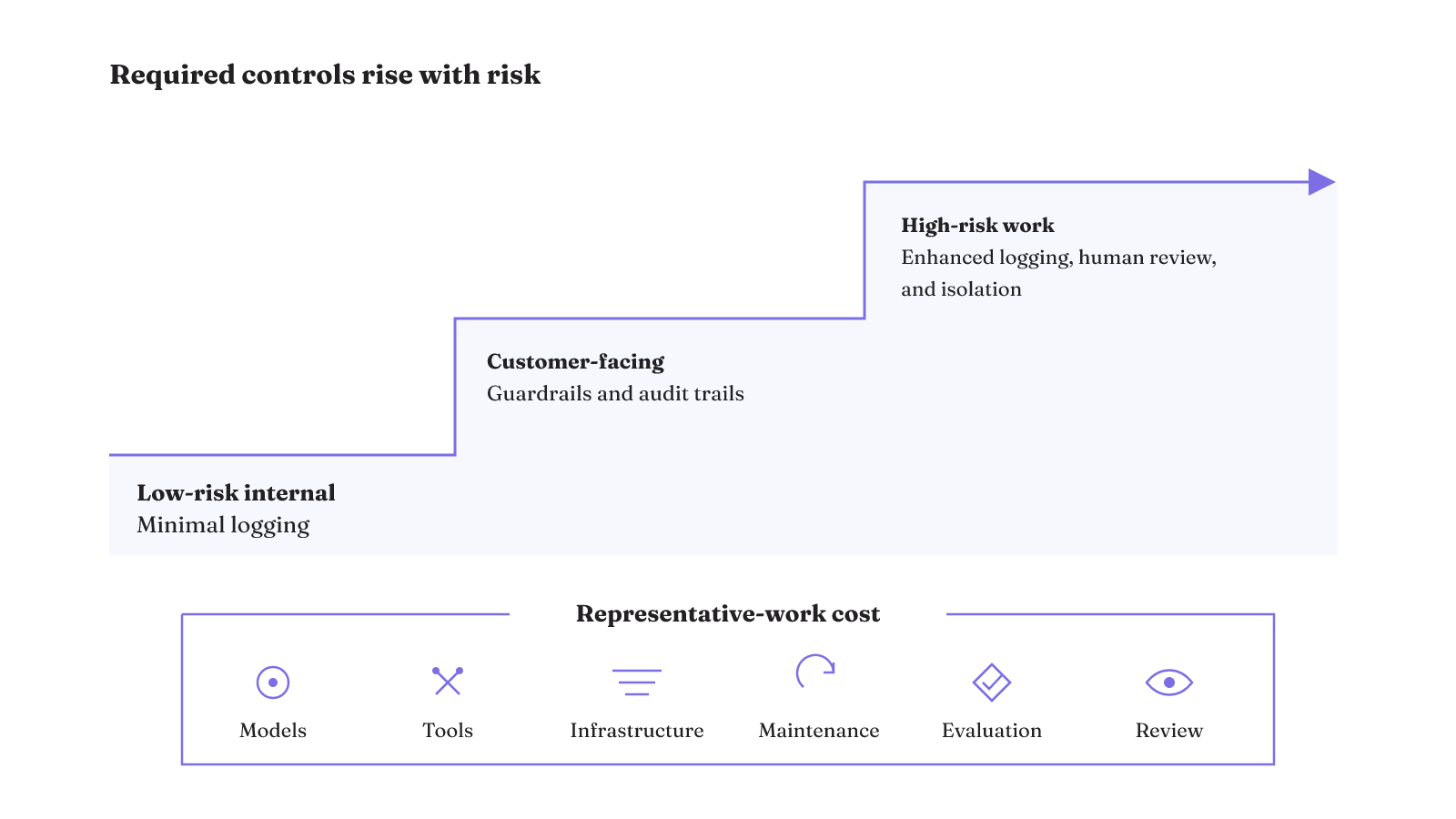
| Project scope | Controls to require | Build-or-hire question |
|---|---|---|
| Low-risk internal work | Minimal logging | Can the responsible team implement and maintain the needed control? |
| Customer-facing work | Standard guardrails and audit trails | Who will own the guardrails, audit trail, and continuing changes? |
| High-risk work involving PII, finance, or regulated settings | Enhanced logging, human review, and isolated environments | Who can supply and operate these controls for the actual environment? |
| Total operating cost | Model usage, tool charges, infrastructure, integration maintenance, evaluation, and review effort | What does representative work cost across the full system? |
Do not use role labels as a shortcut for this comparison. Ask an internal team or an external developer to show the same boundaries, state behavior, evaluation practice, recovery path, runtime signals, and cost inputs. Neither sourcing route is generally better. The relevant question is which route can own the required controls and ongoing work for this project.
Use the Development Readiness Scorecard during your next build review or developer conversation. Then apply the same questions to one representative workflow, from its first permission check through state, evaluation, recovery, and total operating cost.