Key takeaways
- Agentic AI in healthcare can carry multi-step clinical and administrative work without constant human input.
- Explainability, auditing, risk management, and behavioral guardrails belong around autonomous action.
- Platform fit includes the engineering, integration, and configuration needed to reach a live workflow.
The useful unit of evaluation is not the agent label. It is the control path from a trigger to an action. If the basic term is still slippery, our agentic AI glossary gives it a clear starting point. The harder question is how that idea behaves inside healthcare work.
Map what the system observes, the tool or API it calls, and the change that call can make. Then mark the approval boundary, verification step, durable state or audit record, and recovery path. When a workflow description does not establish one of those fields, mark it unknown. An architecture claim should not silently stand in for a control that has not been shown. Data access, identity, consent, and logging show how the path connects to the surrounding health-IT system.
Start with a clean, high-friction home-care workflow
For a home-care team, a high-friction operational process can be a starting point for agentic automation. That narrows the first decision: find work where the operating friction is already visible, then inspect the workflow underneath it.
Two conditions matter at the start. The workflow should be clean, and the data should be reliable. Both are prerequisites in the described home-care strategy. A process can be frustrating and still be a poor automation candidate when its states are unclear or its data cannot support the work.
That gives a technical review three grounded questions:
- Is this a high-friction operational process?
- Is the workflow clean enough to identify its working states?
- Is the data reliable enough for the proposed use?
Those questions do not rank tools or promise an outcome. They identify whether the proposed work has the stated starting conditions. If a team cannot describe the workflow cleanly, adding an agent label does not answer what will trigger the system or what the system will do. Once those conditions are visible, the review can move from the general idea of automation to concrete healthcare actions.
What are examples of agentic AI in healthcare?
The examples become useful when each one is reduced to observable work. For hospital review, that means separating a risk update, a routed task, a monitored signal, and a tracked response instead of grouping them under one clinical-use label.
| Trigger or input | System action | Destination | Visible tracking | Control-path details |
|---|---|---|---|---|
| Conditions are met in a home-care workflow | Trigger the next step and continue workflow progress | Next workflow step | Progress continues without constant manual follow-up | Tool call, approval boundary, verification step, durable state, and recovery path are not stated |
| Patient history, discharge data, lab results, claims, and new data | Update 30-day readmission risk, then route high-risk patients | Care coordinators before discharge | Assigned tasks are tracked | Tool call, approval boundary, verification step, durable state, and recovery path are not stated |
| Patient data streams | Monitor for early signs of clinical deterioration, such as sepsis or adverse events | Not stated | Not stated | Tool call, approval boundary, verification step, durable state, and recovery path are not stated |
| A detected clinical signal | Route the signal with context | Clinician | Track whether action was taken | Tool call, approval boundary, verification step, durable state, and recovery path are not stated |
We treat the missing control fields as separate design questions. The tool call names the system invoked, the acting identity, and the change that call is allowed to make. The approval boundary names the consequential action that waits for human confirmation. Verification names the check performed before a result is accepted or the workflow moves forward. Durable state covers the inputs, decisions, tool results, and approval events that survive an interruption. The audit record preserves the history needed to reconstruct who or what acted and when. Recovery defines how a failed action can be retried, reversed, or compensated from a known state.
None of those controls substitutes for another. An audit record can preserve what happened without reversing it. A rollback can reverse a change without proving the original result was correct. A human checkpoint says little unless the action, the person with authority, and the point of confirmation are visible. This is why a useful control path needs more than a trigger and destination, even when both are clearly described.
The map exposes an important difference between examples. Some stop at detection or a risk update. Others route work, create an assigned destination, or track a response. The distinction changes the evaluation because each additional operation gives the system a larger part in moving the workflow.
For agentic AI for hospitals, monitoring, risk updates, routing, and tracked tasks are different operations. The deterioration example establishes monitoring. The readmission example establishes a risk update, routing to care coordinators before discharge, and task tracking. None of the four examples establishes an exact tool call, approval boundary, verification step, durable-state mechanism, or recovery path. Those controls remain open questions before the workflow can be treated as a complete control path.
Shared services create the healthcare control boundary
Agentic AI in health care does not connect to clinical work through the model alone. Emerging health-IT interoperability standards emphasize reusable building blocks that connect AI agents to clinical data, workflows, and tools. Composable architectures can coordinate four common services across AI-enabled workflows: data access, identity, consent, and logging.
Those services make the control boundary easier to inspect. A review can ask which data the workflow reaches, which identity acts, how consent participates, and what the system logs. These are architecture questions, not properties that can be inferred from the model name. Our comparison of agentic AI and LLMs is useful when that distinction between model behavior and the surrounding system is the part under review.
The boundary becomes more consequential when an AI system can interpret data and trigger actions autonomously. Applicable standards then need to address explainability, risk management, auditing, and guardrails around model behavior. Health-IT deployments should also provide clear privacy notices, explain how data and outputs are used, and control redisclosure or profiling beyond the intended clinical or operational purpose.
Intended use is part of the architecture
Privacy controls sit on the same workflow path as access and action. The health-IT guidance names three visible requirements: a clear privacy notice, an explanation of how data and outputs are used, and control over redisclosure or profiling beyond the intended clinical or operational purpose. These requirements let a team inspect whether the system's data use stays attached to the purpose presented for the workflow.
That inspection can remain concrete. What is the intended clinical or operational purpose? How does the deployment explain the use of data and outputs? Which control addresses redisclosure or profiling beyond that purpose? The answers describe the deployed architecture more clearly than a general statement about responsible AI.
The standards for connecting agents to health data, workflows, and tools are still emerging. An architecture diagram or integration claim therefore sits within an evolving standards environment. The common services and the protections around autonomous behavior remain separate, visible parts of the deployed system.
What does maturity look like beyond a healthcare AI demo?
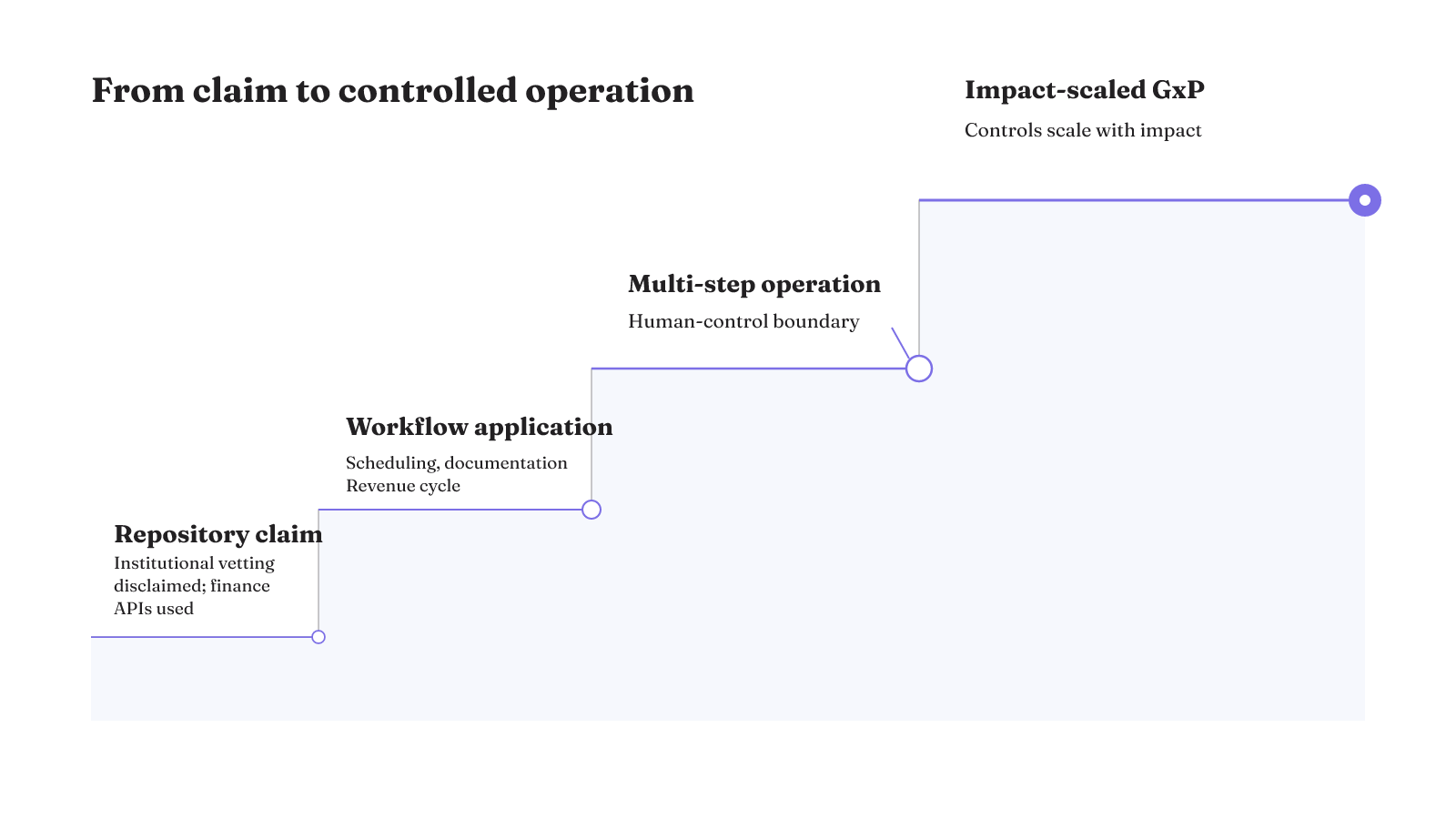
Place a project on this ladder by its observable behavior and control expectation.
| Maturity rung | Observable behavior | Control expectation |
|---|---|---|
| Repository claim | The HeathcareAgent project describes common API interfaces for developing healthcare-related AI agents | The project disclaims institutional affiliation, endorsement, and vetting, and says it uses finance APIs |
| Workflow application | The system is applied to repetitive scheduling, documentation, or revenue-cycle work | Identify the exact repetitive workflow being automated |
| Multi-step agentic operation | The system uses real-time data and automation to complete multi-step clinical or administrative work without constant human input | Locate the human-control boundary around the multi-step work |
| Impact-scaled GxP system | Risk classification and controls scale with system impact in a GxP environment | Evaluate the system through its risk classification and impact-scaled controls |
The ladder is not a winner list. It prevents an interface claim from being compared as though it were already a multi-step workflow, and it keeps impact-scaled execution distinct from a general automation example. When the boundary between demonstration and delegated work is unclear, use our guide to a real agentic AI example to examine that distinction directly.
Which AI tool fits a healthcare workflow?
Which AI tool is best for healthcare? A useful answer starts with fit for the specific workflow, not a general winner. One practical criterion is the engineering, integration, and configuration required to reach a live healthcare workflow. A feature list cannot substitute for that implementation burden.
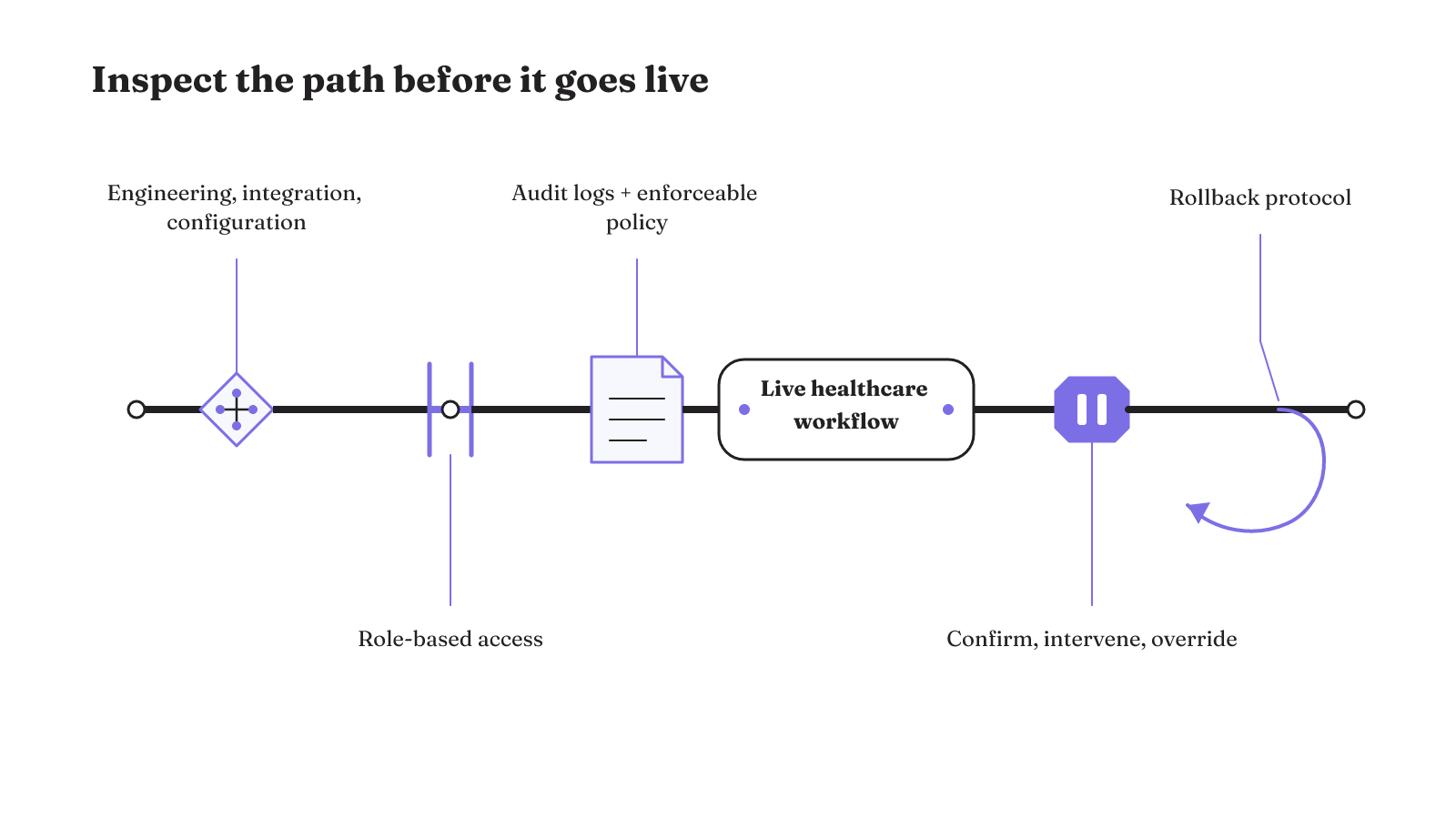
The word "best" hides several decisions. One project may demand more engineering before any workflow is live. Another may expose a different role or policy model. The actionable comparison is whether the proposed system reaches the named workflow with access boundaries, durable state, audit records, human control, and recovery that the work requires.
Use the following checks for a platform or project review:
- Effort and tool path. Identify the engineering, integration, and configuration required before the healthcare workflow is live. Map each tool or API call on the path.
- Role, access, and approval boundaries. Look for role-based access controls around the actions the system can take, then identify which actions require approval.
- Audit records, enforceable policy, and durable state. Inspect whether controls include immutable audit logs and enforceable policies addressing data leakage, prompt injection, and unauthorized actions. Record which workflow state survives between steps and after an interruption.
- Human confirmation, verification, and intervention. Locate human confirmation of critical decisions, the verification performed before action, the ability to intervene, override, or disengage, and continued human accountability.
- Rollback after malfunction. Identify the rollback protocol attached to the workflow, including the state used to restore or compensate for a failed action.
The checklist replaces an abstract tool ranking with five observable tests. It also keeps human presence from becoming a vague box on a diagram. Confirmation, intervention, override, disengagement, and continued accountability describe different parts of human control. A project review can record each one separately and leave a gap visible when the system does not show it.
Governance spans design, deployment, and operation
Governance needs owners who can see different parts of the system. A cross-functional enterprise council can bring clinicians, compliance officers, data scientists, and IT leaders together. That group covers clinical work, compliance, data and models, and the technical environment without treating any one role as the entire governance function.
The lifecycle is equally broad. The NIST AI Risk Management Framework is intended for voluntary use and for incorporating trustworthiness considerations throughout the design, development, use, and evaluation of AI systems. Those four stages give a council a practical span for its work:
- During design, the proposed system and its intended work are in view.
- During development, the system being built remains within the governance span.
- During use, operating behavior remains part of the review.
- During evaluation, the system continues to be assessed through the framework's trustworthiness focus.
The framework is voluntary, and it is currently being revised. It should not be presented as a mandatory or fixed healthcare rule. Its value here is the lifecycle view: governance is not a single approval event at deployment.
A council still needs operating practices
The council structure says who can participate. It does not replace operating practices. Recommended enterprise practices include autonomy boundaries with human checkpoints, rollback protocols, regular risk audits, policy reviews, compliance metrics, and escalation processes.
Connect the framework to an owner
A lifecycle framework and a governance council solve different parts of the operating problem. The voluntary framework keeps trustworthiness in view during design, development, use, and evaluation. The council brings clinicians, compliance officers, data scientists, and IT leaders into the same governance body.
That distinction matters when responsibility becomes vague. A lifecycle stage is not an owner, and a role list is not an operating cadence. Put the four stages and the recommended practices in the same governance record, then name the council roles involved at each stage.
The current revision of the NIST framework adds another practical boundary. A team using it should treat the framework as voluntary and under revision, not mandatory or fixed. That posture leaves room to update the governance work as the framework changes without presenting a moving document as a final healthcare rule.
How should you choose an agentic AI in healthcare course?
Choose a course by the work its curriculum makes visible. A useful curriculum can connect healthcare context to workflow design, validation, governance, and implementation work. That is a stronger basis for selection than a broad promise to teach healthcare AI.
Look for three curriculum clusters:
- Documentation and workflow design. One visible healthcare curriculum covers healthcare context, clinical documentation, documentation-workflow design, and an emergency-medicine workflow assignment.
- Clinical research and validation. The curriculum also covers AI in clinical research, drug-discovery work, and validation of AI-generated clinical insights.
- Regulation, compliance, and implementation. Its topics include healthcare AI regulation, administrative compliance, adaptive governance, a compliance strategy, and an AI implementation-roadmap project.
These clusters describe three different kinds of practice. The emergency-medicine assignment makes workflow design concrete. Validation of AI-generated clinical insights gives the clinical-research material an evaluation task. The compliance strategy and implementation-roadmap project turn governance topics into planned work.
Course selection should match the gap in your own review. If the missing skill is workflow design, inspect the documentation work. If it is validation, inspect the clinical-research material. If it is governance and implementation planning, inspect the compliance strategy and roadmap work. Our note on agentic AI learning can help frame that learning decision.
The curriculum categories can also expose a narrow course. Documentation without workflow design misses the stated design cluster. Clinical-research coverage without validation leaves out the named evaluation work. Regulation topics without compliance strategy or an implementation roadmap omit the visible project work in the governance cluster. Use the actual syllabus items, not the course title, for the comparison.
Use the five platform and project checks above in your next healthcare agent review. If the system still sits between a demo and delegated work, read how we distinguish a real agentic AI example from wrapped automation.