Key takeaways
- Cursor waits and shows diffs; Antigravity runs agent-first, acting without asking.
- Choose Cursor for reversible edits on live code, Antigravity for greenfield prototyping.
- By April 2026, some Google-forum developers had cooled on Antigravity and pointed back to Cursor.
- We don't quote a live price here; both change fast, so check each vendor.
Most antigravity vs cursor write-ups score the two editors on one thing: how it feels to refactor code that already works. That is a real question. It is also the wrong one to bet a codebase on. What you are actually about to do is hand a stateful agent write access to a live repo. Your exposure is not refactor feel. It is control before the agent writes, and recovery after a long run fails.
This page picks up where the launch-week reviews stopped. It maps each tool's control surface, reads recovery through durability, and names the one thing the ranking set skips.
What most antigravity vs cursor reviews skip
Every hands-on comparison landed within days of Antigravity's November 2025 launch. Each author disclosed a bias. None could show how the verdict aged, and none described what a long autonomous run leaves behind when it stops halfway.
So the set answers a feel question and skips three that matter: what it costs, whether the first-week verdict held, and what state your repo is in when an agent quits mid-task.
Which one to pick for your kind of work
Pick by the shape of the work, not the shape of the editor.
Reach for Cursor when you are changing code that already runs in production. Cursor stays inside the repo, shows its diffs, and waits for you to approve before it writes. That posture fits reversible, human-reviewed refactoring, where a wrong rewrite is expensive and you want a receipt for every change.
Reach for Antigravity when you are building something new or running several tracks at once. It is an agent-first IDE built around Gemini 3, where agents plan work, execute it, validate it, and leave artifacts like task lists and browser recordings under a manager view. That autonomy shines on greenfield code and parallel prototyping, where there is little working state to protect.
Here is the soft part. Both are forks of VS Code, so the editor itself feels the same and switching costs almost nothing. You can trial both in an afternoon. Familiar keybindings do not mean the agent behaves the same, though, so the trial that counts is the one that tests behavior, not layout.
Control surface and recoverability at a glance
This is the table to keep. It compares the two on control and recovery, not features.
| What you're deciding | Cursor | Google Antigravity |
|---|---|---|
| Autonomy by default | Approval-gated. Waits before it acts. | Agent-first. Plans, executes, and validates on its own. |
| Diffs and approval | Shows diffs, asks before writing. | Runs multi-step work without a follow-up question. |
| Editor base | VS Code fork. | VS Code fork. |
| Governance posture | SOC 2 Type II, named deployments, audit logging. | Product-specific compliance not documented publicly. |
| Local memory | Keeps persistent local state. | Lighter local footprint. |
| Mid-run recovery | Untested here. Reason from control posture. | Untested here. Reason from control posture. |
| Price | Verify on the vendor page at buying time. | Verify on the vendor page at buying time. |
Two rows carry markers instead of hard values. Price is a check-at-purchase, because no verifiable current figure is available. Mid-run recovery is untested, because no controlled run here stopped an agent halfway and measured the result. The section below explains how to reason about it anyway.
What you can control before the agent writes
This is the axis the reviews treat as vibe. Made concrete, it is a real decision.
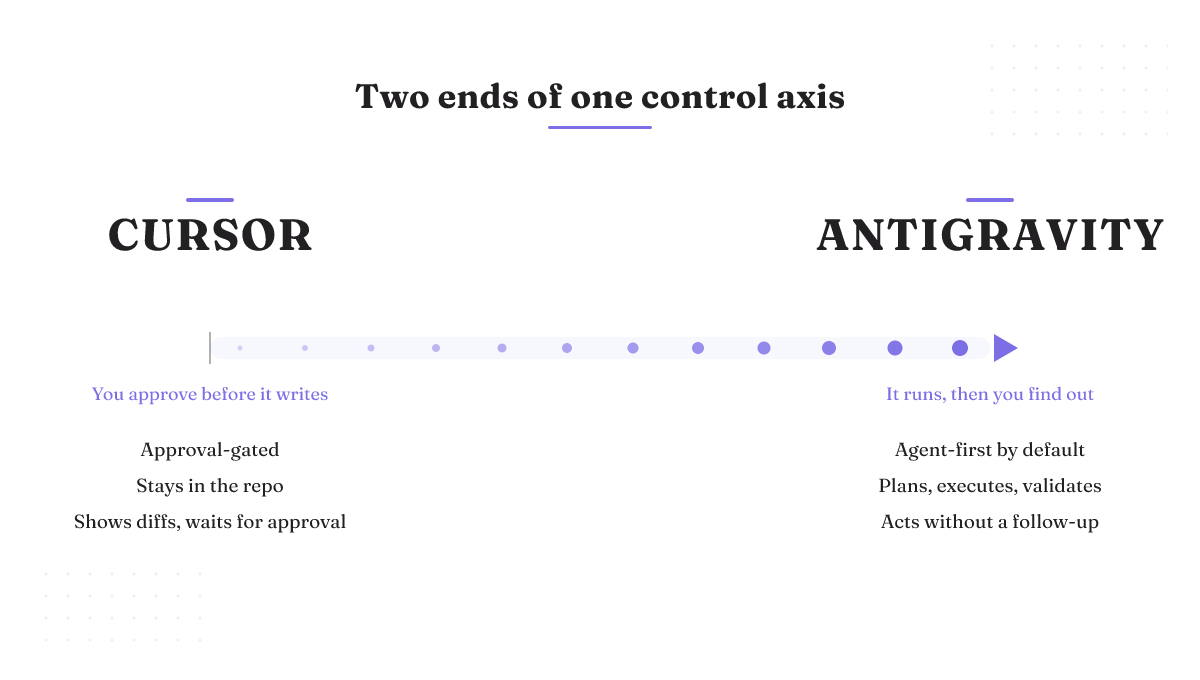
Cursor behaves like a cautious senior engineer. It stays inside the repo unless you send it out. It shows its diffs like receipts. It waits for approval and never assumes. You see the change before it lands, and you are the gate.
Antigravity behaves like an engineer who already opened your browser, terminal, and source graph before you finished the sentence. It plans, executes, and validates in one pass. One developer watched it rewrite an entire subsystem without a single follow-up question. That is the whole point of agent-first, and also the whole risk.
The tension is honest. The same missing approval gate that could produce an unwanted rewrite is exactly what lets Antigravity one-shot a multi-step task. Faster when it is right. Harder to catch when it is wrong. If your work has state worth protecting, the gate is not friction. It is the feature.
What you can recover when a long run fails
Now the part no launch review measured: what state a long autonomous run leaves behind when it dies mid-task.
Start from the mechanism. Durability is an engineering property, not a model capability. Most agents are a single loop that dies the moment the process restarts, the context window fills, or one API call fails. That is fine for a quick chat. It falls apart on tasks that run for hours or days. Recovery does not come from a smarter model. It comes from the system around it: a durable control plane that schedules the work, real state that lives in git plus tiered memory, and a deterministic verifier that is the only thing allowed to call a piece of work done.
Read the two tools through that lens. Cursor's approval gate keeps a human in the loop and every change in a reviewable diff, so a stalled run tends to leave a repo you can read and roll back. Antigravity's agent-first autonomy removes that gate by design, which is the trait that makes recovery the open question, not the model's raw skill.
Be clear about the limit. No controlled test here terminated a long run in each tool and inspected the wreckage. So treat this as the question to answer before you trust either one unsupervised, not as a measured verdict. Run a long task, kill it halfway, and see what you can recover. That test decides more than any refactor score. It is also the discipline behind engineering a harness around the agent rather than trusting the loop.
Governance and compliance, if that is your decision
For most solo developers, skip this section. It only becomes the deciding factor inside an organization with compliance requirements.
If that is you, the gap is real. Cursor ships product-specific SOC 2 Type II certification, named enterprise deployments, and cloud agent environments with audit logging. SOC 2 is a US-origin audit standard, but buyers worldwide use it as shorthand for a vendor that can prove its controls. Antigravity's equivalent product-specific compliance evidence is not documented in its public materials. Absence of documentation is not proof of a failure, but a procurement team cannot check a box it cannot find.
There is a smaller footnote in Antigravity's favor. Its agent-execution model puts less pressure on local memory than Cursor, which keeps persistent local state. That matters for a heavy laptop, not for an audit.
Did the launch-week verdict hold
Here is the time-series the launch-cycle reviews structurally cannot offer.
At launch, the enthusiasm was loud. Months later it was not. By April 2026, some practitioners on Google's own developer forum were calling Antigravity more money for less value and more frustration, and pointing back toward Cursor or Claude Code. The tool that won the first week was losing the second month, at least in that room.
Weigh it honestly. This is community sentiment, not a benchmark, and sentiment on a fast-moving pair ages quickly. Read it as a signal that a launch-week verdict is a weak thing to build on, not as a measured performance result. It also lines up with the momentum on the other side: Cursor is reported to be near $500M ARR, with more than 30,000 engineers at NVIDIA said to rely on it and a claimed 3x code-output gain. Those are vendor-reported figures, so hold them loosely, but adoption that size is its own kind of durability.
What it costs, and why we won't quote a number
Cost is the dimension the whole ranking set names and never resolves. We will not fake it either.
Here is the honest version. To compare price, you need two things side by side: each tool's individual tier and its team or organization tier, pulled on the same day with an as-of date. No verifiable current figure for that pairing exists right now, and both vendors change pricing fast. Quoting a stale number would be worse than quoting none. So pull the live pricing from each vendor before you commit, and re-check it the week you buy.
What you can lean on is scale, not price. Cursor's reported momentum, near $500M ARR and 30,000-plus engineers at NVIDIA, tells you it is well past pilot stage. That is context for the decision, not a cost you can budget against.
How we compared these, and what we didn't test
Fair is better than confident, so here is the method and its edges.
This comparison is built from third-party hands-on writeups, a developer-forum thread, and published analysis, read through a durability lens. It is synthesis, not a first-party benchmark. We did not run our own timed refactor, we did not terminate a long agent run in each tool and document the recovery path, and we did not verify current pricing. Where a claim rests on a single opinion or a vendor's own number, we said so.
That is the boundary. The control-surface contrast is well supported. The recovery reasoning is principled, not measured. The sentiment reversal is a real but recency-sensitive signal. Treat the strong parts as strong and the marked parts as questions to close on your own repo.
How to run your own two-week bake-off
The decision is cheap to test, so test it.
Because both tools are VS Code forks, you can install the second one and be productive in minutes. Pick one real task on a throwaway branch, then run it through both. Watch one thing above all: does the tool wait for your approval before it writes, and can you read the diff before it lands? That is the control surface, and it is the thing that actually differs.
Then push harder. Start a longer task, interrupt it partway, and check what you can recover. Editor familiarity carries over instantly. Agent behavior does not. A two-week trial that tests autonomy and recovery tells you what a first-week refactor score never could.
When the third tool belongs in the room, the Claude Code, Cursor and Copilot comparison and the Claude Code versus Antigravity breakdown extend the same control-and-recovery frame. If you are still deciding how much autonomy to grant at all, agentic engineering versus vibe coding is the argument underneath this one.