Key takeaways
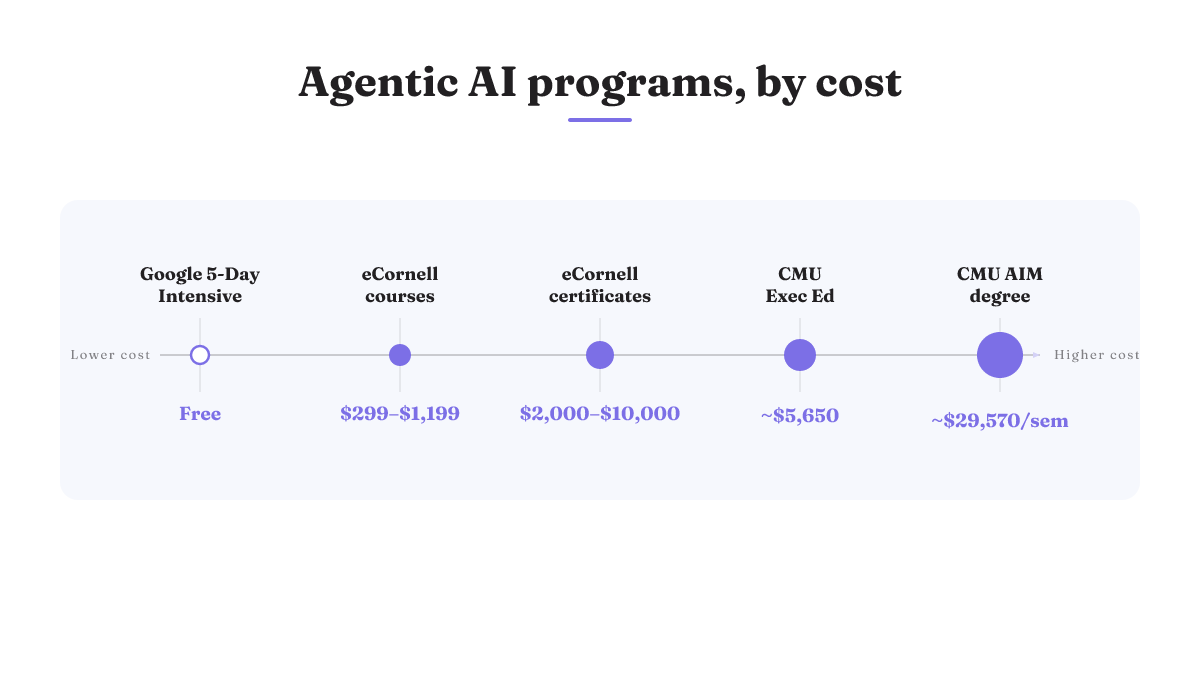
- Cost runs from free (Google's 5-Day Intensive) to ~$29,570 a semester (CMU AIM).
- Judge each program by one test: does it teach engineering or just prompting?
- Free to attend is not the same as free with a certificate.
- To build now, skip the course and start with free tools.
You have a few tabs open. A Carnegie Mellon program. Johns Hopkins. eCornell. A "top 50 courses" listicle that ranks everything by how many lessons it has. They all look serious, and none of them tells you the one thing you need: which of these agentic AI programs teaches the skill that decides whether your agents work in production, and which just teaches better prompting.
That is the gap this page closes. Below is every serious option placed on one cost-and-depth ladder, scored by what it actually teaches, plus a route the listicles skip: learning by building, for free.
The one test that separates a real program from a prompting course
Start with the reframe, because it does the sorting for you. Carnegie Mellon's own program page states the case plainly: as agentic AI moves from experiment to production, the hard part is no longer model access or prompting quality but system design, coordination, evaluation, and observability. That is the engineering layer around the model. It is where agents fail in the real world, and it is the exact thing most course marketing skips over.
So here is your rubric. When you read a syllabus, look for how it handles the boring, load-bearing parts: how agents coordinate, how you evaluate whether an agent did its job, how you watch it in production, how you roll back a bad run. A program that spends its weeks on prompt patterns and a demo chatbot is teaching the easy 20%. That does not make it worthless. It makes it a different, cheaper product than its price tag suggests, and now you can tell the two apart.
One honest caveat: this is Carnegie Mellon's framing of the challenge, not proof that any given syllabus delivers on it. The lens tells you what to look for. You still have to read the curriculum and confirm it is there.
The agentic AI programs side by side, by cost and depth
Prices, fees, and cohort dates move. Everything below is as of mid-2026 and in USD. Treat this as a map, not a live quote, and confirm the number at the provider before you pay.
| Program | Cost (USD) | Time | Format | Level | Best for |
|---|---|---|---|---|---|
| Google 5-Day AI Agents Intensive | Free | 5 days | Live online | Beginner to intermediate | A fast, credible first pass |
| Coursera: IBM and Vanderbilt specializations | Free trial, then paid | 1 to 3 months | Self-paced online | Beginner to intermediate | Structured self-study |
| eCornell AI portfolio | $299 to $1,199 (courses); $2,000 to $10,000 (certificates) | 2 to 4 weeks, or 2 to 6 months | Online | Beginner to advanced | A named-university certificate |
| CMU Exec Ed Agentic AI Program | ~$5,650 (~$5,085 discounted) | 7 weeks, 12 to 15 hrs/week | Live online | Technical professional | Building and evaluating real systems |
| CMU AIM master's | ~$29,570 per semester | Multi-semester | On-campus degree | Graduate | A formal credential and career pivot |
Johns Hopkins runs a well-ranked Agentic AI Certificate that shows up near the top of most searches too. I have left its numbers out on purpose: its published cost and curriculum were not verifiable at the time of writing, and I would rather send you to check the Johns Hopkins Agentic AI page directly than print a figure I cannot stand behind. If the credential name matters to you, put it on your shortlist and confirm the cost at the source.
Which one to pick for where you actually are
The right program is the one that fits your goal, not the one with the most famous name. Four common starting points:
You are a total beginner. Start free. Google's 5-Day Intensive gives you a real, hands-on first pass without spending anything. If you want more structure after that, a Coursera specialization is the gentle next step, with IBM's Building AI Agents and Agentic Workflows rated 4.6 out of 5 across 291 reviews. These are online and self-paced, so they fit around a job.
You are a leader who needs literacy, not code. You do not need to build agents. You need to make good calls about them. Vanderbilt's "Agentic AI and AI Agents for Leaders" on Coursera is aimed squarely at that reader and carries a 4.8 rating. It is the cheaper, faster fit than an executive program you will not use to the hilt.
You are a practitioner who will write code. This is where the engineering rubric earns its keep. CMU's seven-week executive program is built to have technical professionals design, build, and evaluate autonomous systems, which is the layer that decides whether agents hold up. It costs more and asks for 12 to 15 hours a week, so only pick it if you will do the work.
You want a vendor-specific, role-ready path. If your team runs on Google Cloud, its training paths move from beginner to advanced across Vertex AI, BigQuery, and TensorFlow. That is closer to ML platform work than to agent design, so match it to the job you are hiring yourself for.
A cheaper marketplace specialization can beat a famous university certificate for the wrong learner. If your goal is literacy, paying five figures for a graduate seat is the wrong call.
The free and Google options, and what "free" really buys
The most searched question here is some version of "is there a free agentic AI course, ideally from Google, ideally with a certificate?" Here is the honest answer, in three parts.
The strongest free option is Google's. Its 5-Day AI Agents Intensive is built by Google researchers and engineers, free to registrants, and includes a hands-on capstone. Its prior cohort reached over 1.5 million learners, so it is not a fringe offering. It is a short, dense sprint, not a semester.
Coursera options are free to start, then paid. The free trial lets you sample the IBM and Vanderbilt specializations, but finishing and keeping access moves you onto a paid plan.
Now the part the ranking pages fudge: free to attend is not the same as free with a certificate. No option here cleanly pairs a $0 price with a full completion certificate. Google's intensive is free to join; the certificate-bearing university and marketplace programs are paid. If a "free agentic AI course with certificate" is your literal requirement, know that you are choosing between a free experience and a paid credential, not getting both in one.
Executive certificate or full degree: the top of the ladder
At the top, the numbers jump by an order of magnitude. CMU's executive Agentic AI Program lists at around $5,650. CMU's AIM master's runs about $29,570 per semester, and a degree is several semesters. So the degree costs roughly ten times the executive certificate, and takes far longer.
What does the extra buy? Signal and access. A master's opens formal roles, visa and hiring pathways, and a credential that survives a résumé screen. The executive certificate signals serious, current skill without the multi-year commitment.
Who should skip the degree? Almost anyone whose real goal is to build working agents. If you can already code and you want the engineering skill, the seven-week program or even the free build path below gets you there for a fraction of the cost. Pay for the degree when the credential itself is the point, not the skill.
Learn by building instead of enrolling (programming AI agents)
The course listicles all miss the same route: for the "programming AI agents" reader, you can skip enrollment and learn by building with the same tools professionals use. It costs nothing.
Start with a coding agent. Aider and Cline are free, open-source, and model-agnostic, so you can point them at the model you already pay for and start today. Cline is worth a closer look because it is actively maintained and splits its work into distinct Plan and Act modes, which forces the discipline good agent design needs: decide the plan, review it, then let it act. That habit is the engineering rubric in miniature.
For structure, lean on vendor patterns. Google's Agent Development Kit and its Cloud documentation express agent design as reusable workflow-agent patterns, so you get a tested shape for coordinating multi-step agents instead of inventing one. And the tooling itself is shifting: Google Antigravity is positioned as an agent-first IDE built on Gemini models, a sign that agentic development is becoming the default environment, not a course topic.
Be clear-eyed about the tradeoff. This path gives you no credential, no fixed curriculum, and no signal a hiring manager can read at a glance. It works only if you can write Python and steer yourself. If the credential is the point, this is not a substitute. If the skill is the point, it may be the fastest road there. Our guide to building agentic AI systems goes deeper on the practice.
Is a certificate worth it, and does it get you hired?
The buyer's real question sits under all of this: will this pay off? Two honest answers.
First, a certificate is a signal, not the skill. What decides whether you can build agents is the engineering layer CMU points to: coordination, evaluation, observability. A certificate says you put in the hours. It does not, by itself, make your agents reliable. The work does that.
Second, no program in this set can be shown to guarantee a job, a promotion, or a raise. Anyone who tells you otherwise is selling. The defensible read is simpler: a credential opens doors on a résumé, and the engineering ability is what keeps you in the room once you are through them. Buy the credential for the door. Build the skill for the room. If you want to map a path to your goal in more detail, our agentic AI learning guide walks through it.
How I compared these, and what this can't tell you
I ranked on four things a buyer actually spends: money, weeks, format, and level, then scored each on whether the curriculum reaches the production-engineering layer or stops at prompting. I did not score on lesson count or brand, which is how most ranking pages sort, and it is why they all blur together.
What this comparison can't do: quote a live price, vouch for Johns Hopkins' numbers, or promise an outcome. Fees and cohort dates change, so verify at the provider. And a syllabus that names "evaluation" is not proof it teaches it well. Use the rubric to interrogate the curriculum, not just to read the marketing.
If you want to run agents, not just take a course
Here is the thread that runs through every program above. The layer they are all graded on, getting an agent to behave reliably, is an engineering problem, not a prompting one. That is the exact problem Rifty works on: controllable, reversible, function-level control around agentic AI, so an operator's judgment is carried forward and nothing irreversible ships without sign-off.
Being straight with you: Rifty is a research lab and a by-introduction-only product, not a training program. If what you need is a credential or a structured course, pick one above. But if you have realized your real problem is running agents reliably rather than earning a certificate, that is the work Rifty does, and the introduction path is the honest next step.