Key takeaways
- A meta agent harness can coordinate agents, connect different harnesses, or search over harness code.
- For focused requirements and constrained budgets, a single agent is the default.
- Add a layer when work needs cross-domain expertise, time-sensitive parallel work, or fault tolerance.
What is the point of an agent harness?
An agent harness is the surrounding code that determines what information is stored, retrieved, and presented to a language model. That boundary matters because an agent is more than a model response. It receives input, processes a request, reaches external resources, and returns a response. The harness is where those parts become a working system.
In a concrete run, input enters the system and the agent can decide which tools to call, what data to pass between them, and how to chain actions. The harness manages the context supplied to the model, uses tools, and coordinates subagents. That is the practical control surface: it shapes what the agent can see and what work it can carry forward. OpenAI's description of an agent harness likewise includes context management, efficient tool use, and subagent coordination.
Execution needs a place to happen as well. Long-running agents need infrastructure that can keep them running for days, give them environments for files and code, and save intermediate results. A harness therefore joins model decisions to execution and retained work. The distinction is useful before adding a meta layer: first identify the harness already governing the model's information and execution. Then ask whether the new layer controls that harness, coordinates several agents, or connects several harnesses.
That framing also prevents a common blur in technical discussions. Context is not simply a prompt passed once at the beginning. The harness determines what information is stored, retrieved, and presented to the model as work proceeds. Tool calls and data passed between tools are part of the agent's action chain. For work that lasts days, saved intermediate results and an environment for files and code are part of the working system too. A meta layer only makes sense after those existing responsibilities are clear.
What does "meta agent harness" mean?
The phrase describes three different architectures, not a single product class. Each one places control around a different object. Treating them as interchangeable is how a useful routing layer becomes an unnecessary interface project, or an optimization loop gets confused with a team of agents.
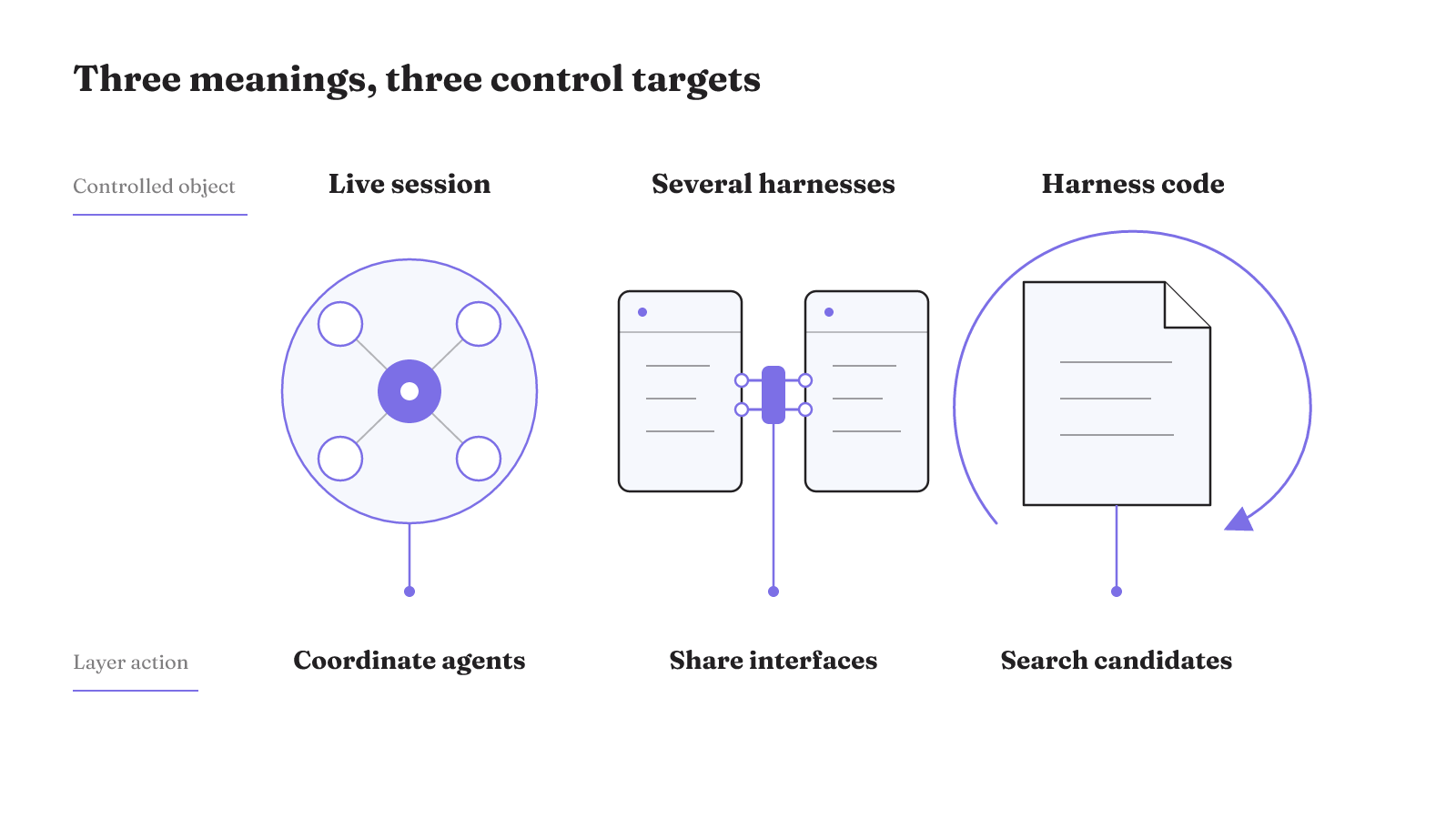
- Multi-agent orchestration. A meta harness can coordinate multiple AI agents within one session, handling routing, context, and output normalization. Its work includes explicit decisions about context management, routing logic, and failure handling. This documented orchestration pattern is about the live session and the work moving through it.
- Shared interfaces across harnesses. Managed Agents is described as a meta-harness of general interfaces that can support many different harnesses. Its interfaces give Claude access to session state and sandbox computation, without assuming a number or location for the brains and hands used through those interfaces. Anthropic's Managed Agents write-up is an example of this pattern. Omnigent is another documented example: it sits above Claude Code, Codex, Pi, or custom agents and treats them as interoperable parts of a larger system. Databricks describes that scope here.
- Outer-loop harness optimization. For LLM, Meta-Harness is an outer-loop system that searches over harness code for large language model applications. Its proposer can access the source code, scores, and execution traces of earlier candidates through a filesystem. It changes harness code rather than routing a live session.
The fastest way to disambiguate the phrase is to follow the object under control:
- Live session -> multi-agent orchestration. The layer routes agents, manages context, and normalizes their output.
- Several harnesses -> shared interfaces. The layer exposes session state and sandbox computation through common interfaces.
- Harness code -> outer-loop optimization. The layer searches code candidates using earlier source code, scores, and execution traces.
The same distinction holds when the architecture is tested across control, permission, and evidence boundaries:
| Pattern | Managed object | State or computation boundary | Permission boundary | Evidence output | Decision boundary |
|---|---|---|---|---|---|
| Multi-agent orchestration | Agents working in one session | Session routing and context | Identity controls, least-privilege access, and checks before actions complete | Normalized agent output | Routing, context, and failure handling |
| Shared interfaces across harnesses | Different harnesses in a larger system | Session state and sandbox computation | Identity controls, least-privilege access, and checks before actions complete | Interface-visible session state and sandbox computation | How interfaces expose state and computation |
| Outer-loop harness optimization | Harness code for an application | Candidate search over prior source code, scores, and execution traces | Checks before an agent-selected action completes | Candidate source code, scores, and execution traces | Which harness-code candidates the outer loop searches over |
| Cross-cutting controls | Agent actions and failing agents | Runtime action checks and isolated agents | Input and output validation, monitoring, and human oversight for high-risk actions | Action-check, monitoring, and isolation signals | Check actions before completion; isolate failures; account for latency and operating overhead |
Use the matrix as a boundary check, not a feature checklist. First identify whether the new layer governs live routing, common interfaces, or code search. Then inspect permission and recovery at that same boundary: apply identity controls and least-privilege access, check actions before they complete, and use circuit breakers to isolate failing agents. Use the evidence output to inspect what the layer changed after it runs. Failure isolation prevents one failing agent from cascading into the rest of the system. That turns the architecture review into six concrete questions: what it controls, what state or computation it touches, what actions it may take, what record it leaves, what delay and overhead it adds, and how a failure is contained.
There is a cost to the meta label. Routing through a meta harness adds overhead, additional agents add model calls, tool calls, handoffs, coordination logic, and infrastructure requirements, and latency can rise as work passes through more steps. That makes the workload, rather than the label, the starting point.
Use a complexity gate before adding another layer
Start with a single agent when the requirement is focused and the budget is constrained. It uses fewer resources and is simpler to implement. A multi-agent architecture earns its added complexity when work needs expertise across multiple domains, time-sensitive work can benefit from parallel processing, or fault tolerance is not available from a monolithic system. This single-versus-multi-agent comparison frames those workload conditions directly.
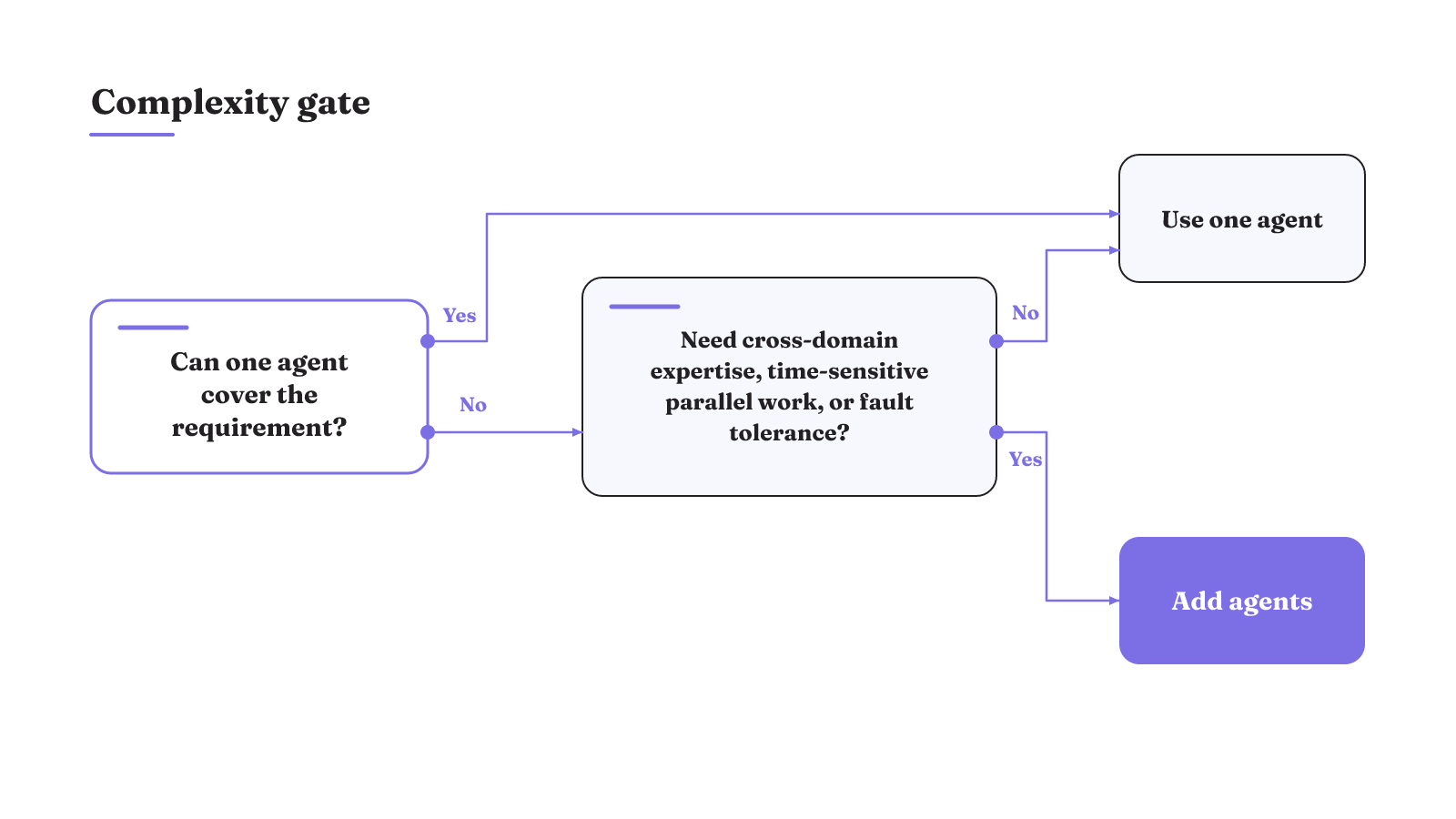
Before introducing a coordinating layer, answer four questions:
- Does one agent cover the requirement?
- Does the work span distinct domains of expertise?
- Does time-sensitive parallel processing matter for this workload?
- Does fault tolerance require separate agents?
If those answers justify more than one agent, test the control layer itself before treating the design as settled:
Several agents can meet the workload test and still lack a usable control boundary. Shared state, cross-agent evaluation, hard isolation, and unified controls are separate design requirements.
- Shared-state test: What session state or sandbox computation must multiple agents or harnesses use through the same interface?
- Cross-agent-evaluation test: Which outputs and handoffs will be evaluated across agents, and where will those results be retained?
- Hard-isolation test: Can a malfunctioning or compromised agent be isolated quickly while the rest of the system continues with reduced capability?
- Unified-control test: Can authentication, input and output validation, runtime monitoring, and approval for critical actions be applied across the agents behind the layer?
If the answers do not establish a need for another layer, retain the smaller design. Classification steps consume tokens, and running agents in parallel costs more than running one. Where a multi-agent system is warranted, token cost can be controlled with smaller routing models, cached results, per-agent token budgets, and monitoring cost per completed task. Operational's cost guidance names those controls.
What has outer-loop harness optimization achieved?
Outer-loop optimization has measured task-specific results, not a general verdict on agent architecture. In online text classification, Meta-Harness improved over a state-of-the-art context-management system by 7.7 points while using four times fewer context tokens. The reported comparison is for that online text-classification task.
For retrieval-augmented math reasoning, one discovered Meta-Harness harness improved accuracy by 4.7 points on average across five held-out models on 200 IMO-level problems. In agentic coding, discovered Meta-Harness harnesses surpassed the best hand-engineered baselines on TerminalBench-2. These are three different evaluations: online text classification, retrieval-augmented mathematical reasoning, and agentic coding.
Richer access to earlier source code, scores, and execution traces can enable automated harness engineering. That is a different proposition from adding a live coordinator to a running session. It is useful when the object under consideration is the harness code itself and the system has prior candidates to inspect.
The reported proposer receives more than a scalar result. Through a filesystem, it can access each prior candidate's source code, score, and execution trace. The object available to the outer loop is the earlier harness and its recorded run, not a live routing decision. The filesystem makes prior candidate material available during proposal, so automated harness engineering can draw on more than an aggregate score.
The result categories should remain separate. The text-classification comparison includes both a point improvement and lower context-token use. The math result is an average across five held-out models and 200 IMO-level problems. The coding result is a comparison with hand-engineered baselines on TerminalBench-2. These results apply to particular tasks, not every workload or model.
Authorization follows the action, not the agent label
An agent label does not narrow the risks created by its actions. Agentic systems expand the attack surface beyond the model through tool- or data-mediated prompt injection, memory poisoning, tool misuse, and credential compromise. Sysdig's overview of agentic AI security names those risks. Multi-agent systems also face agent action authorization bypass, agent state persistence poisoning, and trust-boundary violations.
The control set is concrete: use strict authentication, validate inputs and outputs, monitor non-deterministic behavior, and require human approval for critical actions. Agent security guidance identifies those strategies for autonomous agents. They apply to the action that is about to occur, whether that action was selected by one agent, a coordinator, or a harness optimizer.
This is why permission design belongs in the matrix rather than in a feature list. A new control layer may introduce new state and paths, but the action boundary remains the place to apply authorization and review. For a closer look at that boundary, read our authorization boundary glossary.
The risk list includes both direct action risks and risks that move through the system. Prompt injection can arrive through a tool or data. Memory poisoning affects retained state. Tool misuse and credential compromise concern the resources an agent can reach. Authorization bypass and multi-agent trust-boundary violations concern the authorization path itself. Strict authentication, input and output validation, monitoring, and approval for critical actions form the documented control set for those risks.
Failure isolation determines whether one agent can take down the system
Failure handling becomes more visible when work is distributed. A multi-agent system can be designed to continue with reduced capabilities when an individual agent fails. That does not make failure harmless. It gives the remaining system a defined way to continue after the affected agent is removed.
The operational sequence is concrete. Monitor agent health and performance indicators continuously. Use anomaly detection to identify a potential security compromise or system failure. Rapidly isolate the compromised or malfunctioning agent, then let the remaining system continue with reduced capability. FINOS's multi-agent governance material describes continuous monitoring, anomaly detection, and rapid isolation as relevant mechanisms.
This pattern belongs beside the orchestration decision because a handoff path can make a local failure matter to more than one component. The important question is not whether the design has many agents. It is whether the system can isolate one when its health indicators or anomaly detection identify a problem, while the rest carries only the capability that remains available.
The reduced-capability condition is important. The system can continue when an individual agent fails, but it continues without the affected agent's capability. Continuous health and performance indicators provide the signal. Anomaly detection identifies a possible compromise or failure. Rapid isolation removes the compromised or malfunctioning agent from the operating system. The remaining agents then operate with reduced capabilities.
Deployment choice starts with residency, lock-in, and model control
Deployment starts with compliance and data-residency constraints, before other managed-versus-self-hosted harness factors. That ordering gives the most consequential boundary its proper place. A managed service can reduce operations work. A self-hosted approach is required for multi-model routing flexibility when a managed service restricts users to its provider's model set.
Memory changes the decision over time. Memory accumulated behind a proprietary API increases lock-in, while restricted model sets can constrain a routing design that needs more than the provider's available models. This managed-versus-self-hosted harness guide states both tradeoffs.
There is also a hybrid option: a managed control plane can reduce operations work while execution artifacts remain on self-hosted infrastructure. That is a specific split of control plane and execution artifacts, not a claim that every system needs both. Compare your current design against the matrix above, then examine how an agent harness controls what ships.
The three deployment descriptions answer different constraints. Managed service reduces operations work. Self-hosting is required when managed model restrictions prevent the routing flexibility a multi-model design requires. Hybrid keeps a managed control plane while execution artifacts remain on self-hosted infrastructure. Start with residency and compliance constraints, then consider proprietary memory and the model set available to the routing design.