Key takeaways
- Want the design patterns? Start with Andrew Ng's DeepLearning.AI course (Intermediate, about 10 hours).
- Want to deploy multi-agent systems? Take Google Cloud's Agentic AI ADK path (9 activities).
- Either way, the real test is production, not the demo. No course gets you there alone.
Search "agentic ai learning" and you get a wall of course cards. Each one promises you will build multi-step workflows. Almost none tells you which path fits your goal, or what happens after the tutorial runs clean in a sandbox. This page fixes that. Match your goal to one path, get clear on what an agent even is, then see the three things every course list quietly skips.
What "agentic AI" actually means, and the agentwashing trap
Strip the marketing and agentic AI has a plain definition. It is software where a language model handles some or all of the steps in a complex task. Instead of answering one prompt, an agentic workflow plans a multi-step process, runs it, and improves its own output through reflection and tool use. That is the loop worth memorizing: plan, execute, reflect, and reach for tools when it needs them.
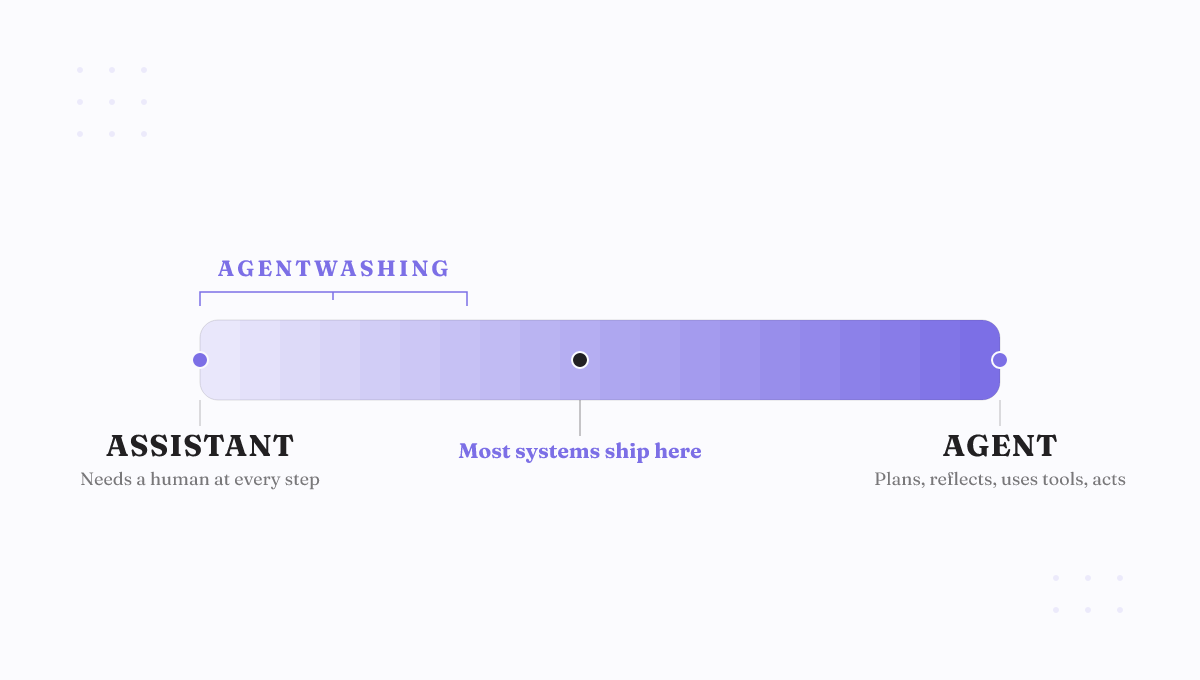
Here is where the course pages go quiet. Gartner names the most common mistake agentwashing: a dependent assistant, one that needs a person at every step, dressed up and sold as an autonomous agent. A real agent goes further. It plans, reasons, works with other agents, and takes action toward a goal without a human holding its hand at every turn.
The line between the two is a spectrum, not a wall. Most systems shipping today sit somewhere in the middle, part assistant, part agent. That is fine. Just know where yours sits before you call it autonomous. If you want to see the difference in a concrete build, our worked example of a real agent versus wrapped automation is the fastest way to train your eye.
Match your goal to a path before you enroll
Before you enroll in anything, answer one question: what are you actually trying to do? Three honest answers, three paths.
| Your goal | Start here | What you get |
|---|---|---|
| Understand the design patterns | DeepLearning.AI (Andrew Ng) | Reflection, tool use, planning, multi-agent. Intermediate, about 10 hours. |
| Deploy and secure multi-agent systems | Google Cloud Agentic AI (ADK) | Build and secure multi-agent systems. 9 activities. |
| Foundations first (new to ML and AI) | Google Cloud ML and AI tiers | Beginner to advanced: Vertex AI, BigQuery, TensorFlow. |
These two named paths are strong for their goals, but they are not the only options. The bigger risk is picking the wrong goal, not the wrong brand. Match yourself to "understand the patterns" when you really needed "deploy multi-agent," and you lose weeks learning the wrong layer. So spend a minute on the goal before you spend a cent on the course.
The design-patterns path: Andrew Ng's DeepLearning.AI course
If your goal is fluency in how agents are built, this is the one to start on. Andrew Ng's DeepLearning.AI course teaches the four core agentic design patterns: reflection, tool use, planning, and multi-agent workflows. This is where you learn how AI agents learn to improve their own answers, through reflection, and how they call external tools instead of guessing.
In the catalog it sits at Intermediate level and runs a little under eleven hours, framed around building systems that take action through iterative, multi-step steps. Plan for a focused week, not an afternoon.
One honest limit. The course ends at building and evaluating workflows. It does not carry you through running them against real data, real users, and real governance. On "is this the Agentic AI Coursera course everyone asks about," there is no confirmation that this exact course is offered on Coursera with specific terms, so check the provider's own enrollment page rather than trusting a listicle. While you are learning the patterns, it helps to keep a map of the AI agent frameworks the wider field is standardizing on.
The deploy-multi-agent path: Google Cloud's Agentic AI and ADK
If your goal is shipping multi-agent systems, Google's option is built for that. The Agentic AI on Google Cloud path runs 9 activities on building and securing multi-agent systems with the Agent Development Kit (ADK), plus an introduction to Gemini Enterprise. So yes, there is an Agentic AI course by Google, and it is aimed squarely at deployment, not theory.
New to the field entirely? Google Cloud also runs tiered machine-learning and AI tracks that step from beginner introductions up to advanced generative-AI work across Vertex AI, BigQuery, and TensorFlow. Start there for foundations, then move to the ADK path.
The tradeoff is lock-in. This path teaches ADK and Gemini, so your skills transfer best inside Google Cloud. If you expect to work across a framework-agnostic stack, treat it as one strong option among several, and read up on autonomous AI agents as a concept, not just a Google product.
Is there a free course, and does it come with a certificate?
This is the search that hides the most disappointment. Here is the straight answer. What is verifiable today is that the DeepLearning.AI Agentic AI course sits in the catalog at Intermediate level. What changes constantly is the pricing and certificate terms.
Free access and certificate rules for these courses shift often, so any "free," "free with certificate," "free Google course," or "with certificate" claim should be confirmed on the provider's own enrollment page, not taken from a roundup. A "free certificate" often means a free audit of the material with a paid certificate at the end, so read the fine print before you assume the credential is included. The learning is the point; the badge is a detail you can verify in two minutes on the source page.
Where agentic AI learning starts if you're brand new
No background at all? Do not start with multi-agent anything. Get the loop straight first: plan, execute, reflect, and use tools. Then build one single-agent workflow end to end before you touch orchestration. That single build teaches you more than three more hours of video.
This is also the honest answer to the "agentic ai learning reddit" search. There is no single community thread that settles the path, and community advice is uneven, so treat it as a nudge, not a syllabus. The demand behind the question is real, though. Agentic-AI engineering is one of the most sought-after skills right now, and that pressure is exactly why so many people are asking where to begin.
What every course list leaves out: production is the hard part
Here is the spine none of the enrollment pages will tell you. The course is the easy half. In a Dataiku and Harris Poll survey of 800 global data leaders, 75% called trust in their AI agent deployments a concern. That number measures worry, not a failure rate, but the worry points at something true: the real test is not the demo. It is what happens after, when agents meet real data, real governance requirements, and organizational complexity no sandbox can fake.
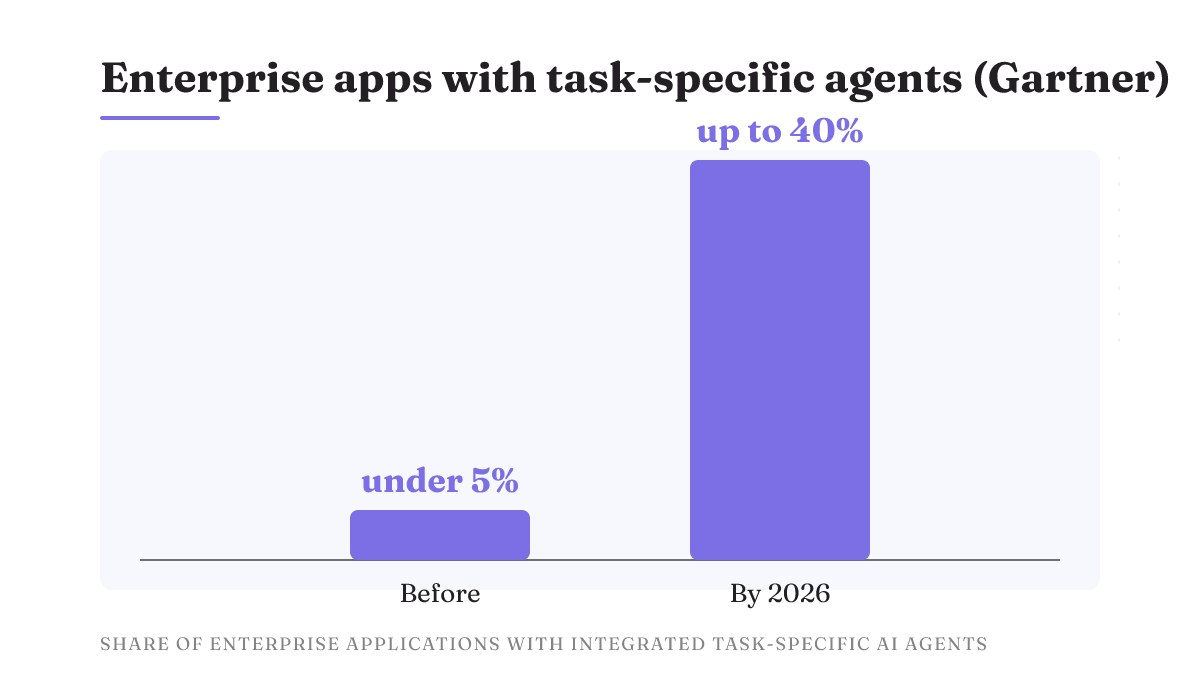
And this is not a niche problem you can wait out. Gartner projects that up to 40% of enterprise applications will include task-specific agents by 2026, up from under 5% before that. The gap between "finished the course" and "runs in production" is the thing that will actually decide your work. If you want the other half of the job, read how the harness, not the course, decides what survives production.
Your next move this week
Pick the path that matches your goal and enroll. That is the easy, satisfying part, and you should do it today.
Then do the harder thing. Before you call yourself done, ship one agent against real data and watch what breaks. The trust concern that 75% of those data leaders named does not show up in a tutorial; it shows up the first time your agent hits messy inputs and a governance rule. Finishing a course and shipping safely are two different milestones. This page gets you to the first one honestly. The second is the whole job.