Key takeaways
Chatbots often handle short, self-contained interactions. Agents can work independently for minutes or hours, orchestrating tools and interacting with environments as they pursue a solution. That added autonomy is useful, but it also introduces new risks. The choice is about authority, not the label.
Agentic AI vs chatbot: what are the key differences?
Is a chatbot considered agentic AI? Conversation alone does not settle the question. A chatbot is often used for a short, self-contained interaction, while autonomy means acting independently to achieve a goal. To compare agentic AI vs conversational AI, inspect what the system is allowed to do after the user speaks.
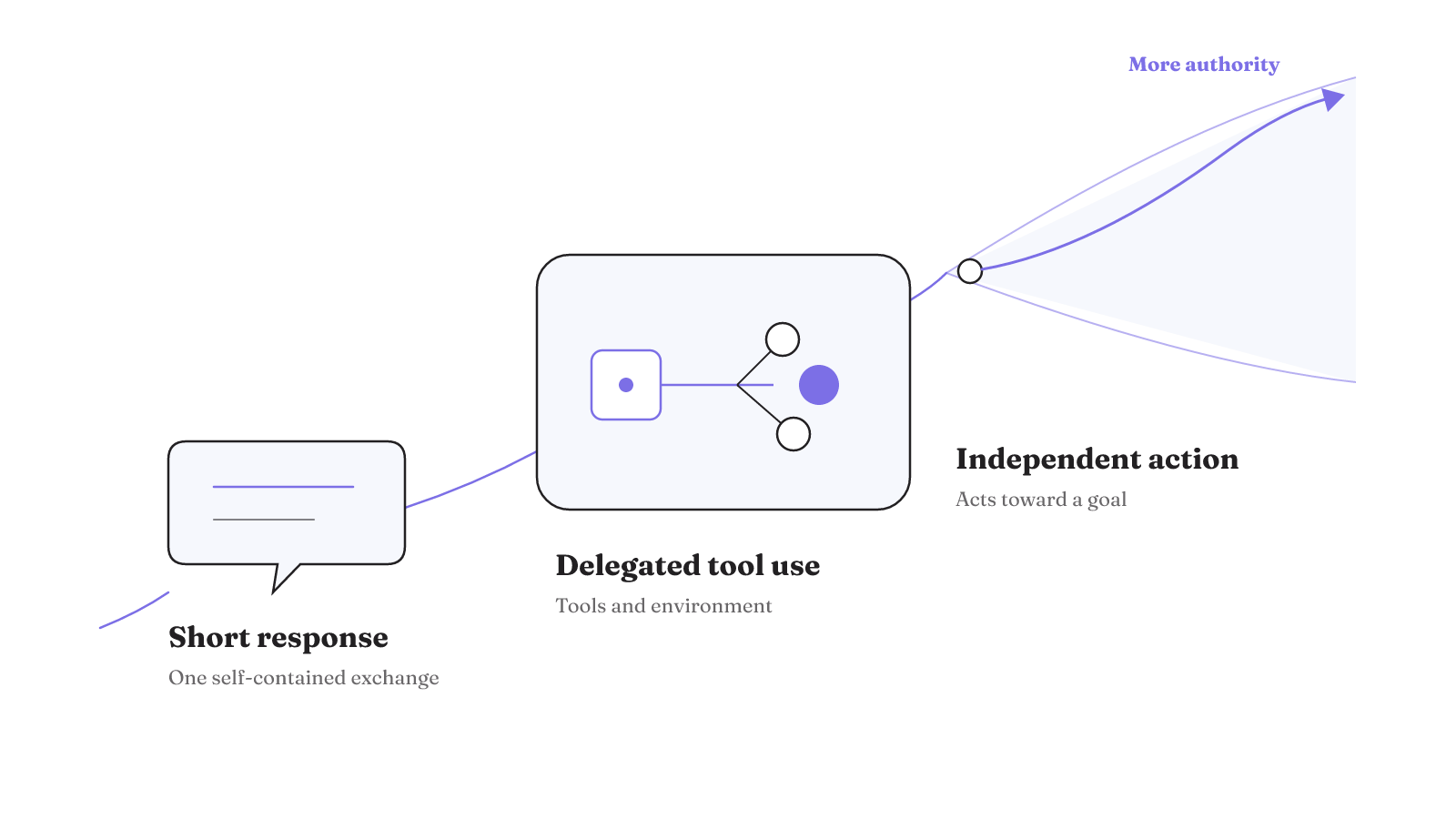
This five-stage ladder is a design tool, not an established industry taxonomy. Each row exposes a different place where authority can expand.
| Authority stage | Work shape | Exercised authority | Boundary to inspect |
|---|---|---|---|
| Response generation | A short, self-contained exchange | Produces an answer to a basic query | The output remains inside the immediate interaction |
| Retrieval | Context or connected data is brought into the task | Reads information before producing a response | Which sources and data connections the system can reach |
| Recommendation | The system proposes a choice or next move | Selects an option without carrying it out | Where a proposal ends and external action begins |
| Bounded action | A delegated task uses tools or an environment | Executes an action within the assigned task | Which tools, credentials, and action limits apply |
| Continuing autonomous execution | Work continues toward a goal across multiple steps | Acts without step-by-step direction | How long the system can continue and what stops it |
The five rows keep a label from hiding the handoff. A scripted chatbot can answer a basic query. Conversational AI interacts, while agentic AI takes action to achieve results. An agent can reason, make decisions, and execute a complex workflow. Autonomy adds independent action toward a goal. Retrieval, recommendation, and bounded action make the middle visible, so you can inspect the point where reading context becomes choosing and then doing. The last row captures the longer work in which an agent orchestrates tools, interacts with an environment, and iterates for minutes or hours.
Use the ladder on the workload, not on a product name. Short chatbot interactions and longer agent work anchor the two ends: the first can stay within one exchange, while the second can orchestrate tools, interact with an environment, and iterate for minutes or hours. Agent autonomy means independent action toward a goal, which is why continuing execution carries a different control burden from generating an answer.
The middle stages keep the classification honest. Retrieval changes what the system can read. Recommendation changes what it can select. Bounded action changes what it can do outside the conversation. Those stages are useful review boundaries, but they should not be mistaken for a universal maturity scale. A separate question concerns the acting unit and the wider system around it; AI agents versus agentic AI separates those scopes.
ChatGPT agent crosses from conversation into action
ChatGPT agent is a useful example because it places action inside a familiar conversational product. OpenAI introduced the mode so users could ask ChatGPT to take actions on the web. It can also work directly with data reached through connectors or through websites where the user is logged in using takeover mode.
Under the authority test, those capabilities matter more than the chat window. The work is not limited to producing a response. The system reaches into websites and connected data as part of the assigned task. That is the operational boundary to notice when comparing chatbot vs agentic AI: the interface may still be a conversation, while the selected mode has authority to act beyond the exchange.
The connected-data detail sharpens the comparison. A connector gives the mode access to data through that connection. Takeover mode covers websites where the user is logged in. Both capabilities belong to the named agent mode. They should not be generalized into a claim about every conversation someone has with ChatGPT.
The expanded tools and broader reach also give ChatGPT agent a higher overall risk profile. Prompt injection is a risk for agentic systems generally. When an agent can interact with external environments, that risk belongs in the system design discussion, not in a footnote added after deployment.
This makes product mode part of the system boundary. The question is not simply, "Is ChatGPT a chatbot or an agent?" Ask which mode is active and whether the assigned work includes web actions or connected data. That keeps the classification attached to documented behavior instead of turning one product name into a permanent category.
Availability is specific to the mode as well. ChatGPT agent mode is available on specified paid plans in supported countries and territories. That fact should not be stretched into a classification of ChatGPT as a whole. The relevant example is the named agent mode and the actions documented for it.
Apply the same boundary test to any agentic AI chatbot example: identify the action, the connected data or environment, and the authority exercised. Those details say more than the label on the interface.
Which system should you choose?
Choose the smallest design that can do the work. Start with a simple prompt, then improve and test that prompt through comprehensive evaluation. Add a multi-step agentic system only when the simpler solution falls short. This sequence keeps the architecture tied to a demonstrated need instead of an appetite for autonomy.
The evaluation step is essential because a weak first attempt does not prove that the workload needs an agent. A simple prompt should be optimized and evaluated before it is dismissed. Only then does a multi-step design answer a real shortfall in the simpler approach.
This selection path also changes what you compare. For a short, self-contained interaction, inspect the response produced by the prompt. For delegated tool use, inspect the longer task and the tools involved. For independent action, inspect the goal and the authority to pursue it. Each step adds system behavior that must earn its place.
Do not collapse architecture selection into one decision. First decide whether the evaluated prompt falls short and multi-step behavior is needed. Then decide how much machinery the agent implementation needs. Agent designs should stay simple. In production, implementations can reduce framework abstraction layers and use basic components.
A multi-step system must be justified by the simpler solution falling short. The amount of abstraction is then an implementation choice, and a production agent may use basic components. The agent loop remains the part to inspect when the work requires iteration.
Comprehensive evaluation belongs before the increase in authority. It is how the simple prompt gets a fair attempt. If that evaluated design does the work, the selection path stops there. If it falls short, multi-step behavior has a reason to exist. The resulting agent should still preserve the simplicity supported by the workload.
The choice, then, is not between an old chatbot and a modern agent. It is between levels of exercised authority. Select the lowest level that survives evaluation, and add the controls demanded by any authority you introduce.
More authority changes the control boundary
Once a system can act, the model is no longer the whole operating problem. The consequence matrix maps four changes to four concrete control responses. It also prevents unchanged model weights from hiding a change in operational authority.
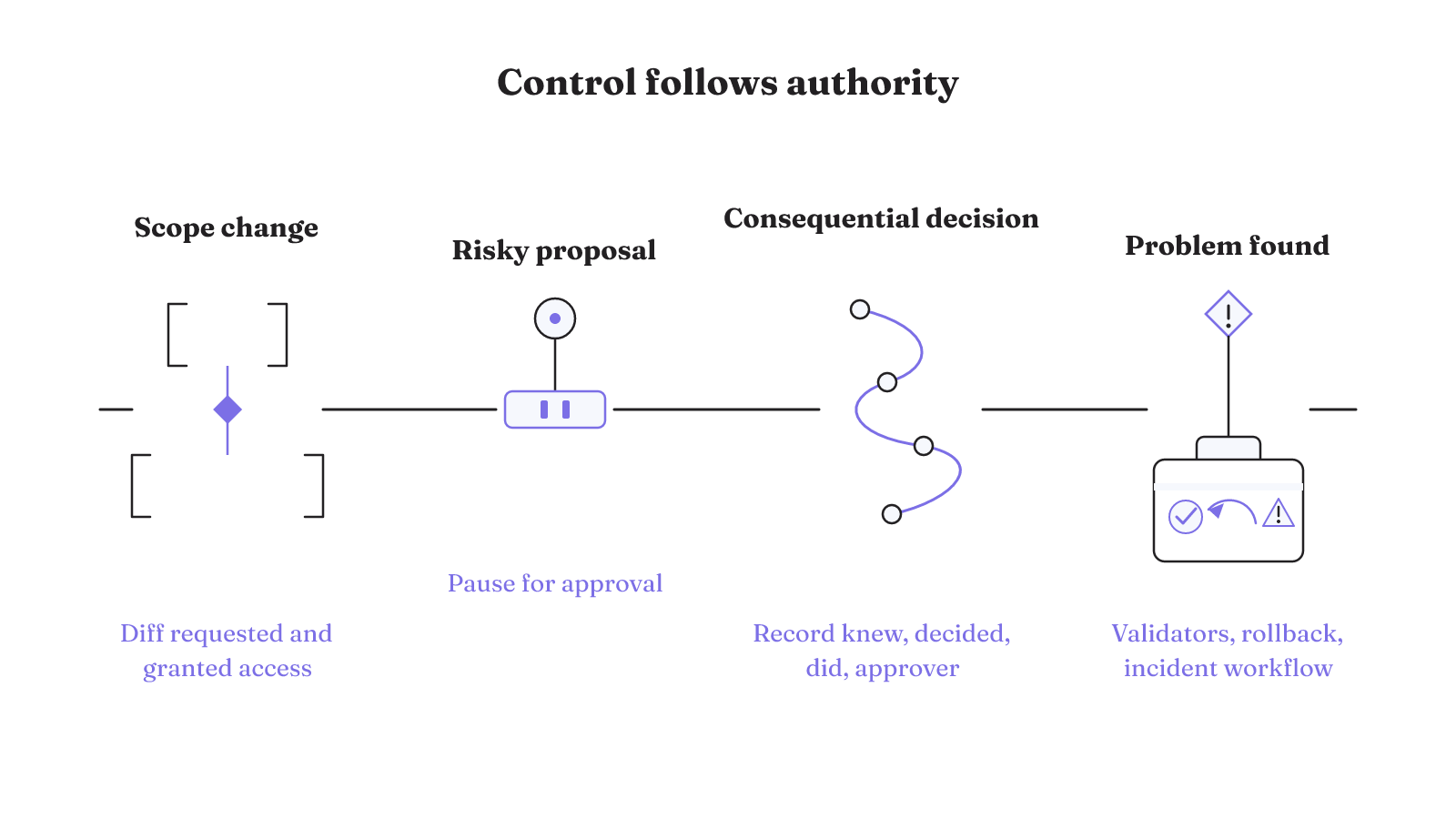
| Consequence to control | What changed or happened | Control response | Evidence the harness retains |
|---|---|---|---|
| Changed permission scope | Tool access, API credentials, or data connectors differ between versions, even when model weights do not | Diff requested and granted access at a separate promotion gate | The production scope and the proposed scope |
| Risky proposed action | The agent proposes an action classified as risky | Pause and wait for human approval | The proposal and approval result |
| Auditable decision | The agent makes a consequential decision or action | Record what it knew, decided, and did | The approver as well as the decision trail |
| Recovery | Validation or an incident exposes a problem | Use pre-action or post-action validators, rollback workflows, or incident workflows | Correlated records and human-override reason codes |
These mechanisms do not make every action reversible. They create explicit places to compare authority, pause a risky proposal, preserve decision evidence, and invoke a recovery or incident workflow when one exists. That is a more honest control boundary than treating access, approval, audit, and recovery as one generic safety setting.
What does human-in-the-loop approval actually mean?
Human-in-the-loop approval means requiring user input before an agent executes a function call. It is a control placed at an action boundary. The person is responding to a proposed call, not reviewing an abstract description of the agent after the action has already happened.
One implementation uses Temporal Signals. The agent reaches the approval point, waits, and receives the person's input through a Signal. The same pattern can support multiple approvers, voting, and escalation workflows. Those extensions are useful when approval authority is distributed, but they remain specific workflow choices rather than a universal shape for every agent.
The workflow can therefore separate the proposed call from the approval decision. A single approver can provide input through a Signal. A broader design can include several approvers, collect votes, or escalate the request. These are supported extensions of the pattern, not requirements for every function call.
Function-call approval is a concrete human-in-the-loop pattern. Conditional approval can focus that interruption on actions deemed risky. Together, the two ideas create a precise boundary: the proposed call is the object under review, and risk can determine whether the pause occurs.
Approval volume is not a proxy for control quality. Credential sharing, static tokens, overly broad access, and overused human-in-the-loop approvals can bring established identity and access vulnerabilities into agentic systems. The identity design still matters when a person is present in the loop.
NIST's identity guidance for agentic AI identifies credential sharing, static tokens, broad access, and overused approvals as familiar identity and access problems that can reappear in this setting. Permission scope and an approval gate are distinct controls. Record both directly instead of treating the presence of a person as the whole control system.
Audit the full trajectory, not an isolated call
A useful agent record covers the complete course of work. It captures inputs, retrieved context, tools called, outputs, costs, latency, policy results, approvals, and outcomes. That field list connects the initial request to the system's actions and the result that followed.
The fields cover different parts of the run without requiring separate audit formats. Inputs and retrieved context preserve what entered the session. Tools called and outputs preserve execution events. Costs and latency preserve operating measures. Policy results and approvals preserve control decisions. Outcomes preserve how the run ended.
Consistency matters at the record boundary. Using one JSON event schema for traces and approvals makes audits faster and automatable. It gives both kinds of events a shared machine-readable form instead of leaving approval evidence in a separate channel that is harder to connect to the run.
The unit of analysis matters too. Individual API tool calls do not provide the same view as complete agent sessions. A call can reveal one interaction with one tool. The session record can hold the inputs, context, sequence of tool calls, approvals, policy results, and outcome together.
Keep the call-level detail, but retain the session boundary around it so the audit does not lose the course of work.
A compact implementation example comes from the avakill CLI. Its commands expose several operational views: inspecting blocked calls, querying denied-call audit logs, following events in real time, and enabling activity tracking. These are concrete ways to examine enforcement and activity without reducing the audit to successful tool output.
Blocked and denied calls belong in that operational view alongside permitted activity. Real-time event following helps expose activity as it occurs, while audit-log queries support later inspection. Activity tracking adds another explicit view of what the system is doing. The named CLI provides these capabilities without changing the broader requirement for a complete session record.
The practical standard is straightforward. Preserve the fields needed to reconstruct the session, give traces and approvals a consistent event shape, and retain a session-level view. If the record stops at an isolated call, it cannot show the same trajectory as the complete run.
What should you inspect before agentic scale?
Inspect identity and access management before scaling the agentic system. Evaluate the current practices, systems, and capabilities against current standards and best practices. Existing identity and access issues, challenges, and capability gaps become more severe when agentic systems are deployed at enterprise scale.
Treat practices, systems, and capabilities as separate inspection targets. Practices describe how identity and access work is handled. Systems are the mechanisms already in place. Capabilities are what those mechanisms can support. The preparation step evaluates all three against current standards and best practices before agentic scale amplifies existing gaps.
For single sign-on, federation, and API access, the safeguard list is concrete:
- key management;
- token verification;
- life-cycle controls;
- secure-by-design practices;
- configurability;
- interoperability; and
- continuous monitoring.
These controls belong to the surrounding system. They govern how access is issued, checked, changed, and observed while the agent works. NIST's guidance on safeguarding access places all seven in the protection of single sign-on, federation, and API access.
The list spans both point-in-time checks and continuing operation. Key management, token verification, and life-cycle controls address access materials over their useful life. Secure-by-design practices, configurability, and interoperability shape how systems work together. Continuous monitoring keeps the access environment under observation as the agent operates.
This is the final test in the comparison. A short response may be enough for the workload. Delegated tool use or independent action may be justified after the simpler design falls short. Once the system receives that authority, its permissions, approvals, session record, and recovery path become part of what you are choosing.
Inspect where the model ends and the surrounding system begins. Then apply the authority test to the real workload: short response, delegated tool use, or independent action.