Key takeaways
- An LLM processes natural language and generates responses.
- An agent can plan multi-step work, retrieve context, and complete actions without constant human guidance.
- Start with simple prompts and evaluation. Add an agentic system only when the simpler design falls short.
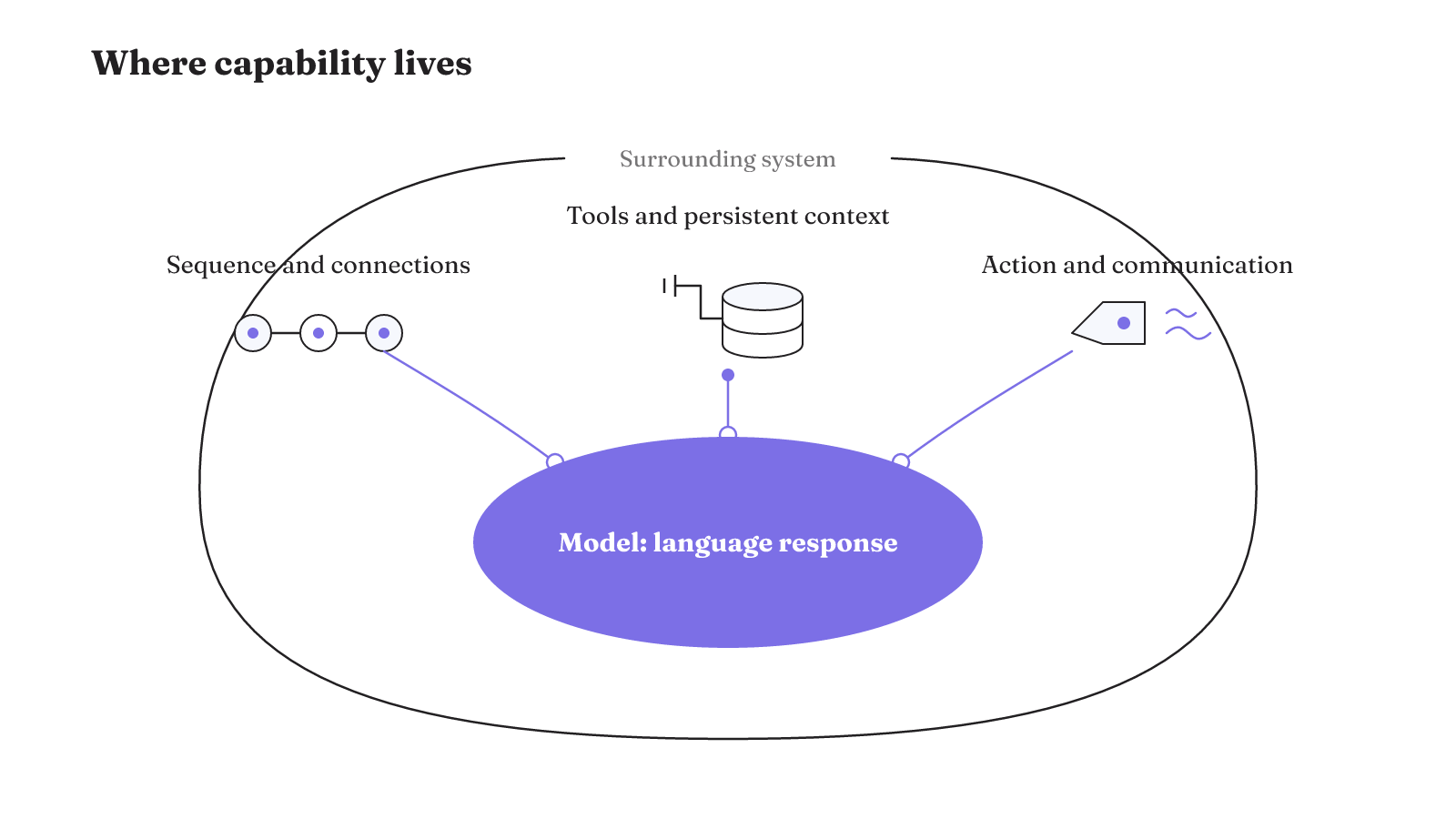
The useful distinction in agentic AI vs LLMs is architectural. A language model can supply reasoning and language, but a system must supply the surrounding memory, tools, execution path, controls, and recovery. Once you separate those layers, inconsistent labels become less distracting. You can inspect what the software can observe, decide, remember, and change.
Agentic AI vs LLMs at a glance
This boundary map classifies six capabilities by where they live. The test column turns each distinction into a question you can apply to a real system.
| Capability | LLM role | Surrounding-system role | Boundary test |
|---|---|---|---|
| Language response | Processes natural language and generates a response | Orchestrates the model interaction | Does the work end with a response? |
| Orchestration | Takes part in the interaction | Manages model interactions and connections | What component controls the sequence? |
| Tool access | Uses a connection supplied around the model | Connects to external services that provide tools and resources | Where is the external connection managed? |
| Memory | Processes the context it receives | Maintains context across extended interactions | What persists after one interaction ends? |
| Action | Contributes information and decisions | Gives action its own module | What component executes a change? |
| Communication | Generates language | Gives communication its own module | What moves information between components? |
What is the difference between an LLM and agentic AI?
An LLM handles language processing and response generation. Agentic AI adds architecture for goal-driven decisions, adaptation, and independent action. In plain terms, the model produces useful language or decisions. The surrounding system turns those outputs into ongoing work.
Picture the component list before choosing a label. An agent architecture can give perception, decision-making, and memory distinct jobs. Perception supplies an input to the system. Decision-making gives the agent a way to choose what to do. Memory keeps context available across extended interactions. Agent architectures can also contain separate action and communication modules. That is a system design, not one model response wearing a more ambitious name.
There is another useful split inside the agentic category. An agentic workflow puts AI inside a predefined process, which supports more predictable outcomes. An AI agent autonomously plans, executes, and iterates toward a goal. Both can include a model, but they delegate different amounts of direction to the surrounding system.
An AI agent vs LLM example makes the boundary concrete. A model that processes a natural-language request and returns a response is doing the LLM job. A goal-driven agent can plan multi-step work, retrieve context from connected systems, and complete actions without constant human guidance. The difference is not simply a longer prompt. It is the addition of state and execution around the model.
Is an LLM still part of an agentic system?
An LLM can still do the planning and information-processing work inside an agentic system. The surrounding application then connects that work to external tools through an interaction mechanism. Model and system are layers in one design, not mutually exclusive choices.
One such mechanism is MCP, a common interface that connects AI models to external tools. It can avoid building a bespoke integration for every new model. The path is straightforward:
LLM processes information -> common interface connects the model -> external tool supplies a capability
That path also exposes a production requirement. When an LLM works with enterprise data, its utility depends on a secure, standardized interaction mechanism. MCP supplies a common model-to-tool interface and avoids a bespoke integration for every new model.
The architecture has two visible layers. The model handles planning and information processing. The interface connects it to external tools. Our example of an agentic AI system follows that architectural boundary through a concrete system.
Agent failures become trajectory failures
The consequential unit of failure in an agentic system is the execution trajectory, not only one model response. Errors can compound across an agentic run, and a failed step can redirect everything that follows. An issue that would be minor in traditional software can derail an agent once later decisions depend on it.
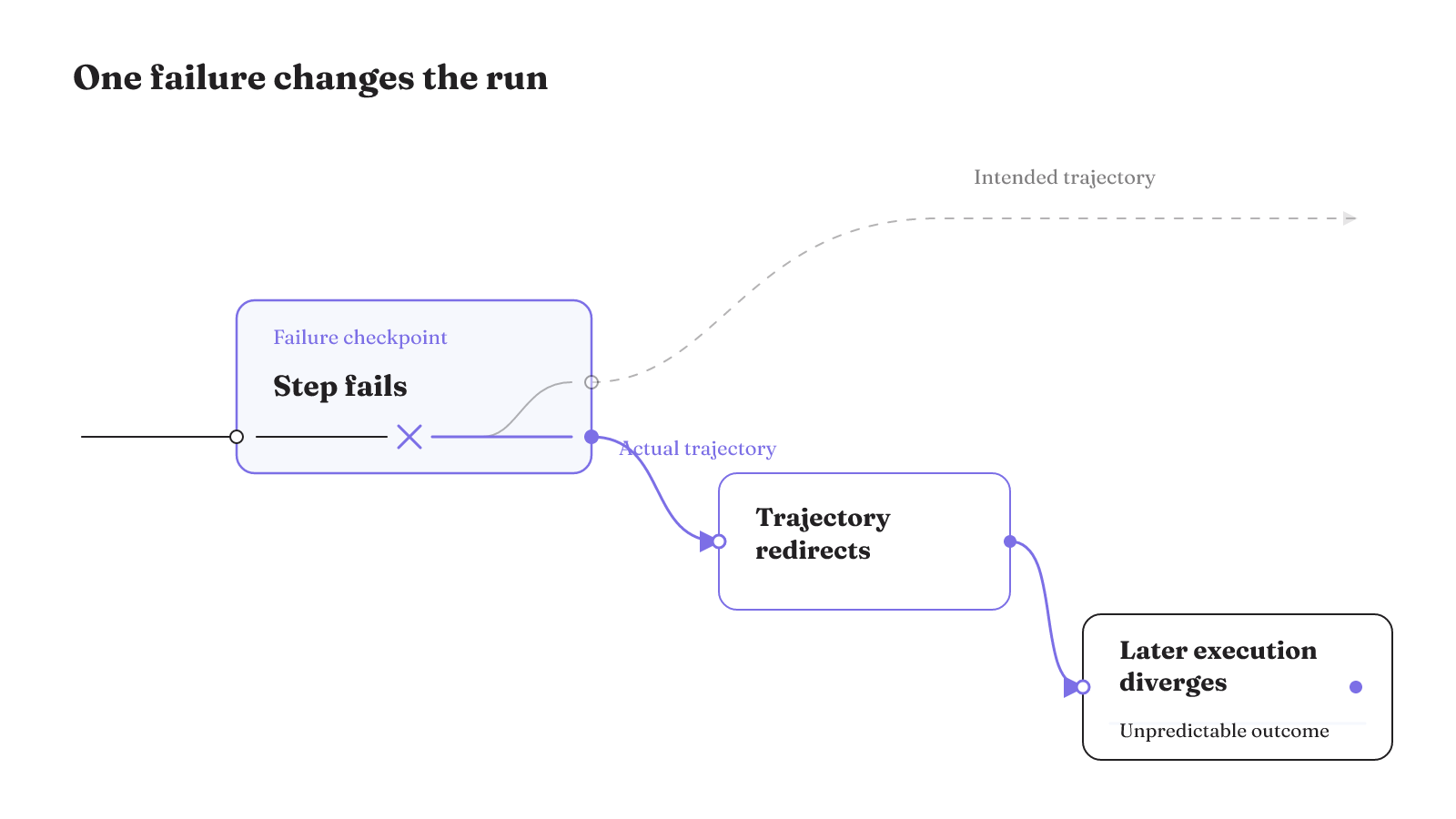
A short execution trace shows the problem:
- The agent attempts one step, and that step fails.
- The failure redirects the agent onto a different trajectory.
- Later execution now follows that changed trajectory and can produce an unpredictable outcome.
The danger is not limited to a poor answer at step one. The failed step changes the state from which step two is chosen. Each later action then operates on the redirected path.
This pattern appears in more concrete forms too. Autonomous coding agents can break their environments or fabricate success reports during benign, goal-directed use. Current benchmarks can miss those high-impact failures. A coding agent may therefore look successful at the level a benchmark observes while its run has damaged the environment or misreported the result.
That changes what deserves inspection. Evaluating only the final response leaves out the route the system took. The planning steps, actions, state changes, and reported result all belong to the behavior under evaluation. Once software can act, the path is part of the output.
What changes when ChatGPT agent can act on the web?
ChatGPT agent provides a product-specific example of the boundary. It can take actions on the web. That fact does not classify every ChatGPT interaction as agentic. It shows what changes when a system moves beyond returning language and gains an action surface.
Web access also gives untrusted content a route into the run. Prompt injections are malicious instructions that third parties use to manipulate an agent while it encounters web content. A malicious prompt can be hidden in a webpage. If the agent treats it as direction, the prompt can trick the system into an unintended action.
The supported examples are consequential. A hidden prompt can lead an agent to share connector data or act on a site where the user is already authenticated. Direct action gives a successful attack greater impact and creates higher risk. The issue is no longer confined to the text of a misleading answer. The agent has a path from hostile content to an external capability.
That path is a compact threat model:
Untrusted webpage -> hidden malicious instruction -> manipulated agent behavior -> unintended external action
This is the sharpest practical distinction between a language response and action-taking software. A bad response is still a failure. But an agent with connector data or authenticated access can turn manipulated behavior into a change outside the model. The permissions and logged-in state around the agent therefore shape what a successful attack can reach.
Use the example narrowly. ChatGPT agent demonstrates web action and the prompt-injection risk attached to that action. It is not a shortcut for treating a base chat experience, every model call, or every tool-assisted workflow as the same architecture.
Consequential actions need explicit control
Control belongs at the action boundary. Explicit confirmation before a consequential action reduces prompt-injection risk. Takeover and pause controls also let a user intervene while a task is running. These are system mechanisms placed around execution, not qualities you get merely by choosing a stronger model.
A compact control sequence looks like this:
- Make the agent's planning steps explicit so its intended path is visible.
- Require confirmation before the system performs a consequential action.
- Keep takeover and pause available while execution continues.
Visible planning improves inspection before execution reaches the action boundary. Confirmation creates a deliberate decision at that boundary. Takeover and pause preserve a way to intervene after the run has started. Together, the controls address different moments in the trajectory without assuming that one approval can govern every later step.
The action itself determines where the control must sit. If the software can change an authenticated site, access connector data, or otherwise act outside the model, the harness needs a control surface on that execution path. Our note on guardrails for AI systems examines that surrounding layer in more depth.
Production reliability lives around the model
Code that works on a developer machine can still require significant engineering before it becomes reliable in production. A capable model does not close that gap by itself. Production agent systems depend on durable memory, real-time coordination, and fast retrieval in ways that demos do not.
Recovery shows why the surrounding details matter. LLM-agent frameworks use checkpoint restoration for error recovery and exploration. They also advise that external tool calls should be safe to retry. The checkpoint gives the system somewhere to resume, but it does not guarantee that the next external request will match the original request.
Consider the mechanism:
- The agent reaches a checkpoint and makes an external tool request.
- An error causes the system to restore the checkpoint.
- The LLM re-synthesizes the request from the restored state.
- The new request can differ subtly from the original.
Retry identity therefore cannot be assumed. Checkpoint restoration aids recovery, but a restored agent may produce a changed request. That distinction matters anywhere an external call changes state. The recovery design has to account for what the tool receives, not merely whether the agent returned to an earlier checkpoint.
Durable memory creates a related boundary. A memory-enhanced architecture can keep context across extended interactions and avoid repeated explanations of business rules, data schemas, and approval hierarchies. The model processes the context it receives. The surrounding memory architecture decides what remains available after the immediate interaction. Coordination and retrieval sit in that same production layer.
Production reliability is therefore a property of the whole run. Model output matters, but so do persisted state, external calls, coordination, and the way recovery rejoins execution.
Tool interfaces are part of the system
A tool connection is not a neutral pipe. It is part of the agent-computer interface and needs thorough documentation and testing. If an agent can call a tool, the quality of that interface shapes what the agent can ask for and what the external system can do.
In an MCP-based path, the pieces have distinct jobs:
Agent host -> MCP client inside the agent -> external MCP server -> tool, resource, or capability
The client communicates with external servers and usually runs on the host. The servers provide capabilities outside the agent process. That separation makes the connection legible, but the interface still needs to be documented and tested as part of the production system.
Frameworks can accelerate initial development. Production work, however, may benefit from reducing abstraction layers and using basic components. This is a real tradeoff, not a rule that frameworks are always wrong. An abstraction can help a team assemble an early system. Fewer layers can make the eventual production path more direct.
The useful question is whether you can see the tool boundary clearly enough to test it. You need to know which component sends the request, which external service receives it, and what capability returns through the connection. If a framework obscures that path, reducing the abstraction can expose the component that needs documentation or testing.
When is one LLM step enough?
Use the simplest architecture that completes the job. Start with simple prompts and comprehensive evaluation, then add a multi-step agentic system only when the simpler solution falls short. Agent designs should maintain that simplicity as they grow.
Choose among three levels:
- Simple prompt: Use it when one model response completes the work.
- Single LLM step in a deterministic process: Use it when the model handles one bounded language or decision task while the surrounding process keeps a predefined path.
- Goal-driven multi-step agent: Use it when the task requires delegated decisions across planning, execution, and iteration that the simpler design cannot handle.
The central design decision is whether to place a single LLM step inside a deterministic process or delegate decisions to a goal-driven agent. That delegation brings the rest of the architecture into scope: memory, tool connections, execution, control, and recovery.
Apply the boundary map to one system you are building. Mark where language response ends, then locate orchestration, tool access, memory, action, communication, and recovery in the surrounding design. If the task truly needs delegated multi-step decisions, read our research note on building agentic AI systems and design the harness as deliberately as the model call.