Key takeaways
- Guardrails are a control layer outside the model that validates its inputs and outputs.
- Pick the layer by what you're guarding: conversation flow, output format, or content safety.
- NeMo Guardrails fits flow, Guardrails AI fits format, LangChain's built-ins fit in-runtime checks.
- Every model-based check adds an LLM call to the request, so more guards means more latency. More guardrails is not automatically safer.
What AI guardrails are, and why a good prompt isn't enough
You searched "guardrails ai" while standing up a feature that could leak a customer's data, get prompt-injected, or say something confidently false. The pages that ranked either sell one tool or define the term. Neither tells you where a guardrail belongs in your stack. That is the gap this page fills.
Start with the mechanism. AI guardrails are programmable checks that sit outside the model and validate its inputs and outputs. They keep an AI system inside defined boundaries, and they run as their own layer, not a setting baked into the model. That independence is the point. The model stays a black box, and the guardrail decides what reaches it and what leaves.
Guardrails catch five failure modes: PII leakage, prompt-injection attacks, harmful content, broken business rules, and low-quality or inaccurate output. That list is also the honest answer to "why does ChatGPT have guardrails." A large model will confidently make things up, and prompt engineering alone won't get you to a system you'd trust to represent a company. A guard constrains behavior at the boundary. It does not fix an unsafe model, and it can't promise the model won't fabricate. It catches the bad output before it ships.
Choose the guardrail layer by what you're guarding
Here's the framework the ranking set skips. Stop sorting guardrails by GitHub stars. Sort them by what you're guarding. There are three layers, and each one intercepts at a different moment.
| What you're guarding | Layer | Where it intercepts | Check style |
|---|---|---|---|
| Conversation flow (on-topic, allowed actions) | Flow | Before the agent starts | Mostly rule-based dialog rails |
| Output structure and format | Format | After the model responds | Schema and format validators |
| Content safety (PII, injection, harmful) | Content | Around model and tool calls | Deterministic and model-based mix |
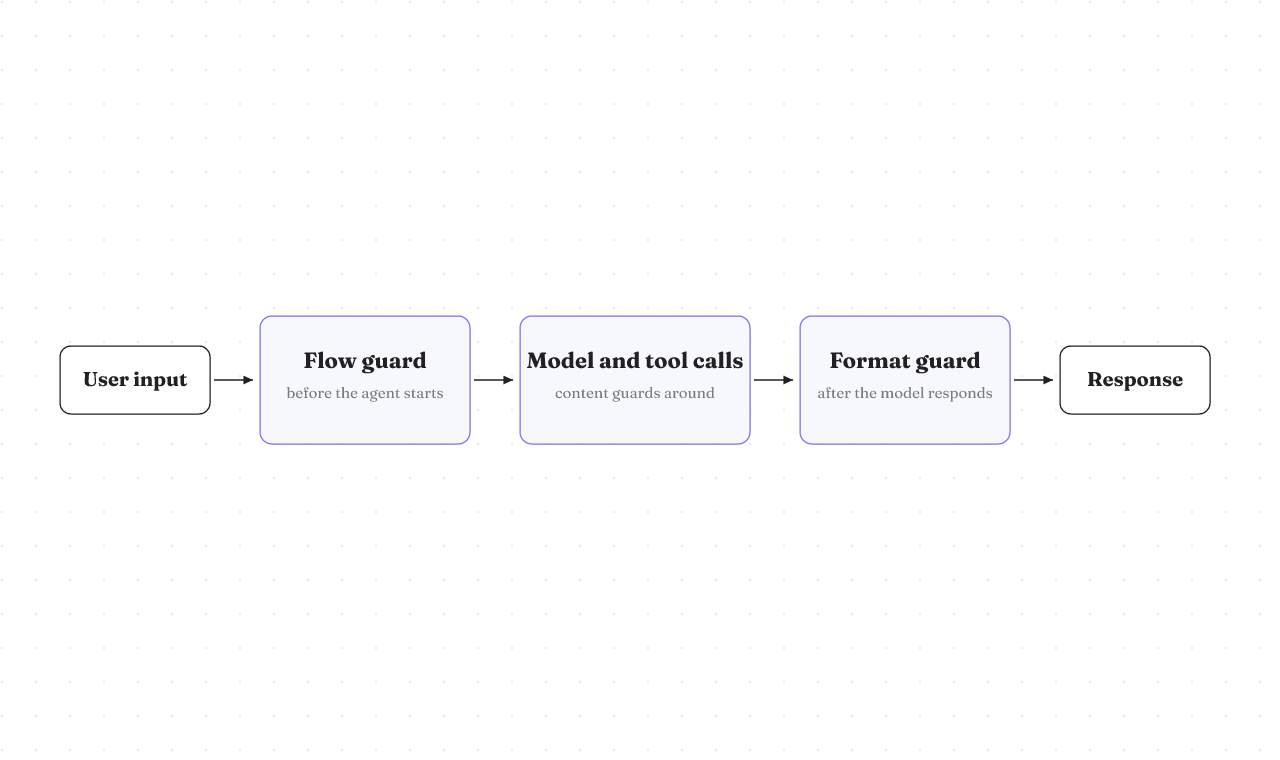
The placement points come from the middleware model. You intercept before the agent starts, after it finishes, or around the model and tool calls. Map each guard to the moment it matters. A dialog rail that keeps the bot on topic belongs before the model runs. A format validator belongs after, though a schema or PII check often belongs on the input side too. A PII scrub belongs on both sides.
There's an honest cost here. These layers overlap, and a real system usually needs two of them. Stacking two guards stacks their latency and their failure modes. Budget for that now, not in production.
Rule-based or model-based checks: pick per guard
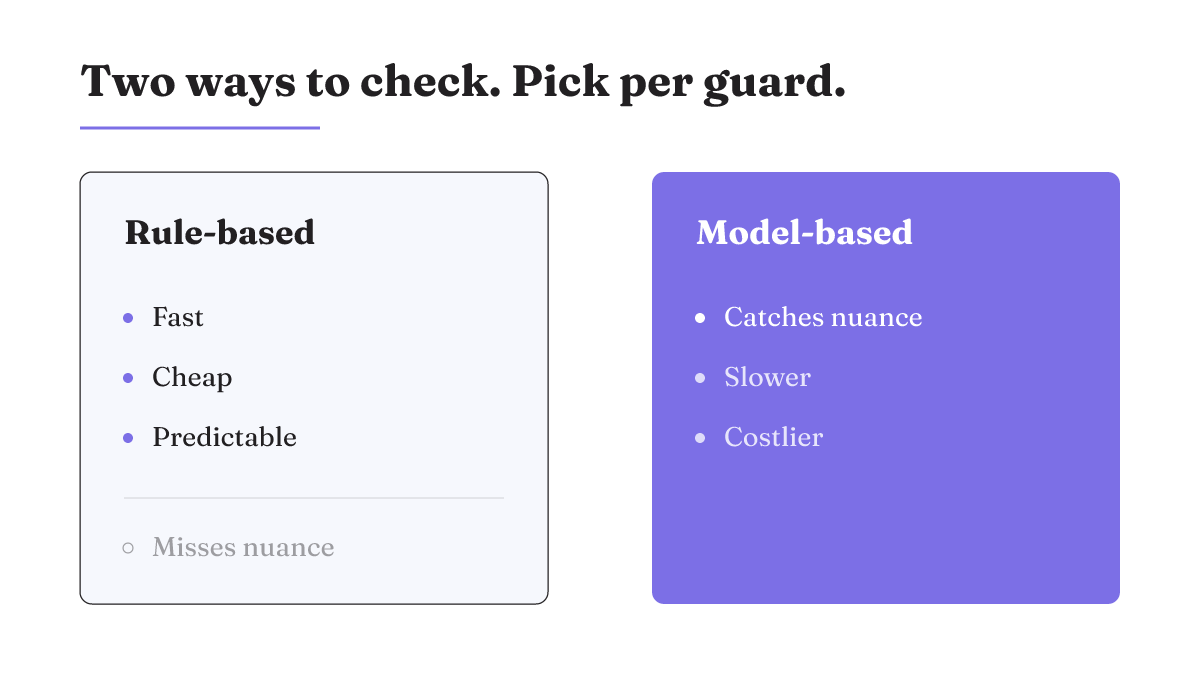
This is the second choice, and you make it per guard, not once for the whole system. Deterministic checks are rule-based: regex, keyword lists, explicit logic. They're fast, predictable, and cheap, but they miss nuance. Model-based checks use an LLM or classifier to read meaning. They catch subtle violations the rules miss, but they're slower and cost more.
The trap is treating this as one decision. A phone-number regex is the right guard for a formatted PII leak. It's the wrong guard for a paraphrased insult, which slips past every keyword you'll think of. A model-based check catches the paraphrase, but each one adds a full LLM call to the request. So mix them. Use a cheap rule where the pattern is fixed. Spend a model call only where meaning actually matters.
Guardrails AI vs NeMo Guardrails vs LangChain guardrails: what each is best at
Now match a framework to the layer it was shaped for.
Guardrails AI owns output format. Its architecture is built around Input and Output Guards, each assembled from pre-built validators pulled from the Guardrails Hub. One validator checks one risk. You combine several into a guard that intercepts what goes into and comes out of the model. It's a Python framework, and it's actively maintained: the guardrails-ai GitHub repo shows roughly 7.2k stars and over 3,200 commits, with merges landing in mid-July 2026.
NeMo Guardrails owns conversation flow. You write programmable dialog rails in Colang, NVIDIA's flow language, backed by YAML config. It blocks, alters, or validates unsafe, off-topic, or policy-violating turns without rewriting your app. It ships two ways from the same config: a Python library for app-level use, and a container microservice you run on Kubernetes with Helm. The NeMo Guardrails repo shows roughly 6.7k stars and over 3,700 commits, updated as recently as July 20, 2026.
LangChain's built-in guardrails own the in-runtime case. If your agent already runs in LangChain, you add guards as middleware at the exact interception points above, in both deterministic and model-based styles, without bringing in a second framework. That's the real answer to "guardrails ai langchain": they solve different jobs. Guardrails AI is a dedicated validation library. LangChain's guards are middleware inside its own agent runtime.
| Guardrails AI | NeMo Guardrails | LangChain guardrails | |
|---|---|---|---|
| Best at | Output format and structure | Conversation flow | Guards inside a LangChain agent |
| How it runs | Python library, Hub validators | Library plus Kubernetes microservice | Middleware in the agent runtime |
| Maturity signal | ~7.2k stars, 3,200+ commits | ~6.7k stars, 3,700+ commits | Part of the LangChain framework |
| Where it loses | No full self-host without a Hub token | Teams must learn the Colang DSL | Assumes you're already in LangChain |
Picking the agent framework underneath your guards is a separate decision, and worth making on its own terms.
A minimal Guardrails AI setup, and what to pull from the docs
Here's how you actually start with Guardrails AI, the "app" and "example" question in one. You install it with pip install guardrails-ai. The mid-2026 release is v0.10.2, licensed Apache-2.0, and it needs Python 3.10 or newer. You pull a validator from the Hub, then combine one or more validators into an Input or Output Guard that wraps your model calls. A Hub API key used to be required. It's now optional, and validators install from public PyPI.
A concrete example of a guardrail: a PII validator on the output guard that redacts a phone number or an email before the response reaches your user. That's one validator doing one job at one interception point.
I'm not going to paste a full runnable script here and pretend it's tested. Version numbers move, and a snippet that looks right but has drifted is worse than none. For the current end-to-end code, pull it from the official validator documentation, which tracks each validator's exact signature. Treat v0.10.2 as the mid-2026 state, not a permanent version.
The self-host limit the comprehensive guides skip
This is the fact that decides the tool for a regulated or data-sensitive team, and the ranking set leaves it out. Someone asked to run the Guardrails Hub services, the API and the validators, fully on-premise without a Hub token, so no client data would leave their org. That request was closed as not planned.
Read that carefully before you standardize on it. If your data can't leave your environment, a hard dependency on a hosted Hub is a design constraint, not a footnote. Roadmaps change, so this is the mid-2026 state, not a permanent verdict. Teams that don't mind the Hub dependency won't feel it. Teams under strict data-residency rules should weigh it now.
How mature these projects are, and what the public signals can't tell you
Both projects are alive. Guardrails AI sits near 7.2k stars with commits through mid-July 2026. NeMo sits near 6.7k stars, updated July 20, 2026. Read those as adoption signals, not reliability scores. Stars measure attention. They don't measure whether a validator holds up on your traffic.
Two things people search that the public signals can't answer: "who is the CEO of Guardrails AI" and "Guardrails AI funding." I won't name an executive from a repo maintainer handle, and there's no reliable public disclosure of a funding round I'd stand behind. Treat both as not publicly established, rather than trusting a name or a number that isn't backed. That's not evasion. It's the same standard that keeps the rest of this page honest.
Demand for conversational AI keeps climbing, which is why this tooling matters. Gartner forecast in 2023 that by 2027, chatbots would become the primary channel for about 25% of organizations. More bots talking to customers means more surface area to guard.
When not to add a guardrail
More guards is not more safety. It's more latency and more cost. A model-based check reads meaning with an LLM or classifier, and it runs around the model and tool calls it guards, so five stacked content checks mean five extra calls before your user sees a token. Prompt engineering alone won't get you to a system you'd trust, true, but the answer isn't to guard everything at maximum.
Guard by blast radius. A guard around an irreversible action, a payment, a delete, an email that actually sends, earns its latency. A guard around a low-stakes answer that's easy to undo often doesn't. Place the check where a wrong output is expensive or hard to reverse. Skip it where the cost of being wrong is a quick retry. Under-guarding is a real risk too, so the argument is for calibration, not for guarding less as a rule.
Where this leaves you
You have the decision now. Name what you're guarding, pick the layer, pick the framework that owns it, choose rule-based or model-based per guard, and check that the guard can run where your data has to stay. If you need a validator in your app this week, install one of the three above and move.
There's a bigger version of the same question. Guardrail placement is really a reversibility question: what's allowed to ship without a human seeing it first? That's the problem Rifty works on. Rifty calls it harness engineering: building the legible, steerable, reversible control layer around agentic AI so an operator's judgment carries forward and nothing irreversible ships unreviewed. It isn't a guardrail library you pip install. It's a by-introduction operating product for people running real agent systems from a single seat.
If that's you, an operator building agent control and not just adding a validator, request an introduction to Rifty. If you're here for the validator, you already have your answer above.