Key takeaways
- Agentic work can run through one agent or several.
- Start with a simple design. Add agents when it falls short.
- Context, tools, parallel work, checkpoints, and hard boundaries can justify decomposition.
- Coordination, authorization, testing, and cost can erase the gain.
Agentic AI vs multi-agent systems is not a contest between basic and advanced software. Agents independently complete tasks for users, while a multi-agent system has several agents working together. Even agentic research systems can use single-agent, multi-agent, hierarchical, corrective, adaptive, or graph-based frameworks. The label does not settle the topology. The workload does.
Agentic AI vs multi-agent systems at a glance
Behavior: an agent independently completes tasks for a user.
Topology: one agent carries the work, or multiple agents collaborate on it.
| Decision axis | Single-agent signal | Multi-agent signal | Engineering consequence |
|---|---|---|---|
| Context size | Small context | Large context spread across sources | Context placement shapes the topology |
| Tool breadth | Only a few tools | Several tools | Tool access must match each agent's work |
| Simple automation | Suited to simple automation | Add agents only if the simple design falls short | Simplicity is the starting point |
| Parallel work and checkpoints | No specific need for decomposition | Parallel execution or multiple decision checkpoints | Separate workers may earn their boundary |
| Hard separation requirements | No hard separation requirement | Isolated agents with scoped access and explicit interface contracts | Security, compliance, organizational separation, or guaranteed multi-domain scaling can require isolation |
| Coordination or testing burden | One agent avoids added multi-agent behavior | Added behavior can bring significant complexity | Multi-agent interactions can be non-deterministic and hard to test reliably |
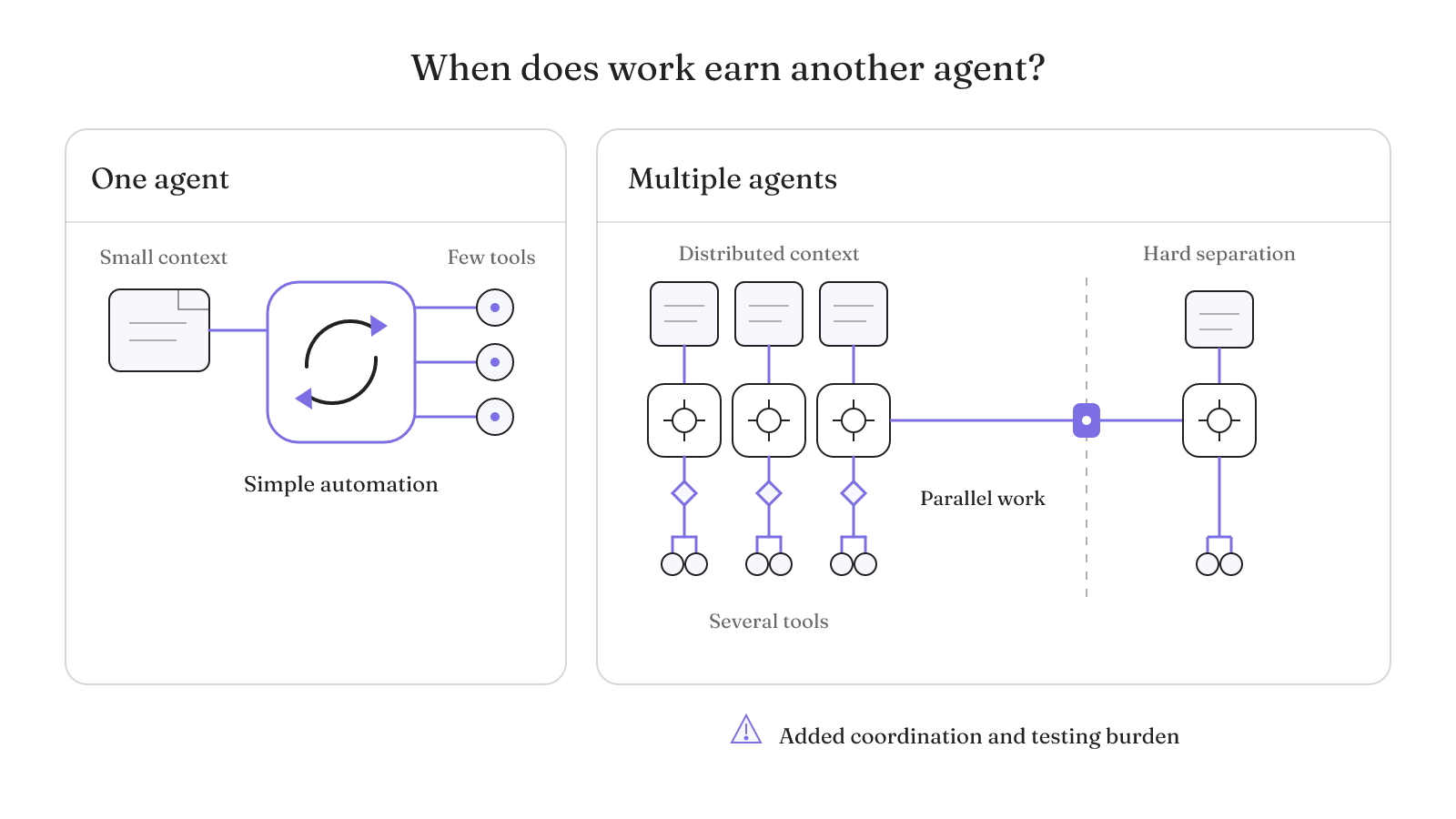
This is why multi agent AI vs agentic AI is the wrong maturity ladder. Agentic research frameworks can use one agent or many, and the simpler solution should come first. Mark the row where that solution falls short, then name the added agent's responsibility. That keeps decomposition tied to a specific architecture pressure.
Agentic behavior is about end-to-end task execution
Agentic behavior shows up in what the system can carry through, not in how many agents appear on an architecture diagram. An agent can reason through ambiguity, act across tools, and handle multi-step tasks with substantial autonomy. Those are three observable behaviors you can examine in a run.
First, ambiguity means the path is not fully specified before execution. The agent must reason about what to do. Second, tool use means its work can include actions outside the model response. Third, multi-step execution means it can keep working through a task instead of returning one isolated answer.
That combination makes end-to-end agents well suited to complex decisions, unstructured data, and workflows that become brittle when expressed as fixed rules. None of those properties requires another agent. One agent may still do the reasoning, use the tools, and complete the steps.
The useful architecture question is therefore narrower: can one process hold the required context and tools while carrying the work from start to finish? If it can, agent count adds no automatic proof of better behavior. Our guide to building agentic AI systems keeps the focus on the surrounding system instead of treating autonomy as an agent-count score.
What is an example of a multi-agent system?
One concrete example is a multi-agent researcher implementation. It uses one orchestrator to coordinate three worker agents. The workers retrieve material from the web and local documents, use memory, and write and verify grounded content.
The example makes the division of labor visible. The orchestrator coordinates the workers, while the workers carry distinct parts of retrieval and content production. It is a real multi-agent topology because several agents work together on the task, not because the overall workflow merely has several steps.
Open-ended research is one workload where multi-agent systems have shown value. That finding stays attached to research work. It does not establish that every workflow benefits from the same design.
The operational price is also part of the example. Reliable operation at scale calls for careful engineering, comprehensive testing, detailed prompt and tool design, and robust operational practices. The three workers do not remove that work. They create more relationships that the harness must make legible.
So, what are examples of multi-agent systems? An orchestrated research system is one. A plan-and-execute topology, covered below, is another. Both expose the feature that matters: work crosses explicit agent boundaries and must be coordinated. Our multi-agent system definition gives the term a compact home, but an implementation earns the label through its topology.
A single agent keeps one working thread
A single-agent system can run as one process with a continuous thread of memory, action, and tool use from start to finish. That continuous thread is the practical center of the design. The same process retains the working state, chooses an action, uses a tool, observes what happened, and continues.
For work with a small context and only a few tools, that arrangement keeps the task inside one operating boundary. The single agent does not need a handoff merely to preserve the thread. It can carry the sequence itself.
Instructions matter inside that boundary. Clear agent instructions reduce ambiguity and improve decision-making, workflow execution, and error rates. Better instructions do not turn one agent into many. They make the role, available actions, and expected workflow clearer to the one agent already doing the work.
This is the useful single-agent side of single-agent vs multi agent examples: one process can maintain memory, actions, and tool use across the complete task. You should not decompose that thread just to make the diagram look more agentic. Start with the continuous process and look for a concrete reason it cannot carry the job.
That reason may be too much distributed context, the need to run work in parallel, a hard authority boundary, or a responsibility that deserves independent scaling. Those are properties of the work, not badges of architectural maturity.
What do multiple agents add?
Multiple agents add value through decomposition. The strongest cases are role specialization, parallel execution, and failure isolation. Each changes how the system can perform work, but each also depends on coordination rules.
Role-specific responsibility
Domain specialization lets each agent hold a limited, role-specific responsibility. The value is not that a specialist agent is inherently more intelligent. Its responsibility is narrower. That boundary can keep different kinds of work in distinct roles when one broad role would be difficult to manage.
Parallel execution
Parallel agents can reduce latency because separate work can run at the same time. Their capacity and capabilities can also be scaled individually. A worker facing heavier demand can therefore have its own capacity, while a worker with a different responsibility can have a different capability.
Parallelism only supports decomposition when the workload actually contains work that can run in parallel. A sequence that must wait for each preceding result does not gain this mechanism merely by being divided among more names.
Failure isolation
A multi-agent design can isolate and contain a failure within one agent. That is a concrete reason to create a boundary when containment matters. The design has to preserve the boundary in operation; a label alone does not contain anything.
These gains depend on shared communication and collaboration rules, not on sheer agent intelligence. Specialists need a way to exchange the information their roles require. Parallel workers need their outputs reconciled. Isolated agents need defined interfaces that keep the failure from leaking across the system.
The decision is not whether specialization, speed, or containment sounds desirable. It is whether one of those mechanisms changes the workload enough to repay the communication and reconciliation it introduces. That repayment is the heart of coordination cost.
Multi-agent system architecture routes work and bounds delegation
A plan-and-execute topology is one of the clearest multi-agent systems examples because every boundary has a visible job:
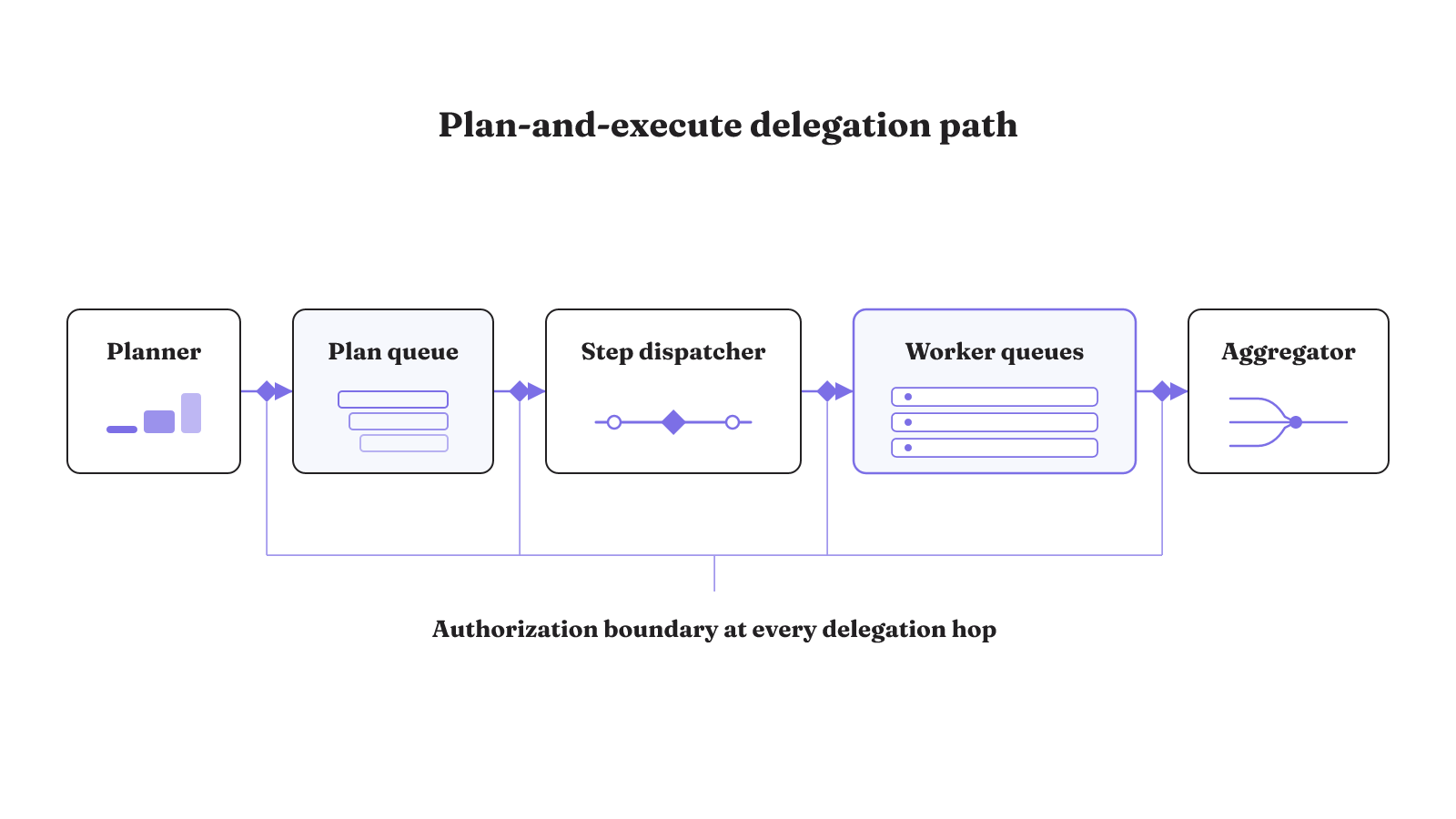
- The planner produces the plan.
- The plan queue holds planned work.
- The step dispatcher routes each step.
- Worker queues receive the routed work.
- The aggregator combines the results.
This topology does more than distribute computation. It creates delegation hops. Every delegation hop needs an authorization boundary. The planner's ability to propose work, the dispatcher's ability to route it, and a worker's ability to use tools are separate authority questions.
Multi-agent systems can be designed with security permissions, audit logs, and human-in-the-loop checkpoints. Those controls belong in the architecture. They cannot be inferred from the presence of several agents.
Hard security, compliance, organizational-separation, or guaranteed multi-domain-scaling requirements can support isolated agents with scoped access and explicit interface contracts. In those cases, separation is not decorative. It expresses a requirement the harness must enforce.
Our deeper AI agent architectures guide can help you place this topology beside other patterns. For the current decision, inspect each delegation edge as both a data path and an authority boundary.
A failed step can redirect the whole run
Agent runs are trajectories, not just final answers. A failure at one step can send an agent down a different path and produce an unpredictable outcome. In a multi-step run, the next action is chosen from the state left by the earlier action. If an earlier step fails, later steps may proceed from a different state.
Consider the path at the level of state, without inventing a happy-path story. One step acts and leaves a result. The following step receives that result and chooses its own action. A failure changes the result available to that following step, which can redirect every later choice. The eventual output may therefore differ because the run took a different trajectory.
That failure mode changes what testing must cover. A correct final output in one run does not describe every route the system may take. Multi-agent interactions can also be non-deterministic and difficult to test reliably, so added boundaries increase the set of interactions you need to observe.
Turn failures into evaluation cases
When you observe a failure, turn it into an evaluation case. This practice helps prevent regressions and replaces guesswork with metrics. The failed trajectory becomes a concrete case the system must handle, not an anecdote that disappears after a prompt change.
Useful agent evaluations need three things: realistic tasks, unambiguous success criteria, and thoughtfully designed graders. Realistic tasks keep the evaluation connected to the work. Clear criteria define what counts as success. Designed graders make that judgment operational.
These controls apply to both single-agent and multi-agent designs. The difference is the surface you must evaluate. A multi-agent run includes the interactions among agents as well as each agent's work. A failure may begin at one step and alter everything that follows.
Cost belongs in the same decision. In one proposed five-step workflow with debate mode, multi-agent execution could cost more than a single-agent call. That is a scenario-specific warning, not a universal multiplier. It is enough to show why the extra steps and interactions need a workload-level reason.
The practical test is demanding but plain: run realistic work, define success before judging the output, and preserve failures as regression cases. Then compare whether decomposition improves the property that justified it without making the trajectory too difficult to evaluate.
Where should human oversight enter?
Human oversight should enter at defined failure thresholds and at actions whose consequences justify a handoff. Production guardrails span input filtering, tool use, and human intervention. Oversight is one control in that wider harness.
A human-intervention mechanism lets the agent transfer control when it cannot complete a task. That is a specific state, not a vague instruction to involve a person whenever the system feels uncertain.
Retry and action limits provide another concrete trigger. The limits can serve as failure thresholds that cause human intervention. They also give a looping agent a stop condition the harness can observe.
Sensitive, irreversible, or high-stakes actions should trigger human oversight until confidence in the agent's reliability grows. This trigger follows consequence. It does not depend on whether the action came from the first agent, a worker, or an aggregator.
Use three checks when placing the handoff:
- Completion: Can the agent complete the task, or has it reached a state that requires a person to take control?
- Limits: Has it exceeded the permitted number of retries or actions?
- Consequence: Is the pending action sensitive, irreversible, or high stakes?
In a multi-agent design, apply these controls alongside the authorization boundary at each delegation hop. In a single-agent design, keep them around the one continuous thread. Agent count changes the number of boundaries, but it does not remove the need for guardrails.
Use the decomposition matrix on your next architecture decision. Start with the simpler design and add agents only when it falls short. Mark the exact pressure, then compare the added agents against their coordination, authorization, testing, and workflow cost. Before adding a worker, define its boundary, its evaluation case, and its human handoff.