Key takeaways
- Set oversight for each action, not for the agent as a whole.
- Match approval depth to consequence, reversibility, sensitivity, and cost.
- Define one measurable workflow before comparing tools.
- Plan recovery before the agent performs live work.
Can AI agents automate a small business?
Yes. AI agents can automate defined parts of a small business by completing tasks on a user's behalf. They can also reason through ambiguity, act across tools, and handle multi-step work with a high degree of autonomy.
Small-business owners are already using autonomous agents to perform tasks and make decisions for them. One documented example is bankruptcy lawyer Scott Bell, who uses agents for client intake, routine inquiries, and financial-document organization. That example shows the range of work an agent can touch. It does not turn one setup into a universal design for every business.
If your question is "Can I automate my business with AI?", begin by separating a task from the authority needed to complete it. An agent that drafts an action poses a different decision from one that executes it across live tools. The practical issue is not only whether the agent can do the work. You also have to decide what it may change, when a person must approve that change, and how the workflow responds when the result is uncertain.
Trying to automate a one-person business with AI makes that boundary more important, not less. With fewer people available for handoffs and review, the first workflow needs a clear problem and a result you can measure.
Start with one workflow, not a tool
Define the business problem and workflow before selecting an agent tool. A practical first pilot uses work that is common, annoying, and measurable. That gives the pilot a specific job instead of turning the platform into a search for something useful to do.
Candidate first pilots include ticket routing, report generation, onboarding checklists, customer relationship management data hygiene, and internal request intake. Each is a named workflow that can be examined on its own. Pick one, then keep the pilot centered on that work.
The same guidance excludes finance posting, firing decisions, contract language, and production deletion from a low-risk first agent pilot. These actions bring consequences that do not belong in the same starting category as internal request intake or report generation.
This workflow-first choice comes before product features. It tells you which task the agent must handle and exposes the actions inside that task. Once those actions are visible, you can decide whether each one may run automatically, needs a condition, or must wait for human approval. That is a more useful buying filter than starting with a long feature list.
Match each action to the right approval gate
Set human oversight action by action, not once for an entire agent. Approval depth should reflect reversibility, blast radius, data sensitivity, autonomy, domain, cost, and regulatory exposure. An approval gate lets the agent prepare or propose consequential work while a person retains confirmation before execution.
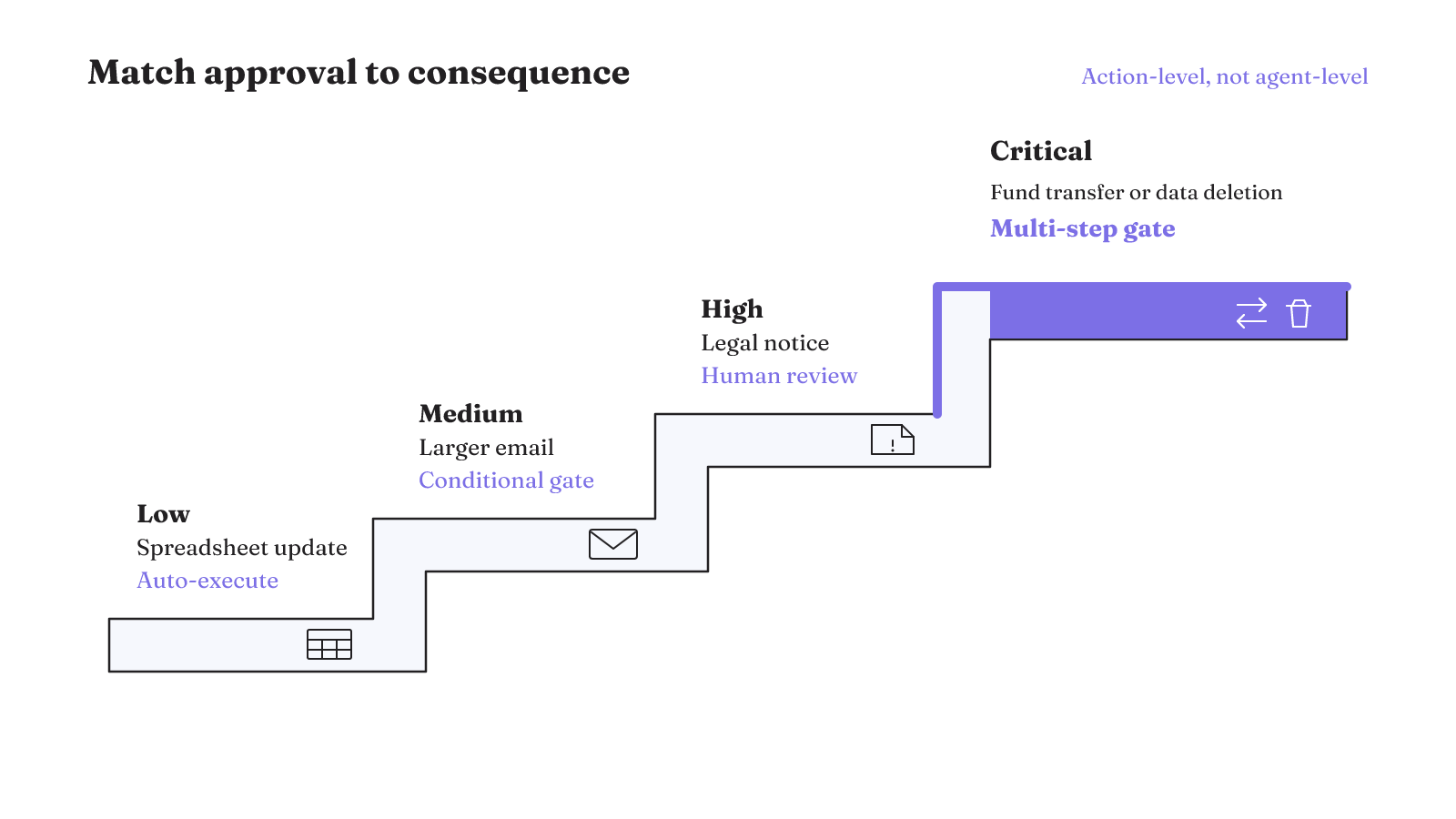
Apply that rule by listing the actions inside the pilot workflow. For each action, consider whether it can be reversed, how far an error could spread, what data it touches, how much autonomy it uses, its business domain, its cost, and its regulatory exposure. Assign the gate only after making that action-level assessment. Repeat the assessment across the workflow instead of giving the whole agent one broad approval setting.
The Automation Consequence Ladder turns that principle into four concrete gate levels:
| Consequence tier | Example action | Allowed execution | Approval gate |
|---|---|---|---|
| Low | Update an internal spreadsheet | The agent may execute | No gate |
| Medium | Send an email above a recipient-count threshold | Execution depends on the condition | Conditional gate |
| High | Send a legal notice | The agent prepares or proposes; a person confirms execution | Human review |
| Critical | Transfer funds or delete data | Execution remains behind several checks | Multi-step gate |
The balance matters. Too much review can lead to rubber-stamping, while too little review allows unapproved consequential actions. The goal is not to insert a person into every routine step. It is to place meaningful review where the action's consequence calls for it.
Use the ladder at the action level even when several actions sit inside one workflow. An agent may have permission to update an internal spreadsheet while a legal notice remains behind human review. The platform name does not decide that boundary. The authority assigned to each action does.
Which AI agents for small business are best?
The best design is the simplest system that can handle the chosen workflow. Reliable agents pair capable models with well-defined tools and clear, structured instructions. The system should keep its planning steps transparent, and its tool interfaces should be documented and tested.
If you're asking how to build AI agents for small businesses, start with simple prompts and comprehensive evaluation. Add multi-step agency only when the simpler approach falls short. Agent orchestration follows the same rule: begin with a single agent, then move to multiple agents only when the workflow needs the extra complexity.
That sequence prevents architecture from becoming the objective. A single agent with defined tools may be enough for the work in front of you. A multi-agent system adds orchestration, so it needs a workflow reason to exist. You can examine agent orchestration tools after the work has shown that need.
The model is only one part of the operating system around the work. Our guide to how an agent harness controls tools, state, execution, and verification shows the wider control surface. Use that surface to compare designs against the workflow and authority decisions you have already made.
Build recovery into the harness before the first live run
A simple architecture can still produce an uncertain live outcome. Production controls need to combine isolation, scoped permissions, action review, monitoring, human oversight, protected credentials, emergency stopping, and cleanup planning. A production setup also needs audit trails, human checkpoints, rollback-capable kill switches, drift monitoring, and a named owner.
Approvals are part of that record. Every approval, denial, and override should be logged so the oversight can be verified. A gate that pauses an action without leaving a record cannot show what was approved, rejected, or changed.
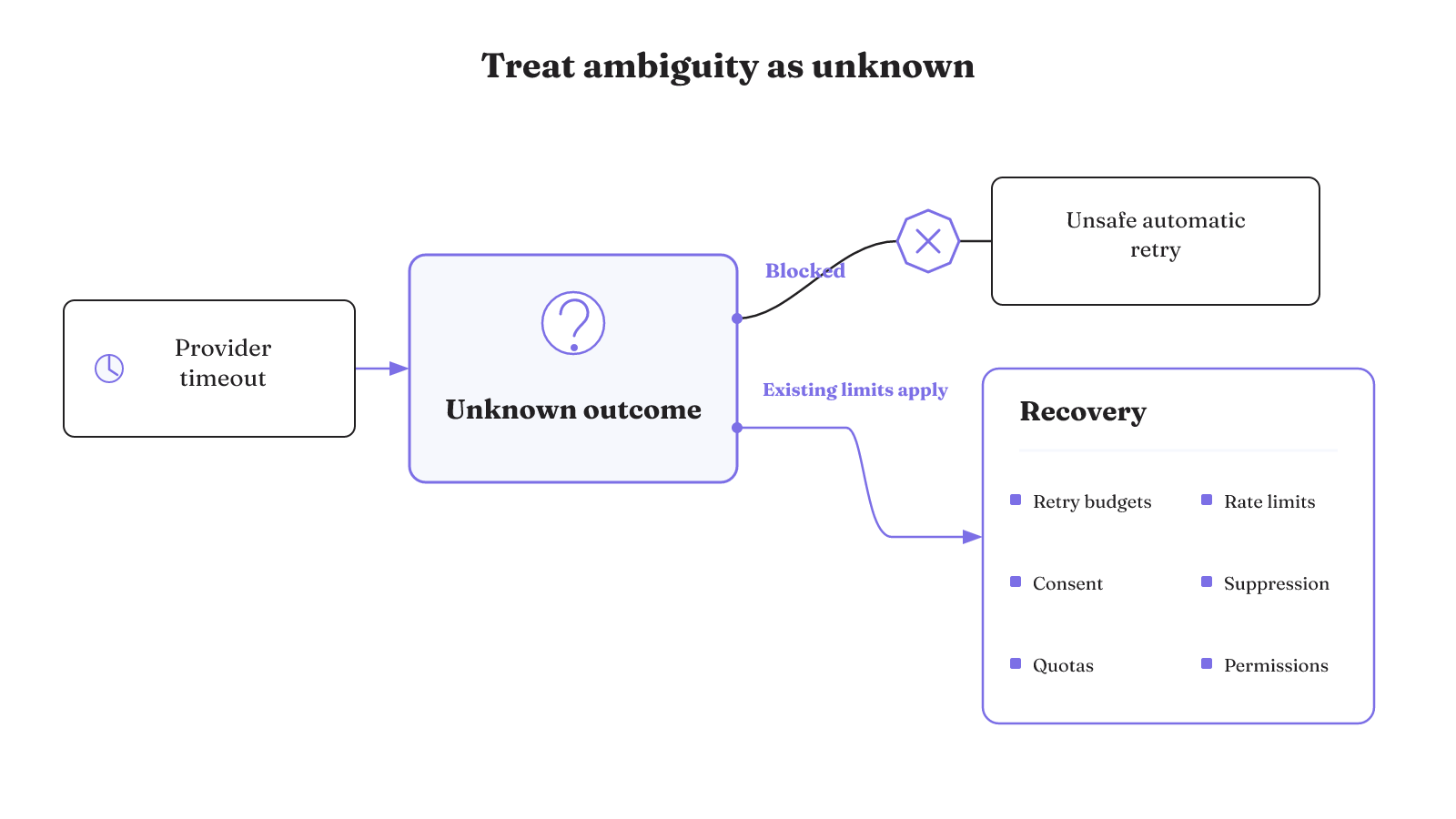
Provider timeouts deserve their own state. When a provider times out and the outcome is ambiguous, classify it as unknown instead of failed or successful. Do not let that unknown state trigger an unsafe automatic retry. A second execution could be consequential when the first result has not been established.
Recovery also stays inside the agent's operating limits. It must respect retry budgets, rate limits, consent, suppression rules, quotas, and secret or tool permissions. Recovery is not permission to bypass the controls that governed the original action.
Define that recovery boundary before live execution. Set the retry budget and rate limits that still apply when an outcome is unknown. Preserve consent and suppression rules during recovery, and keep quotas plus secret or tool permissions in force. The recovery path is another part of the harness, so it receives explicit authority instead of inheriting unlimited access during an incident.
This is why recoverability belongs in agent selection. Ask whether the harness can preserve an unknown outcome, stop further execution, retain the decision record, and keep recovery within existing authority. Those controls determine whether an exception remains bounded when the live system no longer follows the happy path.
A pilot must prove the workflow, not just the demo
Completing a task once does not establish that a live workflow can absorb an agent. Real systems include exceptions, handoffs, ownership, and consequences. A successful demonstration may show that the agent can perform the task, while leaving those workflow conditions untested.
Start the pilot with a baseline. If error rate is the downstream outcome that matters, record the workflow's error rate before the pilot. Then measure the downstream error rate during the pilot and compare it with that baseline. Completion time and conversion rate are other downstream outcomes a pilot can measure. Agent activity alone is not the result.
This distinction changes the buying decision. A tool can look capable in a controlled task and still meet trouble when live work reaches another system, an exception, or a handoff with unclear ownership. Production agent systems can fail in difficult-to-anticipate ways, so the pilot needs to expose the workflow around the task, not hide it.
A passing pilot therefore supports only the scope it actually tested. Expansion should follow measured workflow outcomes and the failures observed during use. It should not turn one successful task demonstration into unrestricted production autonomy.
Turn observed failures into evaluations
When the pilot fails, turn the observed failure into a test case. Early agent evaluations help prevent regressions and replace subjective impressions with metrics. The useful test set comes from realistic tasks the system has failed, not from a collection of convenient examples.
Strong evaluations define robust success criteria, use thoughtfully designed graders, and inspect the agent's transcript. The transcript matters because the final answer alone does not show the path the agent took through tools and decisions. Our agent evaluation glossary provides a compact reference for this discipline.
The improvement loop connects traces, human judgment, evaluations, ranked harness changes, and implementation. A trace captures what happened. Human judgment helps interpret the result. Evaluations make the failure repeatable. Candidate harness changes can then be ranked before the selected change is implemented.
Run the evaluation again after the change. That closes the loop between a production observation and a tested harness improvement, while keeping the decision grounded in behavior you can inspect.
Control cost by routing work by complexity
Not every request needs the same model or the full agent path. Smaller language models can handle simpler agent tasks such as intent classification or parameter extraction. Larger models can remain assigned to complex reasoning.
Requests can be routed by complexity to different model sizes or serverless functions. This approach manages cost while matching performance to the task. The routing decision stays attached to the work being done instead of treating every request as equally difficult.
Common requests can also receive a response before they enter the agentic system, which reduces repeated processing. Together, these controls create three places to make a cost decision: handle the common request early, route a simple task to a smaller model or function, and reserve a larger model for complex reasoning.
Cost control still needs evaluation. The route has to match the task, and the result needs the same success criteria used for the rest of the workflow. A cheaper path is useful when it performs the assigned work. It is not a reason to move complex reasoning into a simpler route.
How do you move an agent from pilot to production?
Move in stages: assessment, planning, pilot testing, full deployment, and optimization. This sequence lets a small business learn, adjust its processes, and prove value before scaling its investment. Deployment can start small, validate with real users, and expand capabilities over time.
Assessment identifies the business problem and workflow. Planning defines the agent design and the controls around its actions. Pilot testing measures the downstream workflow outcome against its baseline. Full deployment broadens live use only after that evidence exists. Optimization continues the evaluation and improvement work once the agent is operating.
Production is not the end of the control work. Response, recovery, and communication plans should be documented and monitored regularly. Post-deployment monitoring should include mechanisms for user input, appeal and override, decommissioning, incident response, recovery, and change management.
The sequence leaves room to change the process before increasing the investment. It also keeps expansion connected to real users, measured workflow outcomes, observed failures, and the controls needed after deployment.
Take one recurring workflow and apply the Automation Consequence Ladder before choosing an agent. Mark each action as low, medium, high, or critical, then assign the matching permission and approval gate. If you need to map the surrounding control system, use the agent harness guide to examine tools, state, execution, and verification.