Key takeaways
Both clear the same capability bar, so neither simply wins. Pick by harness fit: Claude Code for terminal-first, sequential deep refactors and CI/CD. Antigravity for parallel agents, visual orchestration, and browser-tested work. On SWE-bench Verified, both report roughly 76% or better, which is exactly why a blanket "X is better" verdict is the wrong question, and why the honest move is to match the tool to the work rather than crown one.
Both tools are agent harnesses, and that is the real comparison
Most claude code vs antigravity comparisons hand you a verdict or a feature grid, then leave you to guess which one fits your repo. The grids are not wrong. They just skip the part that decides the outcome.
Start from what an agent actually is. The working definition in the field is simple: an agent is a model plus the harness around it. A harness is the software layer wrapped around a language model. It runs the loop between the model and the world outside it, handling the tools it can call, the context it can see, and the actions it takes.
That layer is not plumbing. How a harness manages context and orchestrates work directly shapes what the agent can do. Both of these tools draw on the same class of frontier model. So the model is not the variable anymore. The harness is.
This is a lens, not a benchmark. It will not tell you one tool is faster. It will tell you why the two diverge, which is the thing feature rows cannot show. Read each difference below as a symptom of a harness choice, and the comparison stops being a shopping list.
Claude Code vs Antigravity at a glance
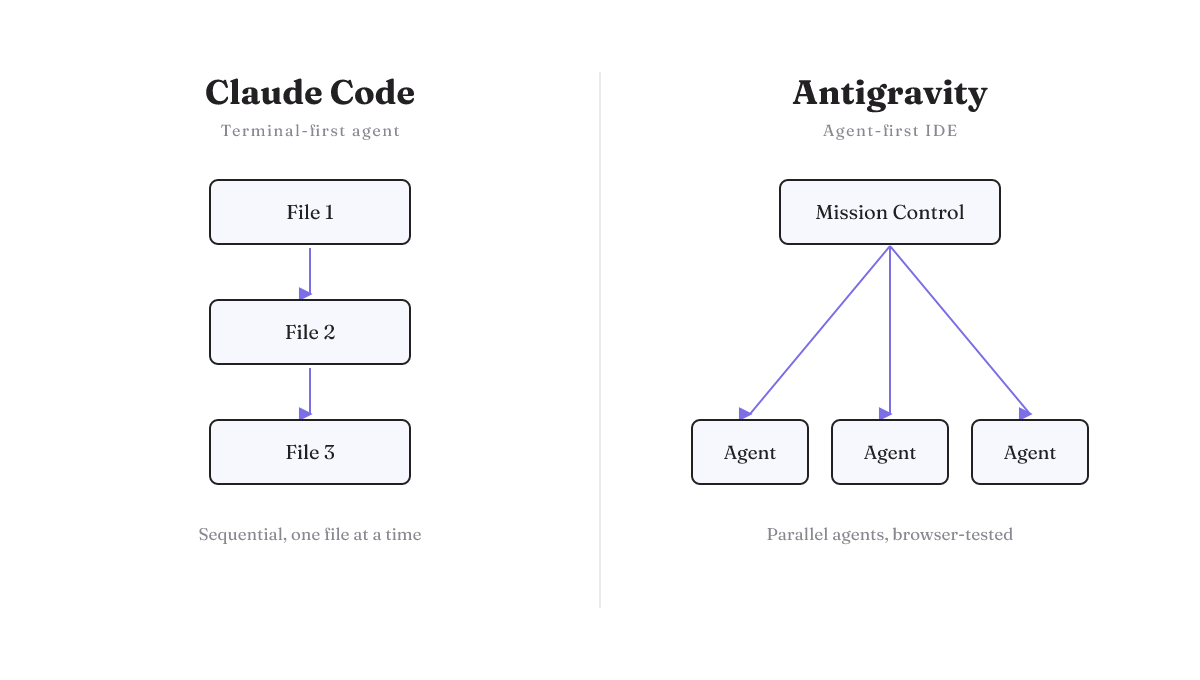
Claude Code is a terminal-first agent. It lives in your shell, reasons deeply across a codebase, and works one file at a time in sequence. That design fits complex multi-file refactors and CI/CD automation, where order matters and you want the agent to hold the whole change in its head.
Antigravity is an agent-first IDE. It plans tasks, drives your terminal and browser, and verifies its own work across several files at once. It spawns parallel agents you steer from a Mission Control dashboard, and it tests in a real browser. It is free while the preview lasts.
People ask whether an agent-first IDE beats a plain editor like VS Code. That framing misses the split. A plain editor waits for you to drive. Antigravity runs agents that plan and check their own output. For hands-off, parallel work it does more than an editor. If you only want a place to type, the comparison was never the point.
| Dimension | Claude Code | Antigravity |
|---|---|---|
| Shape | Terminal-first agent | Agent-first IDE |
| Orchestration | Sequential, file-level | Parallel agents, Mission Control |
| Environment | Shell and CLI | Visual IDE with built-in browser automation |
| Pricing | Published tiers, from about $20/mo | Free during preview |
| SWE-bench Verified (reported) | About 76%+ | About 76%+ |
| Strongest at | Multi-file refactors, CI/CD | Parallel, browser-tested tasks |
Both land around 76% or better on SWE-bench Verified. Treat that as reported by others, not as a number we re-ran, and read the positioning above the same way: it is drawn from public write-ups and stated in our own voice, not a bench we clocked ourselves. The takeaway holds either way: raw capability no longer separates them, so anyone shopping on the headline score alone is measuring the wrong thing.
What each one actually costs
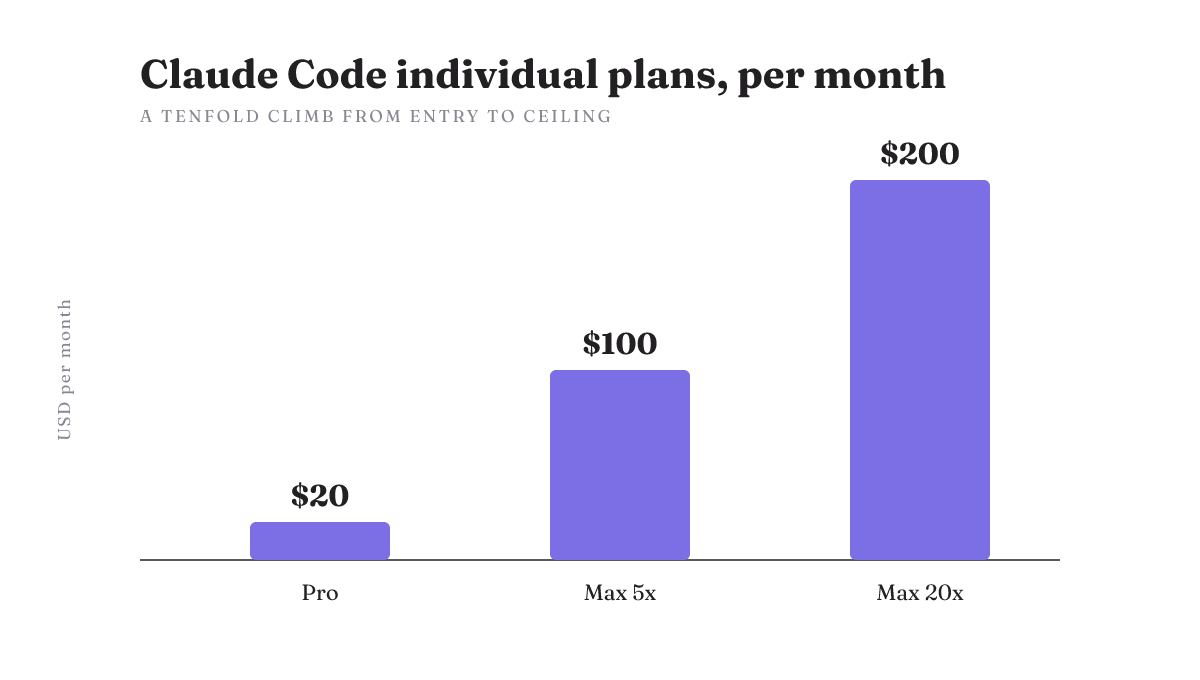
For individuals, Claude Code runs from $0 up to $200 a month. Pro sits near $20, Max 5x near $100, and Max 20x near $200. Team seats run from about $20 to $125 each. That is a mid-2026 snapshot from a single pricing source, and these tiers move, so confirm the live numbers before you budget.
The surprise is not the sticker. It is the billing switch. Weekly usage limits can flip a subscription into pay-per-token mode with no warning. If you run the agent hard on a big refactor week, the plan you picked for its cap can quietly start charging by the token. Watch the ceiling, not just the monthly line.
Antigravity is free while the preview lasts, which reads as the cheaper option today. But free-during-preview is a condition, not a price. It tells you nothing about what a seat or a month will cost once that preview ends, so "is Claude Code cheaper than Antigravity" has no clean answer right now. Claude Code costs money but tells you the rules. Antigravity costs nothing today, and what it will cost tomorrow is the part you cannot budget against yet, so anyone who has to forecast a yearly spend should not treat "free" as the durable number.
Where each one hits a wall
Antigravity's wall is trust, not talent. Its artifact verification is a genuine strength. But at its November 2025 launch, security vulnerabilities surfaced within 24 hours, and it shipped without compliance certifications. In early 2026 that combination kept it out of production enterprise environments. If your work touches regulated data or a security review, that gap is a decision input, not a footnote. It is also time-sensitive, so treat it as a snapshot that may have improved.
Claude Code's walls are narrower and more predictable. It is terminal-first by design, so the visual IDE, parallel-agent orchestration, and built-in browser testing that define Antigravity sit outside what Claude Code sets out to do. And the same weekly limits that protect your bill can also stall you mid-task or push you into per-token billing at the worst moment. You trade Antigravity's breadth for a tool that does fewer things and tells you where the edges are.
Terminal-first vs IDE-first: CLI and GitHub workflows
The CLI-versus-IDE split is the harness lens made concrete. Claude Code's sequential, file-level approach is built for the shell. That is what makes it comfortable inside CI/CD pipelines and long multi-file refactors, where each step depends on the last and you want the agent moving in order. Antigravity pushes the other way. It runs parallel agents from Mission Control and tests them in a browser, which suits work you can fan out and check visually.
Be honest about the resolution here. The terminal-first versus IDE-first split is well established, but the exact command flags and the specifics of how each tool wires into a given GitHub or CI setup are not settled enough to standardize a team on from a comparison alone. So do not commit a whole team on the strength of this split by itself. Map the shape to your workflow, then verify the integration details against your own pipeline before you commit.
Can you use Claude Code inside Antigravity?
Not as a supported, native integration. There is no Claude-Code-inside-Antigravity mode you can switch on, so do not plan a workflow around one existing. What you can do is run them as two separate harnesses side by side, one in the terminal and one in the IDE, and hand work to whichever fits the task.
The harness lens explains why that even works. The harness is a distinct, productizable layer, separate from the model underneath. The Claude Agent SDK is itself a general-purpose harness. So if you want Claude-style orchestration inside your own environment, the honest path is to build on that SDK, not to expect one tool to nest inside the other.
Where Cursor and Copilot fit alongside them
This is a wider field than two tools. Cursor has matured into a serious option, with SOC 2 certification, subagents, and its own Mission Control. GitHub Copilot added a full agent mode, an autonomous coding agent, and MCP server support. Each is a different point in the same harness design space.
Cursor and Copilot each earn a real head-to-head rather than a single row here. Read them the same way: not by logo, but by harness. Cursor's certification answers the enterprise question Antigravity currently cannot. Copilot's agent mode and MCP support put orchestration where your GitHub work already lives. For a genuine four-way, the dedicated Cursor and Copilot breakdowns go deeper than a cramped column could.
Why the blunt Reddit and blog verdicts miss the real variable
Search the forums and you get loud, opposing one-liners. One thread swears Antigravity is better in every sense. A blog swears Claude Code produces better code. Search anti gravity vs claude code and the split repeats. Both camps are describing something real. They are just describing their own workflow and calling it a verdict.
That is why the verdict flips depending on who you ask. The person running parallel, browser-tested tasks is right that Antigravity fits them. The person doing a careful multi-file refactor in CI is right that Claude Code fits them. This tracks the mechanism: the harness, not the model, is the variable, so the answer moves with the work. It is real signal, but workflow-dependent signal, and no one-line "X is way better" survives contact with a different workflow. Neither camp has found the better tool. Each has found the better harness for their work. Take the community signal seriously, then ask the only question that survives it: which workflow is yours.
How we compared, and what we didn't test
This comparison is a synthesis of public reporting read through a harness lens. It is not a first-party benchmark. We did not run both tools on the same task and clock the result, so you will not find a stopwatch number here that we own, and the workflow-to-tool matrix below is directional guidance, not a measured ranking. Anyone who needs a defensible internal standard should treat it as a starting hypothesis to test, not a finding to cite.
Two things follow. First, every capability figure, including the SWE-bench numbers, is reported by others and marked as such. Second, the pricing and enterprise-readiness facts are a mid-2026 read on tools that are moving fast. We flag what is time-sensitive instead of dressing it up as permanent, because a confident wrong date is worse than an honest snapshot.
When this comparison goes stale
Fast-moving tools make any comparison perishable, so here is what to re-check rather than trust forever. Watch for Antigravity leaving preview and publishing real pricing, which changes the "free" math overnight. Watch for it shipping compliance certifications or closing the launch security gap, which would reopen the enterprise door. Watch for Claude Code changing its tiers or its weekly-limit billing behavior. And watch for new SWE-bench results, since the shared capability bar is the whole reason the harness is the variable. If any of those move, the decision below can move with them.
Pick the harness that fits your work
Here is the matrix worth keeping. Match the work to the harness, not the hype.
- Complex multi-file refactor plus CI/CD automation: Claude Code. Terminal-first and sequential is exactly this job.
- Parallel agents, browser-tested tasks, visual orchestration: Antigravity. The agent-first IDE and Mission Control are built for fan-out work you check by eye.
- Production enterprise with compliance needs: weigh the certification and security gap first. In early 2026 that gap kept Antigravity out of regulated environments, so Claude Code or a certified alternative like Cursor is the safer default until it closes.
- Not sure yet, or the workflow is mixed: run both as separate harnesses and route each task to the one that fits.
This is directional guidance built from public reporting, not a benchmark you can cite as gospel. Validate it against your own repo before you standardize a team on either tool.
Run your own bake-off before you commit
The cheapest way to settle this is to stop reading verdicts and stage a small one. Pick one task you actually do, ideally a multi-file change with a test at the end. Run it through Claude Code in the terminal and through Antigravity's parallel agents. Watch three things: how each sets up, how it orchestrates the work, and what it costs you in time and usage. The tool that fits your workflow will show itself in an afternoon, and the answer will be yours instead of a stranger's.
If you want the reasoning underneath all of this, read the agent-harness pillar on the levers that decide what an agent actually ships. Comparing more than two tools? See the Claude Code vs Cursor vs Copilot breakdown, the Antigravity vs Cursor comparison, or the deeper Claude Code guide.