Key takeaways
- Multiple agents fit work that is independent, communication-free, and read-heavy.
- AgentCore Runtime leaves orchestration with your team while AWS manages runtime infrastructure.
- In one flight-cancellation design, deterministic code approves agent proposals before action.
- One February 2026 US East sample cost about $1,456 monthly.
AWS multi agent orchestration is an ownership decision before it is a framework decision. Agent count is not a maturity score. Start by testing whether the work benefits from specialization, then make routing, state, validation, evaluation, and runtime responsibility explicit.
Do you need more than one agent?
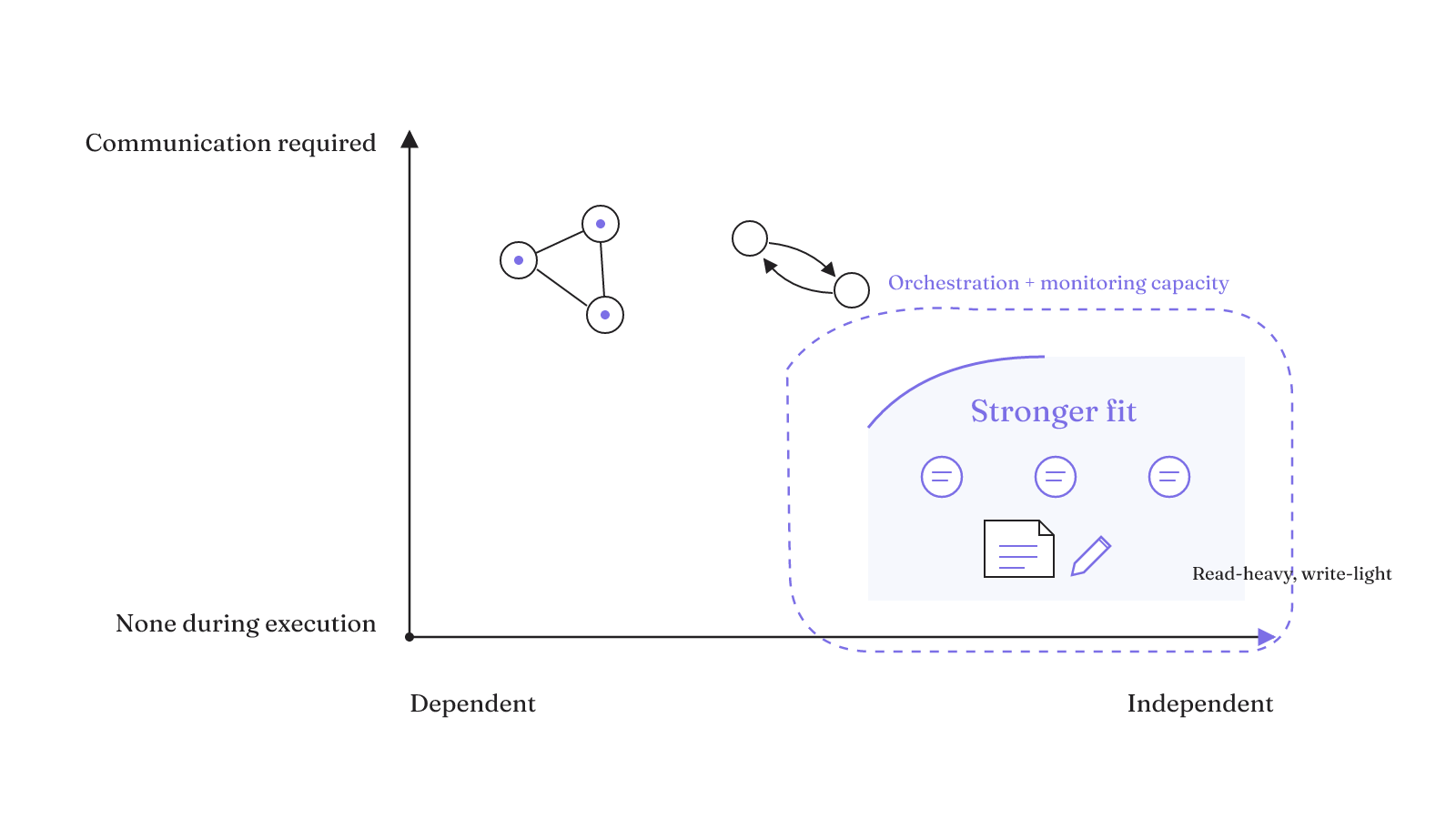
The first decision is whether specialization is worth the coordination it introduces. Use this workload screen before selecting an AWS service or framework:
| Test | Stronger multi-agent signal | Warning signal |
|---|---|---|
| Task independence | Subtasks are genuinely independent, so each agent can execute its assigned work without another agent's partial result | Subtasks depend on shared interim work, so independence is not present |
| Communication during execution | No communication is required while the agents execute | Communication overhead, message congestion, context loss, memory silos, or synchronization overhead can outweigh specialization benefits |
| Read versus write behavior | The design is read-heavy and write-light | The work requires complex collaborative editing instead of independent reads |
| Coordination and operations | The specialization remains useful after accounting for orchestration | Adoption requires orchestration software, skilled engineering teams, and continuous monitoring infrastructure to support reliability and compliance |
Treat operating readiness as part of the necessity test. If the design calls for continuous monitoring, it also calls for the infrastructure and engineering capacity to support that monitoring. If the workload lands mostly in the warning column, a smaller agent system avoids introducing coordination that the tasks do not require. If it lands in the stronger-fit column, the next decision is where the control boundaries sit. Our guide to AI agent architecture patterns can help when the workload itself still needs a clearer shape.
AWS multi agent orchestration starts with clear boundaries
| Boundary | Documented role or failure pressure | Owner | Handoff data and permissions | Verification | Recovery |
|---|---|---|---|---|---|
| Orchestration functions | An orchestration layer can integrate planning, policy enforcement, state management, and quality operations | Name who owns planning, policy, state, and quality operations | Define the input, output, and actions allowed at each transition | Name the check that accepts a transition or decision | Name who can retry, reroute, or roll back the failed step |
| Tool and context access | MCP standardizes agent access to external tools and contextual data | Name the owner of each tool and context source | Record the context an agent receives and the tool calls it may make | Validate tool arguments and returned data before either drives another action | Define how access is revoked and how a failed call is retried or contained |
| Peer coordination | A2A governs peer coordination, negotiation, and delegation | Name who owns each delegation path | Specify the task payload, expected result, and which peers may send or accept it | Check the received result against the delegated task | Set the timeout, reassignment path, and owner of an incomplete handoff |
| Working memory | Separate memories create silos; too much context can dilute instruction density, while summaries can lose critical edge-case requirements | Name the owner of retained state | Record what is passed, summarized, retained, and writable at each handoff | Check that the receiving agent has the required fields before it runs | Define how missing, stale, or conflicting context is restored or rejected |
| Shared writes | Concurrent agents writing code or state require strict serialization because stale snapshots can produce incompatible systems and costly rollbacks | Name the owner of write ordering | Define the proposed change and which agent may write it | Validate the proposal against current state before commit | Name the rollback or reconciliation path for a conflicting write |
| Accountability | Decentralized agent autonomy complicates oversight and accountability | Name the decision owner | Attach the proposal, decision record, and approval authority | Verify that the required approval exists before a consequential action | Define the escalation and reversal owner when the decision fails |
Keep these boundaries distinct. MCP covers tool and context access, while A2A covers peer coordination, negotiation, and delegation. Working context brings the risk of diluted instructions or lost edge cases. Shared writes bring stale-state conflicts and need strict serialization. For every proposed agent, record five controls: who owns it, what crosses the handoff, what it may do, how its output is checked, and who restores or reverses the work after failure.
For a deeper treatment of the surrounding control surface, read our multi-agent orchestration architecture guide.
Which framework supports multi-agent orchestration on AWS?
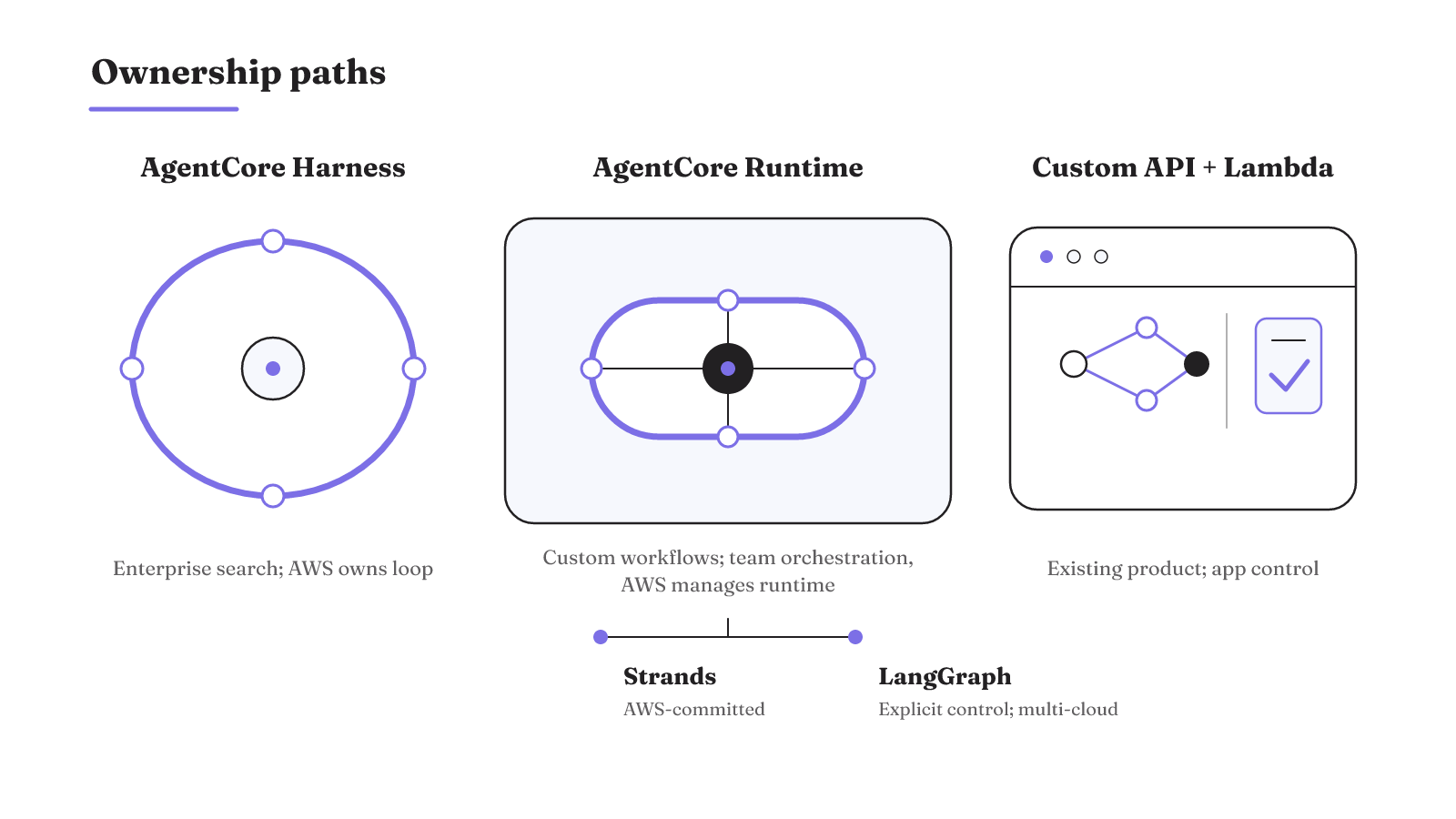
Read each path as an ownership boundary. The same four columns keep workload fit, retained responsibility, and limitations visible without turning the choice into a feature ranking.
| Implementation path | Documented workload fit | Retained responsibility or stack constraint | Limitation or non-fit |
|---|---|---|---|
| AgentCore Harness | Most enterprise-search assistants that access enterprise knowledge through MCP or API-based tools | AWS owns the agent loop, while the assistant accesses enterprise knowledge through those tools | The documented fit is specifically the enterprise-search assistant pattern |
| AgentCore Runtime | A custom workflow or multi-agent platform | Your team owns orchestration while AWS manages runtime infrastructure | Runtime management moves to AWS, but orchestration remains with your team |
| Custom API and Lambda | An existing backend or product workflow | The application already owns routing, authentication, user experience, and release management | Those core application responsibilities remain part of the existing product system |
| Strands | Teams fully committed to AWS that want native Bedrock integration and built-in tools for S3, DynamoDB, and Lambda | Open-source agent tooling in Python and TypeScript, with minimal configuration overhead in the documented fit | The workload fit is scoped to AWS-committed teams |
| LangGraph | Complex multi-step workflows that require explicit control, human-in-the-loop patterns, or multi-cloud flexibility | Your team owns the advanced workflow orchestration and its setup | Advanced LangGraph workflow orchestration carries additional setup complexity |
| AWS Agent Squad | Unclassified in this comparison | Unclassified in this comparison | This matrix makes no selection claim for AWS Agent Squad |
Use the matrix to eliminate an ownership mismatch, not to manufacture a universal ranking. Native AWS integration and minimal configuration overhead do not establish that Strands develops faster or operates more cheaply than LangGraph. LangGraph's additional setup complexity does not establish that it is inferior. AWS management of AgentCore Runtime infrastructure does not move orchestration ownership away from the team, while AgentCore Harness places the agent loop with AWS for its documented enterprise-search fit. A Custom API and Lambda retain the responsibilities already held by the application. The AWS Agent Squad row remains unclassified and makes no selection claim. After selecting a boundary your team intends to own, evaluate the remaining path against the actual workload. If that decision extends beyond AWS, our multi-agent orchestration framework comparison keeps workload and control at the center.
The AWS guidance sample spans runtime, models, state, gateways, identity, and storage
The official Guidance for Multi-Agent Orchestration on AWS GitHub repository shows how quickly a multi-agent design becomes a system, not just a supervisor prompt. Its one-month default deployment includes five AgentCore runtimes and separate supervisor and sub-agent Bedrock model invocations.
The same sample includes two Bedrock Knowledge Bases, shared AgentCore Memory, eight Gateway MCP endpoints, two OpenSearch Serverless collections, a Cognito user pool, nine Lambda functions, and five ECR repositories. Runtime, models, memory, gateways, search, identity, functions, and image storage all enter the operating surface.
That component list matters before cost estimation. Five runtimes and separate supervisor and sub-agent invocations make model execution only one part of the deployment. Knowledge bases, memory, gateways, search collections, identity, functions, and repositories remain present in the stated default stack. A team evaluating the sample has to account for the full configuration it plans to keep.
As of February 2026, the stated default settings in US East (N. Virginia) were estimated at approximately $1,456.35 per month. That estimate covers 100,000 customer-support conversations, with 1,000 input tokens and 500 output tokens per agent invocation and five hours of active agent runtime per day.
Those assumptions make the estimate useful as a concrete configuration, not a general AWS multi-agent price. The service prices behind it are subject to change. If you arrived looking for an AWS multi-agent orchestration GitHub example, use the repository to inspect the whole deployed stack and price the configuration you actually plan to run.
The date belongs with the configuration. A change in conversation volume, tokens per invocation, active runtime hours, region, or underlying service prices would describe a different estimate.
For comparison work, preserve the whole assumption set together: February 2026, US East (N. Virginia), 100,000 customer-support conversations, 1,000 input tokens, 500 output tokens, and five active runtime hours per day. The approximately $1,456.35 monthly figure describes that set. It should not be carried into a design with different inputs as if the architecture name determined the price.
How do you build a multi-agent orchestrator with deterministic control?
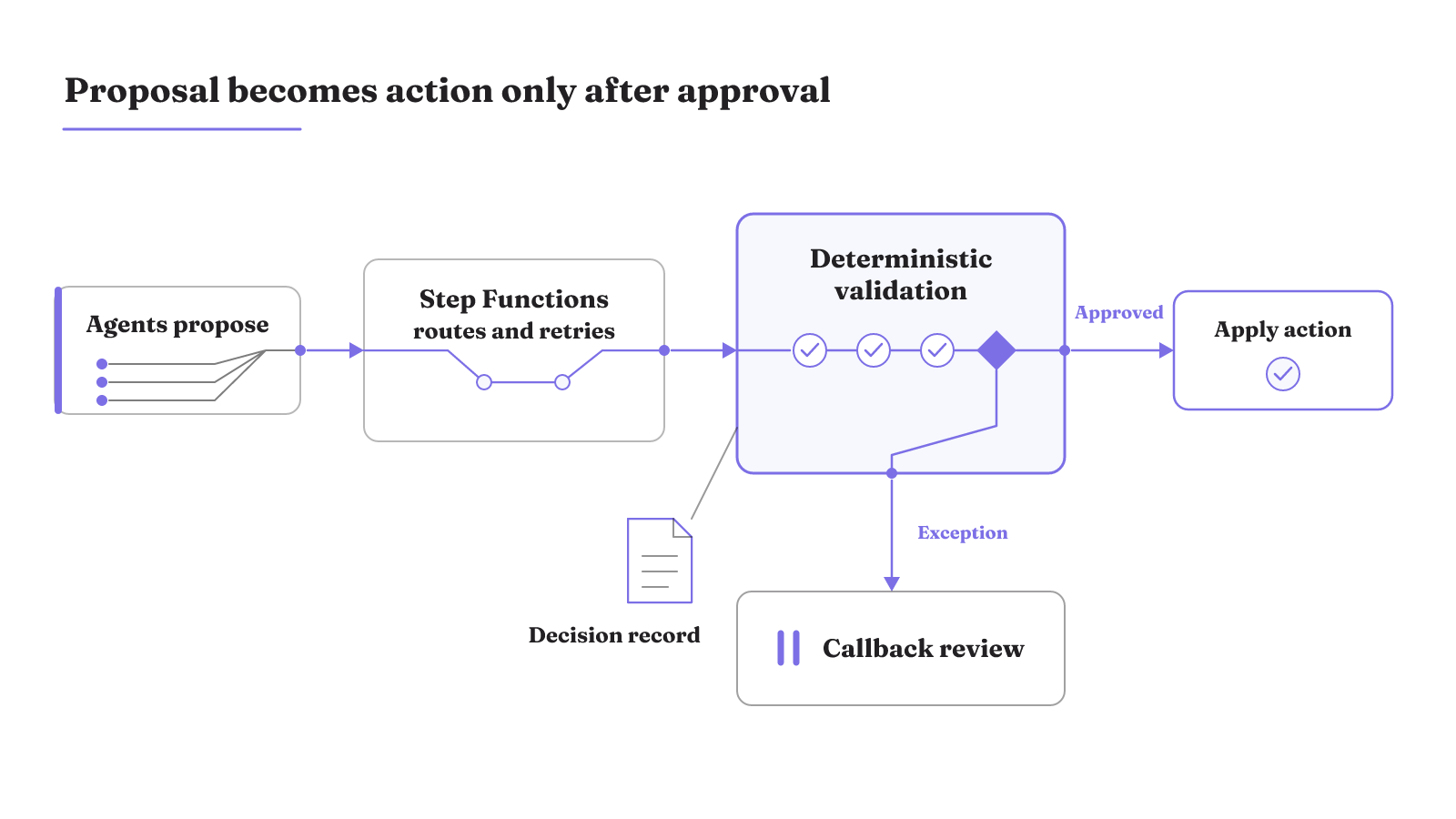
Keep consequential action outside the agents' reasoning. An AWS flight-cancellation design shows one way to do that when automated decisions can have an immediate financial impact. The agents contribute proposals and language, while a deterministic workflow retains authority over what happens.
Separate proposal from action
In this design, Step Functions handles orchestration, fan-out, validation, routing, and retries. Those workflow responsibilities remain outside the agents' reasoning. The state machine controls where work goes, how parallel work fans out, which validation runs, and what receives a retry.
The agents have a narrower role. They propose options and draft language. They do not make the underlying changes directly, and a proposal does not become an action on the strength of the agent output alone. Deterministic code must approve it first. Only output that passes deterministic validation is applied.
That authority split leaves a record at the same boundary where the decision becomes consequential. The design produces a review record for each decision. The record belongs to the decision path, not merely to the final text an agent drafted. This makes the approval available for later inspection alongside the proposal it governed.
Give exceptions somewhere to wait
An exception does not have to become either an automatic action or a failed workflow. In this design, it can pause on a callback while awaiting review. The callback wait does not incur compute or storage cost. The workflow can hold the unresolved branch without keeping active compute or storage attached to the wait.
That boundary is especially relevant to the flight-cancellation case because an automated decision can have immediate financial impact. The agent can still do useful generative work by proposing options and drafting language. Agents do not apply the change directly in this design.
The control point is explicit in the design. Step Functions owns flow and retry behavior. The agent owns proposals and draft language. Deterministic code owns approval, and the callback owns the waiting state for exceptions. The per-decision record preserves what happened across those parts.
This flight-cancellation mechanism is a scoped design, not a universal AWS reference architecture. Its useful idea is the authority split. Agents generate candidate material; deterministic code validates it; the orchestration layer controls flow and retries; and exceptions stop at a review boundary. When you build a multi-agent orchestrator, write those responsibilities down before selecting the runtime. If you need a shared term for the surrounding control layer, our agent orchestration glossary gives the concept a concise home.
How do you test and debug multi-agent behavior?
Test the trajectory as well as the final answer. An AWS agent-evaluation reference implementation places quality gates across four layers: tool usage, reasoning, output quality, and domain-specific checks. The set covers behavior during the run as well as the result it produces.
Evaluate the layers separately
Tool-usage checks cover how the agent uses its tools. Reasoning checks cover the reasoning path, while output-quality checks cover the produced result. Domain-specific checks apply the requirements of the workload itself. The reference implementation treats all four as quality gates across the agent lifecycle.
That lifecycle view prevents the final output from being the only inspection point. Tool use and reasoning occur before the result appears. Output quality addresses the result itself. Domain-specific checks test it against the workload's own requirements. A useful evaluation record keeps those four judgments distinct, even when they belong to one run.
Trace a parallel run end to end
Debugging needs the same end-to-end view. Non-deterministic parallel workflows call for structured logging, correlation-based end-to-end tracing, and graph-based visual analytics, not only linear stack traces.
Structured logging captures the events produced across the run. Correlation-based tracing connects those events from end to end even when several agents run in parallel. Graph-based visual analysis represents the branching path that a linear stack trace cannot show on its own. These are three operating controls, not three names for the same log.
These controls become more important when agents interact. Interaction can magnify hallucination, bias, and data-leakage risks, which creates a need for rigorous evaluation and control frameworks.
Orchestration logic, governance, and observability contribute to system coherence, transparency, and accountability. Observability shows what happened. Governance makes responsibility legible. Orchestration provides the control path that joins the work. Together, they give the system an inspectable shape around non-deterministic behavior.
Evaluation and debugging also answer different questions. The four evaluation layers judge the quality of agent behavior and results. Logging, correlated traces, and graph analysis reconstruct the path that produced them. Governance then connects that path to oversight and accountability. None of these controls removes non-determinism, but each makes a different part of the system available for inspection.
There is a limit to what these documented examples decide for you. They do not rank one implementation path as universally best, and the cost sample describes one dated configuration. Your workload still determines whether multiple agents are warranted, which actions require deterministic approval, and how much orchestration your team should retain.
Run the necessity test against your own workload. If multiple agents still earn their place, inspect the AWS path whose ownership boundary matches your team, then use our framework comparison by workload and control when the decision extends beyond AWS.