Key takeaways
- There is no universal winner. The workload defines the right framework.
- Start with one agent, then add agents only when the work requires them.
- Parallel work, specialized tools, large contexts, or several decision checkpoints can justify multi-agent coordination.
What is the best multi agent orchestration framework for your workload?
The best multi agent orchestration framework is the one that passes the gates your workload makes mandatory. Start with one agent and add multi-agent coordination only when complexity requires it. Parallel work, specialized tools, large contexts, and multiple decision checkpoints are concrete reasons to consider that change. Multi-agent design then requires deliberate choices about frameworks, patterns, and communication protocols, as GitHub's multi-agent overview explains.
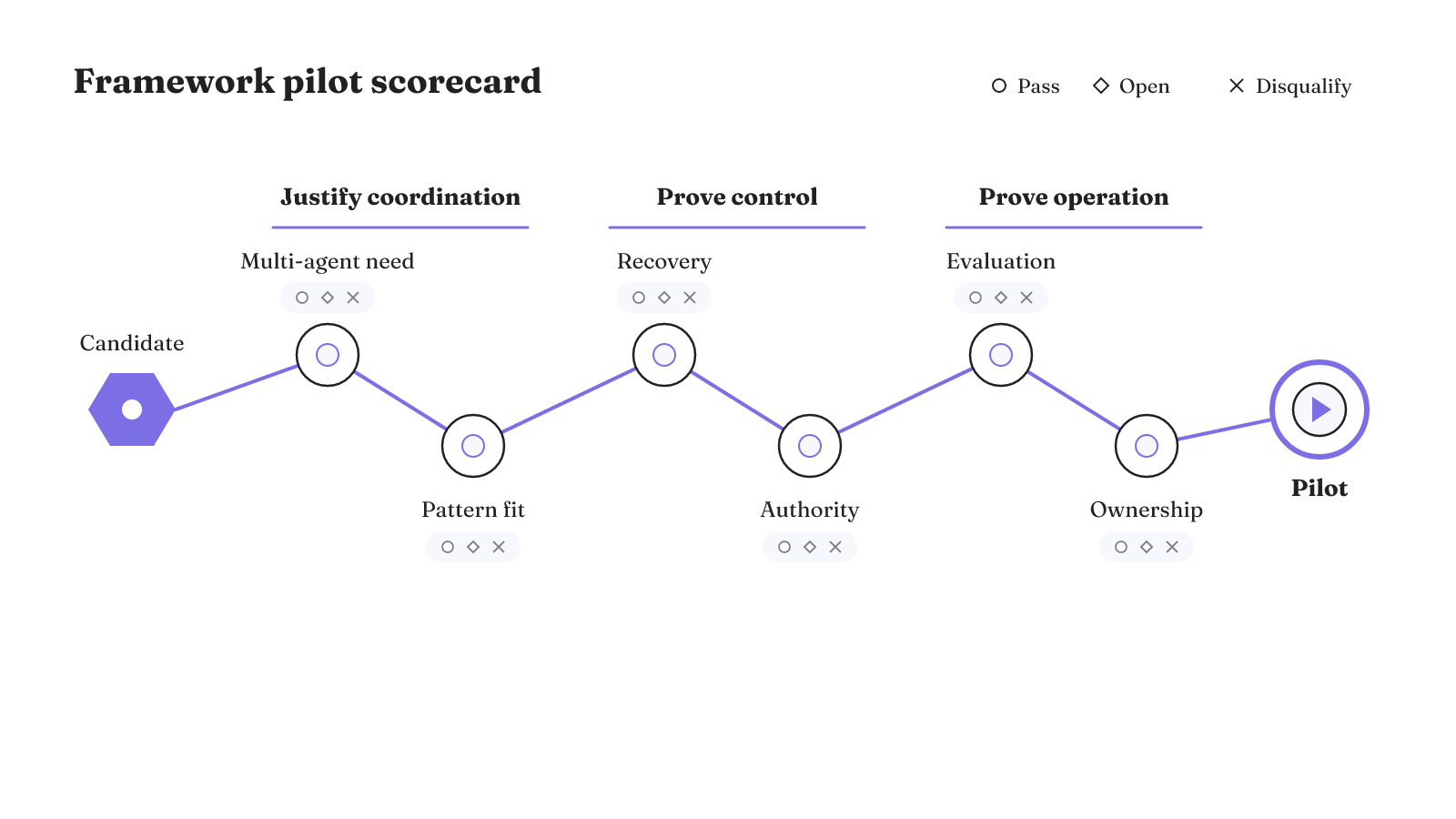
| Decision gate | Fit signal | Disqualifier |
|---|---|---|
| Multi-agent need | The work needs parallel execution, specialized tools, a large context, or several decision checkpoints. | One agent can handle the workflow without added coordination. |
| Coordination-pattern fit | A documented pattern matches the request shape and repeat behavior. | No candidate pattern matches how the request arrives or divides. |
| State and recovery | State has an owner, and a failed step has a testable recovery path. | A failed step can change the trajectory with no inspectable way to recover. |
| Authority and guardrails | Input filtering, tool controls, and human intervention cover consequential actions. | An irreversible action can proceed without the required control boundary. |
| Observability and evaluation | In our method, the pilot records task success, policy violations, tool counts, errors, latency, retries, costs, escalations, and context quality. | The execution path cannot be measured well enough to judge or debug. |
| Operating and maintenance burden | The team can own testing, prompt and tool design, operations, and cross-functional work. | The design depends on operating skills or ownership the team cannot sustain. |
Mark each gate pass, open, or disqualify. For a hypothetical publishing workflow, two research specialists inspect separate document sets in parallel, an editor agent combines their artifacts, and a person approves publication. The need and pattern gates pass. A candidate with no pause at the publication boundary receives a disqualify mark on authority. That result outweighs an easy integration.
The best AI agent framework may still be one agent
Both OpenAI's practical guidance and Anthropic's agent guidance recommend starting with a single agent. Move to multiple agents only when workload complexity requires it. The scorecard prevents the shortlist from starting with integrations and developer convenience before the need for coordination is clear.
Compare candidates only where their controls overlap
Apply the same six gates to every candidate, but do not pretend every documentation set answers every gate. Record a mechanism only where the product documentation or pilot exposes one. Leave the rest open. An open gate is not a pass, and it is not proof of failure. It is work the pilot must resolve.
This keeps the comparison symmetric without inventing a complete feature ranking. A candidate can lead on a documented handoff mechanism while another exposes more detail about recovery or evaluation. Neither fact decides the whole shortlist. The workload determines which gates are mandatory, and a documented conflict with a mandatory gate is a disqualifier. Developer convenience can break a tie only after the required control boundaries survive.
This is our decision method, not a universal product ranking. It makes a hard requirement visible before a polished demo turns into an architecture commitment. Compare the underlying AI agent architecture patterns when the multi-agent need remains an open gate.
Which coordination pattern fits the request?
Request shape narrows the field before product names enter the conversation. A framework can expose several coordination patterns, but the pattern still has to match whether work is single, repeated, parallel, or spread across a large context.
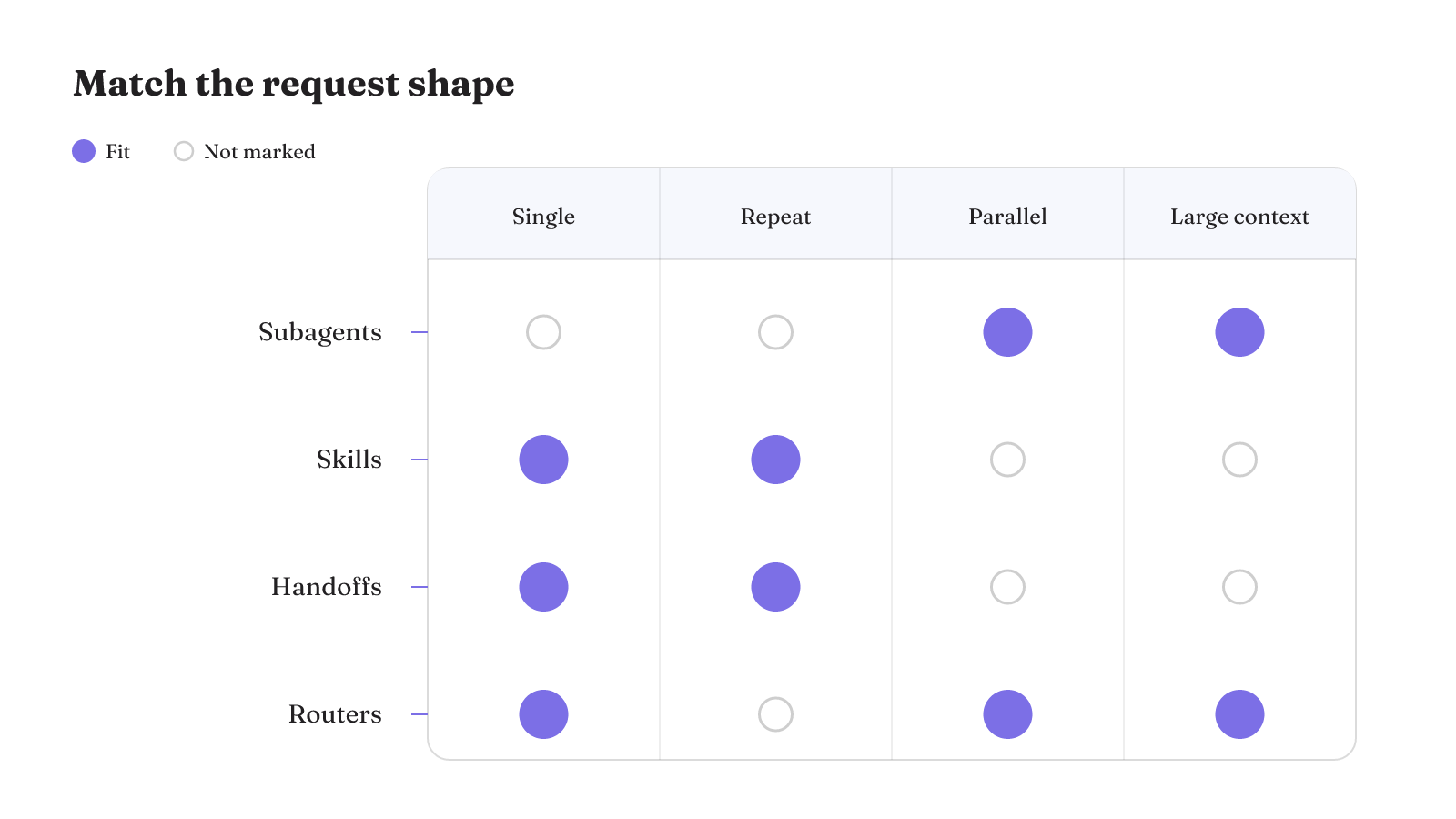
Published pattern guidance provides four useful boundary calls:
- Subagents fit parallel execution and large-context domains. They are not marked as a fit for single or repeat requests.
- Skills fit single and repeat requests. They are not marked as a fit for parallel execution or large-context domains.
- Handoffs also fit single and repeat requests. They are not marked as a fit for parallel execution or large-context domains.
- Routers fit single requests, parallel execution, and large-context domains. They are not marked as a fit for repeat requests.
These are pattern boundaries, not a score for any named implementation. Skills and handoffs occupy the same listed fit categories here, so request shape alone leaves both open. Use the other required gates to choose between candidates that expose them.
Describe the request before choosing the mechanism. Is it one request or a recurring sequence? Must independent work happen at the same time? Does one agent need to delegate because the available context is too large? Those answers can remove several patterns from the shortlist without assuming how any candidate behaves in production.
For a deeper architecture pass, use the multi-agent orchestration design guide to separate coordination shape from the surrounding harness.
A production framework must expose the system around the model
A production choice needs more than a clean agent API. Agents depend on shared communication and collaboration rules to work together. In our workload-first method, coordination is legible only when an operator can see who can act, what each agent receives, and where the work moves.
Keep the design simple. Anthropic recommends exposing planning steps, documenting and testing the agent-computer interface, and resisting unnecessary complexity. Frameworks can accelerate the initial build, but production teams may need to remove abstraction layers and work with more basic components. An abstraction that hides the execution path also makes failure analysis harder.
Testing cannot stop at the final answer. A failed step can push an agent onto a different trajectory and produce unpredictable results. In Anthropic's account of a multi-agent research system, reliable operation at scale required comprehensive testing, detailed prompt and tool design, robust operations, and collaboration across research, product, and engineering.
That makes failure visibility an operator requirement. Before choosing a framework, identify the communication rules, planning surface, tool interface, test boundary, and operating owner. An unseen or untested surface stays open in the scorecard. Missing visibility does not become an assumed capability.
The ownership check is concrete. Name who maintains prompts and tool definitions, who reads traces after a failure, and who can change an agent's authority. Then identify what the framework shows at each boundary. The questions are intentionally operational because reliable multi-agent work crosses research, product, and engineering. A prototype can succeed while those responsibilities remain informal. Production exposes the gap as soon as a tool changes, a prompt drifts, or one step sends the workflow onto a different path.
The broader agent orchestration framework guide explains how these harness responsibilities sit around the model.
Where does Microsoft Agent Framework fit?
Microsoft Agent Framework has a clearly documented fit for bounded specialist handoffs. Its Handoff Orchestration supports conversations in which specialists need to ask follow-up questions, obtain context from another specialist, or redirect work. The named mechanism is a bounded graph: agents choose who speaks next while retaining conversation context and staying inside the graph's guardrails.
The Microsoft handoff walkthrough is useful when the workload resembles a specialist conversation, not a batch of unrelated parallel tasks. It gives the coordination choice a concrete boundary. The graph constrains who can hand work to whom, while the active agent can decide when another specialist should take over.
Microsoft's autonomous handoff sample makes that behavior more specific. Agents continue until they invoke a handoff tool. In that sample, the research agent produces 3-4+ responses before handing off. Treat that number as sample behavior when designing a pilot.
For a fair shortlist, score this documented handoff mechanism on the gates it actually exposes. Pattern fit and bounded routing are visible here. State recovery, evaluation, observability, and approval requirements remain questions for the implementation pilot. We would not turn unscored gates into a complete framework ranking.
Repository documentation reveals the real control surface
When you assess the best multi agent orchestration framework on GitHub, look for control mechanisms you can trace into code. LightAgent documents replayable events, checkpoints, context recovery, retries, approvals, resume, rerun, observability, and regression evaluation. OpenAI Responses Multi-agent documents separate compaction for the root agent and each subagent, along with controls that multi-agent mode does not support. Those specifics create testable pilot work. Feature counts and popularity do not.
LightAgent's documented control surface
The LightAgent repository documents durable runtime state through replayable events, checkpoints, inboxes, goals, budgets, jobs, and context recovery. Its LightFlow layer documents ordered DAG workflows, retries, checkpoints, durable approvals, resume, and rerun. That coverage reaches several scorecard gates without proving production performance.
The same repository documents privacy blocking, confirmation for sensitive tools, checks on high-risk parameters, and output redaction. Its observability surface covers events, latency, usage, retries, errors, and external or JSONL export. Fixed regression evaluations cover output, tools, policy events, recovery, latency, and cost.
Human review is also concrete in the repository. Reviews for tools and handoffs fail closed, allow editable arguments, and record durable decisions. Approval requests can be stored in JsonReviewStore, resolved with an ApprovalDecision, and used to rerun work through the approval request identifier.
One boundary matters: LightAgent describes SharedMemoryPool as an in-memory prototype for experiments across agents. A broad documented control surface does not turn that prototype into production proof. Put the durable mechanisms into a pilot and keep the prototype within its stated role.
OpenAI Responses Multi-agent has different boundaries
OpenAI Responses Multi-agent documents a narrower, product-specific control surface. It applies server-side compaction separately to the root agent and every subagent. It does not support the /responses/compact endpoint, reasoning.summary, or max_tool_calls in multi-agent mode. The documented recommended default for max_concurrent_subagents is 3.
Those details create direct pilot questions about context behavior, concurrency, and tool-call control. They do not establish how the product compares on every other gate. When reviewing agent orchestration tools, keep each candidate's score limited to mechanisms its current documentation lets you inspect.
The six gates now produce different, fair profiles. LightAgent's repository describes mechanisms for state and recovery, guardrails, observability, evaluation, and durable review. Its shared-memory experiment retains a prototype boundary. OpenAI's documentation answers specific questions about compaction, concurrency, and unsupported controls in multi-agent mode. The remaining gates stay open until a pilot or other primary documentation resolves them. That is more useful than forcing both products into identical feature labels they do not document in identical ways.
Coordination costs can erase the benefit
Specialization helps only when its contribution outweighs the extra coordination. In one documented multi-agent development project, specialist agents helped with architecture review, security scanning, issue definition, and UX analysis. The same project reported that over-consultation slowed development, context switching caused confusion, and perfectionism delayed working solutions.
That account is one project, not a cross-framework benchmark. It still gives a pilot a useful failure test. Define when a specialist should be consulted and what artifact it must return. Then watch whether the consultation improves the work or creates another loop of discussion.
We treat every added agent as a new coordination and verification obligation. If its role has no distinct tool, context, judgment, or artifact, the decomposition has not earned its place. If agents repeatedly ask each other for another opinion, tighten the handoff rule or return the work to a simpler design. The framework should make that adjustment possible without hiding the execution path.
How can specialized agents stay inside a controlled execution path?
Specialized agents do not require every part of the workflow to use the same model or the same execution style. One documented supervisor pattern assigns cheaper models to routing and more powerful models to specialized work. This is a scoped implementation example, not a general cost guarantee.
Long-running work can also mix deterministic control with agent specialization. An OpenAI Codex MCP workflow combines deterministic execution and traceable progress with specialized parallel agents and artifact-validation gates. The deterministic path controls how work advances. Parallel agents contribute bounded artifacts, and validation gates check those artifacts before the workflow moves on.
Together, these examples show two distinct control choices. Model selection can follow role, while execution can remain traceable and gated. Neither mechanism proves that a supervisor or a Codex MCP design fits every workload. Put each one through the same authority, recovery, evaluation, and operating gates used for the rest of the shortlist.
Pilot the architecture before committing
Run one real workflow through the scorecard before choosing a framework. Keep the pilot small enough to inspect the full trajectory, including delegation, tool use, handoffs, failures, approvals, and recovery. Gather feedback from the people who use the result early, while the architecture can still change.
Match the system's complexity to user needs and the team's maintenance capacity. A powerful handoff design still requires thoughtful implementation and people who can operate it. Turn each open gate into a pilot test. A disqualifier ends that candidate's pilot while the simpler architecture remains in play.
Early user feedback belongs inside the pilot, not after an architecture rollout. Give users the result from the real workflow and capture where delegation helped or confused the work. Keep that feedback tied to the exact workflow under test. A small pilot leaves room to change the coordination pattern, remove an agent, or narrow its authority before the design becomes expensive to unwind.
Make the commitment only after the real workflow passes its required gates. Then record the pattern, control boundaries, recovery path, and operating owner that made it pass. Use our agent orchestration framework decision guide to compare the broader architecture before you commit.