Key takeaways
- LangGraph can orchestrate single-agent and multi-agent systems.
- Autonomy depends on explicit limits for tools, state, stopping, review, validation, and recovery.
- Persisted graph steps can keep recovery local when a node or tool call fails.
Can LangGraph be used for agentic AI?
Yes. LangGraph is one of the frameworks used for single-agent and multi-agent orchestration, tool integration, and data retrieval. That makes it suitable for building goal-directed systems that choose actions, use tools, and operate in a closed loop.
The graph is only part of the design. A loop becomes operationally meaningful when the surrounding system states what the agent may do, what it must remember, when it must stop, and which results it may accept. Reliability in agentic systems is mainly an architectural property. It comes from component boundaries, disciplined interfaces, and explicit control and assurance loops, not from the model acting alone.
We find “autonomous” too vague to guide an implementation. The better question is: within what operating envelope may this loop act? That framing turns a category label into decisions an engineer can inspect before the graph reaches real tools and data.
Define the autonomy envelope
An autonomy envelope is a control contract for the graph. It records the authority given to the loop and the conditions under which that authority ends. The contract can be reviewed without pretending that one prompt will carry the whole system. Reliability is architectural. It comes from clear components, disciplined interfaces, and explicit control and assurance loops.
| Boundary | Decision to record | Mechanism or control |
|---|---|---|
| Goal and acceptance | Record the managed goal, what must be validated, and who carries the acceptance decision. | Goal manager, verifier, typed result schema |
| Tool permissions | List permitted tools, allowed actions, and the credentials available to each call. | Permissioning, scoped credentials, typed schemas, idempotent operations, and transactional semantics |
| Persisted state | Identify the agent or workflow state saved while execution runs, including its provenance. | Persistence, memory provenance, and memory hygiene |
| Budgets and termination | Set the runtime budget and the condition that ends the loop. | Budget, termination condition, strict stop condition |
| Human review and escalation | Name the tool calls that pause, the available review decisions, and the escalation path. | Policy interrupt with saved state and later resume, accountable service owner, staffed escalation path |
| Validation | Record which proposed solutions must be checked before acceptance. | Verifier, explicit assurance loop, simulate-before-actuate for proposed model solutions |
| Traces and observability | Define the execution record retained for inspection. | Immutable traces, signed tool outputs, model-version pinning, telemetry |
| Rollback | Record the recovery procedure for an AI-initiated action. | Rollback procedure, red-team tests, incident process |
The contract may be implemented across a goal manager, planner, tool router, executor, memory, verifiers, safety monitor, and telemetry. Those components can remain separate or sit inside fewer nodes; the control decision is still explicit. The canvas earns its place before deployment by making authority inspectable. It shows whether the design has named a stopping condition, an acceptance check, an owner, an execution record, and a recovery procedure. It also gives testing a stable target. An engineer can compare a simulated trajectory with the recorded tool permissions, state rules, review points, and stop conditions. The canvas is not a reliability result. It is the concrete contract against which the graph can be reviewed and tested.
Start with the smallest graph that works
Begin with the simplest agent pattern that can perform the workload. Good architecture matters more than clever prompts, and state management can make or break an agent. Those three rules give you a practical test for graph complexity.
For a single loop, make the execution path and state transitions explicit before adding more roles. If the design cannot show what is read, what is written, and what ends the loop, another agent will add coordination without repairing that foundation. Complexity earns its place when a distinct component has a distinct responsibility in the control contract.
For AI agents in LangGraph, GitHub pattern notes give three relevant rules. One collection of LangGraph design patterns says to start simple, favor architecture over prompt tricks, and treat state as a central design concern. An example is a starting point for reasoning about your graph, not an authority model you inherit unchanged.
This choice rule has a hard consequence. If a second agent does not create a clean responsibility boundary, keep one agent and make its state, tools, validation, and stopping behavior explicit.
What changes in a LangGraph multi-agent architecture?
A LangGraph multi-agent architecture adds autonomous decision makers that interact to solve tasks. That differs from a distributed system centered on sharing computational resources and coordinating work without autonomous behavior. The distinction matters because multiple agents introduce multiple sources of reasoning and action, not merely more processes.
LangGraph can orchestrate multiple agents with shared memory and tools. Within that system, an LLM may act as a reasoning agent, a planner, or a tool user. These are roles in the workflow, so each needs a clear relationship to state and authority.
Communication is an architecture choice of its own. Agents may exchange information through:
- direct messages;
- a shared memory store;
- queues;
- formal agent communication languages; or
- structured natural-language prompts.
Each option gives information a defined route through the system. Whatever the channel, record which component can write, read, validate, and act.
Parallel execution adds a state-merge decision. LangGraph uses reducers to merge updates from parallel nodes. A reducer therefore belongs in the state design, not as an afterthought once branches begin returning updates.
Multi-agent decomposition has to earn its coordination, authority, verification, and recovery costs. If planner, reasoner, and tool user roles do not need separate state or control boundaries, a smaller graph remains the clearer design.
Human review belongs at selected tool calls
Human review can be attached to tool calls instead of every turn in the loop. Human-in-the-loop middleware adds oversight to agent tool calls, while a configurable policy can interrupt a call, save LangGraph state, and allow execution to resume later.
The review decision can follow tool risk. One documented configuration allows delete_file and send_email calls to be approved, edited, or rejected. It allows write_file to be approved or rejected. Lower-impact read_file and ls calls run without interrupts. This is a concrete way to distinguish observation from consequential action without forcing a person to approve routine reads.
The policy is not only a list of tools. It also defines the decisions a reviewer can make. An edit path is available for the two calls where changing the proposed action is part of the configuration, while the write call has only approve or reject.
Our LangGraph human-in-the-loop guide goes deeper on placing these approval boundaries.
Interrupts can repeat side effects
An interrupt changes control flow in a way that can surprise an otherwise careful design. When execution resumes, LangGraph re-runs the node that called the interrupt. Any side effect that happened earlier in that node is exposed to a second execution.
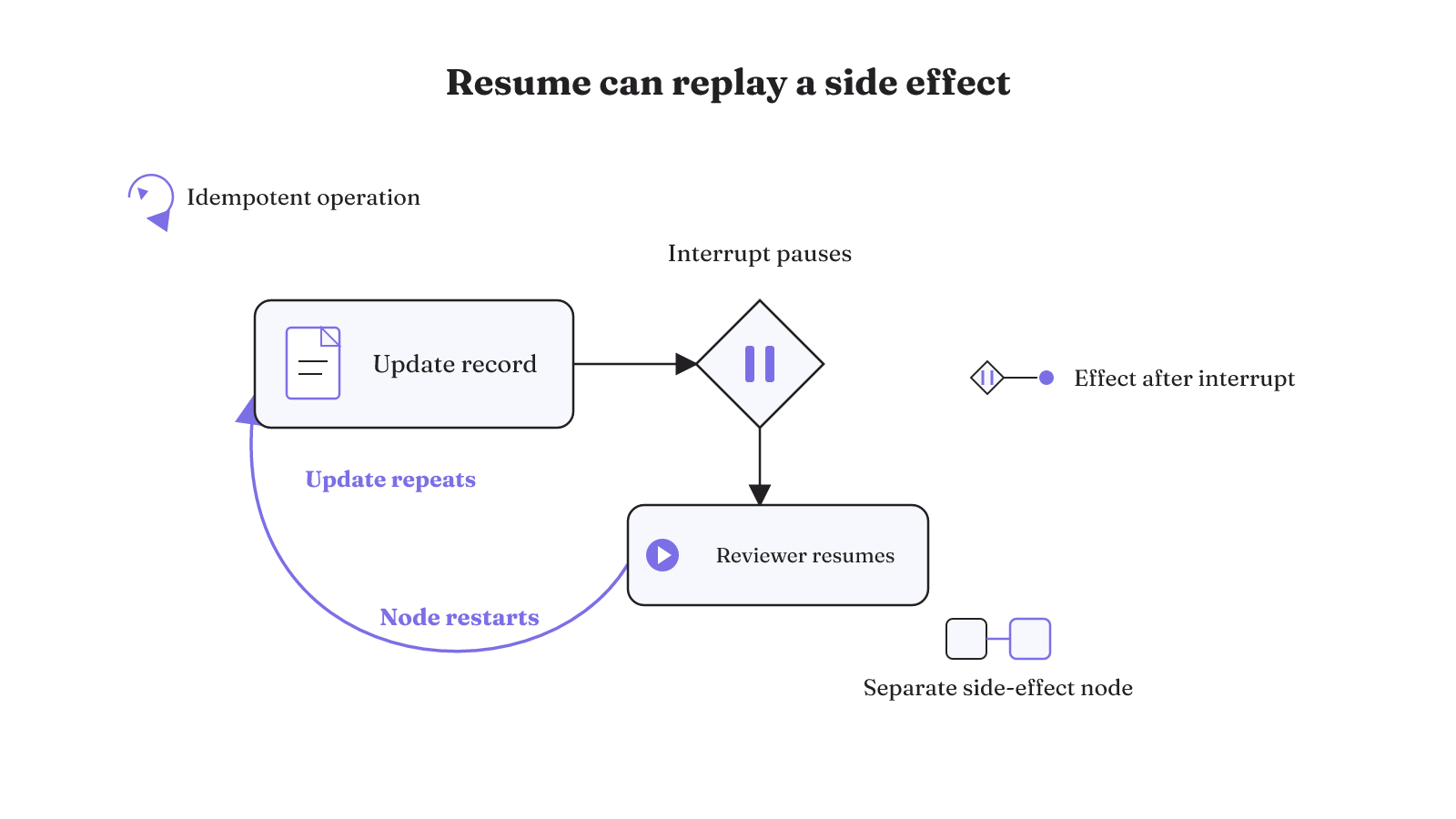
Suppose a node updates a record and then calls an interrupt for review. The graph pauses after the update. When a reviewer resumes execution, the node starts again. The update can run a second time before control returns to the interrupt. Depending on the operation, that repeat can overwrite the earlier update or create a duplicate record.
There are three supported ways to shape the node around this behavior:
- Make the operation idempotent, so repeating it does not create another effect.
- Put the side effect after the interrupt, so it has not happened when the graph pauses.
- Move the side effect into a separate node, away from the node that issues the interrupt.
This is why interrupt placement is an execution decision, not merely a user-interface choice. The approval screen may look correct while the node boundary still permits a repeated write. Review the order of effects in the node, then choose one of the supported designs before relying on resume behavior.
For actions that may need reversal, define the recovery path as deliberately as the approval point. Our glossary note on rollback explains the broader control concept.
Persistence keeps recovery local
Persistence saves agent or workflow state while execution runs. It supports reliability, fault tolerance, pause and resume, memory, and debugging. When every graph step is saved, the resulting checkpoints also enable debugging, undo or time travel, crash recovery, and full observability.
The practical recovery unit can then be smaller than the entire run. In the described persistence design, a failed node or tool call restarts while earlier computed outputs remain saved. The workflow does not need a full rerun that discards those outputs.
That local recovery model makes the state boundary concrete. A checkpoint is not only historical data. It establishes which work remains available after a failure and where execution can restart. The design still has to decide what state is persisted and how updates merge, especially when parallel nodes use reducers.
A bad input can corrupt the whole trajectory
Persisted state helps recovery, but it can also preserve a bad observation. Agentic systems expand the attack surface beyond the model through tool-borne or data-borne prompt injection, memory poisoning, tool misuse, and credential compromise.
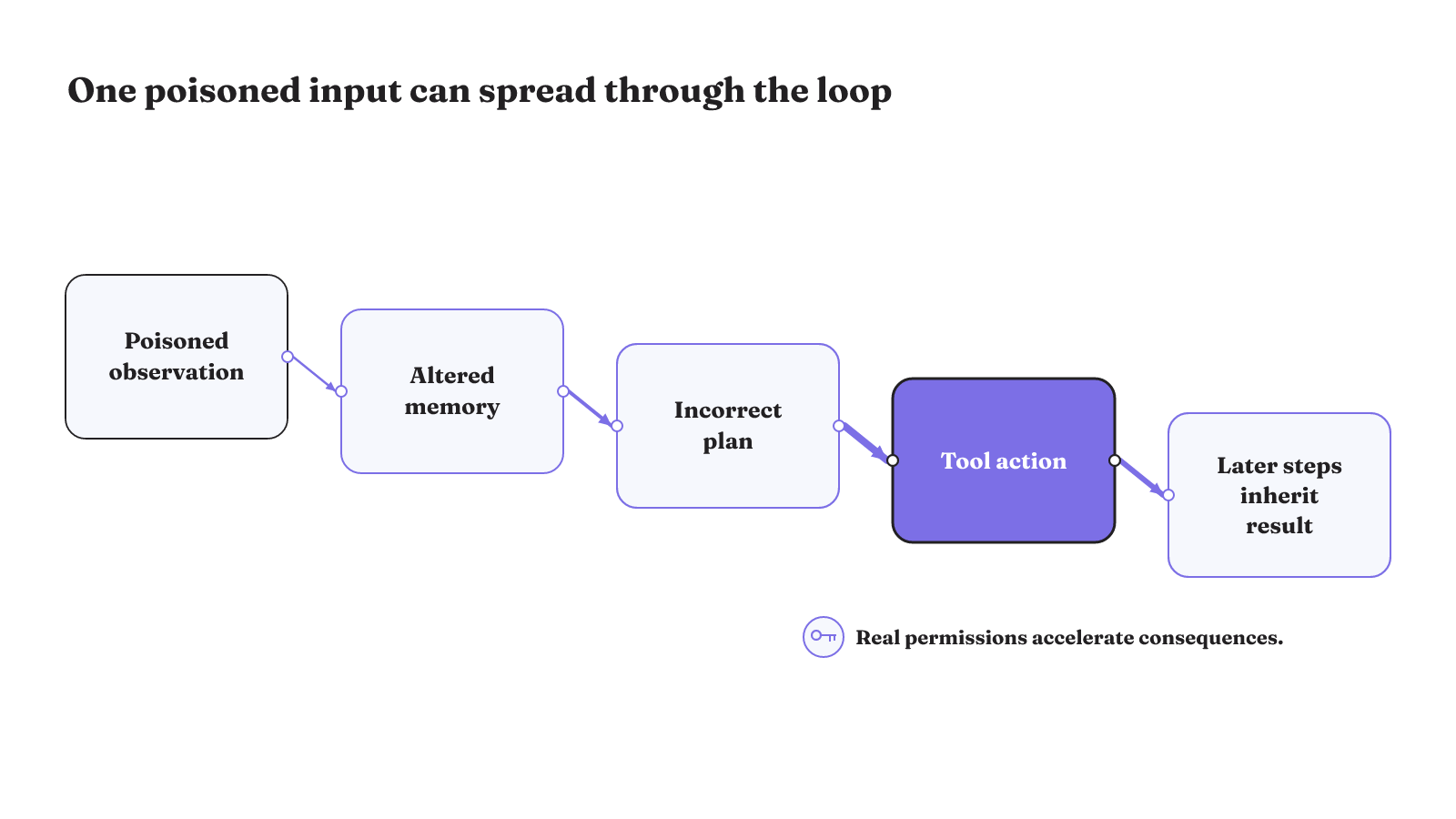
The failure can travel through the loop in a clear sequence:
- A poisoned observation enters the system.
- That observation alters memory.
- The changed memory contributes to an incorrect plan.
- The plan triggers a tool action.
- The result influences later steps in the trajectory.
The final output is not enough to evaluate this system. The execution trajectory shows where the input entered, how memory changed, which plan followed, what tool ran, and what later work inherited the result. Immutable traces and signed tool outputs are controls for that path. Model-version pinning, red-team tests, rollback procedures, scoped credentials, and strict stop conditions address other points in the same operating surface.
Permissions raise the stakes. When an autonomous agent holds real permissions, a manipulated input can trigger data theft or lateral movement at machine speed. That is an authority problem as much as a model problem. The system must limit credentials and tool permissions before an input reaches the loop, while traces and recovery procedures preserve a way to inspect and respond to actions that occurred.
What kinds of autonomous agents show up in practice?
Autonomous AI agents appear in several practical patterns. One useful taxonomy includes tool-using agents, memory-augmented agents, planning and self-improvement agents, multi-agent systems, and embodied or web agents. This is a general agent taxonomy, not an official LangGraph classification.
Agentic frameworks provide pre-built components for perception, reasoning, action, and memory management in goal-driven autonomous agents. The pattern you choose changes which parts of that set carry the control burden. A tool-using agent needs clear tool authority. A memory-augmented agent makes provenance and state hygiene central. A multi-agent system adds communication, shared state, and coordination choices.
Examples of autonomous AI agents and applications include drone swarms, trading bots, warehouse automation, multi-agent reinforcement-learning simulations, content agents, and research assistants. These examples cover different operating environments and consequences. They do not imply one shared graph design.
The useful comparison is the workload boundary. Ask what the system can observe, what it can change, what state it retains, and how an unacceptable action is stopped or recovered. Read our guides to autonomous AI agents and AI agent frameworks for the related architecture decisions.
Test the loop before it acts
Agents are probabilistic, so they should be tested extensively. Simulate-before-actuate adds a specific control: test behavior before the graph performs a real action.
Run the same operating envelope through the simulation. Exercise the goal and acceptance condition, tool permissions, persisted state, stopping rules, review interrupts, validation, traces, and rollback path. Include cases for a poisoned observation, a repeated pre-interrupt side effect, and an update merged from parallel nodes.
Validation should also sit inside orchestration. The system can constrain a model so that its proposed solution is validated before acceptance. That separates producing an answer from granting that answer authority inside the workflow.
Apply the autonomy-envelope canvas to your LangGraph design before the loop touches real systems. Record all eight boundaries, then simulate the graph against them. If human approval is one of those boundaries, use our LangGraph human-in-the-loop guide to place the interrupt with its resume behavior in view.