Key takeaways
- Latent collaboration moves agent messages into model states.
- Orthogonal Backfill cut communication cost by 79.8%–89.4% across nine benchmarks while achieving performance comparable to full key-value relay.
- Replay and evaluation expose behavior. Preventing unsafe actions requires active controls.
The benchmark deserves attention. It does not settle the production decision. For latent collaboration in multi agent systems, communication cost and operational control are separate design axes. The architecture still has to make execution inspectable, replayable, attributable, testable, bounded, and compatible with its inference stack. That is the standard we would apply to any multi-agent system, whatever form its messages take.
How latent collaboration in multi agent systems moves the message inside the model
LatentMAS is an end-to-end, training-free framework for pure latent collaboration among large language model agents. Its defining move is simple to state: collaboration shifts from token space into the model's latent space. Instead of sending ordinary text from one agent to another, the system passes internal model state.
That changes the communication boundary. A text message can be read as text. A latent message is carried in model state. The distinction alone does not decide whether latent communication is ready for a workload.
A production review can begin with four questions. Which state crosses the boundary? Which events are recorded around that exchange? Can a failed run be replayed and attributed? Can the runtime support the required operations? Those are acceptance questions, not arguments against the method.
LatentMAS gives the architecture a concrete name. The more useful production discussion starts with its actual mechanism: agents exchange model states, and some implementations relay full key-value caches between them.
What did the compression benchmark actually show?
Full key-value-cache relay carries a real systems cost. Passing the full cache between agents requires high memory and communication cost. Orthogonal Backfill addresses that specific problem by adapting eviction-style key-value compression while trying to preserve information that hard eviction would discard.
The mechanism is more precise than “compress the message.” Orthogonal Backfill takes a low-rank orthogonal residual from discarded key-value states and injects it into the retained states. The retained cache therefore carries a compressed contribution from state that would otherwise be removed. This is a method for latent key-value relay, with full relay as its comparator.
In the reported evaluation, Orthogonal Backfill was tested against full key-value relay on nine standard benchmarks. Those benchmarks covered mathematical reasoning, coding, and knowledge-intensive question answering. Across that evaluation, the method achieved performance comparable to full relay while reducing communication cost by 79.8% to 89.4%.
That result is substantial within its measured boundary. It supports a concrete engineering claim: this compression method can sharply reduce the communication cost of full key-value relay while preserving comparable performance across those nine benchmarks. It does not establish the same reduction for every latent protocol, model, runtime, workload, or production environment.
The right response is neither dismissal nor automatic adoption. Reproduce the comparison on the workload that matters, then measure the rest of the harness separately. Task performance and communication cost answer whether the experimental method retained its measured value. Replay, attribution, evaluation, failure diagnosis, controls, and runtime compatibility answer whether the resulting system can be operated.
This separation matters because a benchmark can test output quality and cost without answering how a team will investigate one bad handoff. The compression result earns a production experiment. It does not remove the need for a production acceptance test.
For that experiment, keep the comparator intact. Compare the compressed relay with full key-value relay, and record communication cost alongside task performance. If the workload differs from mathematical reasoning, coding, or knowledge-intensive question answering, treat it as a new workload measurement. The published result does not supply that measurement for you.
The implementation record should also identify where compression happens. Orthogonal Backfill is not an unnamed reduction applied anywhere in the stack. It operates on discarded and retained key-value states. That boundary is where an engineer can confirm that the intended residual is injected and that the comparison still uses full relay as its reference.
What are three types of agent communication?
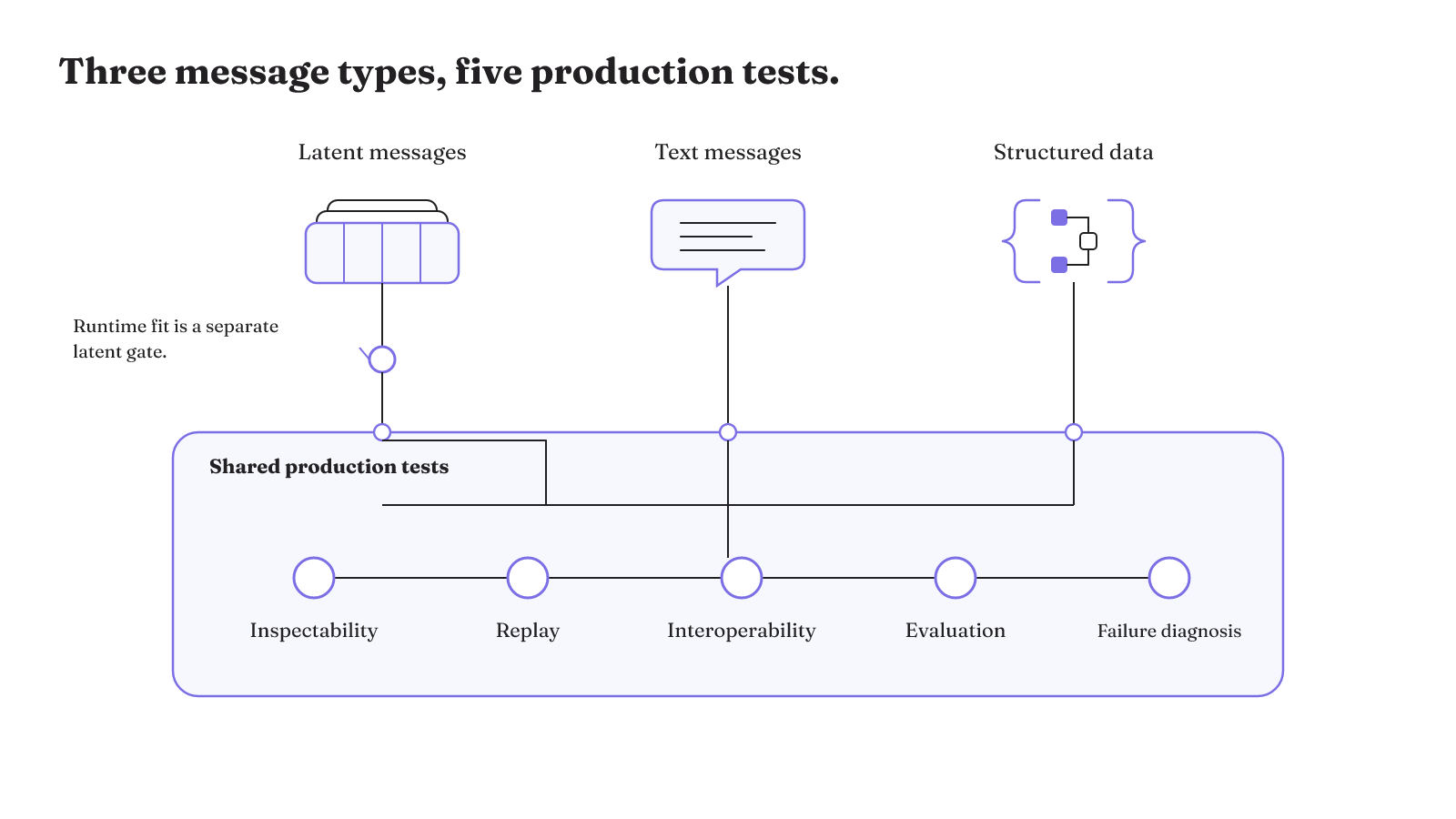
Three useful communication types are latent messages, text messages, and structured data. Latent implementations can exchange full key-value caches or hidden states. One LatentMAS and S-LoRA implementation passes hidden states instead of text. The Agent2Agent specification supplies a common interaction model for independent agents and supports modalities that include text, files, and structured data. Apply the same five acceptance questions to each type.
| Criterion | Latent messages | Text messages | Structured data |
|---|---|---|---|
| Inspectability | Can the trace identify the exchanged model state and the agent lifecycle or task event around it? | Can the trace preserve each interaction and connect it to the relevant lifecycle or task event? | Can the trace preserve the payload and connect it to the relevant lifecycle or task event? |
| Replay | Can every request, stream, failure, retry, and aggregation step be replayed and attributed? | Can every request, stream, failure, retry, and aggregation step be replayed and attributed? | Can every request, stream, failure, retry, and aggregation step be replayed and attributed? |
| Interoperability | Can independent agents built on the chosen stack exchange this state through a common interaction model? | Can independent agents built with different frameworks, languages, or vendors exchange the modality through a common interaction model? | Can independent agents built with different frameworks, languages, or vendors exchange the modality through a common interaction model? |
| Evaluation | Can traces, evaluations, and feedback signals determine whether the system was right, not merely whether it answered? | Can traces, evaluations, and feedback signals determine whether the system was right, not merely whether it answered? | Can traces, evaluations, and feedback signals determine whether the system was right, not merely whether it answered? |
| Failure diagnosis | Can a trace locate the relevant creation, execution, handoff, delegation, hierarchy, or termination event? | Can a trace locate the relevant creation, execution, handoff, delegation, hierarchy, or termination event? | Can a trace locate the relevant creation, execution, handoff, delegation, hierarchy, or termination event? |
The questions draw on several concrete operating models. Proposed OpenTelemetry conventions for agents cover lifecycle events, multi-agent coordination, and task creation, execution, delegation, and hierarchies. A local-first agent testing framework shows another useful target: traceable decisions and interactions with custom evaluators, metrics, and integrations. An orchestration-first evaluation approach requires requests, streams, failures, retries, and aggregation steps to be replayable and attributable before answer quality is judged. Observability can then combine traces, evaluations, and feedback to ask whether the system was right, not only whether it produced an answer.
Compatibility needs its own gate. One LatentMAS interpretability implementation modifies part of the vLLM backend because vLLM does not officially support key-value-cache modification or prompting through latent embeddings. That is an implementation-specific fact, but it is enough to make runtime fit a first-class test. Do not infer compatibility from benchmark performance.
Before selecting a communication mode, require concrete traces, replay records, evaluations, and runtime tests that answer those five questions. Our note on context engineering in multi-agent systems provides related architectural context for the state moving through that harness.
A small failure can redirect the whole trajectory
Multi-agent failures compound. One failed step can send later agents down a different trajectory and produce an unpredictable outcome. The problem is not confined to the message that failed. Later decisions are now acting on a changed execution path.
That is why a multi-agent platform has to maintain authority, clarity, and restraint across several concurrent decision streams. The operating surface expands with each stream. The system needs to preserve who may act, what each agent is doing, and where restraint is enforced while work proceeds in parallel.
Those three obligations deserve separate checks. For authority, identify which decision stream may initiate each tool action. For clarity, determine whether the recorded execution distinguishes one stream from another. For restraint, identify the control that applies when concurrent streams reach the same consequential boundary. These questions turn a broad coordination concern into an architecture review.
Additional agents also add concrete overhead: more model calls, tool calls, handoffs, coordination logic, and infrastructure. Additional execution steps can increase latency. Agent count is therefore not a useful maturity score on its own. Each added agent should justify the operating work it introduces.
Consider the failure path, not only the happy-path division of labor. A handoff adds another place where execution can diverge. A tool call adds another event to test and attribute. Coordination logic adds another part of the system that can fail or retry. None of those facts means a multi-agent design is wrong. They mean its extra parts need a workload-specific reason to exist.
This is where the smallest controllable architecture is a useful baseline. Compare the candidate system with the smallest design that can handle the workload, then account for the calls, handoffs, controls, tests, and infrastructure added by every extra agent. Our guide to AI agent orchestration frameworks can help frame that architecture choice.
Make the comparison at the execution level. Count the additional model calls and tool calls. Map each handoff and the coordination logic around it. Name the infrastructure required to run the added path. Then include the extra steps when testing latency. This does not presume that fewer agents will win. It makes the cost of the larger architecture visible beside the work it performs.
Shared limits belong at the system boundary
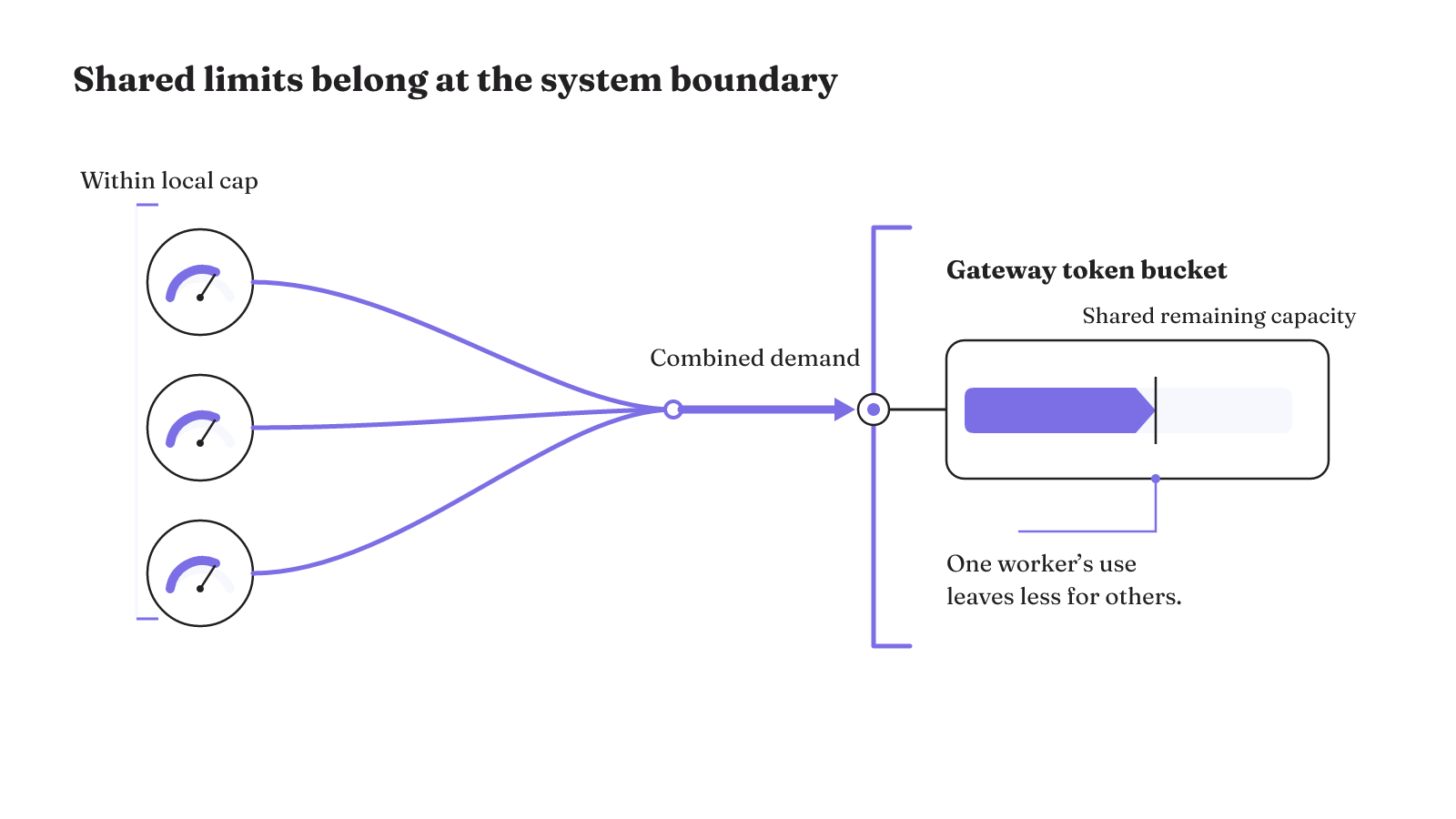
Local compliance does not guarantee safe aggregate behavior. Suppose several workers each remain under their own request cap while acting at the same time. Their combined traffic can still exceed the shared traffic budget. Every worker followed its local rule, yet the system crossed its global limit.
This is a coordination problem, not a messaging-format problem. Text, structured, and latent messages can all sit inside a system whose workers compete for one scarce resource. The relevant boundary is the place where aggregate consumption can be seen and enforced.
A gateway-enforced token bucket makes the aggregate budget shared. Each worker draws from the same bucket. When one worker consumes tokens, fewer remain for the others. The budget becomes a system constraint instead of a promise repeated inside each worker.
The order of worker activity now affects remaining capacity in a visible way. A worker that consumes from the bucket changes what later workers can use. Concurrent workers no longer rely on isolated counters that each describe only local behavior. They face one enforceable pool at the gateway.
The acceptance test is concrete. Run concurrent workers and confirm that the gateway enforces the shared limit even while each worker remains within its local cap. Record which worker consumed the budget and how the remaining capacity changed. The mechanism should make contention visible at the same boundary where it is controlled.
That pattern reaches beyond traffic. Whenever multiple agents consume one bounded resource, the harness needs an aggregate view of that resource. A worker-level metric can still be useful, but it cannot stand in for the system-wide budget. The production question is whether the shared boundary remains authoritative under concurrency.
What should a production-ready multi-agent framework prove?
A production candidate should prove more than benchmark quality. It needs regression evaluations, active controls, comprehensive testing, careful prompt and tool design, robust operating practices, and clear ownership across the people building and running it.
Use this research-to-production checklist as a release gate:
- Regression evaluations: Turn observed failures into test cases, use those cases to prevent regressions, and replace subjective impressions with metrics. Early investment in agent evaluations supports this loop. Require a regression case for an observed failure before calling the repair complete.
- Active permissions and approvals: Put permissions, approval gates, policy checks, guardrails, sandboxing, and application controls around consequential actions. Observability records and analyzes behavior; it does not itself prevent unsafe actions. Name the active control separately from the trace that records its result.
- Comprehensive testing: Test the multi-agent system as a connected execution path, including the failures that can redirect later work. Include the handoffs and coordination logic, not only each worker in isolation.
- Detailed prompt and tool design: Treat prompts and tools as operating surfaces that need deliberate design. Review both as part of the system's execution path.
- Robust operational practices: Define how the system is run when execution fails, retries, or takes a different trajectory. Require the operating record to make those events attributable.
- Shared ownership: Reliable operation at scale requires close collaboration among research, product, and engineering teams, alongside careful engineering and testing. A production account of a multi-agent research system describes that combined obligation. Assign ownership for evaluation, tool and prompt design, and day-to-day operation instead of treating them as one unnamed responsibility.
These gates keep observation and prevention distinct. Traces, evaluations, and feedback help a team understand what happened and whether the system was right. Permissions, approval gates, policy checks, guardrails, sandboxing, and application controls constrain what the system may do. A production harness needs both.
Before adopting latent communication, audit one real workflow against the observability-budget matrix. Require a concrete artifact for every answer: a trace, replay, attribution record, evaluation, compatibility test, aggregate-limit result, or active control. Then compare those obligations with the smallest architecture that can handle the workload. For an implementation path, read our guide to building multi-agent systems.