Key takeaways
- Meta context engineering via agentic skill evolution co-evolves engineering skills and context artifacts.
- The authors report a 16.9% mean relative improvement across five evaluated domains.
- The publication record links public code, but adoption requires trajectory, decision, constraint, authority, and recovery checks.
MCE is interesting because it moves change into the context-building system itself. That makes the evaluation target larger than a final answer. We need to understand what changed, which history informed the change, what the agent did with it, and what happens when an execution must stop or recover.
Meta context engineering via agentic skill evolution: MCE and ACE
Inference-time context has a large effect on how well a large language model operates. That context can include instructions, strategies, evidence, examples, rules, files, and code. Context adaptation changes those model inputs rather than updating model weights.
Agentic Context Engineering, or ACE, treats context as an evolving playbook. The playbook accumulates, refines, and organizes strategies through generation, reflection, and curation. The important unit is still the context presented to the model, but that context is allowed to develop through an iterative process.
Meta Context Engineering, or MCE, changes the level at which evolution happens. It is a bi-level framework that co-evolves context-engineering skills and the context artifacts produced by those skills. A skill is the reusable strategy for building useful context. An artifact is the task-specific material the model receives or works with. For a separate explanation of this reusable unit, see our definition of an agent skill.
That distinction matters when evaluating either approach. ACE describes evolving playbooks that carry strategies forward. MCE adds a layer that changes the strategies used to build and organize those playbooks. Neither term means that model weights changed. They describe changes around the model, within the context and the machinery that produces it.
The three terms also point to different review objects. For context adaptation, inspect the instructions, strategies, or evidence placed in the model input. For ACE, preserve the playbook as it passes through generation, reflection, and curation. For MCE, preserve both the context artifact and the context-engineering skill that produced it. A diff of the final prompt can show an input change, but it cannot display the full MCE search across earlier skills, executions, and evaluations. That history belongs to the mechanism, not just its output.
The publication history also fixes the research record in time. OpenReview lists MCE as an ICML 2026 regular publication, published on April 30, 2026, and last modified on September 22, 2026. Those dates identify the publication record. They do not settle the separate engineering questions around operating the system.
How does MCE evolve skills and context?
MCE divides the work between two interacting agent roles. One learns strategies for building useful context. The other applies those strategies to organize the material needed for a specific task. This split turns context engineering from a fixed recipe into an object of search.
The paper frames the alternative as manually designed harnesses. Rigid generation-and-reflection workflows and predefined context schemas can introduce structural bias and keep optimization inside a narrow design space shaped by human intuition. MCE replaces those static heuristics with a loop in which both the engineering strategy and its outputs can change.
At the meta level, an agent refines context-engineering skills through agentic crossover. The search is not limited to the latest prompt or the latest result. It runs across the history of skills, executions, and evaluations. That history gives the meta-level agent the material from which to form another engineering strategy.
At the base level, an agent executes the selected skills, learns from training rollouts, and optimizes context as flexible files and code. In plain terms, the meta-level role changes how useful context gets built. The base-level role applies that evolving method to examples, rules, files, and code for the task at hand. The paper summary describes these two roles as a co-evolving system rather than one agent repeatedly polishing a single prompt.
The role boundary helps separate two kinds of change. A new skill changes the strategy used to build context. A new file, rule, example, or piece of code changes the task-specific context produced by that strategy. An operator who records only the artifact loses the skill path. One who records only skill versions loses the executions and evaluations that gave those versions meaning. MCE's agentic crossover explicitly searches all three histories, so all three are part of the record needed to inspect a mutation.
This separation creates a concrete inspection problem. A final artifact is only the visible end of a longer path. To explain a result, an operator needs the selected skill, the earlier skills considered during crossover, the executions those skills produced, and the evaluations that shaped the next mutation. That is why MCE is better read as controlled skill evolution than as a new label for prompt iteration. Our comparison of prompt, context, and harness engineering places those control surfaces side by side.
What did MCE report, and where does the public code start?
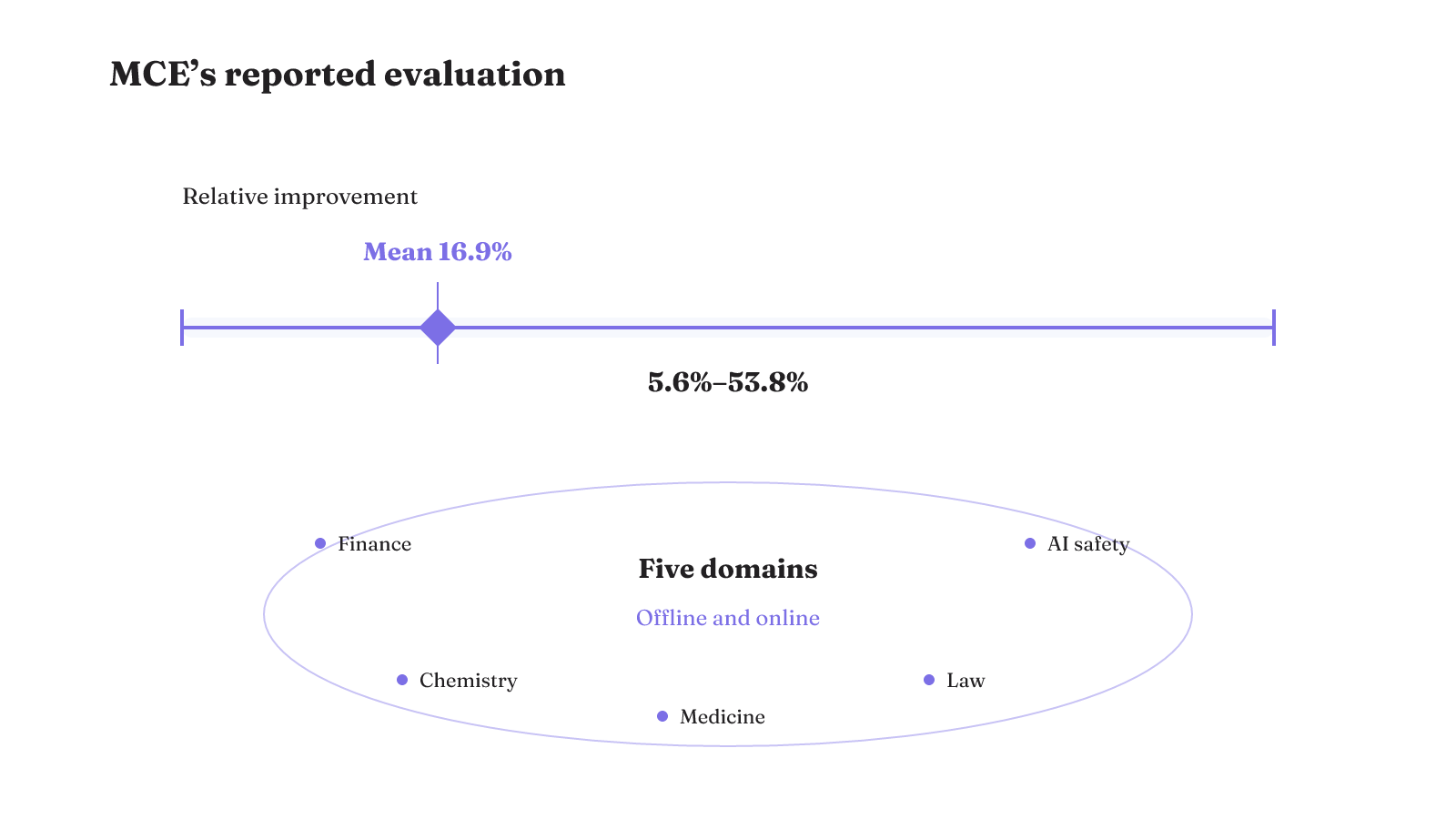
MCE was tested across five domains in offline and online settings. The task set covered finance, chemistry, medicine, law, and AI safety. Its performance and efficiency findings come from that evaluation, while its publication record supplies the public-code entry point.
| Layer | Exact point | Scope |
|---|---|---|
| Evaluation coverage | The evaluation used tasks from finance, chemistry, medicine, law, and AI safety. | Five domains under offline and online settings. |
| Relative performance | The authors reported 5.6% to 53.8% relative improvement over state-of-the-art agentic context-engineering methods, with a 16.9% mean. | The same five-domain offline and online evaluation. |
| Efficiency | MCE often used context more efficiently and required less training work while improving performance over prior context-engineering approaches. | Reported across the evaluated finance, chemistry, medicine, law, and AI-safety tasks. |
| Public code | The publication record links github.com/henry-yeh/mce. | A public-code entry point linked by the publication record. |
The authors' OpenReview summary names the five task areas and the efficiency result. The paper abstract reports the evaluation setting and relative-improvement figures. These are reported research results. The Meta Context Engineering via Agentic Skill Evolution GitHub link tells you where code inspection can begin, not what operational properties that code has.
Separate the reported benchmark from adaptation. The benchmark describes what happened with the reported method and evaluation. Adaptation asks what happens after you change the task, context, permissions, or runtime. The five-domain result covers only its offline and online settings. A controlled trial should preserve that baseline before adding authority or replacing its evaluation with a workload-specific one.
For a controlled experiment, keep the claim ledger intact. Reproduce the evaluated task and measurement before changing the workload, authority, or runtime. Then inspect the code for the controls your environment requires. A repository link alone does not answer whether mutations are isolated, approvals exist, history is complete, external effects are replay-safe, or recovery is secure.
The Skill-Evolution Adoption Gate
Broader authority should follow operational evidence, not the presence of an evolving skill loop. Agentic systems need evaluation of their trajectories, decisions, and adherence to constraints, not only their final outputs. Pre-deployment evaluation also cannot reliably surface every possible alignment failure because the conditions that may produce misaligned behavior are extensive.
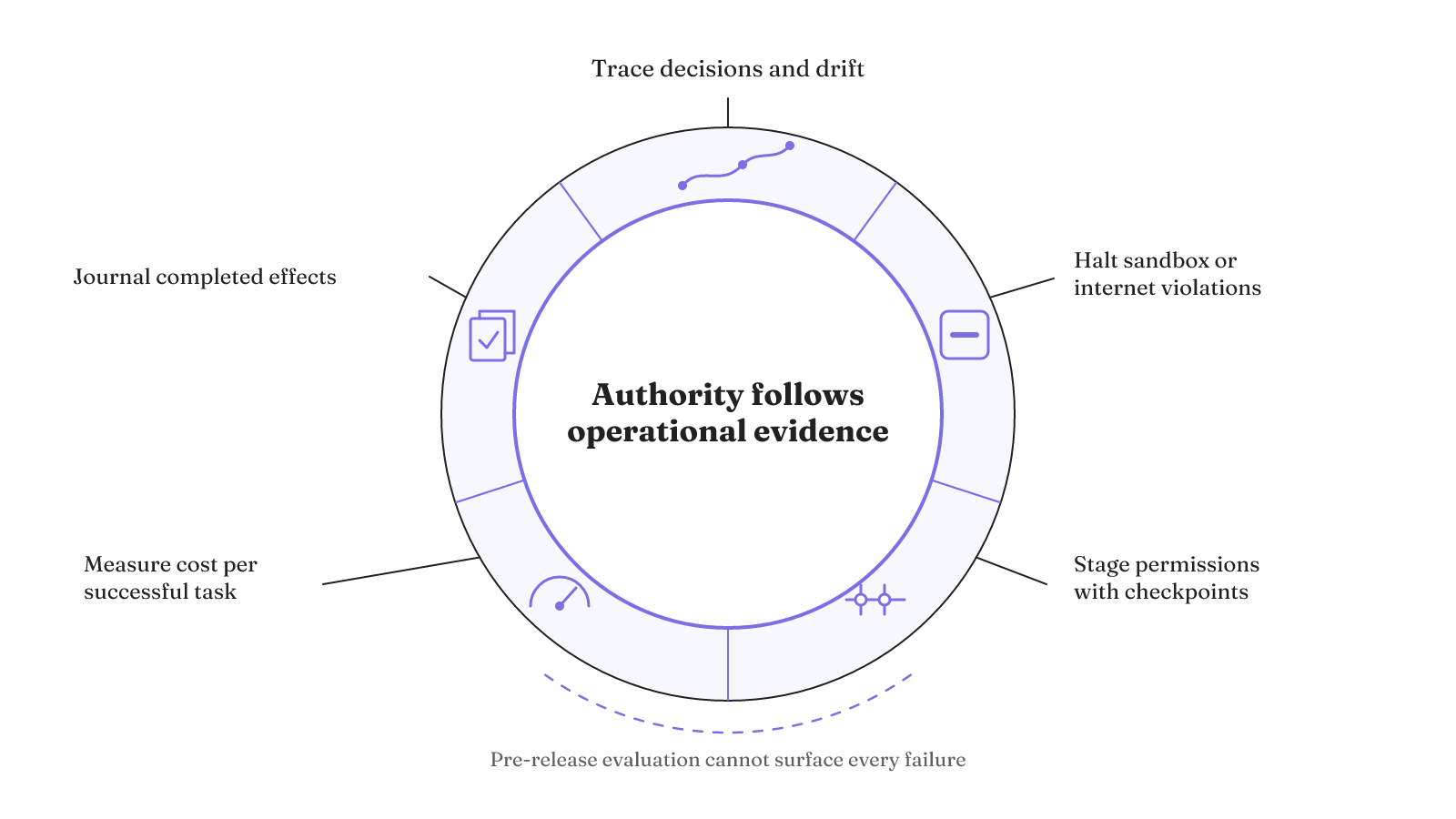
Use this gate to define what must be visible and bounded before an evolving agent receives more authority.
| Dimension | Operational standard | Concrete mechanism |
|---|---|---|
| Trajectory evaluation | Evaluate the path, decisions, and constraint adherence alongside the final output. | Store trajectories and test the decisions and constraints represented in them. |
| Runtime response | Stop runs when behavior crosses a monitored boundary. | Real-time monitors can halt a run if a model probes its sandbox or unexpectedly reaches the internet. |
| Traceability | Make decisions and policy adherence inspectable. | Use observability for decision traceability, end-to-end visibility, and policy-adherence evidence. |
| Staged authority | Expand permissions in calibrated stages with accountability. | Use risk tiers, human checkpoints, and reviews of dashboards and logs to tune permissions. |
| Continuous monitoring | Detect drift and diagnose failures during production iteration. | Maintain execution traces and continuous monitoring across runs. |
| Built-in governance | Treat security, operational, and regulatory risk as design requirements. | Put governance requirements into the system before deployment. |
| Economic cost | Measure the cost of successful work, not activity alone. | Track tokens, compute, infrastructure, and cost per successful task. |
| Recovery | Continue from unfinished work without blindly repeating completed effects. | Journal completed operations and inspect rollback behavior at side-effect boundaries. |
Treat the weakest control as the ceiling on authority. A strong final output cannot compensate for an execution you cannot trace, stop, recover, or measure economically. Pre-release evaluation may test decisions and constraints, while runtime monitors can halt sandbox probing or unexpected internet access. Before expanding permissions, require a readable execution history and a recovery path that distinguishes finished effects from unfinished work.
Can checkpoint rollback safely recover an evolving agent?
Checkpoint rollback is useful, but correct rollback does not guarantee secure recovery. A restored execution may combine internal states, assumptions, and external effects that never coexisted in a valid history. Research on agent rollback identifies incomplete or inconsistent state, stale external dependencies, nondeterministic replay, and unrecorded external effects as failure modes.
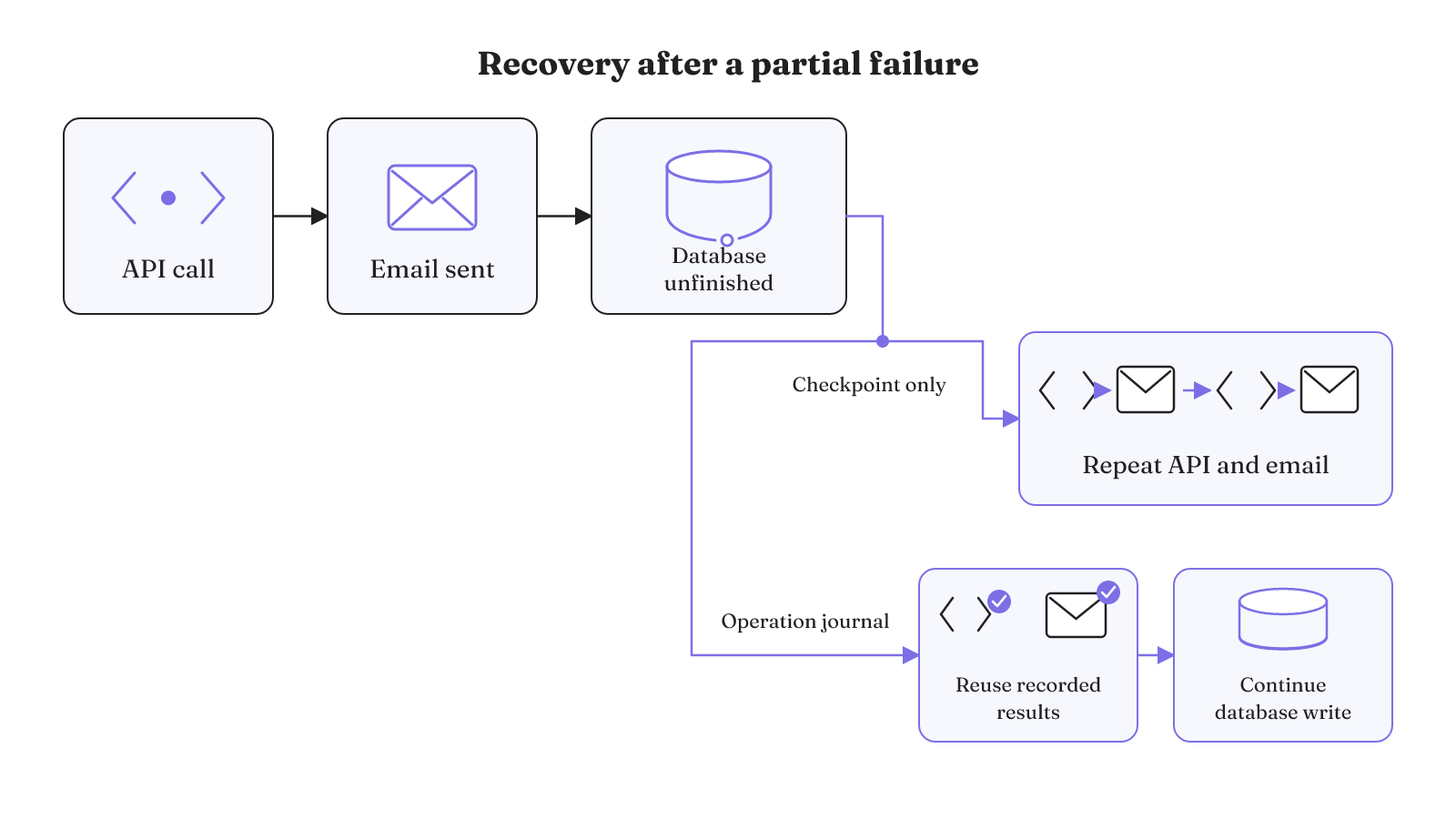
Consider one checkpointed tool that calls an API, sends an email, and writes to a database. It fails after sending the email but before the database write completes. A checkpoint returns execution to a boundary and restarts it; it does not resume directly at the failed operation. If completion of the API call and email was not recorded, the restarted tool can rerun all three actions. The API call and email may happen twice.
This is not only a theoretical concern. End-to-end rollback attacks demonstrated a malware-verification bypass, unauthorized mail forwarding, and double payment across three agent systems. The lesson is narrow and important: restoring internal state does not recreate a valid history of external effects.
There are four separate things to inspect at a recovery boundary. First, determine whether the internal state is complete and consistent. Second, identify external dependencies that may have become stale. Third, account for nondeterministic work that may produce a different result when replayed. Fourth, record effects that happened outside the checkpoint. A clean snapshot can still fail any of the other checks. Recovery has to cover the execution path and the world the execution changed.
Durable execution uses a different recovery unit. It persists each LLM call, tool call, sleep, and remote procedure call. During recovery, completed operations can return their journaled results, while execution continues from the unfinished step. In the API, email, and database sequence, operation-level records distinguish completed effects from the work that still needs to run. The durable-execution explanation contrasts this journal with boundary checkpoint replay.
That does not make checkpoints disposable. Checkpoint documentation lists legitimate recovery uses, including restoring a working state, comparing checkpoint states, recovering after database corruption, and undoing accidental deletion or modification. The engineering mistake is asking one boundary snapshot to provide both state restoration and replay-safe coordination with the outside world.
For an evolving context system, mutation history and execution history both matter. A skill checkpoint may tell you which files or rules existed at a boundary. An operation journal tells you which calls and effects completed. Inspect both before treating rollback as an authority-expanding safeguard. Our harness engineering framework treats recovery as part of the surrounding system that makes model-driven work controllable.
Production failures can become release tests
Evolution has a quieter failure mode: useful detail can disappear while the context still looks coherent. Iterative context adaptation can develop brevity bias, which drops domain insights, and context collapse, which erodes details through repeated rewriting. An evolving playbook therefore needs memory of what must remain true, not only a record of what changed.
A production failure can supply that memory. Capture the failed execution as a trace. Turn the trace into a test case. Add the case to a golden dataset. Then use that dataset as a CI/CD release gate. This failure-to-release sequence makes an observed failure part of the standard applied to later changes.
Behavioral invariants give the regression suite a stable unit. They describe rules that must hold regardless of prompt wording, response phrasing, or conversational path. Tests built around behavioral invariants can survive surface changes while still detecting a broken obligation.
This is more precise than freezing one preferred answer. The prompt may change. The response may use different words. The conversation may take another route. The invariant remains the release condition. If a later skill mutation violates it, the release gate can reject the change even when the final response looks polished.
For skill evolution, pair each consequential failure trace with the invariant it violated. The trace preserves the path through the system. The invariant states the behavior that later mutations must retain. The golden dataset then carries both into the release gate. This turns regression memory into a control on future context changes instead of a collection of old examples.
Use the Skill-Evolution Adoption Gate before granting an evolving agent broader authority. If the gate exposes weak tracing, unbounded permissions, unknown cost, or replay risk, keep the experiment contained. When those controls need a system-level design, apply the harness engineering framework to map authority, state, evaluation, and recovery around the agent loop.