Key takeaways
Python for agentic AI needs explicit state, bounded loops, and least-privilege tools. Put human approval around high-risk actions. Traces support debugging. Recovery must observe workflow state and side effects because a transport response can miss them.
We treat the model call as one component inside a larger harness. If you want to build agentic systems in Python, begin with the parts you can inspect: what state exists, which transition is allowed, when execution stops, what each tool may do, and where a person can intervene. This is the boundary between agentic AI and a standalone LLM call: the execution path becomes software you operate.
That view changes the first design question. A working tool call shows that a model can reach an action. It does not show the allowed path through the run, the authority attached to that action, or what recovery can observe. Those responsibilities need concrete places in the Python program.
Which Python version does your agent toolkit support?
Match the runtime to the named toolkit; no universal Python version follows from product-specific boundaries. They also do not establish a best IDE, a required repository structure, or when tutorial code becomes an operable agent project. Those questions need workload-specific criteria and tested implementation evidence. The practical guide below is limited to the language, runtime, prompt-formatting, and package constraints each toolkit states.
| Decision | Named toolkit | Compatibility boundary | Implementation consequence |
|---|---|---|---|
| Language | Open-source agent tools | Tools are available for Python and TypeScript. | The language choice remains open between those two options. |
| Python runtime | Microsoft Agents SDK for Python | Python 3.10 through 3.14 is supported, with 3.11 or later recommended. | A project using this SDK needs at least Python 3.10. |
| Multiline prompt formatting | AI Functions | Python 3.14 or later can use a Template. Python 3.12 and 3.13 can return a standard string. | On 3.12 or 3.13, the developer must preserve correct indentation when inserting multiline values. |
| Standard or experimental modules | Microsoft Agent Framework | Experimental modules live in agent-framework-lab, outside the standard package set. | A design that depends on a lab module also depends on that separate package boundary. |
Prompt construction can expose validation
Prompt construction is an early control surface because it determines whether validation is visible in ordinary Python. In an AI Functions design, the instructions can live in a function docstring:
def summarize(request: str):
 """Summarize the supplied request."""
The same design can construct and return the prompt from the function body. That creates a place to validate the input before the prompt is returned:
def summarize(request: str):
 if not isinstance(request, str) or not request.strip():
 raise ValueError("request must be a non-empty string")

 return f"Summarize this request:\n{request}"
These two shapes put responsibility in different places. The docstring carries the instruction in the first. The function body makes the validation step explicit in the second. The point is not that one short function makes an agent safe. It is that ordinary control flow can reveal where data is accepted before it reaches the model.
In the second sketch, two outcomes are visible before any prompt is returned. An empty or non-string request raises an error. A valid request reaches the return statement and becomes prompt text. That separation gives a code reviewer a specific validation branch to inspect. It also prevents the prompt itself from becoming the only place where an input expectation is expressed.
What makes state inspectable in Python for agentic AI?
Inspectable state has named conditions and explicit allowed transitions. State machines and Actor-model designs can sit alongside LLMs to provide observability, reliability, and control. The model may propose what happens, but the state model constrains which change the system can accept.
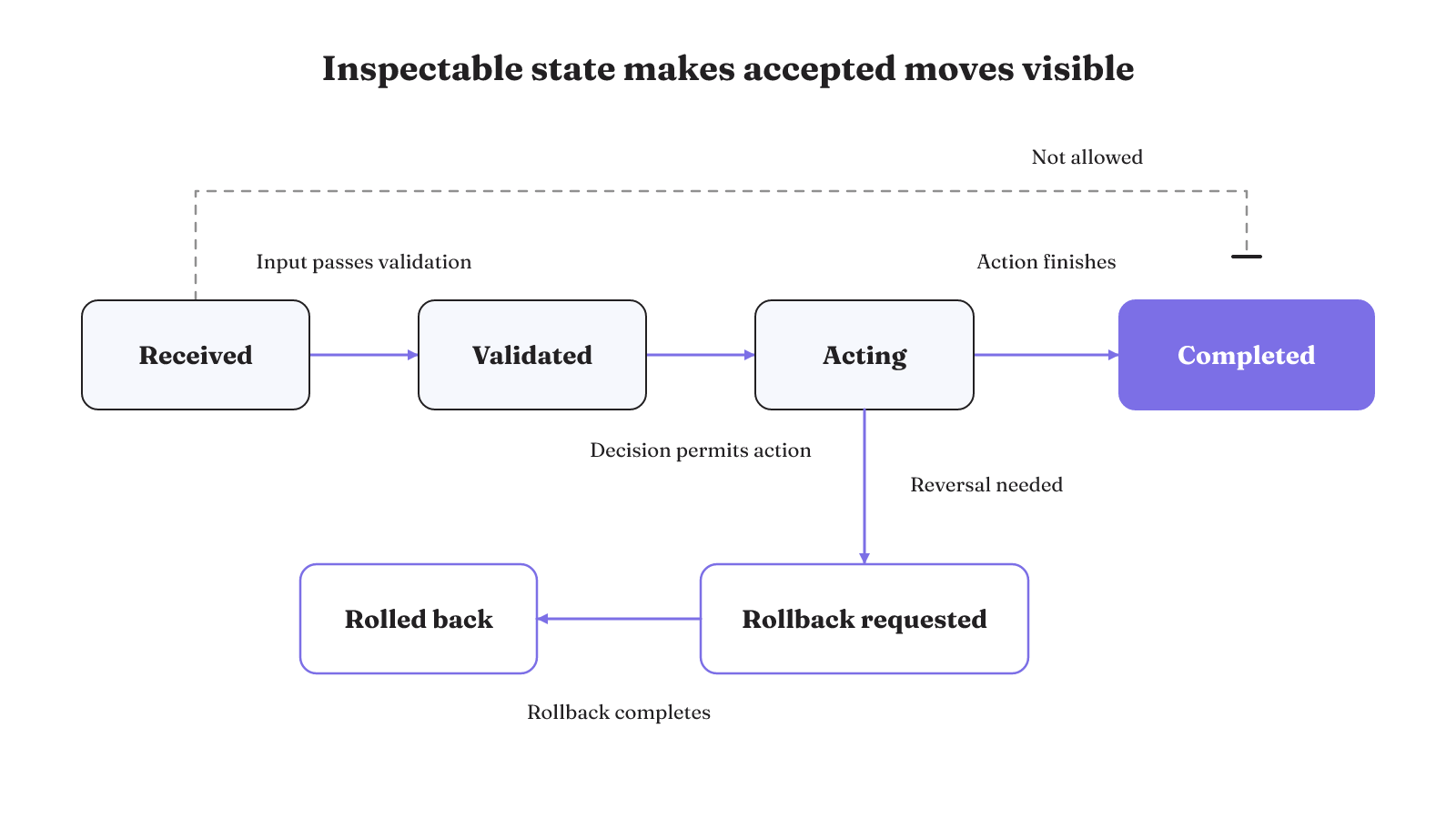
A small transition map makes that boundary concrete:
received -> validated: the input has passed the validation gate.validated -> acting: an auditable decision point permits action.acting -> completed: the allowed action finishes.acting -> rollback_requested -> rolled_back: rollback is represented inside the workflow.received -x-> completed: this direct jump is not an allowed transition.
When a system is limited to explicitly defined transitions, invalid transitions are impossible within that state model. The same explicit structure makes each state change verifiable and each decision auditable. It can also make rollback part of the workflow instead of an improvised response outside it.
That is the engineering value of visible state. A developer can inspect the current state, the requested transition, the decision that admitted it, and the rollback path. The map does not make the model's reasoning deterministic. It makes the surrounding system's accepted moves legible.
The blocked edge is as important as the allowed ones. A request to move straight from received to completed cannot be accepted within this state model because that transition was never defined. The system has to pass through its allowed states. If action later needs to be reversed, rollback has a named route in the same workflow. Verification, audit, and rollback therefore operate on visible state changes, not on a vague claim that the agent handled the task.
Bound the loop before cost becomes the failure mode
A visible state model still needs an execution boundary. Unbounded agent loops can cause excessive API or compute costs. Imagine an agent that calls a tool, receives an answer it treats as incomplete, and repeats the same cycle. Without a stopping boundary, the run can continue making calls and consuming compute.
The failure is not the individual call. The repeated path is unbounded. The surrounding program should expose and enforce a stopping boundary.
For a closer look at the control point itself, inspect the agent loop as part of the harness, not as hidden framework behavior.
Tool authority sets the risk boundary
A bounded loop can still cause damage if every iteration carries broad authority. Overly permissive tools can perform unintended actions or access unauthorized resources. Tool design is therefore a permissions problem as much as an integration problem.
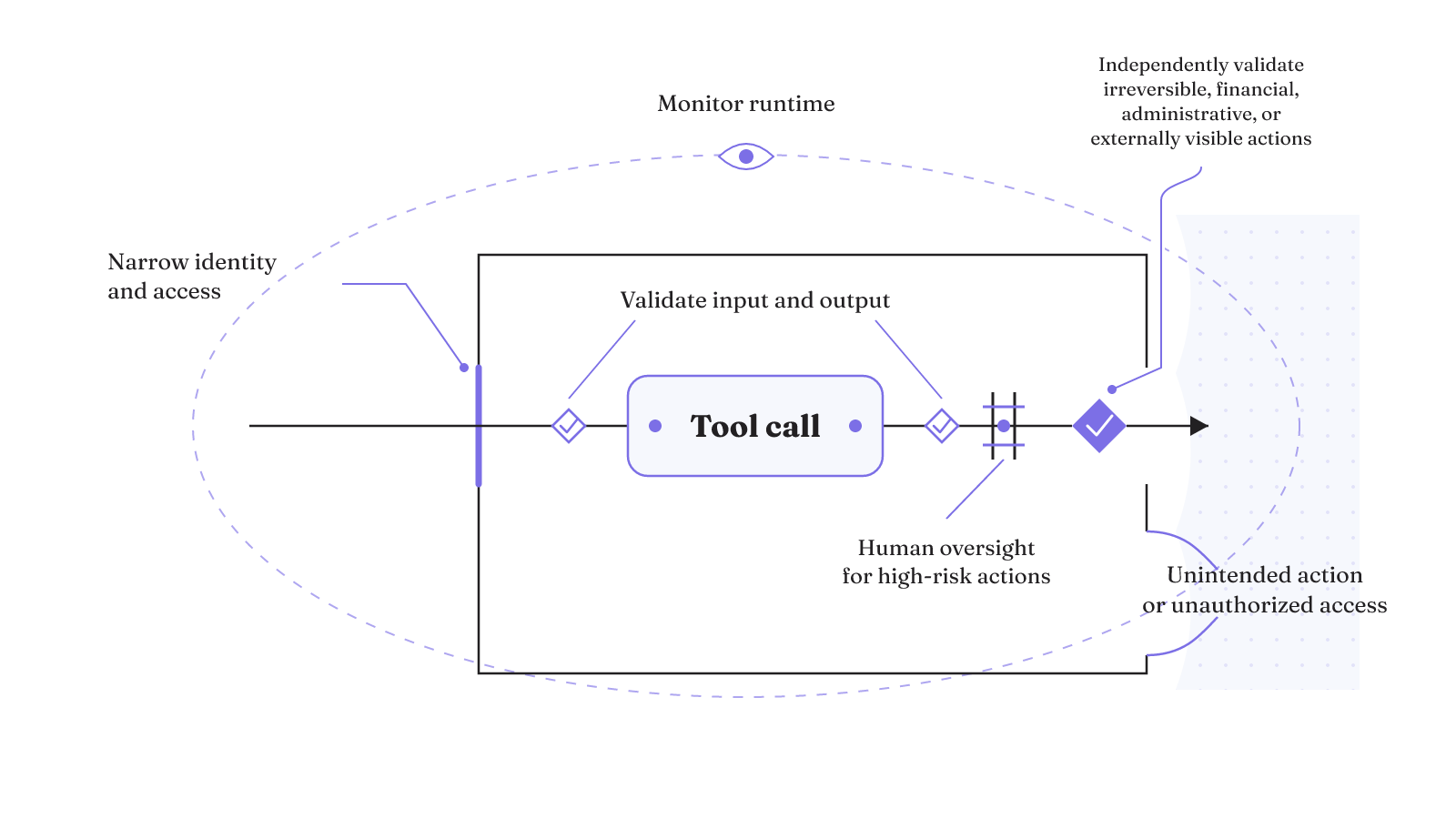
A compact control map keeps the boundary visible:
- Identity and least privilege: connect the acting identity to only the access the tool needs.
- Input and output validation: place checks around what enters and leaves the action path.
- Runtime monitoring: observe the action while the agent is operating.
- Human oversight: require it for high-risk actions.
- Independent validation: put it before irreversible, financial, administrative, or externally visible actions.
These controls cover different points in the run. Guidance on agent protection spans identity, least-privilege access, validation, monitoring, and human oversight. Independent validation matters at the high-impact action boundary because the action may be difficult to reverse or visible outside the system. Giving a model access to a tool does not settle what that tool is authorized to change.
The risk decision becomes concrete when it is attached to the action. A read with narrow access and an externally visible administrative change do not carry the same authority. The latter falls within the actions that need independent validation. The control point should sit before execution, while monitoring observes the runtime path and validation checks what enters and leaves it. Each mechanism has a named job around the tool call.
Where should guardrails sit?
Guardrails can sit on both sides of the model. An input guardrail screens content before it reaches the LLM. An output guardrail controls the response after the LLM runs. Their role is detective: they aim to stop harmful content from reaching an application or user and add steerability to a production model call.
The two positions form a simple control path:
input -> input guardrail -> LLMLLM response -> output guardrail -> application or user
Placement does not settle the threshold. Selecting guardrail thresholds requires performance evaluations and five concrete considerations:
- accuracy;
- latency;
- cost;
- the business cost of a false positive; and
- the business cost of a false negative.
A tighter threshold may change more than the number of blocked requests. Accuracy, latency, and cost trade against one another, while false positives and false negatives can impose different business costs. The threshold should therefore be an evaluated operating choice. It should not be a constant copied into the application without measuring how the guardrail behaves.
The evaluation needs to preserve both error directions. A false positive can block an innocent request. A false negative can allow the content the guardrail was intended to catch. Measuring only the requests that were stopped misses the other half of the decision. Keep both costs visible when comparing thresholds, then include the latency and cost of running the guardrail itself.
Guardrails cannot carry the whole defense
An LLM used as a guardrail still has the vulnerabilities of an LLM call. Prompt injection can evade both the guardrail and the underlying call, so an LLM guardrail does not eliminate injection risk. This is one failure boundary: the content passes the first model-based check and still changes the behavior of the model behind it.
Conversation length adds another pressure. Longer conversations make LLMs more susceptible to jailbreaking as added text dilutes their instructions. That makes the accumulated conversation part of the guardrail problem, not just the latest user message.
The opposite failure also matters. An overly restrictive guardrail can reject an innocent request because it resembles a prompt-injection or jailbreaking attempt. A system that catches more suspicious patterns can also create more over-refusals. That tradeoff is why measured false positives belong beside false negatives in threshold evaluation.
These two failures pull in opposite directions. A permissive guardrail can be evaded, while a restrictive one can refuse harmless work. Longer conversations can further weaken the instructions the LLM guardrail is expected to follow. That leaves no single threshold or model call that can carry prevention, detection, and evaluation on its own.
Monitoring does not close these gaps by itself. It should operate as one layer in a defense-in-depth stack, alongside complementary evaluations and preventative controls. In practice, the architecture needs to show which control tries to prevent a bad action, which evaluation tests the behavior, and which monitoring signal records what happened. Treating one guardrail call as the whole defense hides those separate responsibilities.
Operational visibility includes traces, state, and side effects
Consider a run that attempts a storage write. Its trace groups the operations under run R42, including step 7. The transport reports success, but the workflow remains in write_pending, and the expected storage mutation is not observed. The transport response alone has not established that the workflow and its side effect completed.
Grouping operations into a trace supports debugging, but recovery also needs direct observation of workflow state and side effects. This matters for long-running agents because transport-level success can miss either one.
If the write must be attempted again, a naive retry can repeat a mutation. Use an idempotency key such as (R42, 7, "create_record"), following the (run_id, step_index, action_type) form. Deduplicating that key at the storage layer lets repeated attempts refer to the same mutation. The trace explains the path, state shows where execution stopped, side-effect observation shows what changed, and the key constrains the retry.
Before retrying, recovery can inspect three separate records: the operations grouped in the trace, the workflow's current state, and the observed storage side effect. If the mutation is attempted again, the same run, step, and action produce the same idempotency key. The storage layer can then deduplicate the write instead of treating the retry as a new mutation.
Where does a human belong in the run?
A human belongs at a consequential boundary where the workflow needs input or approval before it proceeds. The control should appear in the execution path as a real pause, not as a note beside an autonomous action.
A pause-and-resume sequence can be explicit:
- The workflow reaches an approval state and pauses.
- It requests the person's input or approval.
- The person responds.
- The workflow records the response and resumes.
Human-in-the-loop workflows can pause, request a response, and resume in this way. The point is operational: the run has a state before the response and a permitted continuation after it.
The surrounding environment should reflect the stakes. Workflows involving personal information, financial data, or regulated activity call for enhanced logging, human-in-the-loop control, and isolated environments. Those are named controls around high-risk work. They are not proof that every action needs human review.
The pause also needs durable meaning in the workflow. Before the response, execution is stopped at the approval state. After the response, the workflow has the input that permits it to resume. Enhanced logging makes that high-risk path more visible, while the isolated environment constrains where the work runs.
Framework capabilities worth inspecting
A framework earns added machinery when it exposes a control the workload actually needs. Two capabilities deserve a direct checkpoint.
- Are specialist handoffs routed explicitly? Specialized agents can collaborate through handoffs, and the
handoff_descriptionmatters to routing. Inspect whether the routing description is visible enough to review when work moves between specialists. - Can governance change separately from application code? A policy-as-a-package pattern can centralize governance, allow policy updates without application-code changes, and support compliance auditing across projects.
These questions avoid treating agent count as architectural progress. A handoff is useful when its routing responsibility is explicit. A governance package is useful when policy can change independently and the result remains auditable across projects. For a broader distinction between fixed paths and delegated runs, compare agentic workflows with AI agents.
Inspect both capabilities in the framework's execution model, not just its feature list. For a handoff, find the description used to route work to the specialist. For governance, find the package boundary that lets policy change without an application-code edit, then determine whether those policy changes remain auditable across projects. Those are specific reasons to accept more framework machinery.
Inspect the agent loop first. Then compare AI agent architectures by control, state, evaluation, and recovery.