
Key takeaways
- RAG retrieves external knowledge for an AI response.
- Context engineering governs everything an LLM sees at inference time.
- They can work together, so start with the layer that failed.
RAG vs context engineering at a glance
The useful distinction is scope. RAG is concerned with bringing external knowledge into a response. Context engineering has a wider control surface around what reaches the model and how that information is handled. Neither label tells you, by itself, where a bad answer began. Start by separating the retrieval result from the rest of the input environment.
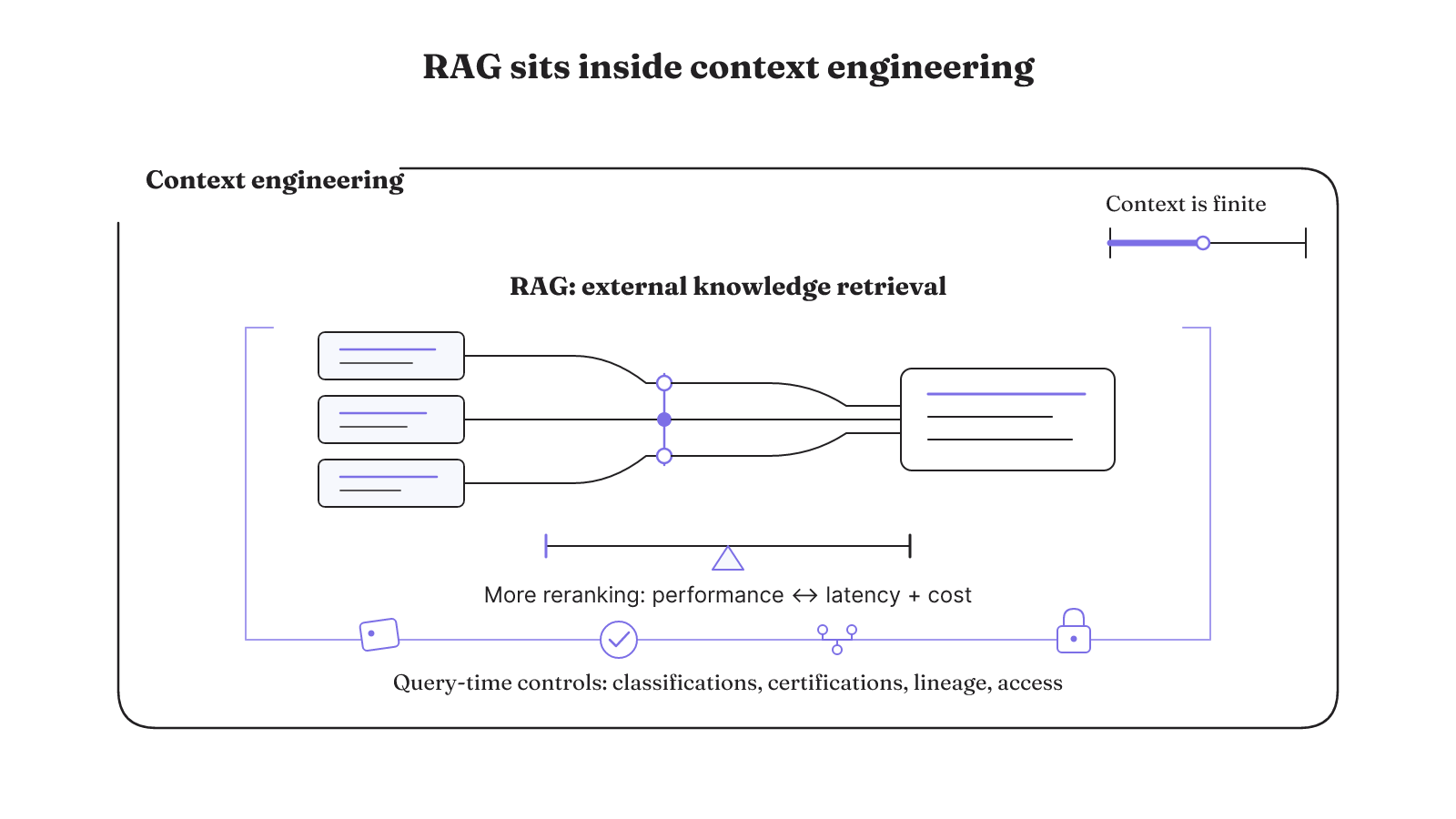
| Decision dimension | RAG | Context engineering | Practical implication |
|---|---|---|---|
| System scope | Retrieval of external knowledge | The information an LLM sees at inference time | A retrieval problem can sit inside a wider context system. |
| Runtime work | Reranking can score retrieved chunks again | Information can be handled across the context environment | Reranking adds a runtime step, even when chunks are scored in parallel. |
| Governance controls | Retrieved material can be part of the input | Can wrap RAG with classifications, certifications, column-level lineage, and access policies at query time | Governance belongs to the wider context control surface. |
| Resource limit | Reranking more chunks trades retrieval performance against latency and cost | Context is a finite resource | Neither layer removes its own constraint. |
RAG can run on context-management infrastructure, so this is not a choice between mutually exclusive architectures. The practical question is whether the failure is in knowledge retrieval or in the environment that receives and governs information.
Is context engineering the same as RAG?
No. Context engineering includes context retrieval and generation, context processing, and context management. Retrieval is therefore one area of a wider system, not a synonym for the whole system.
| Context-engineering area | What it covers |
|---|---|
| Context retrieval and generation | Retrieving and generating context |
| Context processing | Cleaning, organizing, and compressing retrieved information before it reaches the model |
| Context management | Managing the broader context environment |
This boundary matters when an answer looks wrong but the retrieved document is not obviously wrong. The document may be present, while the system still has to process it before the model sees it. Cleaning, organization, and compression belong in context processing.
For the underlying definitions, see our context engineering glossary and retrieval-augmented generation glossary. Here, the job is narrower: locate the failure before changing a component.
When should you fix RAG, context, or both?
Use the failure source as the boundary. RAG grounds AI responses in external knowledge, so begin on the retrieval side when the answer needs information outside the model. Context relevance measures whether fetched context is relevant to the user's query. Context sufficiency measures whether that context contains enough information to answer the query correctly. Those are separate checks, and a failure in either one belongs in retrieval diagnosis.
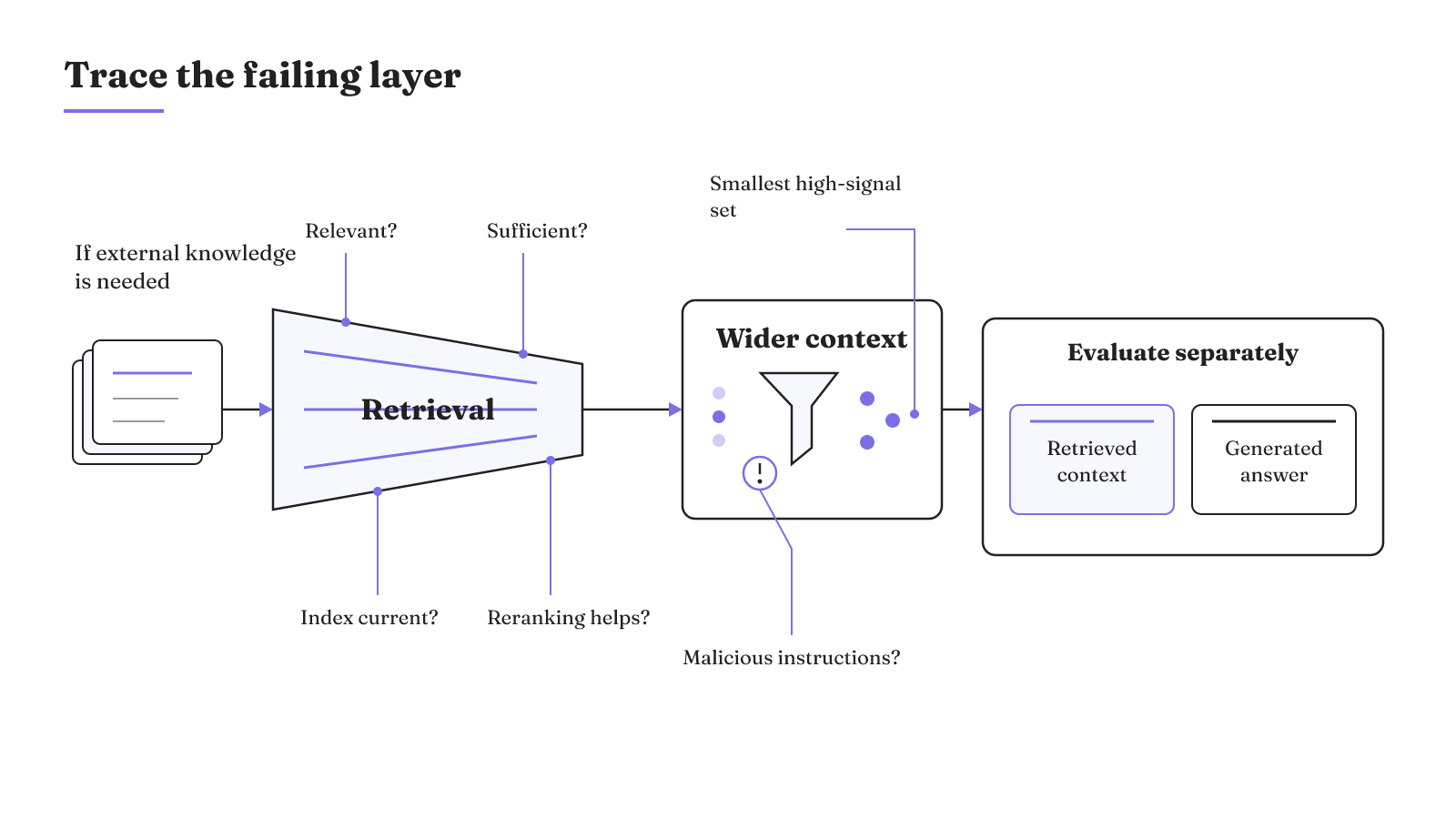
A failure-source decision tree
- Does the answer need external knowledge? If yes, begin with retrieval diagnosis.
- Is the fetched context relevant to the user's query? If no, the retrieval result is the problem to inspect.
- Does the fetched context contain enough information to answer correctly? If no, inspect retrieval sufficiency.
- Is the retrieval index stale? A pipeline can have a 0.95 faithfulness score and still return wrong business answers when its retrieved index is stale. Index trust remains a separate concern from faithfulness.
- Does reranking improve the tested retrieval configuration? Across tested retrieval configurations, reranking performed better than no reranking. Keep that finding attached to the configurations in which it was tested.
- Is the selected context the smallest set of high-signal tokens likely to support the desired outcome? Context engineering treats this as a guiding principle, because context is finite.
- Can encountered content contain malicious instructions? A prompt injection embeds malicious instructions in content an agent may encounter with the intention of overriding intended behavior. That is a wider context and safety diagnosis.
After those checks, evaluate retrieval and the generated response separately. A retrieval check can show whether the system fetched useful material. A generated-answer check can show what the model did with the material it received. Keeping both visible prevents a fluent answer from hiding a retrieval failure, or a relevant passage from hiding a generation failure.
The tree is deliberately narrow. It does not ask a retriever to answer an instruction-exposure problem, and it does not treat a policy decision as proof that a document was relevant. The first five nodes concern external knowledge, relevance, sufficiency, freshness, and reranking. The final two concern selected context and malicious instructions in encountered content. The last evaluation check then keeps the retrieved context and the generated answer as separate results.
Retrieval quality changes at several points
Once the failure is clearly in retrieval, the retrieval path has several places where a tested configuration can change. In tested dataset types, combining embeddings with BM25 performed better than embeddings alone. Adding context to chunks also improved retrieval accuracy across those tested dataset types.
The same work tested how much retrieved material reached the model. Across the tested retrieval configurations, passing the top 20 chunks was more effective than passing the top 10 or top 5. These are useful results to evaluate against a matching workload, not a universal recipe for chunk count or retrieval design.
A tested example stack combined:
- contextual embeddings
- contextual BM25
- reranking
- 20 prompt chunks
That stack names a set of tested retrieval improvements. It does not settle whether a different corpus, query pattern, or system should use the same configuration. Reranking also has a concrete cost: it introduces an extra runtime step, and reranking more chunks trades higher retrieval performance against latency and cost.
The individual findings point at different retrieval choices. The hybrid result concerns embeddings and BM25. The contextual-chunk result concerns adding context to chunks. The top-20 result concerns how many chunks reached the model in the tested configurations. Reranking is another retrieval step with its own latency and cost tradeoff. Keeping those findings distinct makes it easier to evaluate the change that matches the retrieval failure.
The tested stack is also a reminder that retrieval has more than one moving part. A result about contextual chunks is not a result about BM25. A result about the number of prompt chunks is not a result about reranking. The cited work combined contextual embeddings, contextual BM25, reranking, and 20 prompt chunks, but each reported comparison keeps its own tested scope. Use the finding that describes the part of retrieval under investigation.
The distinction becomes important when retrieved context seems plausible but the final answer is still weak. A retrieval improvement may change the material that arrives. It does not replace evaluation of the answer generated from that material.
How do you know whether retrieval or generation failed?
Evaluate both sides of the system. RAG evaluation can measure context relevance, context sufficiency, answer relevance, answer correctness, and answer hallucination. The first two are retrieval checks. The remaining three inspect the generated answer.
| Retrieval checks | Generated-answer checks |
|---|---|
| Context relevance: whether fetched context is relevant to the user's query | Answer relevance |
| Context sufficiency: whether fetched context contains enough information for a correct answer | Answer correctness |
| Answer hallucination |
An evaluation program should establish a gold standard early in its lifecycle. Automated testing patterns are also relevant, and drift thresholds provide a way to detect change over time. Together, those practices give the retrieval layer and the generated response their own places to fail.
This split also improves the question you ask after a bad result. If relevance or sufficiency is weak, investigate what came back from retrieval. If the retrieved context clears those checks while the answer does not, the result points at the generated response. The categories do not prove which component caused every failure, but they keep the diagnosis from collapsing into one broad quality score.
The early gold standard gives the evaluation program a defined reference point. Automated testing patterns make it possible to run those checks as part of the system's work. Drift thresholds make change detectable rather than invisible. None of these practices turns retrieval quality into generated-answer quality. They make each result inspectable on its own terms.
Retrieval metrics still depend on a trustworthy index
Retrieval metrics have a boundary of their own. Faithfulness, relevance, precision, and recall assume that the retrieval index is trustworthy. A high score can therefore describe how a system behaved against the material it retrieved without establishing that the index itself is current or reliable.
That is why evaluation continues after deployment. User corrections can act as signals that the retrieval index needs improvement. They are not the same thing as a metric, but they can expose an index problem that the metric does not see.
This is a useful boundary for a stale-answer investigation. Faithfulness, relevance, precision, and recall rely on a trustworthy index. A user correction can therefore be a signal to improve the index even when those retrieval metrics appear healthy. The correction does not tell you every cause of the failure. It identifies index trust as a live part of the diagnosis.
For readers building the full input path, our note on context assembly is useful alongside this distinction. Retrieval evaluation tells you about fetched material. Index trust asks whether that material came from an index worth trusting.
Production context carries policy and attack-surface decisions
A RAG prototype without data-quality gates, lineage, and policy enforcement cannot hold up in regulated production. Those controls are part of why context engineering has a broader scope than retrieval alone. At query time, context engineering can wrap RAG with classifications, certifications, column-level lineage, and access policies.
The input itself can also carry an attack surface. Prompt injection can lead to data exfiltration, unintended actions, or incorrect answers. It is not a retrieval-relevance issue. It concerns malicious instructions embedded in content an agent may encounter and the possibility that those instructions override intended behavior.
Agent design also needs visible planning steps. An agent-computer interface should have thorough tool documentation and testing. These are concrete system boundaries: the quality and policy controls around retrieved material, the instructions that may arrive with encountered content, and the tools through which an agent acts.
Each boundary answers a different production question. Data-quality gates, lineage, and policy enforcement concern the material around RAG. Prompt injection concerns malicious instructions within content an agent may encounter. Visible planning steps, tool documentation, and testing concern how the agent works with its computer interface. Treating all three as retrieval quality would leave important parts of the system unexamined.
The point is not to make the surrounding system bigger by default. It is to recognize when the failure is no longer only about selecting a document. When policy, encountered instructions, planning, or tool behavior is part of the failure, the wider context environment is already involved.
Use the simplest agent design that clears your evaluations
Start agent systems with simple prompts and comprehensive evaluation. Add multi-step behavior only when simpler solutions fall short. Effective agent design should maintain simplicity, and that rule applies whether the system uses retrieval, broader context controls, or both.
The caution is practical. Minor issues can compound and derail an agentic system entirely. A single failed step can send an agent down a different trajectory and produce unpredictable outcomes. Once work is spread across steps, a failure can redirect later work even when the original defect looked small.
The gap between an agent prototype and a production system is often wider than expected. This is where a narrow failure diagnosis earns its keep. If the system needs external knowledge, evaluate retrieval relevance, sufficiency, and index trust. If the failure concerns selected context, encountered instructions, policy, planning, or tool use, include the wider context environment in the investigation. If the final answer is weak, evaluate the generated response as its own result.
Simple design does not mean ignoring the surrounding system. It means adding multi-step behavior only when simpler solutions fall short, then evaluating the resulting system comprehensively. Retrieval can be a necessary part of that system. Context processing, management, policy, instruction exposure, planning, and tool interfaces may also be part of it. The boundary lets you keep the diagnosis specific while the system remains inspectable.
Use the failure-source decision tree on the next RAG or agent failure. Then read our harness engineering comparison of prompt engineering and context engineering to place that diagnosis inside the surrounding system.