Key takeaways
- Start with one agent whenever possible.
- Add specialists when isolation, prompt clarity, or trace legibility materially improves.
- Match the platform to the architecture, then inspect its policies, auditability, and human oversight.
The useful decision starts before the shortlist. First decide whether your workload needs deterministic rules, one bounded agent, or several coordinated specialists. Then compare AI agent orchestration frameworks inside the layer that fits. A broad feature list cannot settle that architecture choice because every added agent brings prompts, traces, approval surfaces, and coordination work. The best option is the one whose control burden your workload can justify.
What is the orchestration layer for agentic AI?
AI agent orchestration is a control layer. It coordinates collections of agents and gives their work structure, governance, and scale. So, is AI orchestration agentic AI? It is the layer that controls and coordinates agentic AI, not just another name for an individual agent.
The orchestration layer sits inside a wider harness. An AI agent harness connects model reasoning to tools, memory, execution environments, and guardrails. Common harness components also include prompts, infrastructure, orchestration, and deterministic middleware. In practical terms, the model reasons while the harness determines what context and tools are available, where execution happens, and which constraints surround the work.
Keep three questions separate during evaluation. Does the workload need a collection of agents to be coordinated? Which harness components surround the model? Which software layer provides the role you need? This separation keeps tools, memory, execution, guardrails, infrastructure, and deterministic middleware visible when a product description puts most of its emphasis on agent routing.
That is our comparison method throughout this guide. We first choose the architecture from the work. We then group tools by their stated software layer and workload role. Finally, we inspect the controls that make execution bounded and legible. This order does not produce a universal winner. It produces a choice that can be defended against the actual system contract.
That distinction matters when an agentic AI orchestration platform appears to offer everything in one place. The platform is still one part of the system around the model. Our guide to AI agent architectures gives the broader system shapes. The framework choice becomes much easier once you know which shape you are building.
Which AI agent orchestration framework fits your workload?
Which framework is best for AI agents? Start with the workload, not a universal ranking. Platform selection should match the system being built, and simpler architectures are often easier to test, govern, and maintain. Greater autonomy is not automatically the better choice.
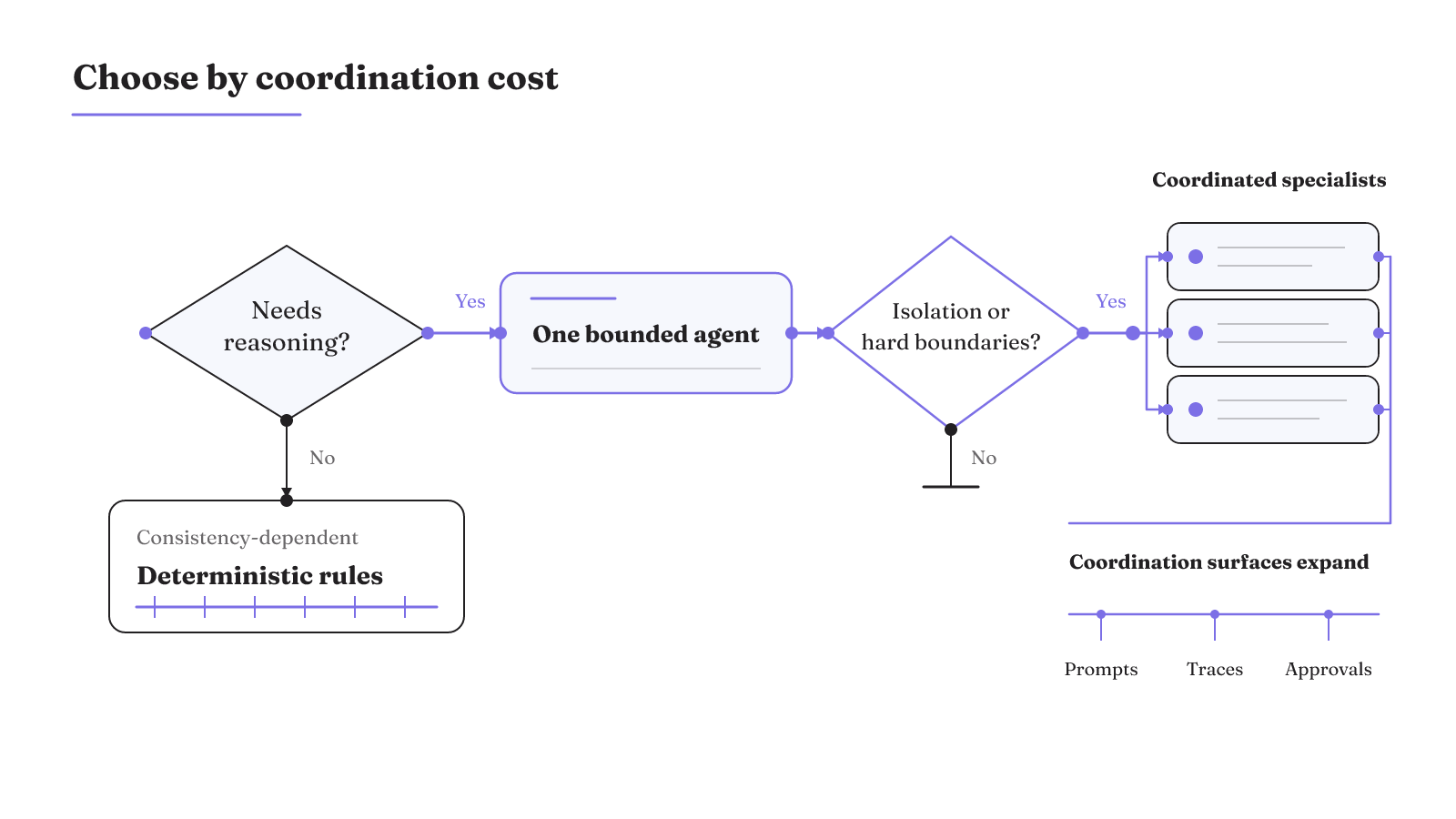
This three-row gate is both an AI agent orchestration architecture check and a coordination-cost scorecard:
| Architecture and best-fit condition | Useful capability | Coordination burden | What justifies moving to it |
|---|---|---|---|
| Deterministic workflow for consistency-dependent steps | Rules run at low marginal cost as volume rises | Routine steps do not need per-task inference and compute | A step needs reasoning instead of consistent rule execution |
| Single-agent system for well-defined, sequential work | Simpler governance and cost-effective execution | One agent can struggle with cross-functional complexity | A specialist materially improves capability isolation, policy isolation, prompt clarity, or trace legibility |
| Multi-agent system for process-driven work | Specialization, parallel execution, scalability, and fault tolerance | More coordination affects performance, cost, and governance | Requirements demand security, compliance, organizational separation, or guaranteed multi-domain scaling |
The default is clear: start with one agent whenever possible. Splitting work too early creates more prompts, traces, and approval surfaces without necessarily improving the workflow. Specialist agents earn their place when they materially improve isolation, prompt clarity, or trace legibility. When hard separation or guaranteed multi-domain scaling is required, agents should have scoped access and explicit interface contracts, according to Microsoft's architecture guidance.
The tool field spans several orchestration layers
AI agent orchestration tools are not all the same kind of software. Some are application frameworks, some are runtimes or harnesses, and others focus on multi-agent workflows. Comparing them as direct substitutes hides what each one is meant to do.
The current field map includes several distinct layers and stated workload roles. LangChain's framework guide presents LangChain as an MIT-licensed application framework for fast prototyping of complex agentic workflows. It presents LangGraph as an MIT-licensed runtime for complex agents that require precision, while Deep Agents is an MIT-licensed harness for long-running workflows.
The multi-agent group has different stated fits. CrewAI is presented as an MIT-licensed orchestration framework for rapid prototypes built around role-based agent workflows. Microsoft Agent Framework is presented as an MIT-licensed multi-agent framework and a unified successor to AutoGen and Semantic Kernel for the Microsoft stack. LlamaIndex Workflows is presented as an MIT-licensed workflow framework for document-centric, event-driven multi-agent systems.
Other choices sit closer to development kits, software development kits, and application frameworks. Google Agent Development Kit is presented as an Apache-2.0-licensed development framework for teams using Google Cloud Platform and seeking opinionated agent runtimes. OpenAI Agents SDK is presented as an MIT-licensed workflow software development kit for tightly scoped assistants and delegation. Mastra is presented as a partially open-source application framework for TypeScript teams building custom production agents.
Use those labels as comparison boundaries. A candidate described as a runtime should be assessed for the runtime job your architecture creates. A workflow software development kit belongs with choices for tightly scoped assistants and delegation. A multi-agent framework belongs in the shortlist only after the workload has justified multiple agents. This keeps a larger product surface from winning simply because it has more categories to list.
License and workload role answer different questions. The stated license tells you the documented open-source status. The stated role tells you what kind of system or workflow the tool is presented for. Neither establishes a universal lead in quality, latency, cost, recovery, or maintenance. A fair comparison would require the same workload and a reproducible benchmark for those outcomes.
That field map is more useful than declaring one AI agent orchestration platform the best. It preserves each option's stated layer, workload role, and license scope. You can compare more AI agent frameworks, but keep the architecture decision in front of the catalog. A runtime, harness, development kit, and multi-agent framework solve different parts of the system.
The control plane is the architecture
Once the software layer fits, inspect the control plane. A successful agent architecture depends on robust state management, clear execution patterns, and policy-driven governance. For a multi-agent deployment, the concrete requirements also include explicit role boundaries, communication protocols, continuous monitoring, and built-in oversight.
This is how to create AI agent orchestration that remains governable. Define the state the system carries and the execution pattern that moves work. Give each role a boundary and each communication path a protocol. Map execution paths, tool access, and cross-system dependencies. Then examine whether the platform makes its policies, auditability, and human-oversight roles explicit. An orchestration platform can act as a control plane for security, compliance, and cost through those mechanisms.
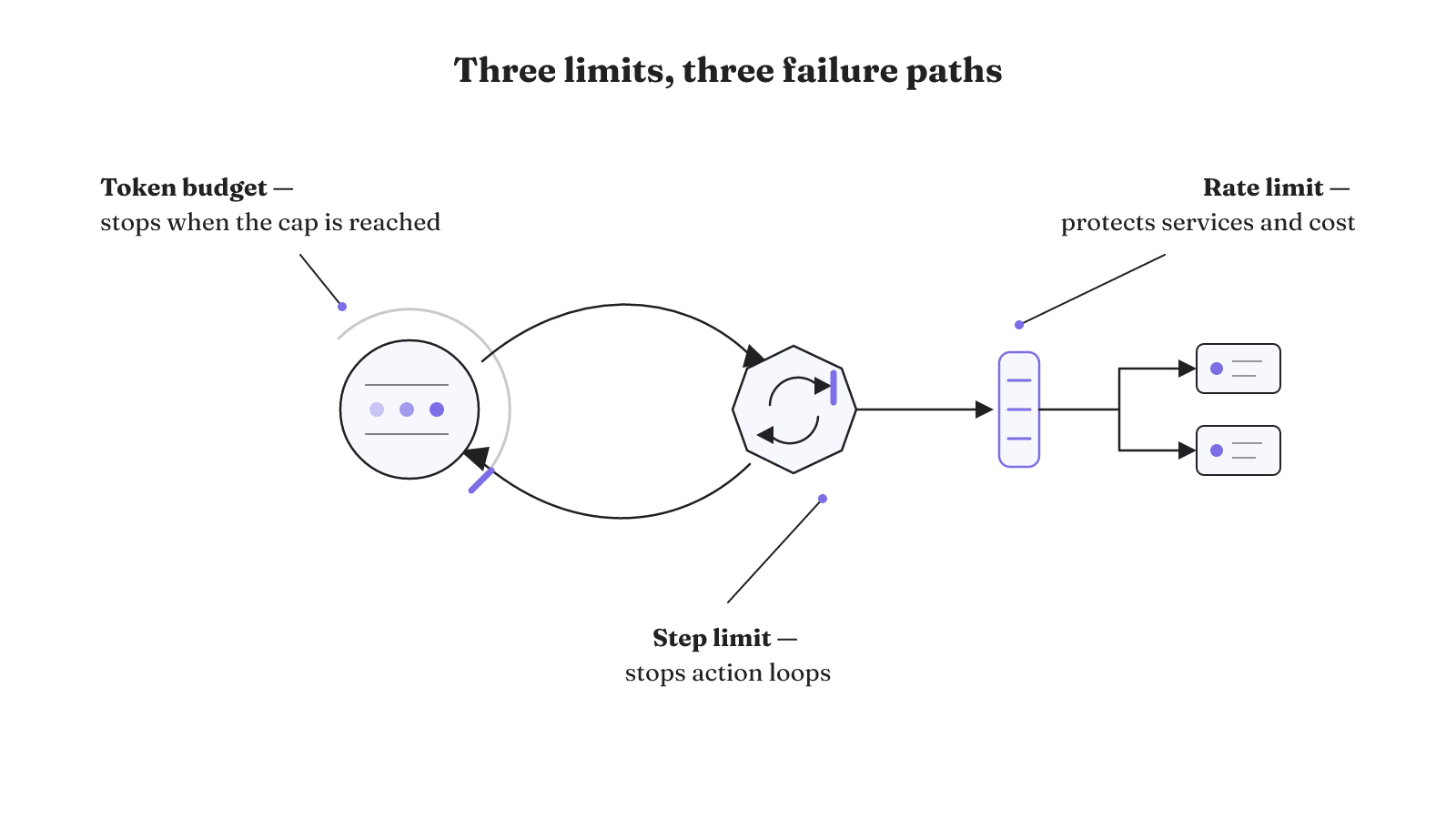
Execution limits belong in the architecture, not in an operations wish list. Token budgets cap consumption for an agent, task, or user and halt execution when the budget is reached. Step limits cap the actions an agent may take and prevent infinite loops. Rate limiting controls calls to internal and external services, manages pay-per-call costs, and prevents agents from overwhelming downstream systems.
Read broad governance language through those inspectable mechanisms. Policies and auditability describe part of the platform's control plane. Defined human roles place oversight in execution. Role boundaries and communication protocols shape a multi-agent deployment, while mapped tool access and cross-system dependencies expose where authority travels. If a candidate cannot make these surfaces concrete, a longer agent list does not answer the control question.
Limits also address different failure paths. A token budget bounds consumption and stops the run when that budget is reached. A step limit bounds how many actions the agent can take, including an infinite loop. Rate limiting governs calls across service boundaries, including paid calls and downstream load. One generic usage cap cannot stand in for all three controls because each limit governs a different part of execution.
The control plane also has to make behavior inspectable. Agent governance should map execution paths, tool access, and cross-system dependencies. Evaluation should cover behavior and outcomes, not merely plausible answers. Defined boundaries and documented rollback procedures preserve operational control. Those surfaces tell you much more about a framework than a generic claim of flexibility.
That gives you a practical review sequence without turning the process into a feature census. Inspect state management and execution patterns first. Then inspect policies, auditability, oversight roles, access paths, and limits. Finish with behavior evaluation and rollback procedures. Together, these checks cover what the system remembers, how it runs, where authority moves, when execution stops, and how operational control is preserved.
Our coordination-cost reference turns that review into a sharper question: does another agent materially improve the system contract enough to justify another role boundary, communication path, monitoring surface, and set of limits?
Where should human oversight sit?
Human oversight has three distinct operating positions. In a human-in-the-loop design, the agent pauses for explicit approval before a critical action. The approval is part of the execution path, so work cannot continue past that point without a person.
In a human-on-the-loop design, the agent continues to operate while a person supervises it. That person can intervene, override a decision, or take control. This keeps autonomous execution available while preserving an active intervention path.
A human-out-of-the-loop design gives the agent full autonomy over a predefined task. That mode is appropriate for low-risk, highly repeatable work, with ticket categorization and standard weekly reports given as examples. It does not establish a default for every workflow. The nature of the action determines whether the control plane needs a blocking approval, an intervention path, or full autonomy over the predefined task.
The useful comparison is the position of the person in the execution path. A required approval stops a critical action. Supervision leaves the agent running but preserves intervention, override, and takeover. Full autonomy removes human involvement only for the predefined task. These are different control contracts even when a platform places all three under one human-oversight heading.
When you evaluate AI agent orchestration platforms, look for the oversight mode your actual actions require. A platform's claim that it supports human oversight says little unless you can place that human role at the right point in execution.
A GitHub runtime makes observability concrete
An AI agent orchestration example on GitHub can make abstract platform language easier to inspect. The @open-multi-agent/core repository includes an orchestration runtime, tools, memory, checkpoints, traces, a command-line interface, and an offline Run Viewer.
The local path is concrete. Core users can store traces locally and inspect them in the offline Run Viewer. That makes the runtime's trace surface available without requiring a centralized telemetry system. The @open-multi-agent/otel package offers a separate, optional integration with a centralized OpenTelemetry stack.
The package split makes two observability decisions visible. One is whether a local trace and offline viewer meet the inspection need. The other is whether the system also needs centralized telemetry. Because the centralized integration is optional, the core path remains useful on its own: run the orchestration runtime, store traces locally, and inspect them in the offline viewer.
The runtime also places memory, checkpoints, and traces beside tools and orchestration. That is a more concrete evaluation surface than a single observability checkbox. You can see which package owns the runtime path, where local inspection happens, and which optional package adds the centralized path.
This example does not settle which framework is best. It shows what to inspect in any candidate: where a run leaves a trace, how that trace can be viewed, and whether central telemetry is required or optional. Checkpoints, traces, and a viewer are distinct runtime surfaces. Their presence gives you concrete documentation to assess instead of a broad observability label.
For a wider comparison of layers and workload roles, use our guide to agent orchestration tools. Keep the same test in view: identify the runtime path that lets you inspect the work your architecture creates.
The framework does not remove production engineering
A framework can supply useful primitives without completing the production system. The harder costs of building orchestration in-house include observability, state management, and orchestration migration. Those areas remain engineering work even after a framework has made the first workflow easier to express.
LangGraph provides built-in checkpointing, but production-scale, long-running workflows still require additional engineering. Checkpointing covers part of the persistence problem. It does not remove the need to evaluate behavior and outcomes or document rollback procedures.
This is the right level for a build-versus-platform decision. Count the built-in primitive, but also count the engineering around it. Observability, state management, and orchestration migration remain named cost areas. Long-running production work still extends beyond the presence of a checkpoint feature.
This boundary should shape a platform comparison. Ask what the framework supplies, then account for the state, observation, migration, evaluation, and recovery work that remains around it. The gap between a built-in feature and an operable system is part of coordination cost.
Every connector expands the security boundary
Agent systems reach outward through connectors, APIs, identity providers, and databases. Each new connector expands the attack surface and increases integration risk. The relevant security boundary therefore includes the services an agent can call, the identities it can use, the data stores it can reach, and the execution paths that join them.
The context stream is part of that boundary too. Indirect prompt injection places malicious instructions in content an agent reads, so security has to cover both incoming context and the actions the agent takes after reading it. A permission model that looks narrow at the tool layer can still face risk through untrusted content entering the agent's context.
This is where the architecture choice returns with real force. Each specialist can add access paths, cross-system dependencies, and communication protocols that need governance. Before choosing a framework or platform, compare the underlying AI agent architectures and test whether every added agent earns that control burden. Then use the agent orchestration tools guide to compare candidates within the software layer your workload actually needs.