Key takeaways
- Deterministic means one input, one output, every time. Non-deterministic means the same input can give more than one output.
- Non-deterministic is not a synonym for "random." Randomness is one cause of it, not the definition.
- LLMs set to be deterministic still swing up to 15% in accuracy between runs.
- Decide per component: enforce determinism, accept the variance, or wrap it in guardrails.
You probably landed on the phrase non deterministic vs deterministic from one of three places: an algorithms course, an AI vendor's page, or a debugging session where the same model call returned two different answers. Each of those worlds defines the term for itself and stops there. None of them tell you what to do next. This page holds one definition steady across all three, draws the line between non-determinism and randomness, explains why a "deterministic" LLM still drifts, and ends on a decision you can actually apply.
What deterministic and non-deterministic actually mean
Here is the whole definition, and it holds everywhere. A process is deterministic when identical starting conditions always produce the same result along the same path. It is non-deterministic when the same starting conditions can produce more than one output.
That's it. A one-line answer to "what is an example of deterministic?" is a function that returns x + 1: feed it a 3, you get a 4, forever. The minimal non-deterministic case is just as small:
def f() {
 return rand() + 1;
}
Call f() twice with nothing changed and you can get two different numbers. Same code, same inputs, multiple possible outputs. That is non-determinism in one line.
One honest caveat before we go further. This definition is about what you can observe, not about the deep cause. A system can look non-deterministic because it is genuinely random inside, or because it is so complex that you cannot predict it even though the machinery underneath is fixed. The output looks the same in both cases: you can't call the result in advance.
Why non-deterministic, stochastic, and random are not the same word
The single distinction the ranking pages blur is this one, so let's be precise. These three words get swapped around in casual and even technical use, and you will see them treated as synonyms elsewhere. We are picking the strict usage on purpose, because it changes what you build.
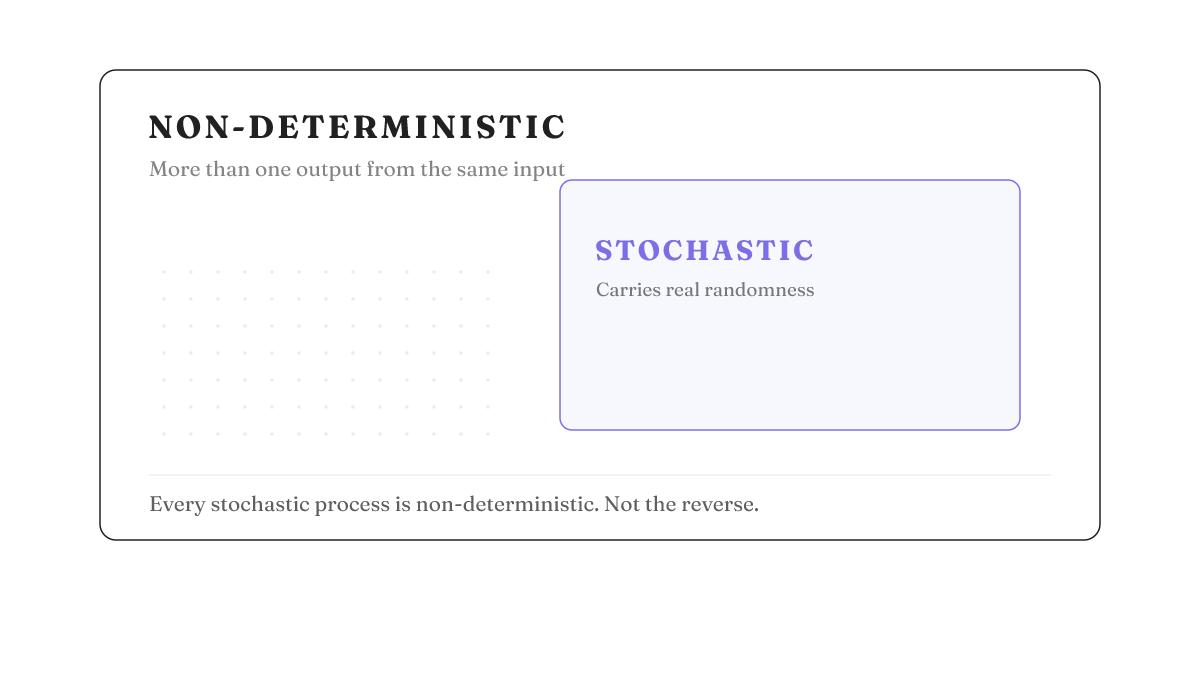
Non-deterministic only means one thing: more than one possible output from the same input. It says nothing about why.
Stochastic is narrower. A stochastic process carries an actual element of randomness. A purely deterministic process has none, and its outcomes are in principle logically derivable from the initial conditions and the rules. So every stochastic process is non-deterministic, but not every non-deterministic process is stochastic. A system can hand you different outputs without a single random number in it, just because too many moving parts feed the result.
Predictability is a third axis again, and it is easy to conflate with determinism. Something can be fully determined and still unpredictable to you, simply because you can't compute all the causes fast enough. Unpredictability is not proof of randomness, and it is not proof of freedom either. Hold these apart and most of the confusion in deterministic vs non-deterministic vs stochastic dissolves.
Worked examples: algorithms, environments, and Turing machines
The rand() + 1 snippet above is the cleanest answer to "what is an example of a non-deterministic algorithm?" The output depends on a value that isn't fixed by the input, so the same call can branch. A deterministic algorithm, by contrast, walks the same steps to the same answer every run: a binary search over a fixed sorted list always probes the same positions and returns the same index.
Environments work the same way. In a deterministic environment, an action always leads to the same next state. Move a chess piece and the board is exactly what you expect. In a non-deterministic environment, the same action can land you in different states. Take one step in a game with a dice roll, or a robot rolling on a slick floor, and "move forward" sometimes means forward and sometimes means a slip sideways. The action didn't change. The result did.
The Turing-machine framing is the formal version of the same idea. A deterministic machine has exactly one legal move from each configuration. A non-deterministic one is allowed several, as if it could explore many paths at once. The formal complexity results that follow from this (how the two classes relate in time and difficulty) are a deep field on their own, and this page only sketches the concept rather than proving anything about it. The intuition is enough for what comes next: one path versus many possible paths.
Deterministic vs non-deterministic AI, and why "deterministic" LLM settings still drift
Now the practical part, and the reason most people search this phrase in 2026.
Is AI deterministic or non-deterministic? Is ChatGPT deterministic? The mechanism answers it better than any yes-or-no verdict about a named model. Large language models are probabilistic by design: they generate each token by sampling from probability distributions learned during training. That sampling is what lets them be fluent and varied. It is also why they are non-deterministic by nature. So the honest framing of "is AI deterministic or stochastic" is that generative models sit on the stochastic side: same prompt, more than one possible completion.
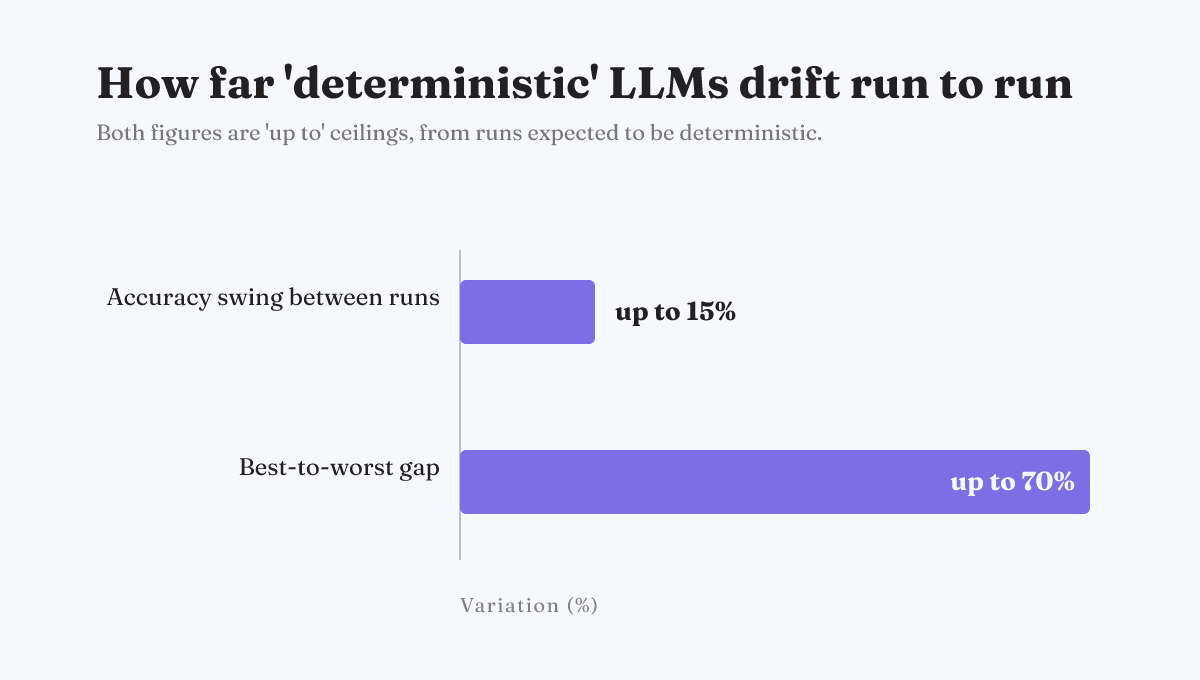
The common fix is to set temperature to zero and expect a fixed answer. It helps, but it does not deliver true determinism. A study of LLMs run under settings people expected to be deterministic found accuracy swings of up to 15% between runs, and up to a 70% gap between the best and worst outcomes. That same sampling mechanism is why zeroing the temperature narrows the variance without closing it: the model is still drawing from a learned distribution, not following a fixed path.
That is the answer to "what is deterministic AI vs non-deterministic AI." Deterministic AI is the code path around the model: the routing, the database write, the schema check, which behave identically every time. Non-deterministic AI is the model's own generation, which does not. Some setups get much closer to reproducible than others, so treat "LLMs are non-deterministic" as a strong tendency to design around, not an iron law. The point isn't that determinism is impossible. It's that you can't assume it for free.
Determinism in psychology and philosophy, without the free-will detour
The term has a second life outside computing, and the philosophy pages over-index on it, so here is the working version you can actually use. In psychology, determinism holds that every behavior has a cause and is in principle predictable, driven by internal or external forces rather than pure will. That is the same shape as the CS definition: fixed causes, fixed outcome.
The useful nuance is the one people miss. Don't confuse predictability with determinism. Unpredictability doesn't automatically mean free will; it could just be complexity or randomness. That is exactly the axis we separated earlier, showing up again in a different field. This is genuinely contested philosophical ground, and we are giving the working psychology definition, not settling the free-will debate. But notice the through-line: across code and cognition, "I can't predict it" and "it isn't determined" are two different claims.
Non-determinism as a tool, not just a problem
Most treatments frame non-determinism as a defect to eliminate. But there is a case for the opposite move: sometimes you introduce non-determinism on purpose. Translating a complicated deterministic system into a non-deterministic one is often the first move when you want to prove something about it. Planning, optimization, and reinforcement learning are the clearest cases, where over-approximating the system as non-deterministic makes it tractable to reason about.
This is a modeling habit more than a settled rule, so treat it as a useful lens, not a law. The takeaway is that non-determinism isn't only something that happens to you. It can be a deliberate choice you make to simplify a problem you couldn't otherwise crack.
The decision: enforce determinism, accept it, or wrap it in guardrails
Everything above is definition. This is the part you keep. For any component in a system you're building, you have three moves, and the right one depends on what failure costs.
| Branch | Use it for | Failure mode if you get it wrong |
|---|---|---|
| Enforce determinism | Billing, auth, routing, data writes, anything that must be repeatable and auditable | You force it where variety was valuable (creative drafts, search), or you trust a "deterministic" setting that still drifts up to 15% |
| Accept non-determinism | Brainstorming, first-draft generation, ranking candidates, anywhere multiple good answers exist | Variance leaks into a step that needed to repeat, so an action fires differently than the last identical run |
| Wrap in deterministic guardrails | Any non-deterministic step whose output triggers something with real consequences | The wrapper adds a review step and latency, and it never makes the model itself deterministic |
The wrap branch is where harness engineering lives. You let the model be probabilistic, then put a deterministic gate in front of the consequence: a schema check, a rule, a human sign-off before anything irreversible ships. The failure mode to name out loud is over-enforcing. Forcing determinism onto genuinely creative generation gives you rigid, worse output. Determinism is not the goal everywhere. It is the goal exactly where a second, different answer would cost you.
Where this leads if you're building on non-deterministic AI
If you are shipping on models that vary run to run, the next move is concrete: find the irreversible step in your workflow and put a deterministic gate in front of it. The database write, the payment, the email that actually sends. Everything upstream of that gate can stay probabilistic and creative. The gate is what makes the blast radius bounded.
That reframing matters. Guardrails don't make the underlying model deterministic, and pretending otherwise is how teams get burned. They bound what a variable output is allowed to do, which is a different and more honest goal than chasing reproducibility you can't guarantee.
If you want to see how that control layer is designed, the harness decides what a non-deterministic agent is allowed to ship. For the fuller picture, here's how these levers play out across a whole system, what a deterministic gate looks like when the check is an eval, and where the line sits for autonomous agents acting on their own. The definition was the easy part. The decision is the work.